
I asked myself the same question you’re asking: Can I put a Tonal in my apartment? The marketing makes it look seamless — a sleek arm on a wall, a few square feet of floor, and you’re done. But I’ve been through enough security deposit disputes to know that “seamless” usually omits the part where you’re spackling eight holes at 11 p.m. on moving day. So I started measuring. And calling installers. And reading the fine print.
Will Your Apartment Even Fit It?
Tonal’s official floor space requirement is 7 feet by 7 feet, with a ceiling height of 7 feet 10 inches. The wall must have studs spaced 16 to 24 inches apart, be no thicker than 1.25 inches, and have a grounded outlet within 6 feet. On paper it looks manageable. In a typical apartment, each of those points can be a slow no.
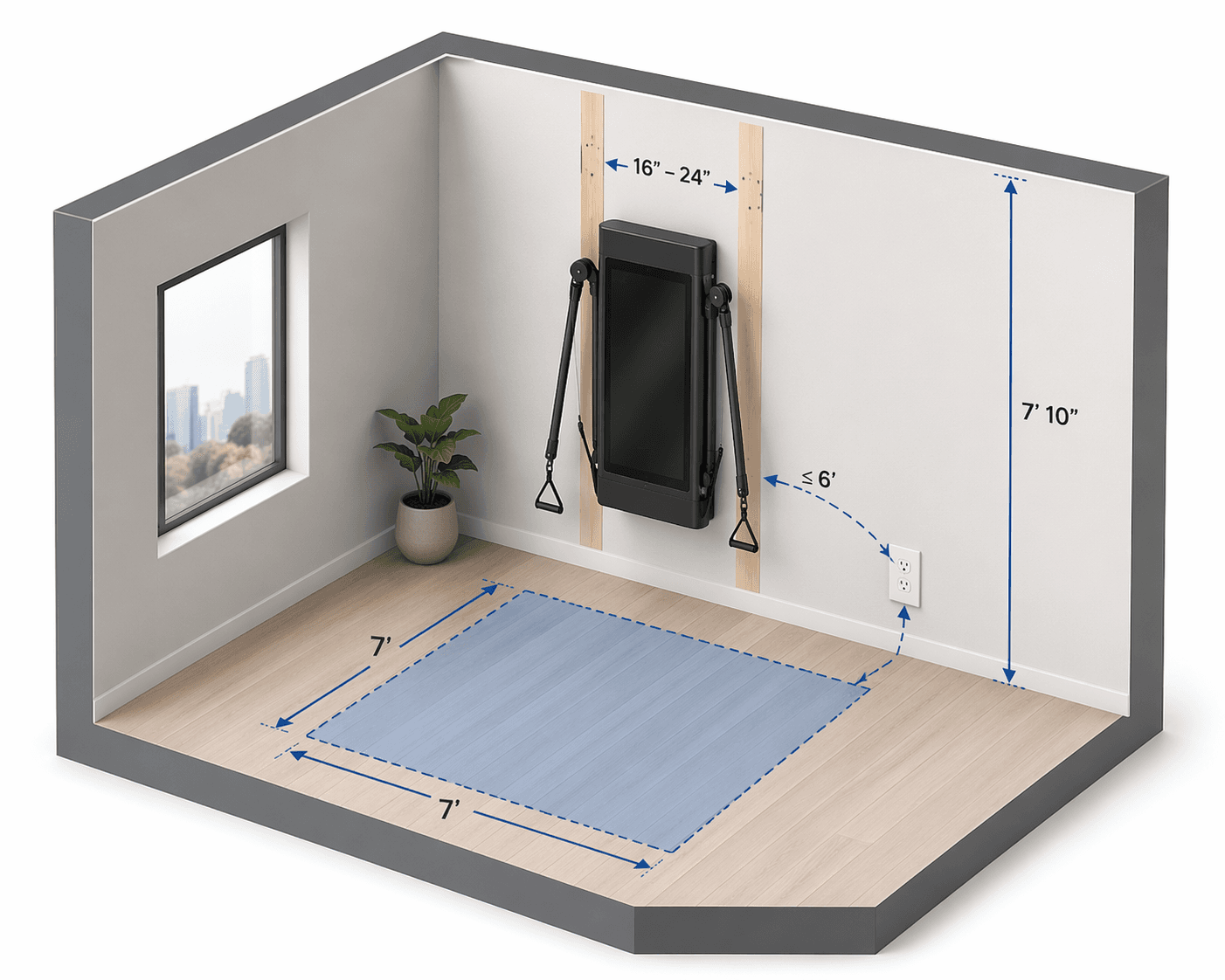
Take the ceiling. Many apartments built after 2000 have 8-foot ceilings — but a dropped ceiling in the bathroom or a duct in the hallway can eliminate your only candidate wall. I measured my own living room: 7′8″ at the low end. Non-negotiable fail. If your ceiling is exactly 7′10″ or above, you still need to find a wall where you can stand 7 feet away from it without hitting furniture or a doorway. That’s not a given in a studio.
- Floor: 7′ × 7′ — about the size of a small dining table.
- Ceiling: 7′10″ minimum — older apartments with 8′ ceilings might still fail if there’s a duct or dropped ceiling.
- Wall: studs on 16″ or 24″ centers, thickness ≤1.25″, outlet within 6 ft.
- Stud spacing is the trap: concrete or brick walls are incompatible without building out a new wall, which is a contractor job.
If your walls are concrete, you may need a contractor to build a stud frame before installation — an extra cost and an extra layer of permanence. CNET explicitly warns about this. It’s not a rare edge case.
What Installing Actually Means for a Renter
You submit photos of the wall. Tonal’s team confirms stud spacing. Then a professional installer shows up, drills eight holes into the studs, mounts the 150-pound unit, and leaves. The installation fee runs $295 to $550 depending on your location. That’s separate from the machine itself.
Eight holes sounds like nothing. But they are in the studs, not in drywall — which means the spackling and repainting Tonal’s blog mentions is not just filling a screw hole. You need matching paint, some sanding, and enough skill to make the patch invisible. It’s doable. But it’s not nothing.
Also: the machine cannot be moved without professional help. Unauthorized uninstall voids the warranty. So if you think you can take it down yourself when you move — you cannot.
Do You Need to Tell Your Landlord?
You drill eight holes into the wall of a unit you do not own. Even if you spackle perfectly, the landlord may not have given you permission to modify the wall. Innerbody’s analysis flags that installation could cause significant wall damage and risk your security deposit. I’ve seen security deposit deductions for less than two screw holes. Eight holes, even if well-patched, can be a point of contention.
Ian, a renter who wrote a long-term review of Tonal, did not inform his landlord before installing. It worked for him, but he was gambling that his landlord either would not notice or would not care. If you are not willing to take that gamble, you need explicit written approval. And many landlords will say no.
What Moving Costs Really Look Like
Tonal offers a relocation service. The cost is not published transparently. Cybernews mentions an additional relocation charge without specifying amounts. User reports and third-party articles put the fee between $250 and $500+, depending on distance. That’s for the uninstall, transport, and reinstall at the new place.
But the real cost is not just the fee. It’s the risk that the new apartment’s walls are incompatible. If you move into a place with concrete walls or studs on the wrong spacing, you pay the relocation fee plus need a contractor to build out the wall (another few hundred dollars). And if the relocation damages something — cables are consumables, according to Ian’s blog, out-of-warranty repairs cost several hundred dollars — you are on the hook.
For a renter who moves every two or three years, the cumulative hassle is real: schedule the uninstall, coordinate the movers, hope the new wall works, pay the fee, schedule the reinstall, retest the machine. It is not a line item on a spreadsheet. It is a series of phone calls and service windows that eat weekends.
Is It Really Quiet Enough for an Apartment?
Tonal uses electromagnetic resistance — no clanging plates, no impact noise. CNET found it quiet enough not to disturb neighbors. That part is accurate. The motor and cable mechanism produce a low hum, but it’s quieter than a dishwasher.
The nuance: vibration through floor joists. If your Tonal is on an upper floor in a wood-frame building, the weight and movement of the machine (150 pounds anchored to the wall) can transmit sound to the unit below — not the machine’s noise, but the thud of your body and the slight shake of the wall mount. It’s not loud, but it’s not silent either. In a thin-walled apartment, that might still irritate a downstairs neighbor.
One Renter Who Made It Work
Ian’s blog is the most honest renter account I found. He had exactly one possible location in his apartment that met the requirements. He did not ask his landlord. He went ahead anyway. After a year, he still uses it daily and has had no issues. But he also notes that the cables are showing wear and that out-of-warranty repairs are expensive. His story is a proof of possibility — and a reminder that it took a specific set of conditions to work.
If you have a similarly accommodating apartment — studs where needed, ceiling clearance, a wall you can dedicate — and you are willing to accept the moving risk, Tonal can absolutely work. But “one possible location” is a common refrain. You do not get to pick any wall; the wall picks you.
What About Alternatives That Skip the Wall Mount?
If the installation hassle, landlord risk, and moving burden feel like too much, there are smart gyms designed to bypass the wall entirely. I am not going to run a full head-to-head here — that already exists on this site — but for the renter specifically, three options stand out.
- Speediance Gym Monster 2 — freestanding, no wall mounting, folds up, can be moved without voiding warranty. Requires about 40 sq ft of floor space. No installation fee, no relocation service. Its resistance feel is different from Tonal’s (cable-based with digital resistance), but for a renter the portability is a genuine advantage. Multiple sources confirm it is freestanding and portable.
- Amp (by Vitruvian) — wall-mounted but much cheaper at $1,795, with white-glove installation included. Max resistance is 100 lbs, which limits heavier lifters. Still requires drilling, but lower financial commitment.
- Tempo Move — uses your TV as the screen, no wall mounting. The weight is stored in a cabinet. It is more of a guided workout system than a pure strength machine, but it eliminates the installation risk entirely.
None of these is a perfect substitute. Tonal’s electromagnetic resistance and AI coaching are genuinely good. But for a renter, “perfect but impractical” loses to “good enough and moveable.” I would only recommend Tonal if you meet every space requirement, have landlord clearance (or are willing to risk the deposit), and plan to stay put for at least three years.
The Honest Answer
Yes — if you check every box. Measure your ceiling. Verify the stud spacing. Get landlord permission in writing. Accept that moving will cost $250–$500 plus uncertainty. Accept that you might need to spackle and paint before you get your deposit back.
If you stumble at any of these steps, the freestanding alternatives are not a compromise — they are the more sensible tool for the job. Tonal is a great machine. It is not a great machine for every apartment.

Comments
Join the discussion with an anonymous comment.