A realistic treadmill desk daily step goal is 7,000–10,000 steps during the workday, but only if you stop imagining it as one long, heroic shuffle. At common desk-walking speeds, the math is manageable: 1.5 mph is roughly 3,300 steps per hour, 2.0 mph is about 4,200–4,800 steps per hour, and 2.5 mph is about 5,500–6,000 steps per hour.[1] That puts the target at roughly 90–150 cumulative minutes of walking, usually split into two or three sessions.
The catch is that those minutes have to land in the right parts of the day. Email cleanup, reading, routine calls, admin work, and light editing can often tolerate slow walking. A blank document, a delicate spreadsheet, precise data entry, or a high-stakes call usually cannot. A treadmill desk works best when it becomes a task-matching tool, not a moral referendum on sitting.
The Step Math Before the Schedule
The useful thing about treadmill desk walking is that it turns a vague goal into arithmetic you can control. If your comfortable working pace is 1.5 mph, a 45-minute session gives you about 2,475 steps. Two of those sessions put you near 5,000 steps; three put you near 7,400. At 2.0 mph, the same 45-minute block is roughly 3,150–3,600 steps. At 2.5 mph, it can be about 4,125–4,500 steps.[1]
| Walking pace | Approximate steps per hour | Workday walking time for 7,000–10,000 steps |
|---|---|---|
| 1.5 mph | About 3,300 | About 130–180 minutes |
| 2.0 mph | About 4,200–4,800 | About 90–145 minutes |
| 2.5 mph | About 5,500–6,000 | About 70–110 minutes |
Those are estimates, not a lab-grade promise. Step counts change with stride length, height, walking speed, and the device or watch doing the counting. Still, the range is good enough for planning. If your walking pad reads low, do not immediately assume the plan failed; compare the same type of session across a few days and watch the trend.
Observed treadmill desk use makes the target look plausible, with some caveats. In a 2023 study of treadmill desk users, participants walked an average of 2.71 hours per day at 1.87 mph, covering about 4.89 miles per day; using a common steps-per-mile conversion, that is close to 9,800 steps, though individual stride length matters.[2] The range was wide, from 45 minutes to more than 10 hours per day.[2] It is useful evidence that multi-hour desk walking happens in real routines, but the study was small, with 20 participants, and the sample was predominantly white, high-income, and female, so it should not be treated as a universal average.[2]
For baseline context, WebMD reports that desk workers without walking pads average about 1,000–3,000 steps per day and cites a 2021 study suggesting a walking pad may add about 4,500 steps per day.[3] That second number is helpful as a rough expectation, but it is less firm here because it is reported secondhand rather than from the primary study.
A Workday Structure That Can Actually Survive Friday
For most desk workers, the cleanest way to reach 7,000–10,000 steps is not to walk all day. It is to reserve two or three predictable walking windows and attach them to work that is already compatible with motion.
| Session | Best task match | Example pace and time | Approximate steps |
|---|---|---|---|
| Morning reset | Email triage, calendar review, messages, planning | 45 minutes at 1.5–2.0 mph | About 2,475–3,600 |
| Midday block | Reading, routine calls, light editing, admin | 45–60 minutes at 2.0 mph | About 3,150–4,800 |
| Late-day cleanup | Follow-ups, inbox zero attempt, low-stakes review | 30–45 minutes at 1.5–2.5 mph | About 1,650–4,500 |
That kind of day can land around 7,000 steps at the lower end and near 10,000 steps when the sessions are longer or the pace is closer to 2.0–2.5 mph. It also leaves the workday with seated space for deep work, which is where many treadmill desk plans get weirdly unrealistic.
A sample day might look like this: walk for the first 45 minutes while clearing email and sorting priorities; sit for a writing or analysis block; walk again during a routine meeting and document review; sit for detailed spreadsheet work; finish with a shorter walking session for follow-ups. Nothing about that schedule requires turning the workday into a workout. It does require admitting that not every task belongs on a moving belt.
Walk for These Tasks; Sit for These
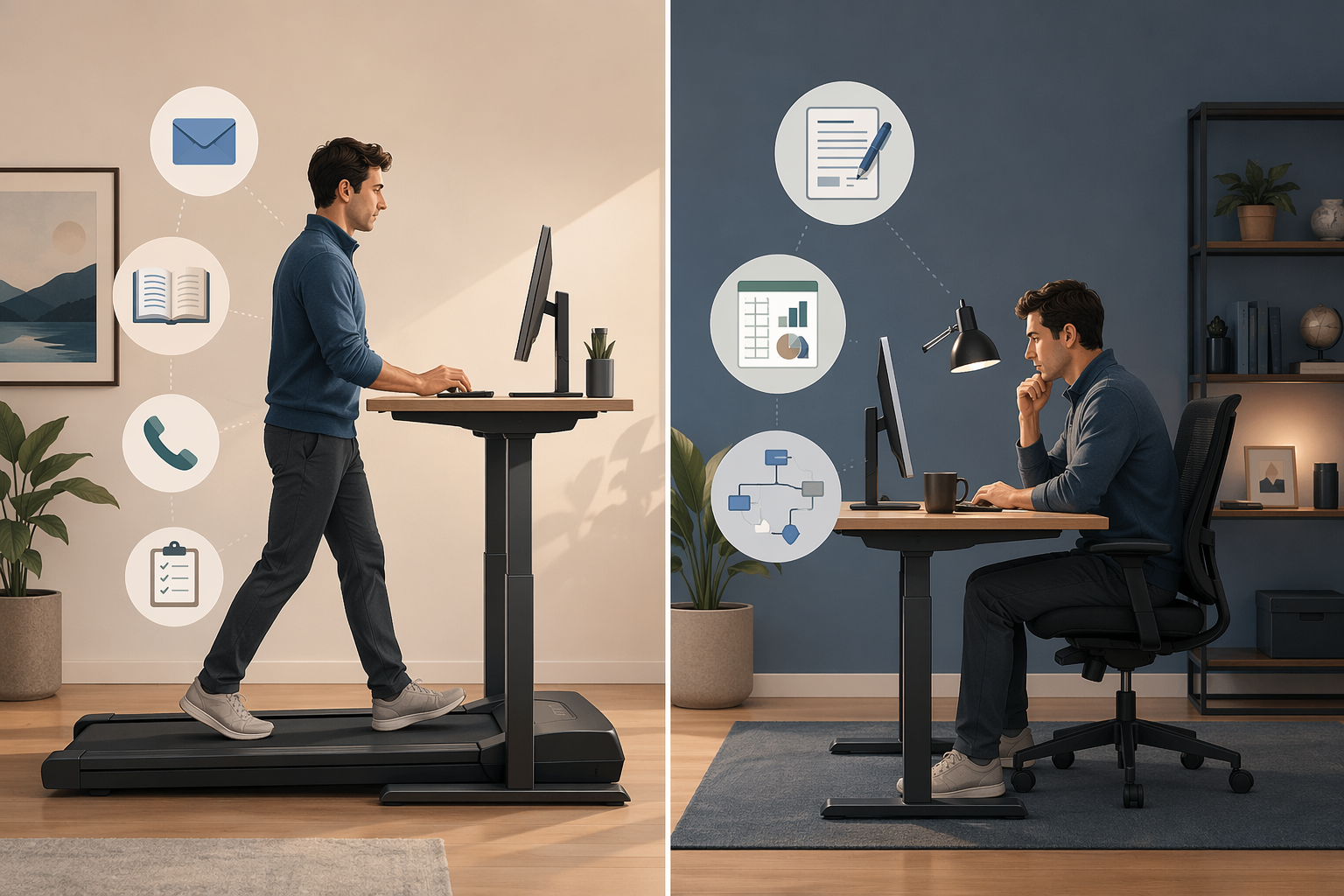
The best treadmill desk tasks are repetitive, verbal, or review-based. They have enough structure that your brain is not constantly inventing the next sentence while your feet are also negotiating a moving surface. Good candidates include email triage, reading reports, checking dashboards, routine one-on-one calls, internal training videos, admin forms, expense review, and light edits to work you already understand.
The tasks to protect are the ones that punish small errors. Sit down for intensive writing, complex analysis, detailed spreadsheet formulas, precise data entry, design work, coding that requires careful navigation, and meetings where you need to read the room or respond quickly. Sitting for those blocks is not a failure of the treadmill desk plan; it is what keeps the plan from vandalizing your job.
The performance research supports that split. BYU, reporting on a 2015 PLOS One study, noted that people walking at 1–2 mph performed most desk tasks nearly as well as seated workers, but fine-motor and speed-sensitive tasks took a hit, including about a 9% drop in processing speed and a typing decrease of about 13 words per minute.[4] That does not mean walking destroys productivity. It means the walking pace that feels gentle in your legs can still be enough motion to make certain tasks clumsier.
If you are new to this, start with tasks where a small slowdown does not matter. Do not test your first treadmill desk week on a client proposal, a board deck, or the spreadsheet everyone else depends on. Test it on email, reading, and calls where you can mute, slow down, or step off without consequence.
Build Up Over Weeks, Not by Guilt
The most tempting mistake is to chase the full 10,000-step workday immediately because the first session feels easy. Slow walking does not announce itself like a hard workout, but two hours of it can still make your calves, feet, hips, or lower back complain the next day.
| Timeframe | Daily treadmill desk target | What to prioritize |
|---|---|---|
| Weeks 1–2 | 20–30 minutes per day | Comfort, posture, typing tolerance, shoe choice |
| Weeks 3–4 | 40–60 minutes per day | One or two stable walking blocks tied to easy tasks |
| Weeks 5–6 | 90+ minutes per day | Two or three sessions that can reach the 7,000–10,000-step range |
That progression mirrors a LifeSpan Europe recommendation for building toward 10,000 steps at work: 20–30 minutes per day in weeks 1–2, 40–60 minutes in weeks 3–4, and 90 or more minutes in weeks 5–6.[5] It is not glamorous, which is exactly the point. A treadmill desk habit that feels almost too easy in week one has a better chance of still existing in week six.
The first few days often feel awkward. Daily Burn reports a 3–7 day adaptation period for walking and working at the same time, with typing speed normalizing within about a week.[6] In the Scisco study, early discomfort also showed up in ordinary places: sore feet, sore calves, and the general weirdness of moving while working.[2] Mild soreness is one thing. Sharp pain, escalating joint pain, numbness, or a limp is not a badge of consistency; it is a reason to stop, reduce volume, change footwear, or get help.
A Forgiving Ramp-Up
- Days 1–3: Walk 10–15 minutes at a very easy pace during email or reading, then stop while it still feels too short.
- Days 4–7: Move toward one 20–30 minute block if your feet and calves feel normal the next morning.
- Weeks 2–3: Add a second short block only after the first block feels boringly manageable.
- Weeks 4–6: Stretch the best-matched sessions first; do not add walking to your hardest work just to reach a number.
- Any week: Drop back for a day or two after poor sleep, unusually long meetings, calf soreness, or a work deadline that needs seated focus.
The step goal is useful only if it does not make you dread the machine. Some days, 4,000 treadmill steps during work plus a normal walk outside will be the smarter choice. Other days, a meeting-heavy calendar makes 9,000 workday steps almost effortless. The plan should flex around the work, not pretend the work is incidental.
Speed Settings That Do Not Sabotage the Desk Part
Most people should treat 1.5–2.0 mph as the main working range and 2.5 mph as a faster option for calls, videos, or low-typing blocks. The difference matters. At 1.5 mph, your upper body stays calmer and typing is less chaotic. At 2.5 mph, the step count rises quickly, but the desk starts feeling less like a desk.
A simple rule works well: if your hands are doing precise work, lower the speed or sit. If your eyes and ears are doing most of the work, walking can usually continue. If you notice yourself rereading the same paragraph, sending sloppier messages, or postponing decisions because you are moving, the belt is no longer helping that task.
Noise is also part of sustainability, especially in apartments. A walking pad that keeps you moving but irritates downstairs neighbors is not a neutral purchase. If that is your situation, look first at quieter models and floor setup before chasing speed; the guide to quiet walking pads for apartments is the more relevant next question than another step-count chart. If space is the constraint, start with choosing an under-desk walking pad for small apartments. If you are still sorting out the equipment category, the comparison of a foldable treadmill and a walking pad will save some confusion.
What a 7,000–10,000-Step Workday Can Look Like
Here is a realistic version, using the middle of the speed range rather than assuming you will march through the whole day.
| Time | Work mode | Treadmill choice | Approximate steps |
|---|---|---|---|
| 8:45–9:30 | Email, calendar, priority sorting | Walk at 1.5–2.0 mph | About 2,475–3,600 |
| 9:30–11:00 | Deep writing or analysis | Sit | None from treadmill |
| 11:00–11:45 | Routine meeting or reading | Walk at 2.0 mph | About 3,150–3,600 |
| 1:00–2:30 | Spreadsheet, client work, complex decisions | Sit | None from treadmill |
| 3:30–4:15 | Follow-ups, light edits, admin | Walk at 1.5–2.5 mph | About 2,475–4,500 |
That day lands somewhere around 8,100–11,700 treadmill steps depending on pace, stride, and device estimates. If that is too much, shorten the last block. If it feels easy after several weeks, lengthen the middle block. The important part is not the exact template; it is the separation between walking-compatible work and work that deserves a chair.
On a meeting-heavy day, the step count may come from longer call blocks. On a writing-heavy day, the treadmill might only cover inbox cleanup and a short afternoon review. Both days can be good uses of the same tool. The step target should guide the schedule, not bully it.
When the Target Is Too High
A 7,000–10,000-step treadmill desk goal is realistic for many remote and hybrid workers, but not for every workday. It is too high if you are still in the first week and waking up sore. It is too high if you keep missing details. It is too high if the walking pad noise changes how people in your home or building experience your workday.
There is also no prize for making recovery harder. If your calves and feet feel tight after the first week, add a lower-volume day and use a short mobility session after work. A simple mobility routine for desk workers pairs better with treadmill desk use than pretending slow walking cannot accumulate.
The practical decision is straightforward: if you can protect seated deep-work blocks, start below the target, and build toward two or three walking sessions at 1.5–2.5 mph, a treadmill desk can make 7,000–10,000 steps part of the workday instead of another obligation after it.
References
- Walk while you work: are the extra steps on an under-desk treadmill worth the cost? The Conversation.
- Walking Workstations: A Survey of Users PMC, 2023.
- Walking Pads WebMD.
- People on treadmill desks perform tasks nearly as well as those sitting BYU Life Sciences.
- Walking Pad for Weight Loss: Hit 10,000 Steps at Work LifeSpan Europe.
- Walking Pads Are Under-Desk Treadmills Worth It for Remote Workers? Daily Burn.

Comments
Join the discussion with an anonymous comment.