
Quietest Walking Pads for Apartments, Ranked by Decibel Evidence
If the goal is the best quiet walking pad for apartment workout use, the short answer is narrower than most product roundups make it sound. As of June 2026, only two current walking pads in this group have apartment-relevant manufacturer-verified decibel claims: the UREVO CyberPad at under 35 dB and the WalkingPad Z1 at 40 dB.[1][2] Everything else may be quiet enough for some renters, but it belongs in a lower-confidence tier until comparable noise data is published.
| Rank | Model | Noise Claim | Evidence Level | Apartment Judgment |
|---|---|---|---|---|
| 1 | UREVO CyberPad | Under 35 dB | Manufacturer-verified | Quietest verified option; best when neighbor disturbance matters more than flat-fold storage.[1] |
| 2 | WalkingPad Z1 | 40 dB | Manufacturer-verified | Best verified quiet value; wider 17.3-inch belt and lower price make it easier to recommend for daily use.[2] |
| 3 | KingSmith P1 | About 42–48 dB | Estimated | Plausibly quiet, but the number is inferred from motor lineage rather than a comparable verified claim.[3] |
| 4 | WalkingPad C2 | Below 50 dB | Estimated | Reasonable on paper, but too loosely documented to rank beside the verified models.[3] |
That distinction matters because “quiet” on a product page can mean almost anything. A walking pad that sounds acceptable in a showroom can become a ceiling thump downstairs, a microphone hiss on a work call, or the reason someone starts recognizing your morning routine through the floor.
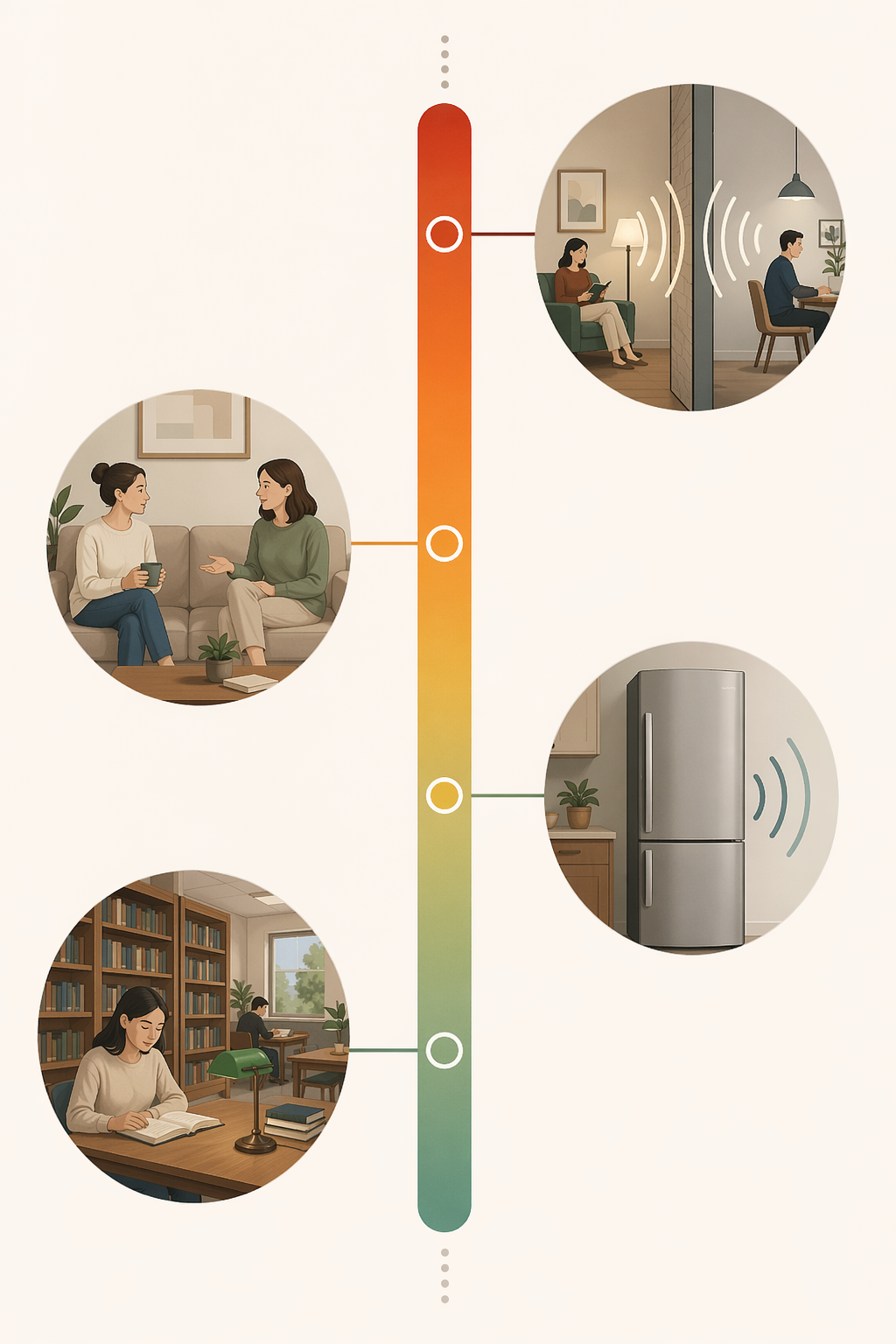
What 35, 40, 45, and 55 dB Mean in an Apartment
A decibel number is not just a tidier adjective. Under 35 dB is quieter than a library reading room. Around 40 dB is refrigerator-hum territory. Around 45 dB approaches quiet conversation. Around 55 dB is loud enough to be heard through a wall, and because decibels are logarithmic, a 55 dB pad is more than three times as loud to human ears as a 40 dB model.[4]
For apartment use, the useful cutoff is not “Can I tolerate this sound while wearing earbuds?” It is whether the motor and belt stay below the level where a laptop microphone notices them, and whether the floor turns each step into a dull knock for someone below. CitySports’ walking pad noise guide treats models below 45 dB as quiet enough that laptop microphones generally should not pick them up during calls.[3] That makes the UREVO CyberPad and WalkingPad Z1 much more interesting than models that merely promise a low-noise motor.
1. UREVO CyberPad: The Quietest Verified Choice
The UREVO CyberPad is the standout if quiet is the first filter and everything else comes after. UREVO publishes an under-35 dB claim for the CyberPad, and that places it below the usual refrigerator-hum range rather than merely below “annoying.” It is listed at about $339 and includes a 14% auto-incline, which is unusual in a compact walking pad conversation where incline is often missing or manual.[1]
The apartment appeal is obvious: under 35 dB gives you more room for imperfect reality. A belt that gets a little dry, a room with less soft furnishing, or a morning when you walk during a meeting is less likely to push the whole setup into “the neighbor can hear that” territory. It is the rare product claim that actually changes the buying conversation.
The drawback is just as practical: the CyberPad does not fold flat.[1] That is not a small footnote in a studio, a shared bedroom, or a living room that already has a desk chair doing too much work. If you have a permanent strip of floor beside a desk or sofa, the trade-off is easy to defend. If your walking pad has to disappear under a bed every night, the quietest verified option may also be the most irritating to live around.
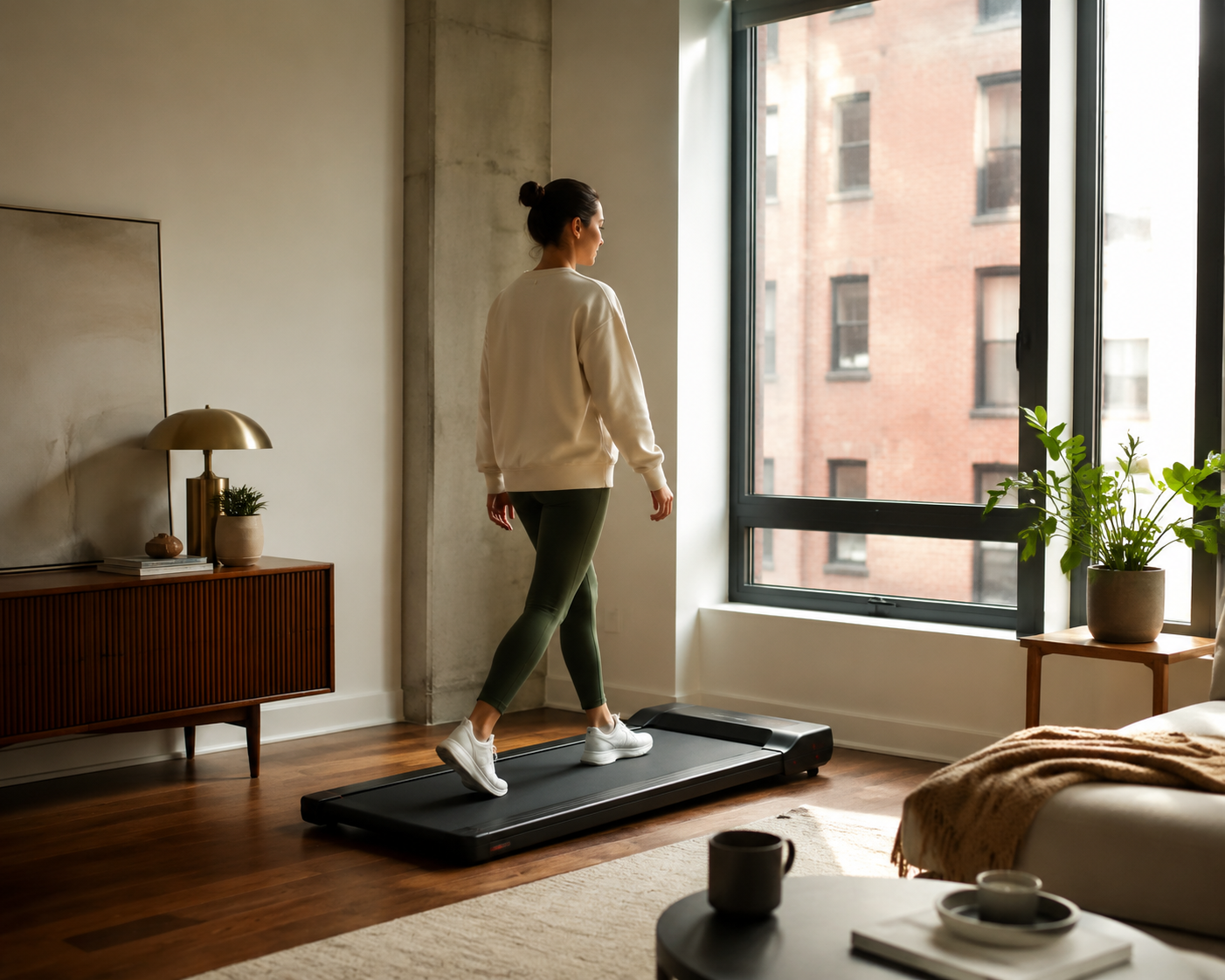
That is the honest version of the CyberPad recommendation: choose it when the sound floor matters more than storage elegance. It is the model I would look at first for early mornings, upstairs units, thin flooring, and work-call walking, provided the room can absorb a non-flat-fold machine.
2. WalkingPad Z1: The Best Verified Quiet Value
The WalkingPad Z1 is the better balanced recommendation for many renters. WalkingPad publishes a 40 dB claim, the price is about $299, and the belt is 17.3 inches wide.[2] That combination matters more than a long list of console features because it solves three ordinary apartment problems at once: it is quiet enough for noise-sensitive use, cheaper than several estimated-noise alternatives, and wide enough to feel less fussy under a desk.
Forty decibels is still a real number, not silence. You may hear the pad in the same room, especially in a bare room with hard floors. But in the apartment-noise hierarchy, 40 dB is much closer to refrigerator hum than to conversation or wall-traveling sound.[4] For walking while answering emails or taking low-stakes calls, that is the right zone.
The Z1 also becomes more important because the KingSmith A1 Pro, previously treated as a quiet benchmark, is globally out of stock with no confirmed restock. A discontinued or unavailable walking pad is not a recommendation; it is a historical reference. The Z1 is the current model that carries the useful part forward: verified 40 dB operation in a package that still makes sense for small-space use.[2]
If the CyberPad is the quiet-first pick, the Z1 is the “I still have to live with this thing” pick. It gives up the CyberPad’s unusually low under-35 dB claim, but it costs less, has a wider belt, and stays inside the verified range where work calls and neighbor-sensitive walking are realistic expectations rather than hopeful interpretations.
The Estimated Quiet Tier Is Useful, but Not Equal
The KingSmith P1 and WalkingPad C2 should not be dismissed, but they also should not be ranked as if their numbers carry the same weight. The P1 is commonly estimated around 42–48 dB based on brushless motor lineage, while the C2 is treated as below 50 dB; those figures are estimates rather than independent controlled measurements or directly comparable verified claims.[3]
| Model | Why It Might Still Work | Why It Ranks Lower |
|---|---|---|
| KingSmith P1 | Estimated 42–48 dB range keeps it near the video-call-friendly zone. | The number is inferred, not verified in the same way as the CyberPad or Z1.[3] |
| WalkingPad C2 | Below-50 dB positioning suggests it may be acceptable in many apartments. | “Below 50 dB” leaves too much room between barely noticeable and clearly audible. |
| KingSmith A1 Pro | Historically relevant as a quiet reference point. | Globally out of stock with no confirmed restock, so it should not be treated as a current buy. |
This is where vague quietness language gets expensive. A model estimated at 48 dB may still be fine in a concrete-core building with a thick mat. The same model over wood framing in an older apartment can be the wrong kind of audible. Without a verified number, the buyer absorbs the risk.
If you are still deciding whether the category itself fits your room, the broader under-desk walking pad guide for small apartments is a better next read than another feature-grid roundup.
The Noise Number Does Not Cover the Whole Apartment Problem
A decibel claim mainly helps with motor and belt noise. It does not fully answer the floor problem. In real apartments, walking pad noise comes from three places: the motor, belt friction, and footfall vibration. The first two are where quiet motors and maintenance help. The third depends on the building, the floor, and what sits under the machine.
Belt lubrication is the boring maintenance step that matters. CitySports and OCDevel both describe regular lubrication as a way to prevent friction noise from building up, with the practical interval commonly landing around every 30–60 days depending on use.[3][5] A walking pad that was acceptable in week one can become louder simply because the belt has been allowed to drag.
Motor type also matters. Brushless motors are generally quieter and more durable than brushed motors, which is one reason very cheap walking pads often struggle to compete on apartment noise even when the listing uses the same “quiet” language.[6][5] That does not prove every brushless model is quiet, but it does explain why the better quiet candidates tend not to be the cheapest machines on the page.
Footfall is the part people underestimate. A rubber mat will not turn a loud treadmill into a silent one, but it can reduce vibration transfer and protect the floor. If you are upstairs, on hardwood, or in a wood-frame building, assume the mat is part of the purchase rather than an accessory you might add later. The apartment home gym flooring guide and the home gym flooring mistakes guide cover that layer more directly.
A Quick Apartment Check Before You Buy
- If you need the quietest verified model and have floor space, choose the UREVO CyberPad.
- If you want the best mix of verified quiet, price, and daily usability, choose the WalkingPad Z1.
- If you take calls while walking, stay at or below the 45 dB zone and keep the pad maintained.
- If you live above someone, budget for a dense rubber mat before testing morning or late-night sessions.
- If a product only says “ultra quiet” without a dB number, treat that as marketing, not evidence.
If you are comparing a walking pad against a folding treadmill, the noise question changes because running speed, deck impact, and frame structure add more vibration. The folding treadmill noise guide for apartments and the walking pad versus folding treadmill explainer are more useful for that decision than assuming all compact treadmills behave the same.
Final Pick
Choose the UREVO CyberPad if absolute quiet matters most and you have dedicated floor space. Choose the WalkingPad Z1 if you want the best verified quiet value for an apartment workout. Treat every other “quiet” walking pad as unverified until it publishes comparable decibel data.
References
- Quiet Compact Walking Pads for Apartments, UREVO, https://www.urevo.com/blogs/blog/quiet-compact-walking-pads-for-apartments
- Apartment Treadmill, WalkingPad, https://www.walkingpad.com/blogs/whywewalk/apartment-treadmill
- Walking Pad Noise Levels: Can You Use One in an Apartment?, CitySports, https://www.citysportspro.com/blogs/citysports-walking-pad-guide/walking-pad-noise-levels-can-you-use-one-in-an-apartment
- Quietest Walking Pads for Apartments, TheBestWalkingPads.com, https://thebestwalkingpads.com/reviews/quietest-walking-pads-apartments
- Treadmill Motor Guide, OCDevel, https://ocdevel.com/walk/guide/motor
- Treadmill Motor Guide: Brushless vs Brushed Explained, Toputure, https://toputure.com/blogs/product-guides-comparisons/treadmill-motor-guide-brushless-vs-brushed-explained
Comments
Join the discussion with an anonymous comment.