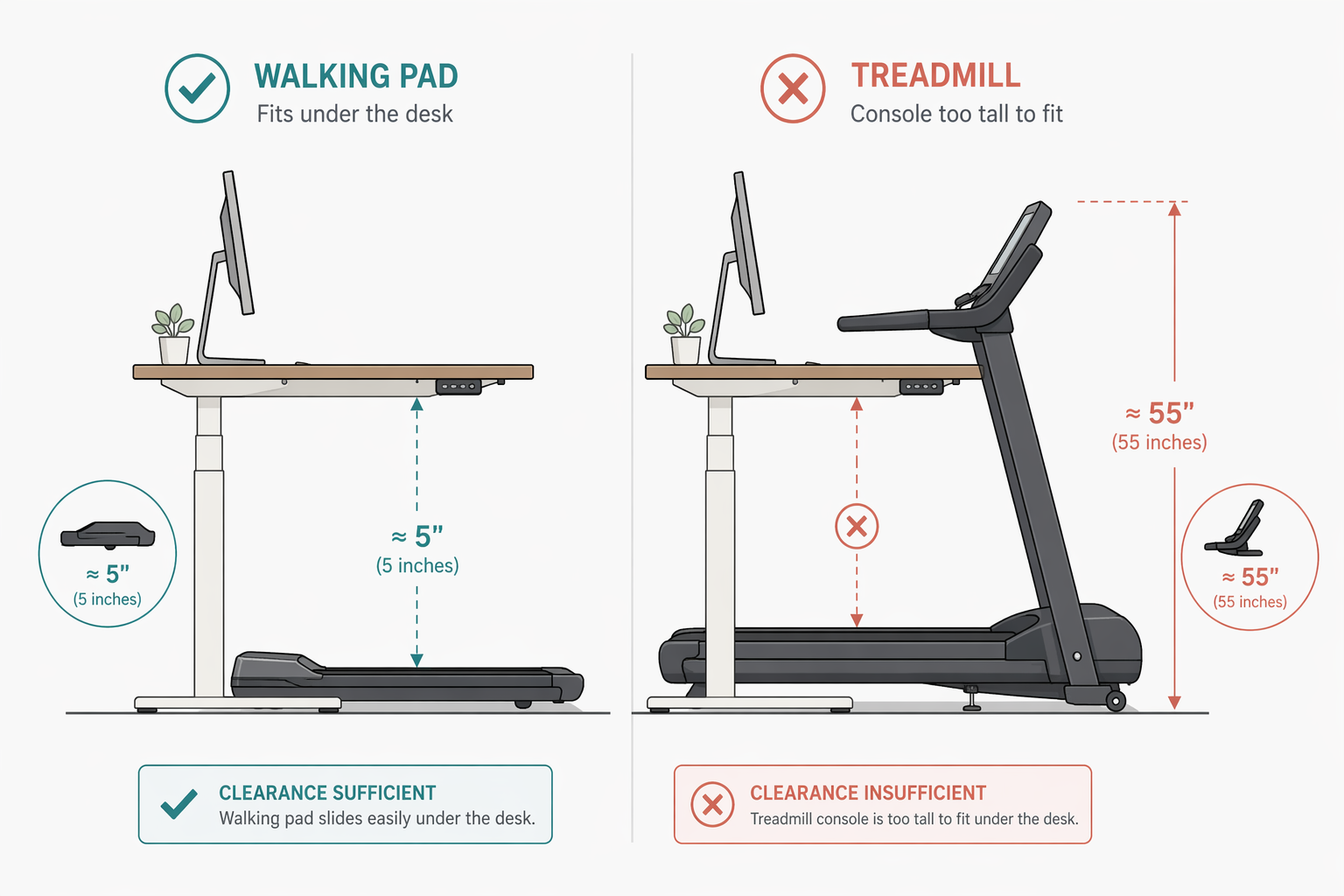
The walking pad vs treadmill for home office decision usually gets clearer the moment you stop picturing a showroom and look at the desk. A full-size treadmill can be excellent fitness equipment. It can handle running, incline work, intervals, and heavier training loads. It also usually has a console rising roughly 50 to 67 inches, which means it does not slide under a standing desk in any normal sense of the phrase. A walking pad, by contrast, is commonly about 5 inches tall and built to roll under the work surface instead of replacing it.[1]
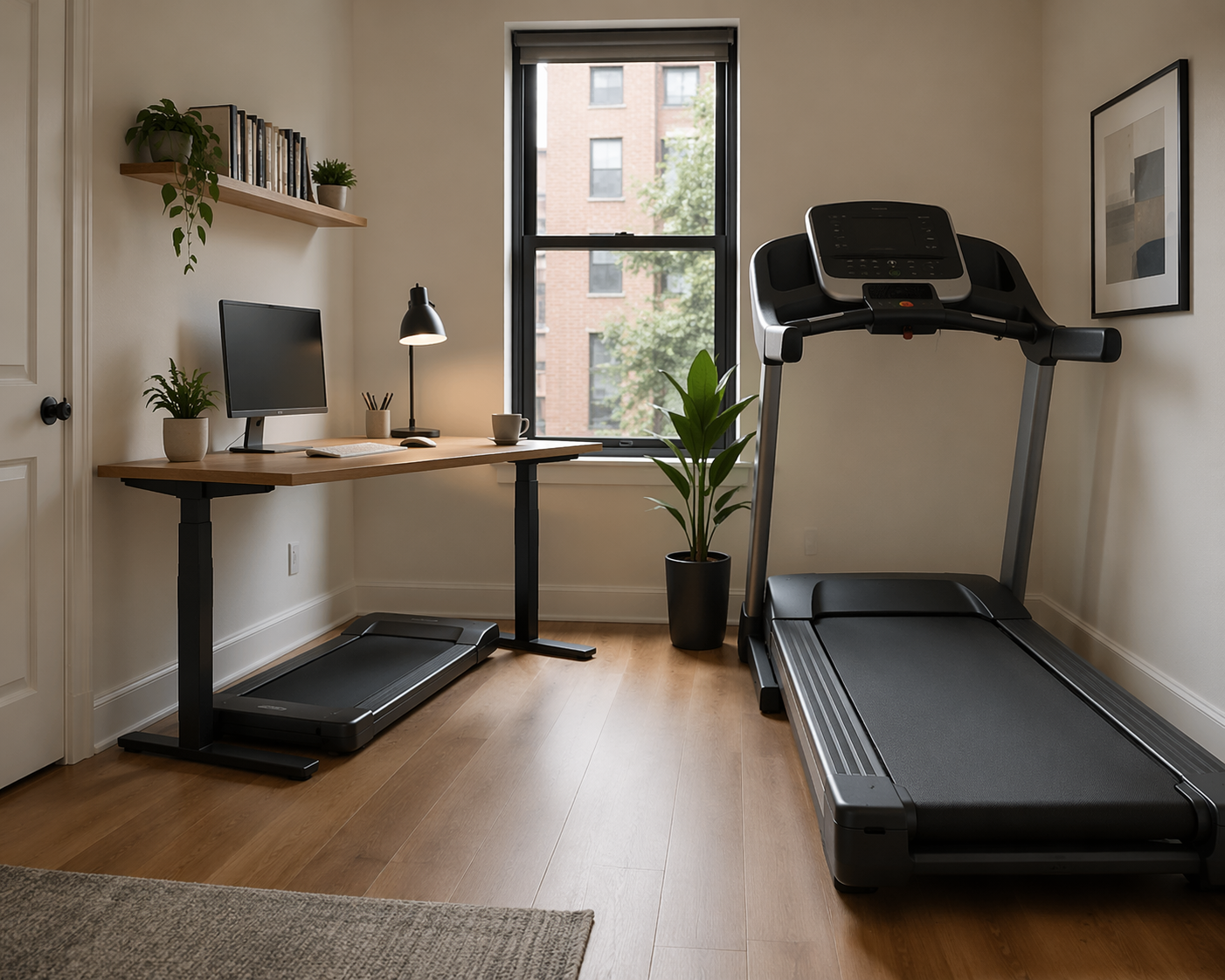
That single fit issue eliminates a lot of bad purchases. If the machine is meant to live under your desk while you answer email, join calls, and move at a quiet walking pace, most remote workers should start with a walking pad. The exceptions matter: longer daily use, higher weight-capacity needs, actual jogging plans, or enough dedicated space can push the decision toward a continuous-duty walking pad, a 2-in-1 hybrid, or a full-size treadmill.
The Decision Comes Down To Four Constraints
Feature lists make treadmills look like the obvious winner because they are more powerful machines. That is true, and it is also beside the point for many home offices. The better question is whether the machine can do the job you will actually give it on a Tuesday morning.
| Constraint | What To Measure Before Buying | Why It Changes The Choice |
|---|---|---|
| Daily walking duration | Less than 2 hours, several hours, or all-day use | Longer sessions put more demand on the motor and belt |
| Available floor space | Desk clearance, storage path, and whether one person can move it | A machine that cannot be parked easily tends to stop getting used |
| Noise sensitivity | Calls, shared walls, upstairs floors, and headset quality | Quiet enough in a spec sheet may not be quiet enough in a meeting |
| Running intention | No running, occasional jogging, or real running workouts | Walking pads are not substitutes for running treadmills |
The basic spec split is useful only after those constraints are on the table. Walking pads commonly top out around 0.5 to 4 mph, use smaller motors, support around 220 to 265 pounds, weigh about 40 to 70 pounds, and store under furniture. Full-size treadmills can reach around 0 to 12 mph, use stronger motors such as 3.0 CHP units, support 325 pounds or more, and often weigh 200 to 300 pounds or more, which usually means they need dedicated space.[1]
Those numbers do not make one category universally better. They tell you what kind of friction you are buying. The treadmill buys speed, durability, incline potential, and running capability. The walking pad buys desk compatibility, easier storage, and a better chance that one person can actually move it without turning the office into a gym renovation.
Home-Office Fit Is A Pass/Fail Test
Under-desk clearance is the first pass/fail condition. A low walking pad can sit beneath a standing desk while the desk does the ergonomic work. A full treadmill console, even on a good machine, puts controls and handrails where your keyboard, monitor, and forearms need to be. If your plan is to walk while working, the console is not a convenience; it is the obstruction.
The second condition is where the machine goes when it is not being used. In an apartment, “folds up” is not the same as “disappears.” A 40- to 70-pound walking pad can often be rolled against a wall, under a bed, or beside a bookcase. A 200-pound treadmill may fold, but it still occupies a large vertical block of room and usually cannot be repositioned casually between calls.[1]
Noise is the condition people underestimate until the first meeting. The useful reference point is normal conversation at about 60 dB. LifeSpan figures cited in the available comparison data put walking-pad noise at 47 dB at 1 mph, 50.1 dB at 2 mph, and 54 dB at 3 mph, below that conversation benchmark.[1] In practice, a walking pad at roughly 1.5 to 2.5 mph with a decent headset is often the zone where typing, talking, and walking can coexist. Faster belt speed, hard shoes, hollow flooring, and a room with bare walls can change that.
Upstairs apartments add another layer. The sound you hear in the room is not always the sound a downstairs neighbor hears through joists and flooring. A treadmill mat is not a decorative accessory here; it is the first thing I would put under either machine. It will not make impact vanish, especially if you jog, but it reduces vibration, protects the floor, and gives you a more honest test of whether the setup can stay.
Barefoot use also deserves a quick reality check. Cleveland Clinic notes injury risk with walking pads when people use them barefoot, because the moving belt can irritate skin or contribute to foot problems.[2] This is not a reason to abandon the category. It is a reason to treat it like equipment, not a rug: wear appropriate footwear, start slower than your normal outdoor walking pace, and give yourself time to adapt.
Match The Machine To The Worker, Not The Other Way Around
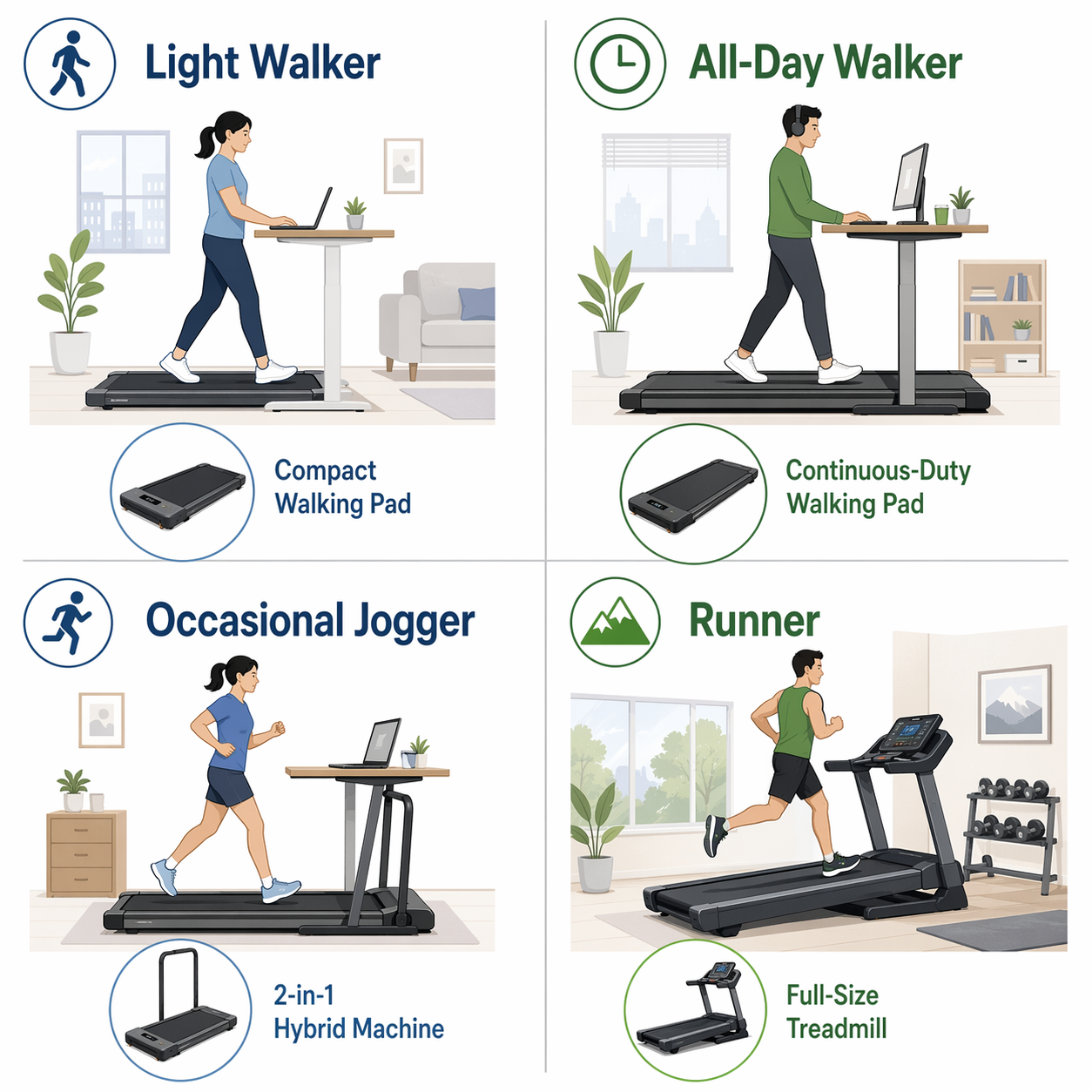
Most buying mistakes happen when someone chooses the category they admire instead of the one that matches their workday. A runner sees a compact walking pad and expects it to behave like a treadmill. A desk worker buys a treadmill because it looks more serious, then discovers the console blocks the desk and the machine has nowhere to live.
| User Profile | Best Fit | Why |
|---|---|---|
| Light walker in a small apartment | Walking pad | The goal is low-speed movement during work, not training |
| All-day standing-desk walker | Continuous-duty walking pad | Longer sessions need a motor designed for sustained use |
| Occasional jogger who wants one machine | 2-in-1 hybrid | It bridges desk walking and limited off-desk jogging |
| Runner who needs incline or intervals | Full-size treadmill | Running, incline, speed changes, and durability matter more than storage |
Light Walker: Buy The Simple Walking Pad
If you expect to walk during email, document review, webinars, or admin work for less than about 2 hours a day, the simple walking pad is the cleanest answer. You are buying a low deck, a slow speed range, and a machine that can leave the center of the room when the workday ends.
This is also the profile where calorie-burn claims can become a distraction. Cleveland Clinic gives a broad estimate of 100 to 260 calories per 30 minutes depending on body weight and other variables.[2] Helpful context, yes. But if the machine is annoying to move, too loud for calls, or uncomfortable under the desk, the theoretical burn rate will not matter because the pad will sit upright in a corner.
All-Day Walker: Look For Continuous-Duty Engineering
If your plan is to keep the belt moving through large parts of the day, do not shop only by deck height and price. Some consumer content uses “walking pad” and “under-desk treadmill” almost interchangeably, while some manufacturers and reviewers distinguish heavier-duty under-desk units by motor design and sustained-use expectations. The practical question is simple: is the motor meant to run for the duration you expect, day after day?
For this profile, check the warranty language, motor rating, user weight capacity, belt size, and any stated duty-cycle guidance before getting excited about a thin frame. A very compact machine may be perfect for short walking blocks and still be the wrong choice for someone who wants movement from the first meeting to the last.
Occasional Jogger: Consider A 2-in-1 Hybrid, Carefully
The 2-in-1 hybrid is the middle category worth taking seriously. It usually keeps a lower, desk-compatible mode for walking and adds a raised-handrail mode for faster use. Wirecutter tested 24 under-desk treadmill models and named a 2-in-1 hybrid as its top pick, which is a useful signal that this bridge category is not just a gimmick.[3]
The caution is that “can jog” does not always mean “should replace a running treadmill.” A hybrid may make sense if you want one machine for walking during work and occasional light jogging outside work hours. It is less convincing if your real habit includes intervals, incline, long runs, or faster paces where a full-size treadmill’s frame, motor, deck, and controls are doing real work.
This is the category where reading tested reviews helps more than reading product copy. Verywell Fit reports testing 47 under-desk treadmill models, which matters because small differences in belt feel, remote controls, stability, and noise are hard to judge from spec tables alone.[4]
Runner: Buy The Treadmill And Give It Space
If you know you will run, do not talk yourself into a walking pad because it looks tidy under a desk. Running changes the load on the motor, the belt, the frame, and the floor. A full-size treadmill is the better tool when speed range, incline, interval controls, deck length, and higher weight capacity are central to the purchase.
The tradeoff is honest space. A treadmill belongs in a garage, spare room, basement, or dedicated corner where its size is not a daily negotiation. If that space exists and your work calls are not happening beside the belt, the reasons to avoid a treadmill become much weaker.
Productivity Takes Practice
Walking while working is not equally good for every task. Many people can handle calls, inbox triage, reading, and routine admin at a slow pace. Dense writing, spreadsheet cleanup, design review, and anything requiring fine cursor control may be better done standing still or sitting. Daily Burn’s remote-work coverage highlights the adjustment period and the way productivity depends on task type rather than on walking alone.[5]
The useful approach is to assign the belt to the work that tolerates movement. Start around the lowest comfortable speed, use a headset, and treat walking blocks as part of your schedule rather than as a test of willpower. If you find yourself gripping the desk, shortening your stride awkwardly, or rereading the same paragraph three times, the pace is too high for that task.
Price Should Not Be The First Filter
Approximate price ranges are useful, but they move with sales, model year, motor quality, warranty, and brand. Walking pads are often discussed in the rough $150 to $600 range, while treadmills can run from about $500 to $2,000 or more. Those ranges are too broad to decide the purchase by themselves.
A cheap walking pad is not cheap if it cannot handle your daily duration. A discounted treadmill is not a bargain if it blocks the desk and has to stay folded beside the closet. Price belongs after fit, noise, duration, and running intent, because those are the conditions that determine whether the machine enters your workday or becomes furniture.
The Practical Verdict
For most WFH professionals with a standing desk who only want to walk, a walking pad is the better home-office choice. It fits the desk problem directly: low deck, slower speeds, easier storage, and less room disruption. If you expect several hours of daily use, move up to a continuous-duty walking pad rather than simply buying the thinnest one. If you sometimes want to jog and still need desk compatibility, compare 2-in-1 hybrids. If you are a runner, buy the treadmill and give it the floor space it deserves.
If foldability itself is becoming the bigger question, the comparison is slightly different; this Folding Treadmill vs Walking Pad guide covers that angle. For the home-office decision, keep the purchase filter tighter: daily walking duration, available floor space, call noise, and whether you will actually run.
References
- Walking Pad vs Treadmill, Garage Gym Reviews
- Walking Pad Treadmill, Cleveland Clinic
- The Best Under-Desk Treadmills, Wirecutter
- Best Under-Desk Treadmill, Verywell Fit
- Walking Pads Are Under-Desk Treadmills Worth It for Remote Workers, Daily Burn

Comments
Join the discussion with an anonymous comment.