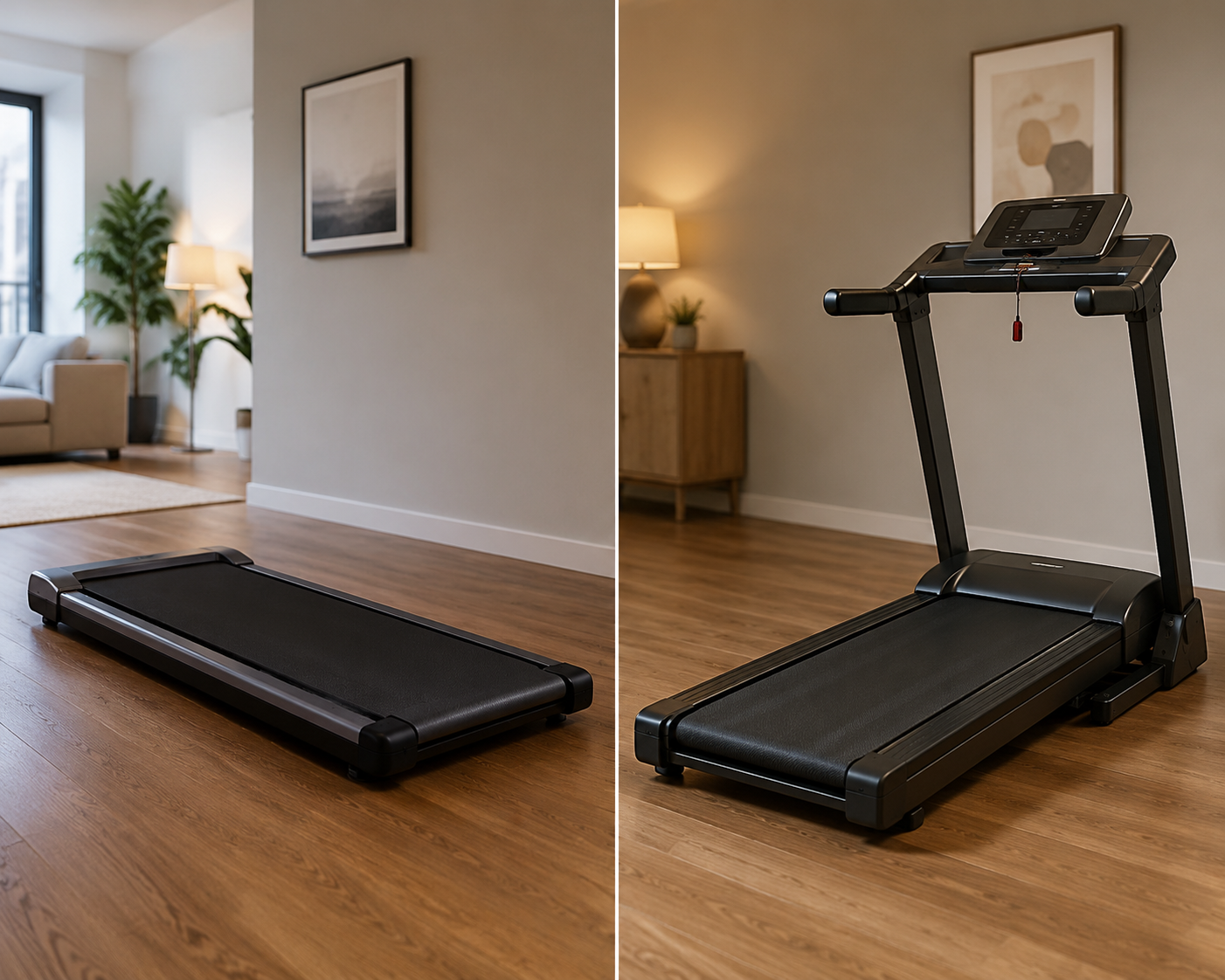
Two machines can both be sold as “compact” or “foldable” and still belong in completely different homes. One may be a low-profile walking pad that slides under a sofa and tops out around brisk-walk speed. The other may fold upright, take over a larger corner, and support real running. The difference is not the label on the product page. It is the machine’s motor power, top speed, deck length, incline, and warranty.
That is the practical answer to the foldable treadmill vs walking pad question: buy the category that matches the workout you actually plan to do. A pure walker should not pay for a 12 mph treadmill with a 60-inch deck just to collect laundry on it. A runner should not talk herself into a slim under-desk machine because the listing says “jogging” in one bullet and “portable” in the next.
The Five Specs That Separate a Walking Pad From a Foldable Treadmill
Retail names blur because they describe storage, not capability. A walking pad can be “foldable” if the handle folds down. A treadmill can be “compact” and still have a full running deck. Before comparing remotes, apps, cup holders, or whether the frame fits under a bed, check the five specs that decide what the machine can safely and comfortably do.
| Spec | Typical walking pad | Typical foldable treadmill | Why it matters |
|---|---|---|---|
| Motor power | Around 2.25 CHP | 3.0+ CHP | Higher-load use, repeated jogging or running, and durability expectations |
| Top speed | About 4–7.5 mph | Up to 12 mph on many full foldable treadmills | Whether the machine is walking-only, light-jog capable, or running-capable |
| Deck length | About 40–43 inches | About 55–60 inches | Stride room, especially for jogging, running, and taller users |
| Incline | Rare | Often available; some models offer 0–15% | Hill walking, running variety, and training intensity without more speed |
| Warranty | Often 90 days to 1 year | Can extend to lifetime frame and motor coverage from some major brands | How much confidence the maker is putting behind the frame and drive system |
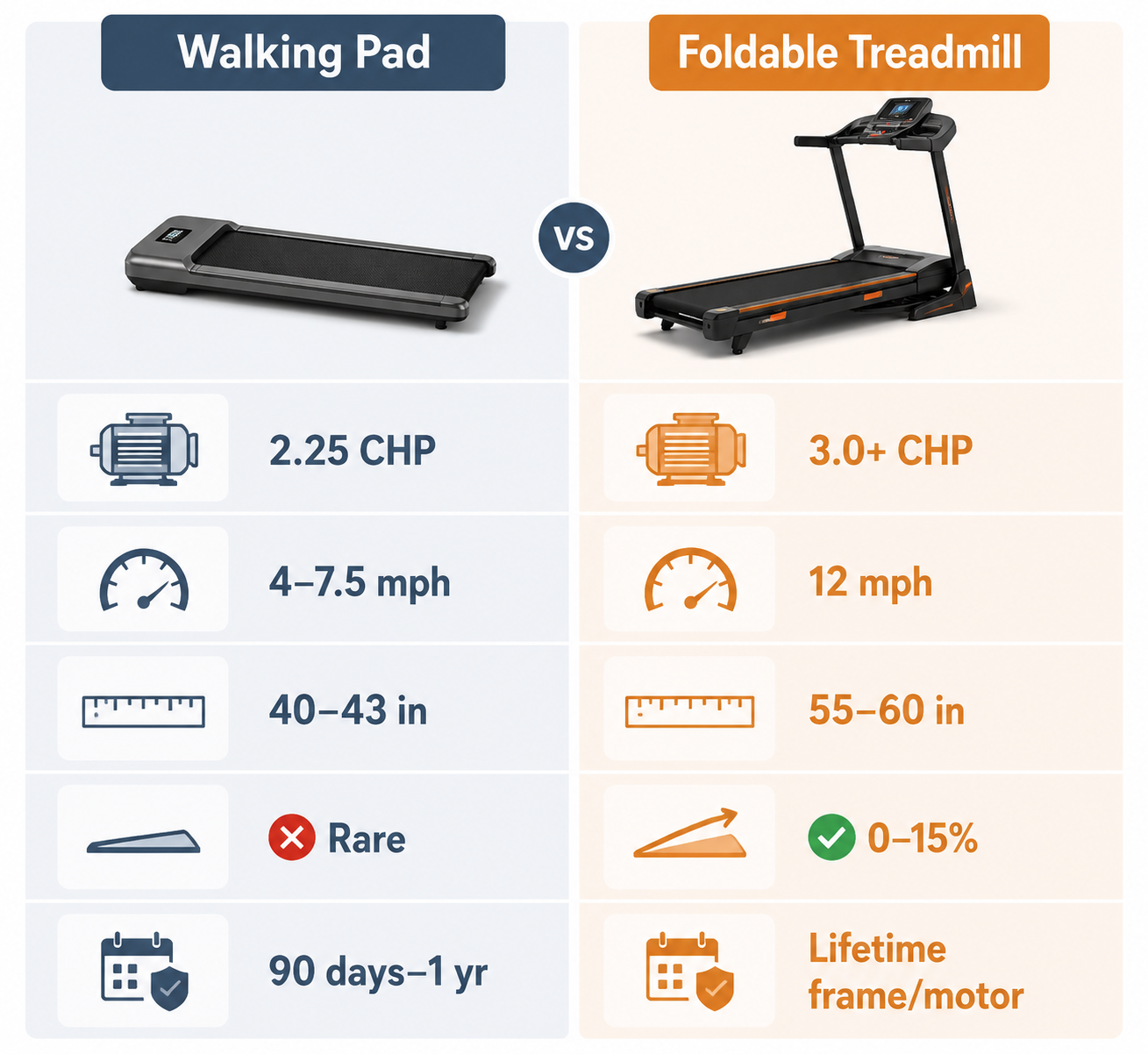
Those ranges are not minor spec-sheet trivia. Verywell Health and Healthline both describe walking pads as machines with much lower speed ceilings and shorter decks than conventional treadmills, commonly topping out around 4–7.5 mph with walking surfaces around 40–43 inches long.[1][2] Garage Gym Reviews’ folding treadmill testing points to the other side of the category: even a budget-oriented model such as the Sole F63 is listed at $1,299 with a 12 mph top speed, a 60-inch deck, and 0–15% incline.[3]
Speed Is the First Reality Check
Top speed is where many disappointing purchases begin. A walking pad that maxes out at 4 mph can be excellent for work calls, rainy-day steps, and steady low-impact movement. It is not a hidden bargain running treadmill. A model that reaches 7.5 mph may be enough for occasional light jogging for some people, but that still leaves little headroom compared with a foldable treadmill that reaches 12 mph.[1][2][3]
That headroom matters because a machine should not live at its maximum setting every time you use it hard. If the top speed on the page is already the speed you hope to use, the purchase is too tight. For walking, that may not matter. For running, it usually does.
The uncomfortable part is that the product language often hides this. “2-in-1,” “jogging,” and “home cardio” can sit beside a speed cap that tells a more cautious story. When in doubt, treat the posted maximum speed as a boundary, not an invitation.
Deck Length Decides How Natural Your Stride Feels
Deck length is less glamorous than speed, but it may be the spec you feel first. A 40–43-inch walking surface can work well when your stride is short and controlled. It becomes more limiting as pace increases, stride length grows, or the user is taller.[1][2]
A 55–60-inch deck gives more room for running mechanics and small missteps. That does not mean every home needs a 60-inch deck. It means the buyer has to stop treating deck length as a storage inconvenience and start treating it as usable workout space. If you plan to run, the extra length is part of the machine’s safety margin.
This is also where small apartments force an honest trade-off. A walking pad can disappear in a way a full foldable treadmill cannot. If your realistic use is 30-minute walks while watching TV, that storage advantage is meaningful. If your realistic use is interval running, the shorter deck is not a clever compromise; it is the wrong platform.
Motor Power and Warranty Tell You What the Machine Was Built to Survive
Motor power is easy to skim past because listings use different language and not every brand makes the same disclosures. Still, the broad split is useful: walking pads are commonly described around 2.25 CHP, while stronger foldable treadmills are often in the 3.0+ CHP range. That difference lines up with the intended use. Walking creates a different load pattern than repeated jogging or running.
Warranty length is the less romantic version of the same story. Walking pads often carry short warranty windows, commonly 90 days to 1 year. Foldable treadmills from brands such as Sole, NordicTrack, and Bowflex can offer lifetime frame and motor coverage. A long warranty does not make a treadmill perfect, and a short warranty does not automatically mean a machine will fail. But it does show how differently the categories are positioned for long-term load.
If two machines are close in price, this is where the comparison should slow down. One may be priced for convenience and storage. The other may be priced for frame, motor, deck, incline, and longer coverage. Similar sale prices do not mean similar capability.
Incline Is Usually a Foldable Treadmill Feature, Not a Walking Pad Feature
Incline is not required for every home workout, but it changes what a machine can do. It lets a walker raise intensity without raising speed as much, and it gives runners more training variety. Walking pads rarely include incline. Full foldable treadmills often do, with the Sole F63 example listed at 0–15% incline in Garage Gym Reviews’ testing.[3]
For a pure under-desk setup, no incline may be the point. A flat, low-profile machine is easier to place under a standing desk and easier to store afterward. For hill walking or running workouts, the absence of incline is a real limitation, not a missing luxury.
The Safety Issue With Cheap Walking Pads
The strongest case for a walking pad is friction reduction: fewer steps between “I should move” and actually walking. Cleveland Clinic’s discussion of walking pads frames them as a practical way to add movement during the day, especially for people who sit for long stretches.[4] That benefit is real enough, but it does not erase the need to inspect basic safety behavior.
Consumer Reports found major issues among many under-desk treadmills under $500, including sudden belt stops when safety keys were pulled, inaccurate speed displays, and belts that ran without load.[5] Those findings are category-level warnings, not permission to condemn every low-cost walking pad or attach every fault to a specific model. They do mean a bargain listing deserves more scrutiny than the word “compact” usually receives.
For walking-only use, the practical checks are simple: look for a safety key or stop mechanism that behaves predictably, a speed display you can understand, a belt that tracks consistently, and a return policy long enough to test the machine in your actual room. If the machine will sit under a desk, also think about where the remote lives and how quickly you can stop the belt without looking down.
Where 2-in-1 Machines Fit
The most confusing machines are the 2-in-1 hybrids: GoPlus-style, MERACH T12-style, or UREVO Strol 2E-style models with folding handlebars, compact frames, and maximum speeds around 7.5 mph. They are not useless. They are useful precisely because they occupy an awkward middle: more structure than a flat walking pad, less machine than a full running treadmill.
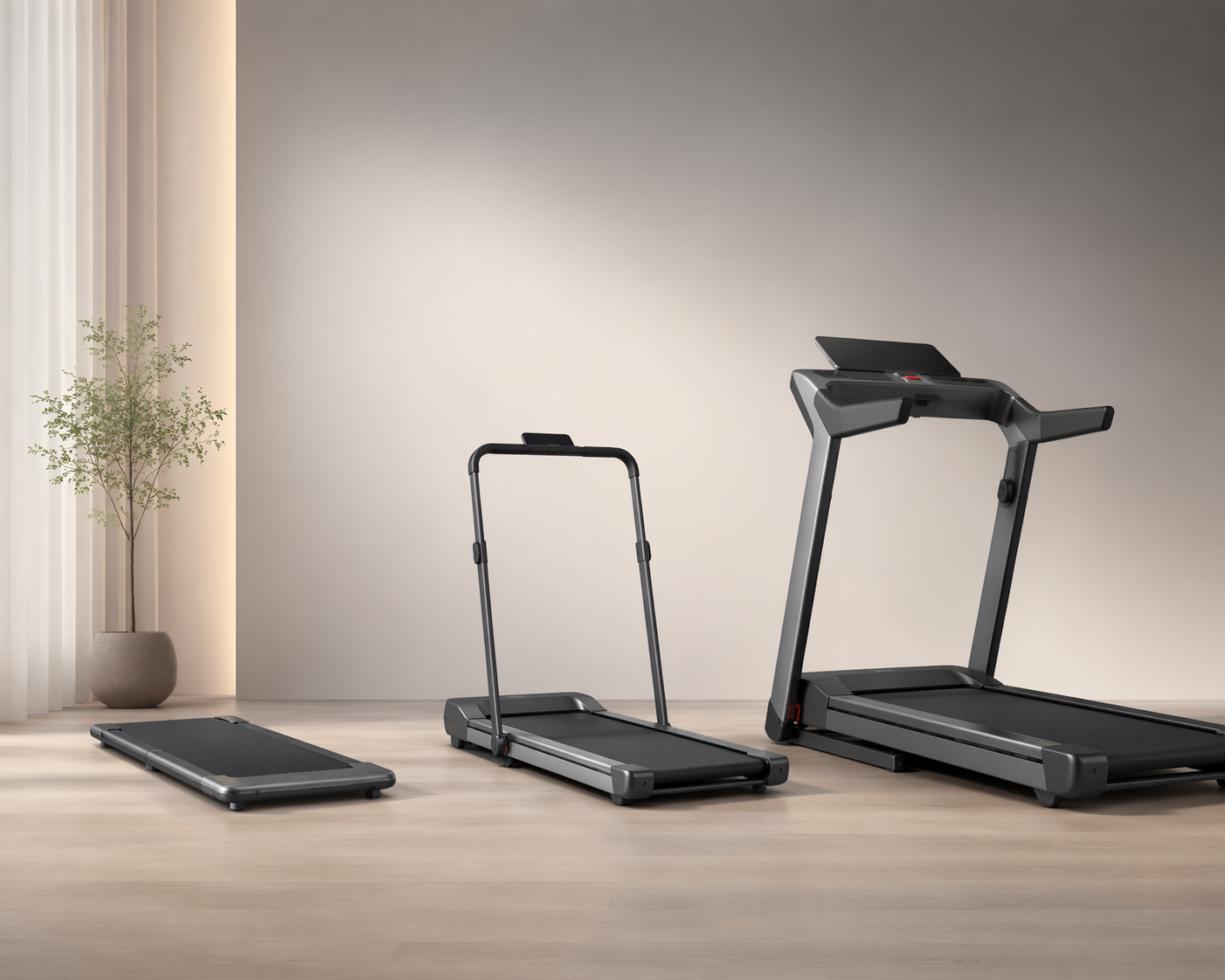
The right buyer for this zone wants compact storage first and occasional jogging second. The wrong buyer is trying to get a full treadmill experience from a machine designed around apartment convenience. Wirecutter’s long-term testing is a useful caution here: it reported belt fraying on the GoPlus after a few months.[6] That is one product experience, not a universal rule for every hybrid, but it matches the broader reason to be careful about asking light compact machines to behave like heavy training equipment.
If you are still sorting out the category names, a deeper breakdown of the walking pad, flat-fold, and folding treadmill tiers can help; see this guide to walking pads vs folding vs flat-fold treadmills or the broader overview of three types of small treadmills.
Price Overlap Can Be Misleading
Healthline gives a broad cost reference: walking pads around $300–$600 and treadmills around $300–$1,000+, with overlap at the lower end.[2] Current 2026 prices should be checked before treating any number as fixed, but the overlap itself is the important point. A $500 walking pad and a $600 treadmill are not automatically close substitutes.
A cheaper walking pad may be the smarter buy if it will be used for slow desk walking five days a week. A more expensive foldable treadmill may be the smarter buy if it prevents you from replacing an underpowered machine after discovering that jogging on a short deck feels cramped. Budget matters, but it should come after intended use and the five specs, not before them.
For readers comparing models by budget rather than category, the next useful stop is a focused list of budget treadmills under $1,000. If the concern is the total cost after repairs and warranty coverage, compare that against treadmill total cost of ownership rather than the sale price alone.
Which One Should You Buy?
Choose a walking pad if the main job is walking: under-desk movement, TV walking, bad-weather steps, or a low-friction way to move more at home. In that case, a lower top speed and shorter deck are not flaws if they match the task. You are paying for storage efficiency and ease of use, not running performance. Pure walkers can also compare dedicated options in this guide to the best home treadmill for walking.
Choose a foldable treadmill if running, longer stride room, incline training, or long-term durability matters. The machine will demand more floor space and more planning, even if it folds upright. That extra structure is the point. Runners who still need a small footprint should start with true running-deck options in this guide to compact treadmills for home and then check the stability trade-offs of folding treadmills at home.
Consider a 2-in-1 hybrid only if you understand the compromise: it may store more easily than a full treadmill and feel more versatile than a flat walking pad, but it should not be treated as a substitute for a 12 mph treadmill with a long deck, incline, and stronger warranty. That is especially true if more than one person in the household plans to use it at higher speeds.
One final apartment note: do not trust manufacturer decibel claims as proof that a machine will be neighbor-proof. Noise depends on the building, floor construction, user weight, speed, and mat setup. If sound and storage are the hard constraints, plan them separately with a small-apartment treadmill noise and footprint guide before ordering.
The cleanest purchase decision is also the least glamorous one: write down the fastest speed you intend to use, whether you need incline, who will use the machine, where it will live, and how long you expect it to last. Then match those answers to the specs. A walking pad is a good buy when walking is the job. A foldable treadmill is the better buy when the workout needs treadmill capability, not just treadmill-shaped storage.
References
- Walking Pad vs. Treadmill, Verywell Health
- Walking Pad vs. Treadmill, Healthline
- Best Folding Treadmill, Garage Gym Reviews
- Walking Pad vs. Treadmill, Cleveland Clinic
- Best Under-Desk Treadmills of the Year, Consumer Reports
- The Best Under-Desk Treadmills, Wirecutter
Comments
Join the discussion with an anonymous comment.