
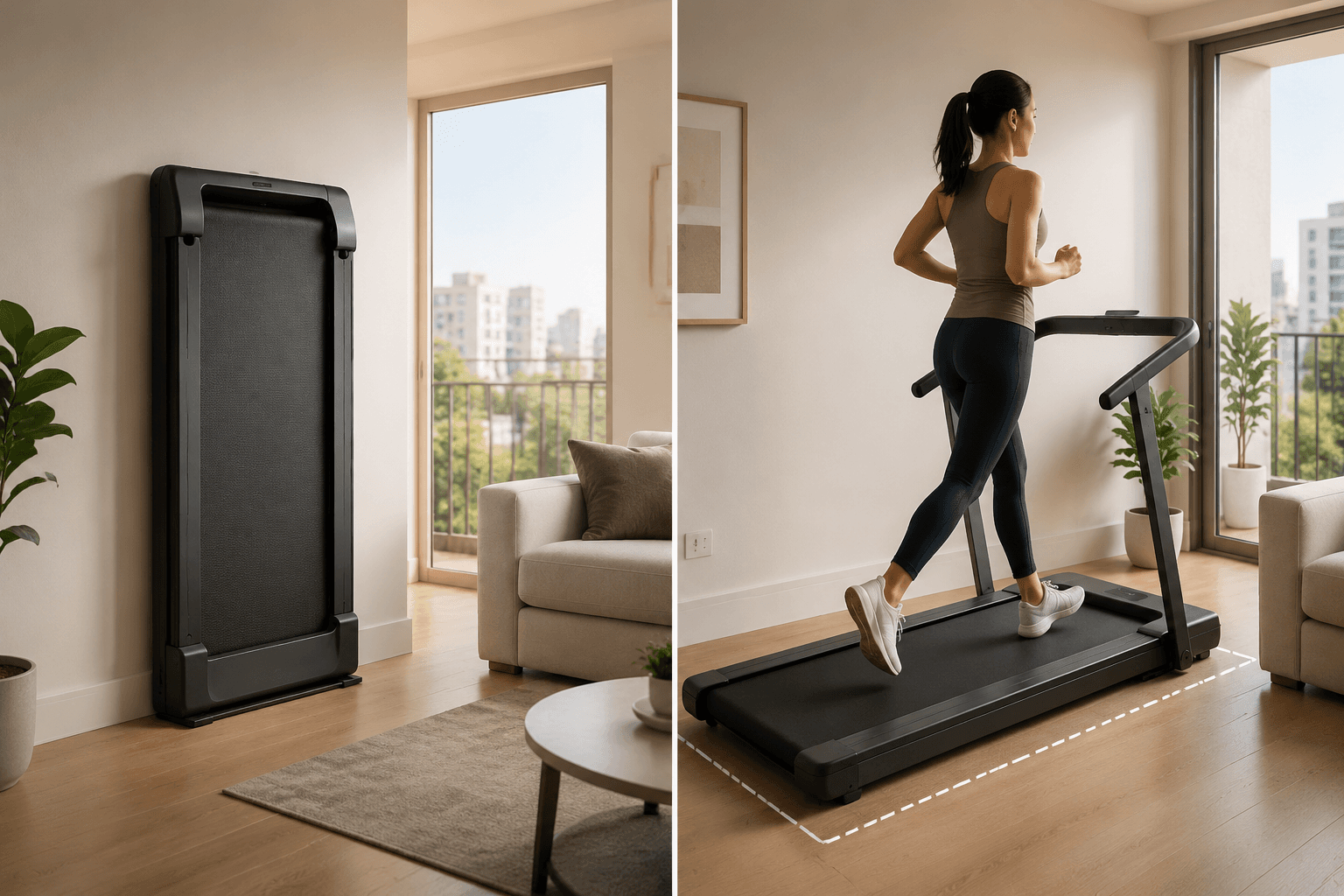
A folding treadmill for home use does not make the workout smaller. It makes the aftermath smaller. That distinction sounds fussy until the box arrives, the deck drops, and the machine needs the same long strip of clear floor every time you walk or run. The hinge helps when the session is over. It does not shorten your stride, move the sofa, or give the belt more clearance from a wall.
That is where a lot of “best compact treadmill” advice gets slippery. Folded height and storage depth are useful numbers, but they are not the numbers that decide whether you can run comfortably in a spare bedroom or walk during calls without blocking a door. The working footprint, belt size, frame behavior, motor rating, user weight capacity, noise, and warranty terms matter more once the treadmill becomes part of the room instead of a product photo.
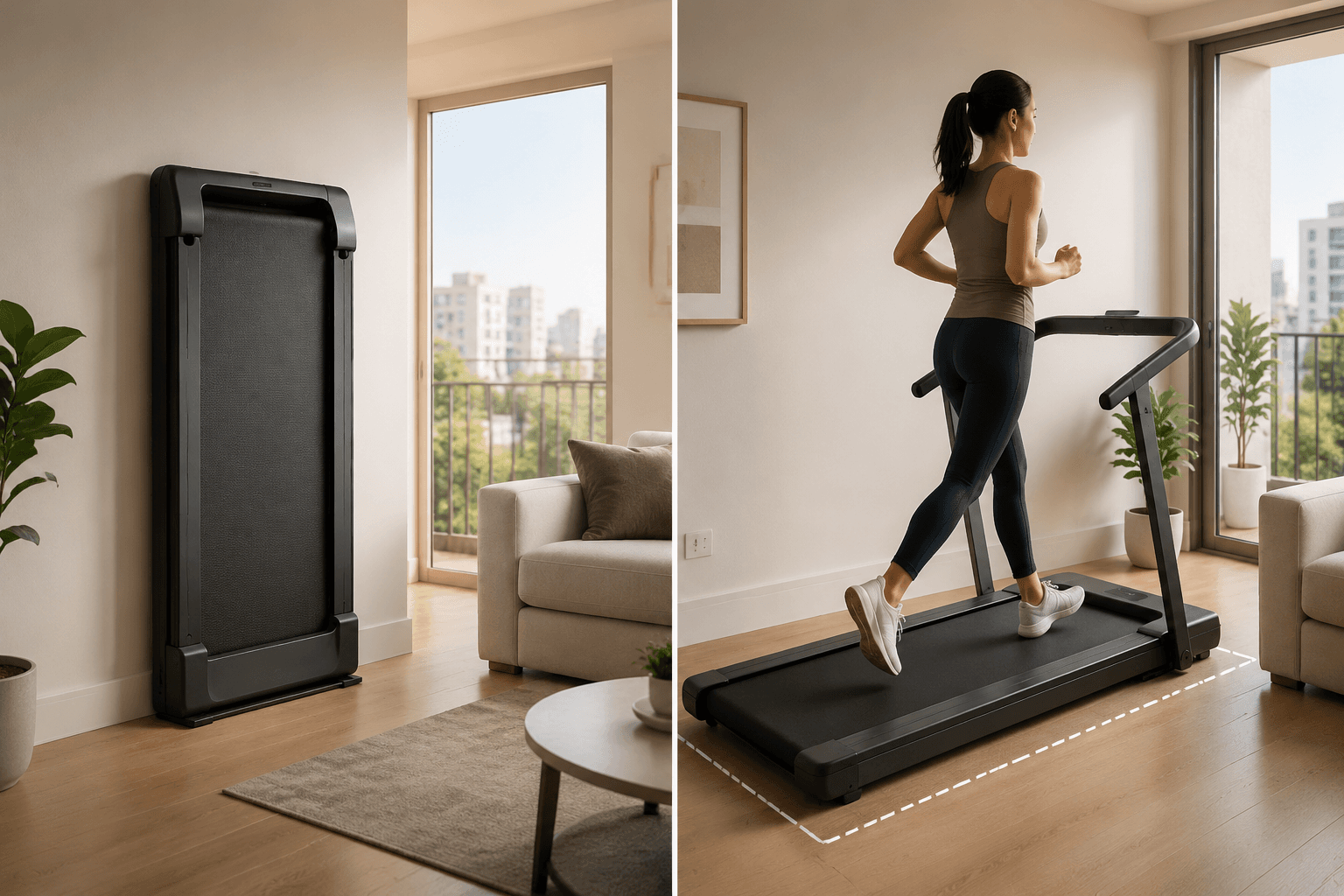
The Space Saving Happens After the Workout
The first measurement should be the treadmill unfolded, with room behind it, room beside it, and enough clearance to step off without turning every workout into furniture choreography. Folding changes storage geometry. It does not change the fact that the belt has to be long enough for your stride and the frame has to sit flat while your body weight repeatedly lands on it.
This is especially easy to miss in apartments because the folded machine looks solved. Upright against a wall, it may take less visual space than a bike or bench. In use, though, it still claims a lane. If that lane crosses a closet, bedroom door, radiator, desk chair, or child’s play area, the treadmill will either be moved constantly or used less than expected.
There is nothing wrong with buying for storage. In a small home, storage may be the only reason a treadmill is possible at all. The mistake is treating the folded measurement as the main fit test. The better question is whether the unfolded machine can stay in place long enough for the workout you actually plan to do.
| What to Measure | Why It Matters at Home |
|---|---|
| Unfolded length and width | Decides whether the treadmill can be used without blocking doors, drawers, walkways, or furniture. |
| Rear clearance | Matters if you drift back on the belt or need to step off quickly. |
| Folded depth and height | Decides whether storage is realistic after the workout. |
| Frame weight | Often hints at how stable the machine will feel at faster speeds. |
| Belt length | Controls stride comfort more than the word “compact” does. |
| Noise under load | Decides whether the machine works in an apartment, early morning, or shared house. |
Walkers and Runners Are Not Buying the Same Compromise
For walking, a folding treadmill can be a very sensible home machine. A walking pad under a desk, a low-profile foldable unit, or a lighter upright model may be enough if the pace is moderate and the user is not asking the frame to absorb hard running impact. The compromises still exist, but they may not be the compromises that matter for that use.
Running changes the purchase. At running speed, a light frame has to control more vibration, more belt force, and more side-to-side movement. Garage Gym Reviews’ folding-versus-non-folding comparison notes that folding treadmills “may be less sturdy,” while non-folding models tend to have larger motors and accommodate more user weight.[1] That does not make every folding treadmill flimsy. It does mean the hinge and lighter storage design should be treated as engineering choices with consequences, not free space-saving magic.
A useful rule of thumb is to be suspicious of treadmill frames under 90 pounds if the plan is actual running. That is not a lab-certified cutoff and it should not be treated as one. It is a practical wobble warning. Very light machines can be fine for walking, but once speed rises, the same lightness that makes them easy to fold and move can make the deck feel busy underfoot.
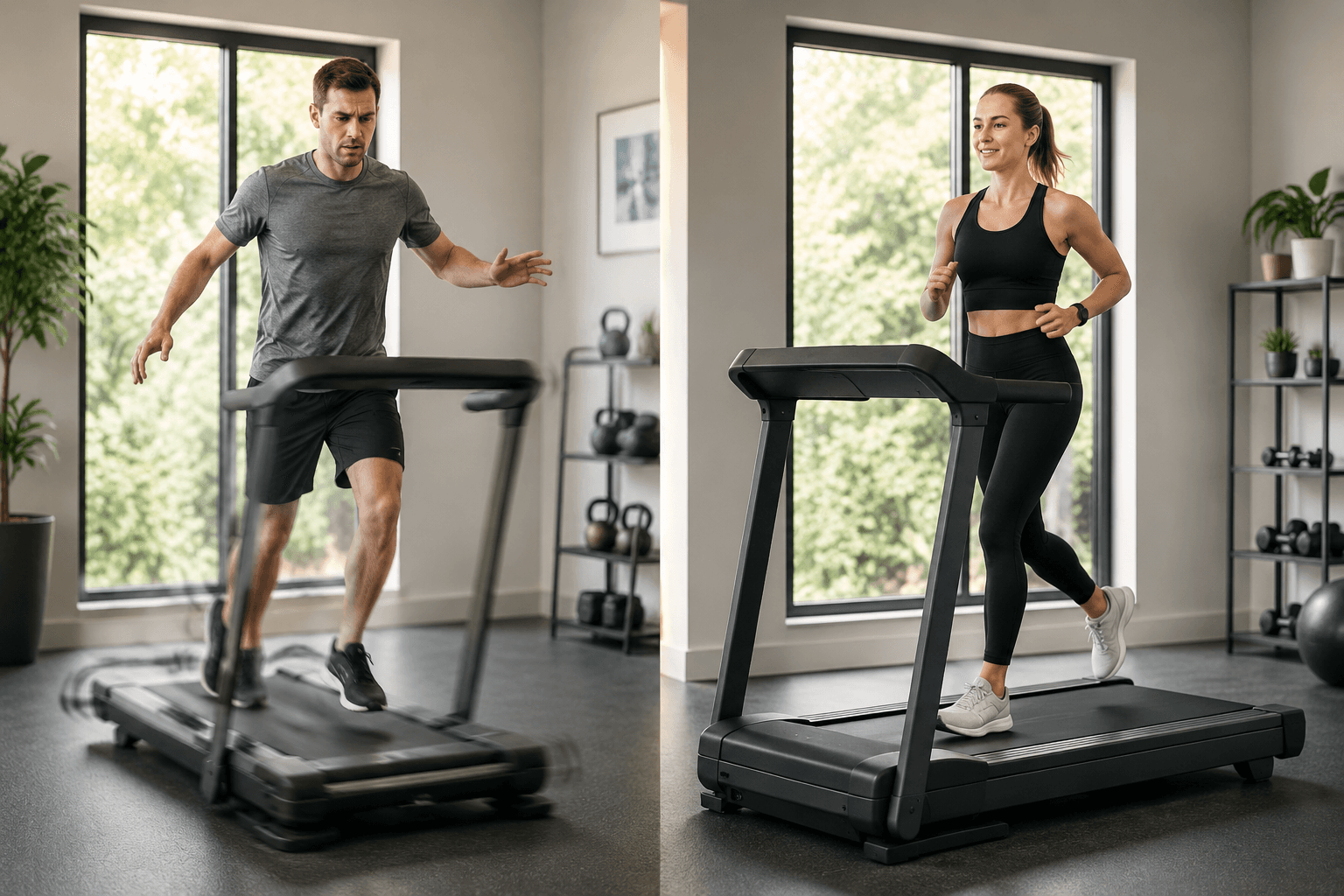
Belt length is the next filter. A shorter belt can be acceptable for walking because the stride is shorter and the landing forces are lower. For running, a cramped belt changes posture. People shorten their stride, look down more often, or run closer to the front hood than they should. A treadmill can technically reach running speed and still feel wrong for running if the usable belt does not match the person using it.
User weight capacity belongs in the same conversation. It is not only about whether the machine can hold a person. It is about how much margin the frame, deck, belt, and motor have during repeated use. A heavier runner near the top of a compact treadmill’s stated capacity is asking more of the machine than a lighter walker at a slower pace. Non-folding models often have the advantage here because they are built around a heavier, less portable frame rather than an easy storage motion.[1]
Budget Folding Treadmills Can Hide the Cost in the Belt
The budget tier is where folding treadmills become most tempting and most uneven. The product page may show the same basic promise as a more expensive model: folds up, fits at home, supports walking or running, costs less. The differences often sit in the parts people do not inspect closely enough before buying: belt thickness, roller quality, deck rigidity, motor rating, frame weight, and warranty length.
Consumer Reports’ 2026 durability testing is a useful warning here. In its testing of budget under-desk treadmills, belts tore during a 12-hour robot test.[2] That result should not be stretched into a claim that all inexpensive folding treadmills fail quickly. It does show that build quality in the low-cost compact category can vary enough that two machines with similar-looking listings may not survive the same use.
For a buyer comparing models under a tight budget, the right move is not to reject every inexpensive folding option. It is to match the machine to the job. A lower-cost walking pad used for gentle daily walking has a different risk profile than a budget upright treadmill expected to handle interval runs. The more intense the use, the less patience you should have for vague motor claims, short belts, very low frame weight, and thin warranty language.
If price is the hard ceiling, compare the trade-offs against a broader budget treadmill guide before deciding that folding is automatically the better fit. Sometimes the best budget choice is a folding walker. Sometimes it is a less compact machine that gives up storage convenience for a better belt and frame.
Noise Is Not One Number
Noise is where small-space buying gets personal fast. In a detached garage, a treadmill can be annoying and still workable. In an apartment, the same machine can become a neighbor problem, a nap problem, or a reason the treadmill only gets used at quiet hours. The motor is only part of it. Footstrike, belt texture, deck cushioning, floor construction, mat choice, and speed all change what people hear.
Tech Fitness Lab’s calibrated sound testing gives a concrete spread worth taking seriously, with one caveat. It measured the TOPUTURE Walking Pad at 62–65 dB at walking speeds, while competing budget models reached 75–80 dB.[3] Those measurements came from one source in controlled conditions, so they should not be treated as a universal promise for every apartment floor. Still, the spread is large enough to matter. A machine in the low-to-mid 60s is a different home object from one pushing toward 80 dB.
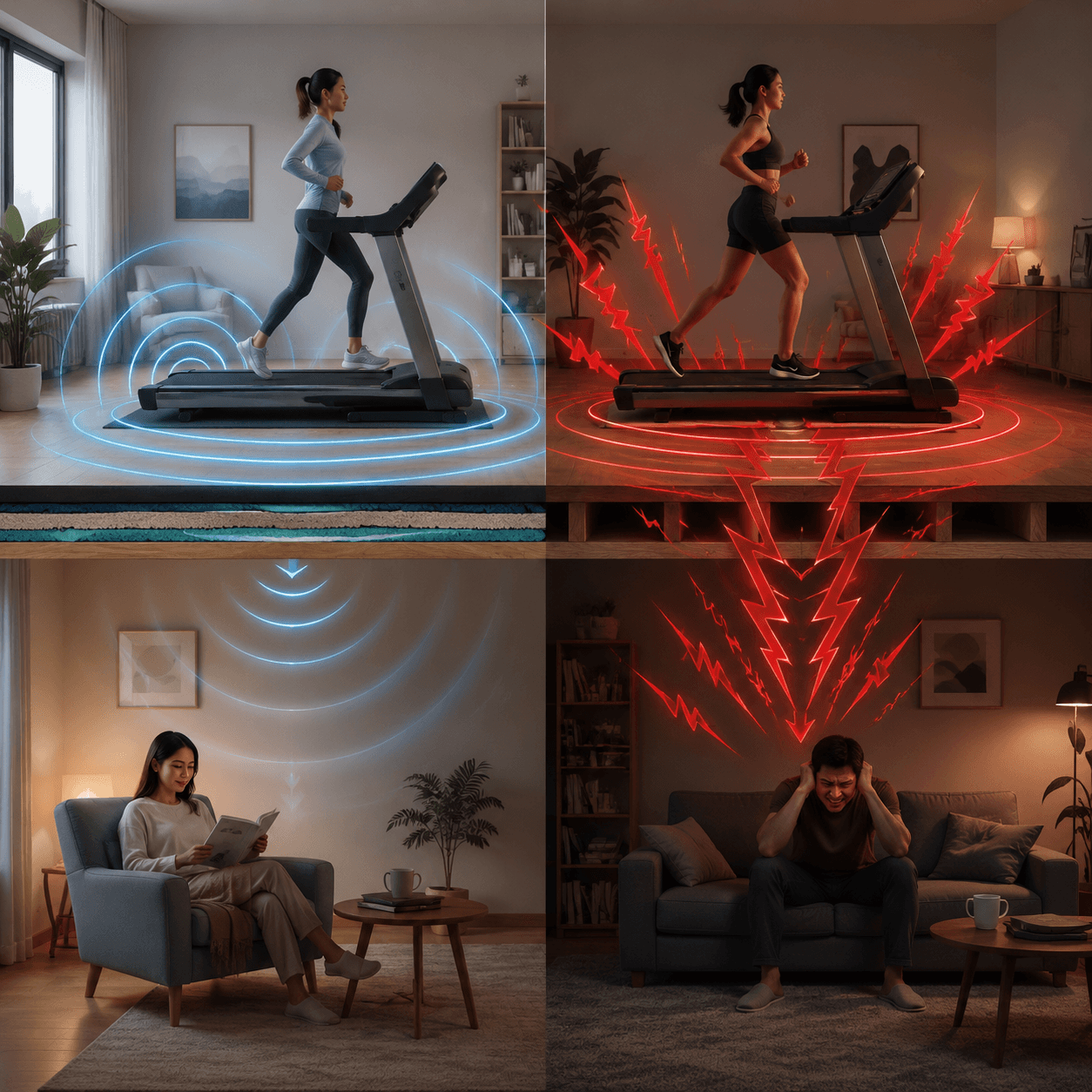
This is also where walking pads can outperform larger-looking budget machines. A slower walking setup may produce less impact noise simply because the workout produces less impact. That advantage disappears if the machine has a harsh belt sound, a rattling frame, or a motor tone that carries through the floor. Quiet-looking is not the same as quiet under load.
For apartment use, assume you are buying the treadmill and the floor system together. A dense mat, careful placement, lower speeds during quiet hours, and a check of what sits below the machine may matter as much as the brand. The next task after choosing a realistic model is usually noise control, and a dedicated guide to quieting a folding treadmill in an apartment is more useful than another generic “compact” label.
Motor Specs Need a Second Look
Motor language is another place where compact treadmill listings can sound better than they behave. Peak horsepower and continuous horsepower are not the same claim. A peak number describes a short burst. A continuous-duty rating is more relevant to sustained walking or running because the motor has to keep working after the first impressive moment on the spec sheet.
This matters more as the user gets heavier, the speed gets higher, or the sessions get longer. A folding treadmill with a modest motor may be perfectly serviceable for walking while working. The same motor may feel strained during longer runs, especially if the belt and deck are also built to keep the machine light. When a listing leans heavily on peak HP, treat it as a prompt to read closer rather than a reason to relax.
For a deeper spec check, use a treadmill motor specs explainer before comparing compact models by headline horsepower alone. The practical question is not which motor number is largest; it is whether the motor rating fits the speed, body weight, incline use, and session length you expect.
The Warranty May Assume a Better Room Than You Have
A folding treadmill often gets stored where space exists: garage, porch-adjacent room, basement corner, laundry area, or a wall near a window. Garage Gym Reviews has flagged a NordicTrack garage-storage warranty issue: some Commercial series coverage can be voided if the machine is stored in temperature or humidity extremes.[1] That specific clause should be verified against the current warranty terms before purchase, because warranty documents change.
The larger point is not limited to one brand. Storage is part of the ownership plan. If a treadmill folds but the only place it can live is a damp garage or an unconditioned space, the storage feature may be solving the wrong problem. Before buying, read the warranty for location limits, frame coverage, motor coverage, labor coverage, and exclusions tied to environment or misuse.
Subscription terms deserve the same quick check. Some connected treadmills are far less appealing if the screen, classes, or guided features depend on an ongoing membership. That does not make subscription equipment bad; it means the real purchase price includes the software relationship. If that is a concern, compare the machine against a broader look at smart home gym subscription lock-in before treating the sale price as the full cost.
A Simple Fit Test Before You Buy
The cleanest way to choose is to start with use, not storage. A folding treadmill should pass the workout test first and the parking test second. If it only passes the parking test, it becomes a neatly stored compromise.
- If you mainly walk while working, prioritize low noise, easy movement, enough belt width to avoid constant foot correction, and a storage shape that does not create a daily hassle.
- If you jog occasionally, look harder at frame weight, belt length, deck feel, and user weight capacity. The machine should not feel near its limit at your normal pace.
- If you run regularly, treat very light folding models as walking machines unless there is strong evidence that the frame, belt, motor, and warranty are built for running.
- If you live above or beside someone, make noise a primary buying criterion rather than an afterthought.
- If the treadmill will live in a garage, basement, or humid room, read the warranty before ordering.
The person who only wants a quiet walking pad for emails can reasonably accept compromises that would be unacceptable for a runner. The runner trying to train at speed should be much less forgiving. These are different home-gym purchases wearing similar product names.
A folding treadmill belongs in the home when storage is the real constraint and the workout fits the lighter, more compact design. Choose non-folding when running stability, belt room, higher user weight capacity, or warranty confidence matters more than parking the deck upright. For the bigger equipment decision around space, durability, and training style, it may help to compare the treadmill choice with a wider home-gym decision framework before giving the machine a permanent lane in the room.
References
- Folding vs Non-Folding Treadmill, Garage Gym Reviews
- Consumer Reports 2026 durability testing of budget under-desk treadmills, Consumer Reports, 2026
- Best Folding Treadmill 2026, Tech Fitness Lab
Comments
Join the discussion with an anonymous comment.