
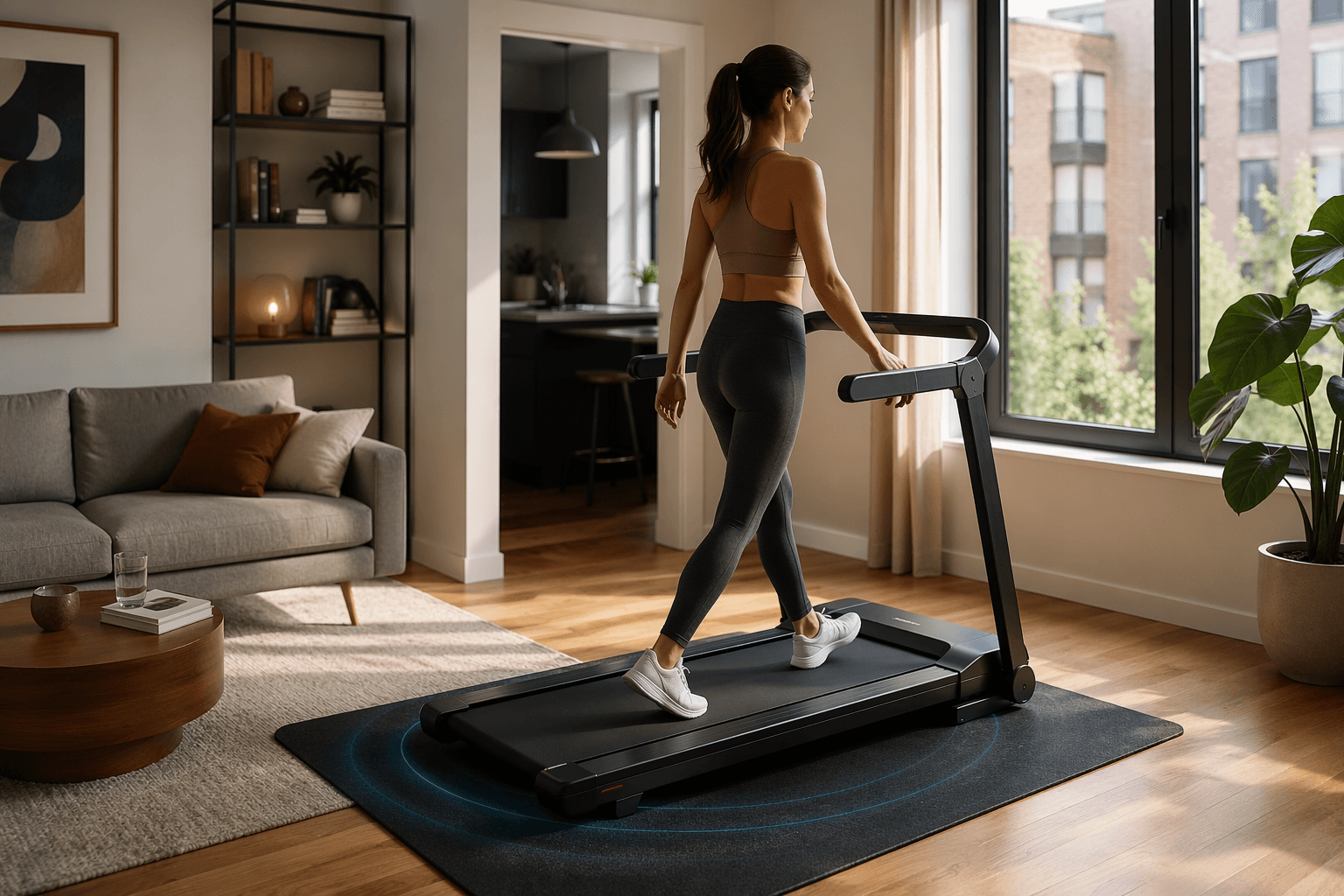
The awkward question with a folding treadmill for home use is not whether it folds. It is whether the person below you hears a steady ceiling-thud every time you walk after dinner or jog before work. Noise is also the regret people tend to underestimate: Commonplace identifies it as the top reason apartment treadmill buyers regret and resell machines, based on its used-marketplace observations rather than a controlled study [1].
That does not make a treadmill impossible in an apartment. It means the machine, floor, and workout have to match. A walking pad at an easy pace is a different neighbor problem from a 250-pound runner doing intervals on a second-floor wood-frame rental. The first can often be made ordinary-room quiet with a mat and sane timing. The second may still be a complaint waiting to happen, even with a good machine.
Useful noise guidance starts with ranges, not promises. TreadmillReviews.com measured the NordicTrack Commercial 1750 at 50.8 dB at a 3 mph walking speed in its quiet treadmill testing, but that reading was a lab-style benchmark, not a guarantee for every apartment floor [2]. In practice, walking pads often sit around 45–55 dB, quieter full-size folding treadmills often land in the mid-50s to mid-60s, broader full-size folding treadmills can run around 55–70 dB, and running at 7 mph or faster can push the experience into the 70–80 dB range where complaints become much more plausible [2].
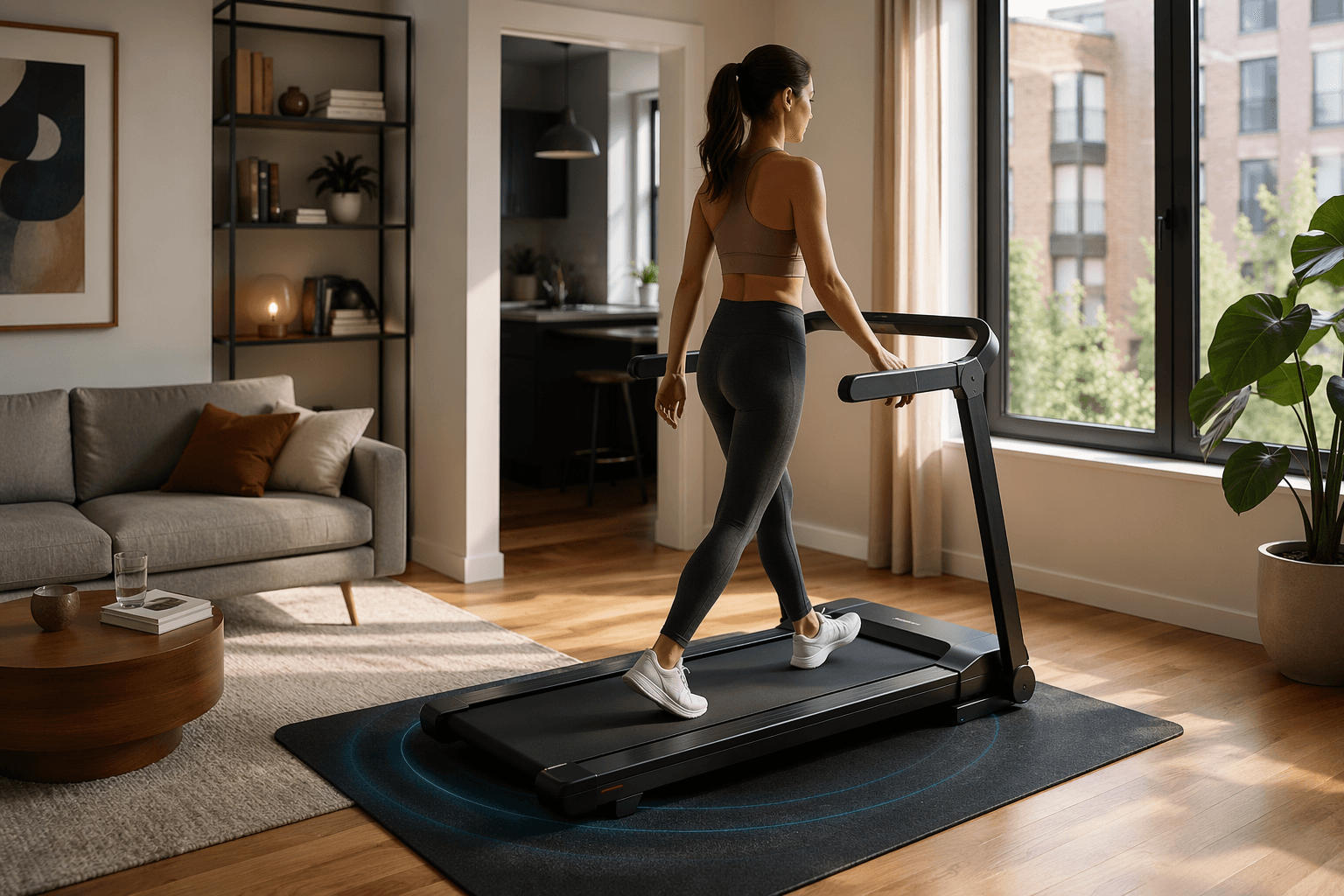
The noise you hear is not the whole problem
A treadmill makes two kinds of trouble in an apartment. Airborne noise is the sound in your room: motor whine, belt hiss, console beeps, fan noise, and the slap of shoes on the deck. Structure-borne vibration is the part that travels through the frame, into the floor, and into the ceiling below. The downstairs neighbor often gets more of the second one than you realize.
This is why a treadmill can seem acceptable while you stand beside it, then become maddening below. The motor may be quiet enough for a conversation, but each footstrike loads the deck, compresses the frame, and sends a pulse into the floor. On a concrete slab, that pulse has less room to resonate. On an upper floor in a wood-frame building, the floor itself can behave like a drumhead.
So when a brand calls a folding treadmill “quiet,” the missing question is quiet where? Quiet at the motor cover? Quiet to the person using it? Quiet through an old hardwood floor at 6 a.m.? Those are not the same test.
Use decibels as a sorting tool, not a neighbor guarantee
Decibel numbers are still useful. They keep “quiet” from meaning whatever the sales page needs it to mean. But they are best treated as a first-pass filter: low enough to consider, high enough to avoid, or uncertain enough to require a conservative setup.
| Apartment use case | Typical noise range | What it usually means |
|---|---|---|
| Walking pad or under-desk walking | About 45–55 dB | Usually the safest apartment category, especially at steady walking speeds |
| Quiet full-size folding treadmill for walking/light jogging | About mid-50s to mid-60s dB | Workable for many apartments with a rubber mat and reasonable timing |
| General full-size folding treadmill | About 55–70 dB | Depends heavily on deck cushioning, floor type, user stride, and placement |
| Fast running, especially 7+ mph | About 70–80 dB | Higher complaint risk, particularly above another unit |
The important line is not between 54 and 57 dB. It is between controlled walking and impact-heavy running. Walking noise is often dominated by motor, belt, and light foot contact. Running adds repeated vertical loading. That is the sound that tends to leave your apartment.
If your plan is 30 minutes of walking while watching TV, you can shop from the quieter tiers with some confidence. If your plan is regular 7+ mph running on an upper floor, the treadmill itself is only half the story. The floor assembly becomes part of the machine.
The rubber mat is not decorative
If I had to spend one modest amount after buying the treadmill, I would spend it under the treadmill. A dense rubber mat in the $30–$60 range is the simplest, most cost-effective way to reduce vibration transfer, with commonly cited mitigation estimates around 50–70% depending on the floor, mat, machine, and use [1]. That does not mean it erases impact. It means less of each pulse reaches the floor below.
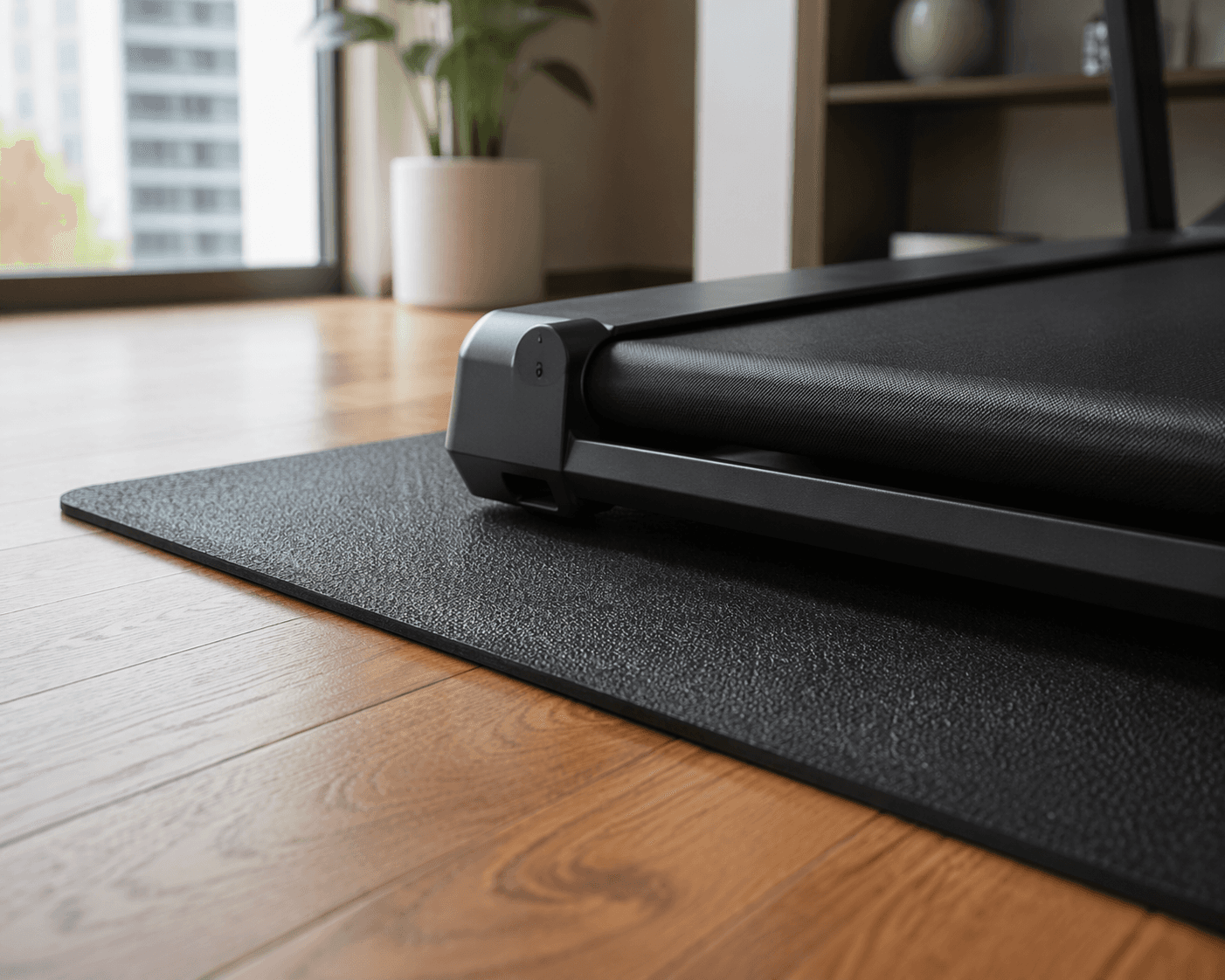
The mat should be large enough for the whole footprint, including the rear feet where impact loads often concentrate. A thin yoga mat is not the same thing. You want dense rubber that resists compression, stays flat, and keeps the treadmill from walking across the room. If the machine rocks, slides, or lets one foot sit off the mat, the setup is doing less than it should.
There is a practical order that works better than guessing:
- Place the treadmill on the most stable section of floor available, not on a loose board, hollow-feeling corner, or spot that already flexes underfoot.
- Add a dense rubber mat that covers the full treadmill footprint.
- Level the treadmill feet so the frame does not rock.
- Start with walking speeds and listen from outside the room if possible.
- Only then increase speed and incline, paying attention to new rattles or floor pulses.
For renters, this is also the least dramatic intervention. You are not modifying the building. You are putting a vibration break between a moving machine and a shared structure.
Floor type changes the answer
Hardwood is the floor that makes people overconfident because it looks solid. In many apartments, especially older ones, it can transmit vibration clearly. A treadmill foot landing on hardwood without a mat gives the impact a direct path into the structure.
Carpet gives you a little help, mostly by softening high-frequency sound and adding a small buffer under the machine. It does not automatically solve frame vibration, and thick carpet can make some treadmills less stable if the feet sink unevenly. A mat can still be useful on carpet because it creates a flatter, more predictable base.
Concrete is usually friendlier for treadmill noise than a suspended wood floor. Ground-floor concrete is the easiest case. Upper-floor concrete can still transmit sound through the building, but it is generally less springy than wood framing. If you live above someone in a wood-frame building, choose as if the floor is working against you.
Placement also matters. A treadmill pushed against a shared wall can send vibration into the wall assembly. A machine placed over the downstairs bedroom at 6 a.m. is asking more of your neighbor than one used over a living room at noon. You may not know the exact layout below you, but you can still avoid the obvious mistakes: early fast running, bare hardwood, unstable flooring, and a frame touching walls or furniture.
Folding treadmills have their own little noise traps
Folding is useful in a small home. It is also another set of moving parts. Ordinary treadmill reviews often discuss deck size, motor power, and screen features, then skip the parts that start clicking after a few weeks in a real apartment.
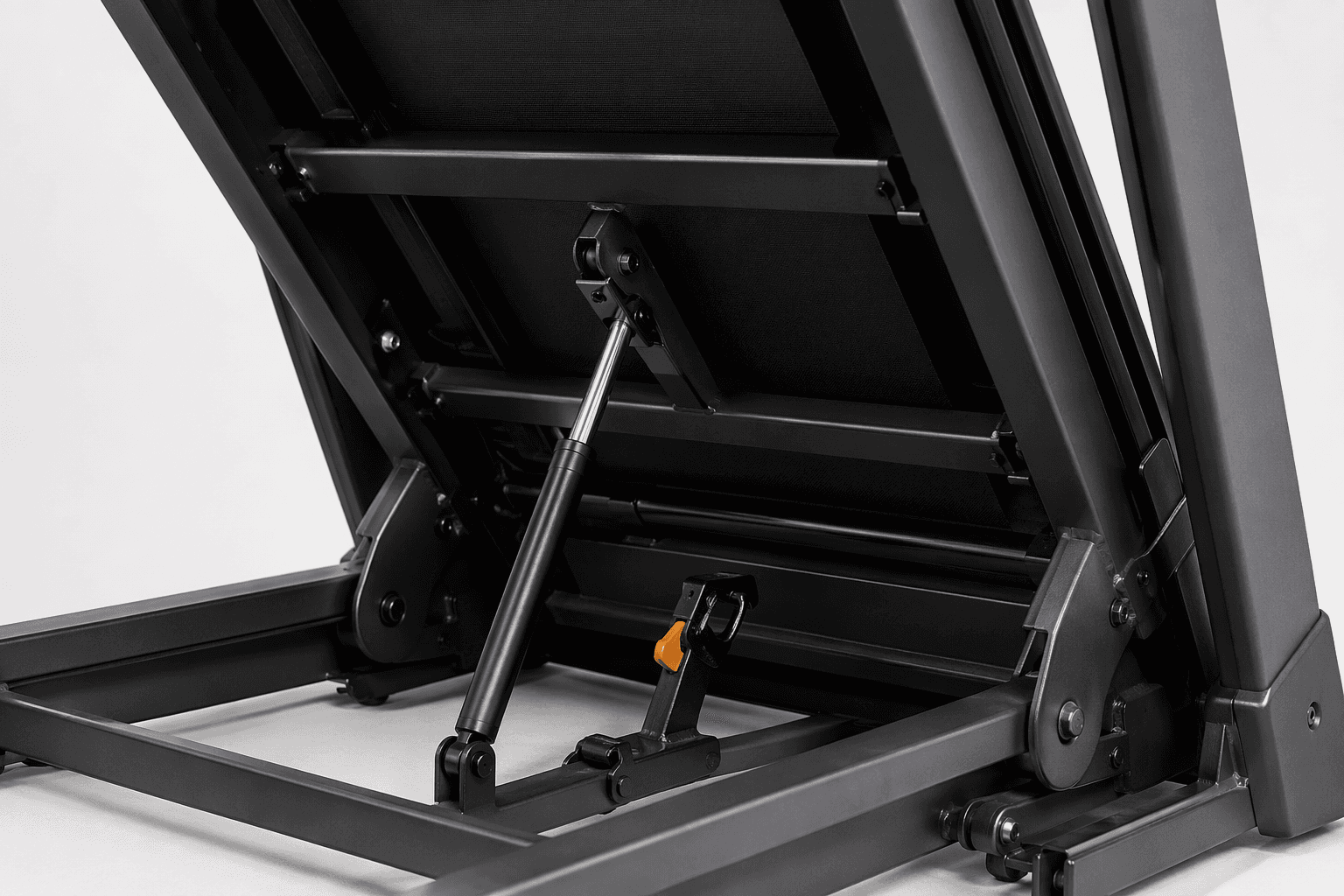
The first place to listen is the deck latch. If the latch has play, the deck can chatter against the frame during use. The second is the hinge and gas shock area. A gas shock that lowers the deck smoothly is nice; a mechanism that clunks at the end of travel is not something you want to demonstrate above a sleeping neighbor. The third is the folded frame itself. Some machines are quiet while unfolded but rattle when stored upright because the console mast, latch, or transport wheels have loosened.
Before the return window closes, do a boring but useful inspection: unfold the treadmill, lock it, tap the frame lightly near the latch, walk at a low speed, then increase speed gradually. If the machine develops a metallic tick or plastic buzz while walking, it is unlikely to become less annoying when you jog.
Motor noise matters, but do not turn it into the whole decision
A quieter motor helps, especially for walking workouts where footstrike is low. Belt-drive systems tend to be the friendlier direction for home noise than clankier drive designs, and brushless motors can reduce the high-pitched whine some people notice in compact machines. But motor quietness is not the same as apartment quietness. A smooth motor on a loud deck still sends impact through the floor.
If motor labels start turning into alphabet soup, step out to a deeper guide like Treadmill Motor Specs Decoded. For an apartment purchase, come back to the practical question: at your intended speed, does the machine create mostly soft operating noise, or does it hammer the floor?
Model guidance by apartment use case
The right model category depends less on the phrase “folding treadmill for home” and more on what you actually plan to do on it. A quiet walking machine and a foldable running treadmill are both home cardio equipment, but they ask very different things from your floor.
For quiet apartment walking: start with a walking pad
If your real use is walking, a walking pad is usually the cleanest answer. Models in the WalkingPad C2 style sit in the quietest practical tier, roughly 45–55 dB, and they avoid some of the frame mass and deck slap of larger machines [2]. They are also easier to place, easier to mat, and easier to move away from a shared wall.
The tradeoff is honest: many walking pads are not built for serious running, steep incline work, or long-stride jogging. If the noise answer is pushing you toward walking-only use, compare the category directly in Folding Treadmill vs Walking Pad before buying more treadmill than your apartment can comfortably absorb.
For walking plus light jogging: choose the quiet middle
If you want a more traditional folding treadmill, look at the quieter middle tier first: machines in the Horizon 7.0 AT or Sole F63 class rather than the biggest, heaviest, most console-heavy option in the store. This is the category that can make sense for walking, incline walking, and some light jogging when paired with a dense mat and reasonable hours.
This is also where the buying checklist should narrow. Skip the temptation to rank every screen, app, fan, and entertainment feature. For an upstairs apartment, the useful questions are simpler: Is the frame stable? Is the deck cushioned without bouncing? Does the folded latch feel tight? Are user reviews complaining about rattles? Can the treadmill be returned if it is too loud in your specific room?
For full-featured folding treadmills: possible, not automatically neighbor-safe
Larger cushioned folding treadmills such as the NordicTrack Commercial 1750, Sole F80, and similar full-size models can be surprisingly quiet at walking speeds. The 50.8 dB walking benchmark for the NordicTrack Commercial 1750 is a useful example of why big does not always mean loud [2]. But that number should not be stretched into “safe for fast running above a neighbor.” It was a measured walking-speed reference point, not a promise about your building, body weight, stride, or floor.
Full-featured machines make the most sense in apartments when the use case stays moderate: walking, incline walking, controlled jogging, and daytime workouts. They become harder to recommend when the intended use is regular fast running on an upper floor. Better cushioning may make the workout feel nicer to you while still sending repeated impact into the structure.
A practical apartment setup before you commit
Before choosing a model, decide which of these situations you are actually in:
- Ground floor or concrete slab, mostly walking: you have the widest room to shop. A walking pad or quiet folding treadmill with a mat is usually reasonable.
- Upper floor, carpeted room, walking and light jogging: still workable, but choose from the quieter tiers and treat the mat as required.
- Upper floor, hardwood, wood-frame building: be conservative. Favor walking pads or quieter folding models, avoid early or late running, and test during the return window.
- Upper floor, fast running several days a week: even a good folding treadmill may be a neighbor-risk purchase.
If space and storage are competing with noise in your decision, the more complete footprint discussion belongs in Treadmill for Small Apartments. If you are still deciding whether noise, floor strength, or workout type should drive the purchase, use the broader Folding Treadmill for Your Home diagnostic. And if the mat, delivery, and machine price are all starting to add up, compare the quieter low-cost options in Best Budget Treadmill for Home Use Under $1,000 rather than buying the cheapest loud machine and hoping the floor forgives it.
The neighbor-safe answer is conditional
For apartment walking or light jogging, a folding treadmill for home use can be a perfectly workable purchase. Choose from the quieter tiers, put the machine on a dense rubber mat, keep it level, listen for latch or frame rattle, and schedule harder workouts when the building is awake.
For regular fast running on an upper floor in a vibration-prone building, the honest answer is less comfortable: even a well-reviewed folding treadmill may still be a neighbor-risk purchase. In that case, the quieter decision may be a walking pad at home and running somewhere else.
References
- Best Treadmills for Apartments, Commonplace.
- Best Quiet Treadmills, TreadmillReviews.com.
Comments
Join the discussion with an anonymous comment.