
The easiest mistake when buying a treadmill for a home gym is treating the price on the product page as the cost. It is only the first invoice. Over five years, the same basic decision can land near $1,700, $4,840, or $5,935 depending on the machine, the subscription model, and the maintenance you are likely to absorb along the way.
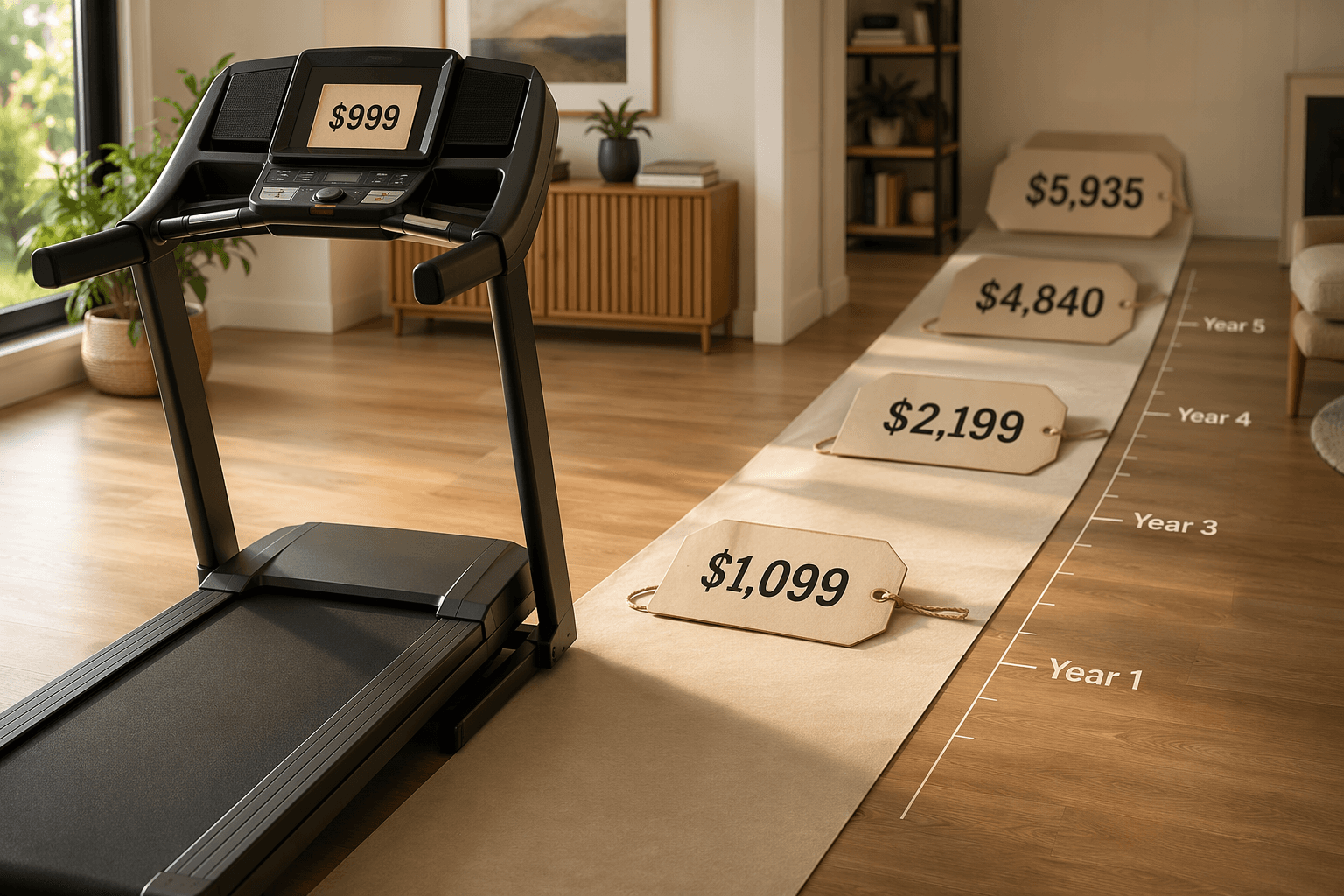
| Treadmill path | Upfront machine price | Subscription assumption | Approx. 5-year cost | What the number tells you |
|---|---|---|---|---|
| Horizon 7.0 AT | $1,099 | No required subscription | ~$1,700 | The affordability baseline: a capable treadmill without a recurring content bill. |
| Bowflex T6 without JRNY | $999 | No JRNY subscription | ~$1,099 | The same machine stays close to its purchase price when the smart layer is skipped. |
| Bowflex T6 with JRNY | $999 | $19.99/mo JRNY for 5 years | ~$2,199 | An optional subscription creates roughly a $1,100 fork in the road. |
| NordicTrack Commercial 1750 | ~$2,500 | $39/mo iFIT Pro for 5 years | ~$4,840 | The connected training path more than doubles the purchase-price conversation. |
| Peloton Tread | $3,295 | $44/mo Peloton All-Access for 5 years | ~$5,935 | The most expensive path here, and the one that only makes sense if the Peloton ecosystem is part of what you are buying. |
Those totals are the reason a $999 treadmill and a $3,295 treadmill should not be compared as if they are separated by only $2,296. Once recurring fees enter the picture, the five-year gap between a subscription-free Horizon 7.0 AT and a Peloton Tread is roughly $4,235. The Peloton path is more than three times the Horizon path, even though both still do the same essential job: let someone run indoors. Model pricing and the five-year scenario figures come from the current treadmill comparison and buying-guide data summarized for this analysis.[1]
That does not make the expensive treadmill irrational. It does make the buyer’s actual behavior matter. If the classes, coaching, leaderboard, scenic routes, incline programming, or app ecosystem are what get used week after week, the subscription is not decoration. If they become background noise after the first month, the treadmill quietly turns into a very expensive belt.
The subscription is not one cost category
“Smart treadmill fee” is too vague to be useful. Peloton All-Access, iFIT Pro, JRNY, and Zwift are different buying commitments, and they should be judged differently before the treadmill goes in the cart.
| Platform | Monthly price used here | Five-year subscription cost | Decision type |
|---|---|---|---|
| Peloton All-Access | $44/mo | $2,640 | Mandatory for full Peloton connected functionality. |
| iFIT Pro | $39/mo | $2,340 | Required for the NordicTrack connected incline/decline training experience used in this comparison. |
| JRNY | $19.99/mo | About $1,200 | Optional on the Bowflex T6; the treadmill still works without the smart features. |
| Zwift | $14.99/mo | About $900 | Platform-agnostic option that can work with many open-ecosystem treadmills. |
Peloton All-Access is $44 per month, or $528 per year. Over five years, that is $2,640 in subscription payments on top of the $3,295 Tread purchase price. iFIT Pro is $39 per month, or $468 per year, which becomes $2,340 over the same period. JRNY is lower at $19.99 per month, about $240 per year, but over five years it still adds about $1,200. Zwift, at $14.99 per month, is about $180 per year and roughly $900 over five years.[2]
The Bowflex T6 is the cleanest example because the machine itself is not the whole argument. At $999, it can remain close to a subscription-free ownership path, landing around $1,099 in the five-year scenario. Add JRNY for the full five years, and the same treadmill reaches about $2,199. That extra $1,100 is not caused by a bigger motor, a wider deck, or a heavier frame. It is the subscription decision.
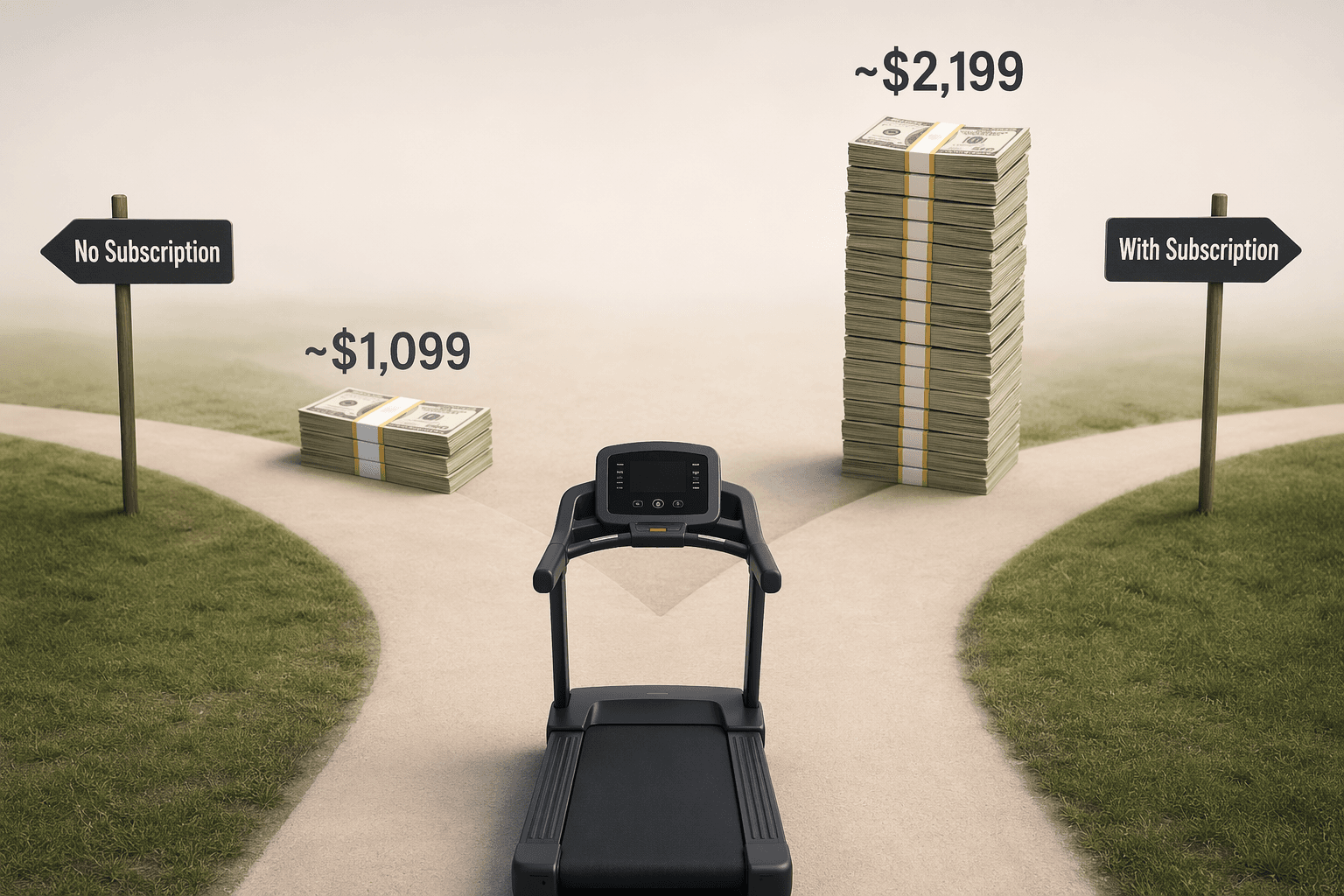
That optionality matters. A buyer can start with JRNY, cancel it, and still have a functioning treadmill. That is not the same financial posture as buying a machine whose best features assume an ongoing membership. Optional subscriptions preserve the right to change your mind after the novelty period.
Maintenance is the second bill, even when nothing dramatic breaks
The subscription is the obvious recurring cost because it arrives every month. Maintenance is easier to ignore because it arrives unevenly. A treadmill is still a motorized belt carrying repeated impact, and the parts that move are the parts that eventually ask for attention.
TreadmillDoctor’s repair-cost guidance puts belt lubrication at about $17 per application, typically needed every three to six months. That works out to roughly $34 to $68 per year if the owner keeps up with it. Belt replacement is listed at about $250 to $350 and is commonly needed every three to five years. A standard annual service call runs about $150 to $200, while average repair costs fall in a broader $195 to $500 range. Motor replacement is less common, but possible on budget models, with a cited range of $300 to $600.[3]
Those are not guaranteed invoices. A careful owner may lubricate the belt, avoid overloading the deck, keep the treadmill clean, and go years without a paid service visit. Another owner may face a belt issue earlier because of mileage, dust, heat, storage conditions, or local service availability. Warranty coverage also changes what comes out of pocket, especially when parts or labor are covered for part of the five-year window.
Still, maintenance should be in the buying spreadsheet because it changes the meaning of “affordable.” A low purchase price can remain a good deal if the treadmill is simple, serviceable, and used within its limits. It can also become fragile economics if a cheap machine needs a belt, service call, or motor repair earlier than expected.
What creates the five-year spread
The five-year totals do not spread out evenly. The biggest jump is not from routine lubrication. It is from pairing a higher purchase price with a subscription that is treated as part of the product.
- A subscription-free treadmill keeps the cost curve flatter. The Horizon 7.0 AT scenario starts at $1,099 and lands around $1,700 over five years.
- An optional-subscription treadmill creates a fork. The Bowflex T6 can sit near $1,099 without JRNY or rise to about $2,199 with JRNY for five years.
- A connected treadmill with an assumed ongoing platform fee compounds the purchase. The NordicTrack Commercial 1750 scenario reaches about $4,840 with iFIT Pro.
- A premium connected ecosystem pushes the total highest. The Peloton Tread scenario reaches about $5,935 with Peloton All-Access.
The practical test is not whether connected fitness is good or bad. It is whether the treadmill’s recurring cost buys behavior you would not otherwise sustain. Paying for Peloton or iFIT can be sensible if the programming is what turns planned workouts into completed workouts. Paying the same fee while mostly using manual mode is a different purchase entirely.
The gym membership pressure test
A gym membership is not the same product as a home treadmill. It includes other equipment, a different environment, commute time, hours of operation, and the small but real friction of leaving the house. Still, it is a useful benchmark because many buyers are trying to replace a monthly fitness bill.
Using the $69 per month average cited in FitAtHome’s gym-membership comparison material, a gym membership costs $4,140 over five years. At that benchmark, the gym is cheaper than the Peloton Tread scenario at about $5,935 and cheaper than the NordicTrack Commercial 1750 with iFIT Pro at about $4,840. It is more expensive than the Horizon 7.0 AT at about $1,700 and more expensive than the subscription-free Bowflex T6 scenario at about $1,099.[4]
At premium gym rates of $150 or more per month, the math flips hard toward buying the treadmill. A $150 monthly membership is at least $9,000 over five years, which is higher than every treadmill scenario in this comparison.[4]
| Five-year option | Approx. cost | Compared with $69/mo gym over 5 years |
|---|---|---|
| Bowflex T6 without JRNY | ~$1,099 | Cheaper than the gym benchmark |
| Horizon 7.0 AT | ~$1,700 | Cheaper than the gym benchmark |
| Bowflex T6 with JRNY | ~$2,199 | Cheaper than the gym benchmark |
| $69/mo gym membership | $4,140 | Benchmark |
| NordicTrack Commercial 1750 with iFIT Pro | ~$4,840 | More expensive than the gym benchmark |
| Peloton Tread with All-Access | ~$5,935 | More expensive than the gym benchmark |
How to decide before the treadmill is in your house
A five-year treadmill budget should be built in this order: machine price, required subscription, optional subscription, routine maintenance, and a repair cushion. That order prevents the common shopping problem where the treadmill with the flashiest monthly programming looks only slightly more expensive than the simpler model beside it.
- If you mainly want a reliable indoor running surface, start with the subscription-free baseline. The Horizon-style path is the cost control case.
- If you are curious about coaching but not sure you will keep using it, favor optional subscriptions or open-platform compatibility. The Bowflex T6 and Zwift-style logic preserve flexibility.
- If you already know that classes, instructor personality, scenic programming, or ecosystem tracking are what make you train, price the subscription as part of the treadmill, not as an add-on.
- If the five-year total beats your current gym bill and removes a commute you dislike, the home treadmill may be financially and practically easier to justify.
- If the five-year total is higher than the gym and you are not sure you will use the connected features, the machine is asking you to pay premium money for uncertain behavior.
The cleanest affordability line is subscription-free ownership. The most flexible middle ground is a treadmill that works well without its optional app. The highest-cost path can still be defensible, but only when the connected ecosystem is not a novelty — it is the reason the treadmill gets used.
For a shorter time horizon, compare this against the site’s 3-year treadmill total cost of ownership analysis. If the subscription decision is the part you are still weighing, the connected-versus-standalone treadmill cost guide is the closer companion. If you are still deciding whether a treadmill belongs in your setup at all, start with the broader treadmill buyer’s decision framework before getting attached to a sale price.
References
- Best Treadmill Roundup and Buying Guide — Garage Gym Reviews — 2026
- iFIT vs. Peloton vs. JRNY vs. Zwift Treadmill Subscription Comparison — TreadmillReviews.net
- Average Treadmill Repair Cost — TreadmillDoctor
- Home Gym vs. Gym Membership Comparison Articles — FitAtHome
Comments
Join the discussion with an anonymous comment.