
Staying under $1,000 can be smart. It can also be the point where a treadmill stops being a bargain and starts becoming a large, squeaky reminder that you bought the wrong machine. The difference usually is not the brand name on the console. It is whether the motor, deck, incline, warranty, and weight capacity match the way the machine will actually be used.
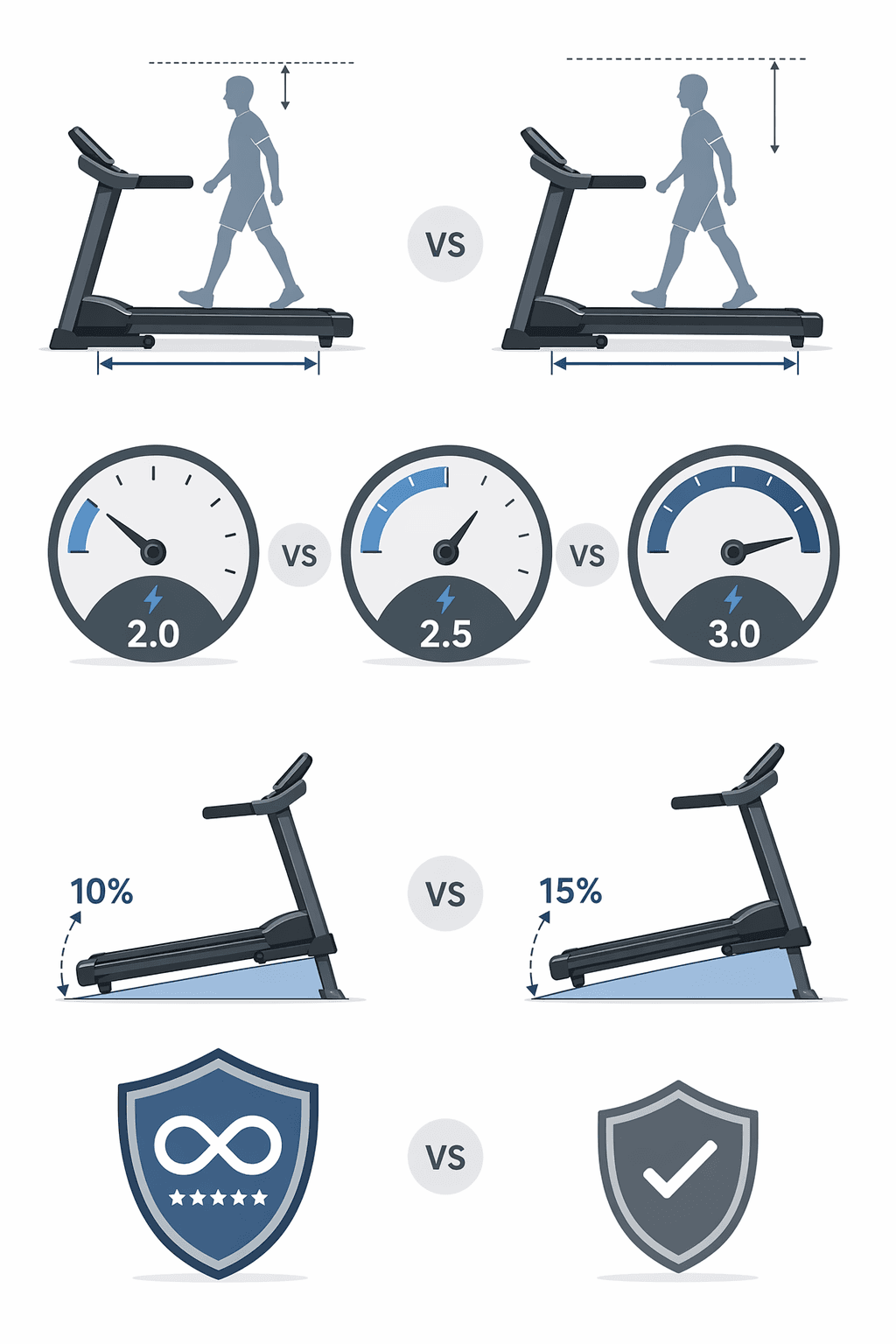
For walkers and light joggers, the best treadmill for home use does not have to cost $2,000. A good sub-$1,000 model can be a perfectly sensible purchase. The honest limits are clear, though: expect more 55-inch decks than 60-inch running decks, more 2.0–2.5 CHP motors than 3.0 CHP motors, more 10% incline ceilings than 15% climbs, and much wider gaps in warranty coverage than you see in the next price tier.
Prices here are June 2026 ranges, not promises. Treadmills move in and out of sale pricing constantly, and a model like the Bowflex T6 can sit on either side of the $1,000 line depending on the week. Treat the price tier as a buying boundary, not a law of physics.
What under $1,000 usually buys you
The first trap in this category is comparing every machine with a belt as if it is trying to do the same job. A walking pad under a desk, a folding treadmill for a 30-minute walk, and a 60-inch-deck runner’s treadmill are not interchangeable just because they all turn on and move.
| Budget-treadmill feature | Common under-$1,000 reality | Who can live with it | Who should be cautious |
|---|---|---|---|
| Deck length | Often around 55 inches on stronger budget picks | Walkers and many light joggers | Taller runners, especially users over 6 feet who need more stride room |
| Motor power | Often around 2.0–2.5 CHP below $1,000 | Walking, incline walking, and occasional jogging | Regular runners and users near the treadmill’s weight limit |
| Incline | Often tops out around 10% | Most home walkers who want moderate hill work | Buyers who specifically want steeper incline training |
| Warranty | Ranges from strong lifetime frame/motor coverage to very short coverage | Buyers who choose models with serious protection | Anyone tempted by the cheapest machine without looking at coverage |
| Expected lifespan | Budget treadmills are commonly framed as lasting 1–10 years depending on use and maintenance | Moderate users with realistic expectations | Heavy-use households expecting commercial-machine durability |
That lifespan range matters. Garage Gym Reviews describes budget treadmills as typically lasting 1–10 years depending on usage and maintenance, compared with 10–20 years for mid-range machines.[1] That does not make every budget treadmill disposable. It does mean the machine has to be bought for the workload it can actually survive.
Motor size is where a lot of regret begins. Below 2.5 CHP, motors can struggle when users are close to the treadmill’s weight limit.[1] That is not just a spec-sheet concern. It can show up as heat, belt hesitation, noise, and the slow realization that the machine is being asked to do a job it was not built to do.
The short answer by user type
| You are buying for… | Under $1,000 can make sense if… | Consider spending more if… |
|---|---|---|
| Daily walking | The warranty is solid, the belt feels stable, and the listed capacity leaves margin | Multiple people will use it heavily every day |
| Light jogging | You are comfortable with a 55-inch deck and moderate motor power | You are tall, have a long stride, or plan to jog often |
| Regular running | Only if the sale price brings a stronger 60-inch-deck model under budget | You want a 3.0 CHP motor, 60-inch deck, and stronger incline range |
| Apartment or small-space use | Folding size and noise matter more than running performance | A full treadmill will dominate the room and you only walk |
| Heavier users near stated limits | There is meaningful motor and warranty margin | The machine is below 2.5 CHP or has very short coverage |
A buyer under $1,000 is not automatically making a compromise too far. The safer version of the purchase is boring in the best way: a sturdy folding treadmill, no huge built-in screen, a real warranty, and enough deck and motor for walking or light jogging. The riskier version is buying the lowest checkout price and hoping the machine grows into a runner’s treadmill after delivery.
Horizon T101: the cleanest budget answer for most walkers and light joggers
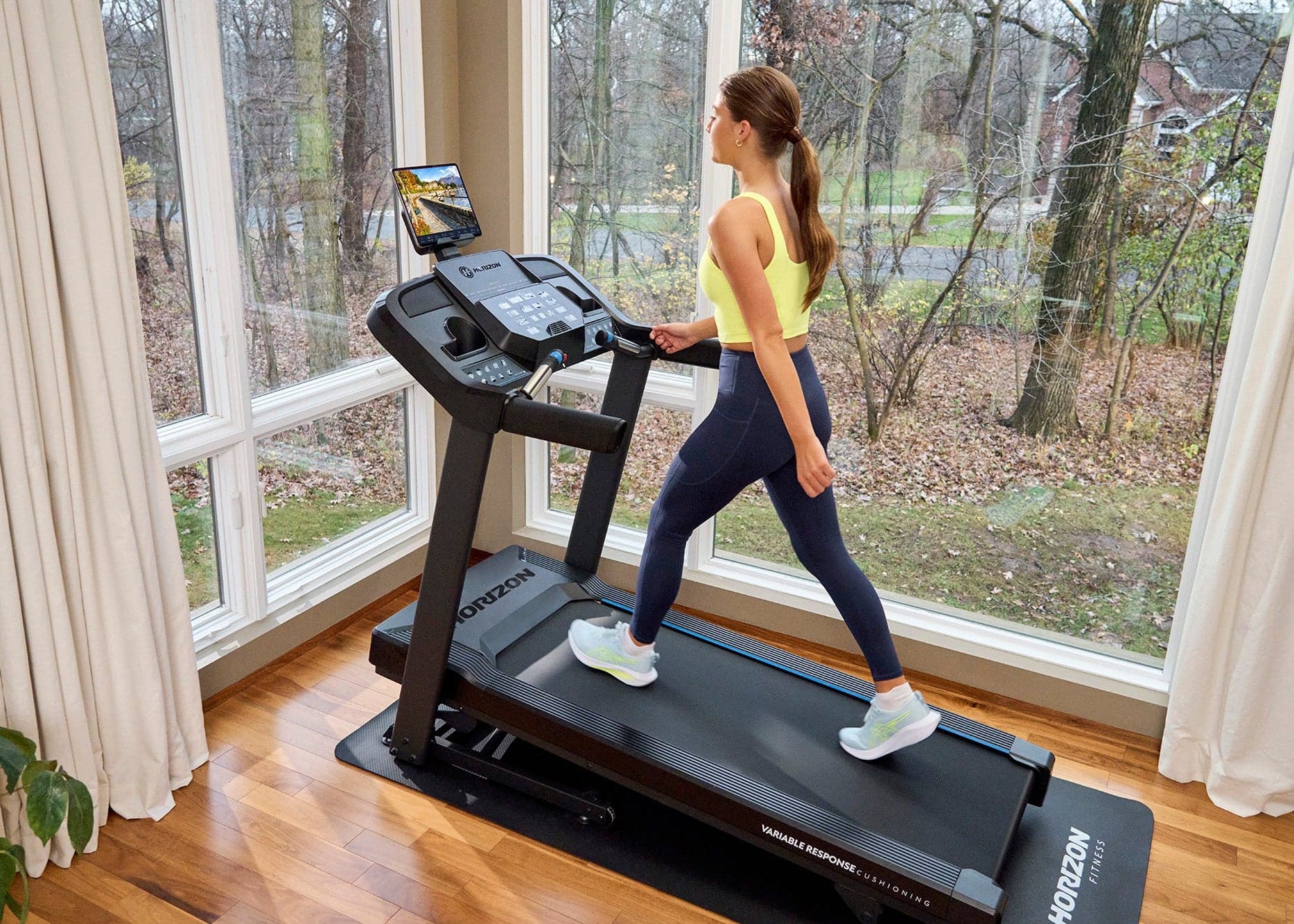
The Horizon T101 is the model that best explains why this category exists. It is not a luxury treadmill disguised as a budget machine. It is a budget machine with the right compromises in the right places for many home users.
As of June 2026, the T101 commonly sits in the $649–$999 range. Garage Gym Reviews rates it 3.8 out of 5, Runner’s World names it a “Best Value,” and TreadmillReviews.net lists it as a top-rated home-use option.[1][2][3] The specs explain why it keeps appearing in budget recommendations: lifetime frame and motor warranty, folding design, 10 mph top speed, 10% incline, and a 55-inch deck.[1]
The warranty is the part I would pay attention to before the console. Lifetime frame and motor coverage at this price is not common, and it gives a budget buyer a real signal. You are still buying an affordable treadmill, but the manufacturer is not treating the motor and frame like temporary parts.
The 55-inch deck is the trade-off. For walking, it is usually fine. For light jogging, it can be fine for many users. For runners over 6 feet, it is too short, according to the reviews cited here.[1] This is where a friend who was excited on delivery day may become less excited after the first few faster sessions. The machine did not fail; it was bought for the wrong stride.
The T101 is the best fit if you want a full treadmill for walking, incline walking, and occasional light jogging without turning the purchase into a major home-gym project. If you are trying to understand what the $649 price tag turns into after delivery, accessories, maintenance, and ownership costs, it is worth comparing the machine price against the broader 3-year cost of owning a home treadmill before you check out.
Bowflex T6: the sale-dependent upgrade if incline and deck length matter
The Bowflex T6 is where the under-$1,000 category gets fuzzy. At $999–$1,299 on sale as of June 2026, it may qualify as an under-$1,000 pick one week and miss the cutoff the next.[1] That makes it a bad fit for a rigid “under $1,000 only” list, but a very useful model for a real buyer watching sale prices.
Garage Gym Reviews scores the Bowflex T6 4.6 out of 5 and highlights its rare combination at this price: 15% incline, 60-inch deck, and 12 mph top speed.[1] Those numbers move it closer to what taller joggers and some runners are looking for, especially compared with the more common 55-inch, 10%-incline budget pattern.
Bowflex also makes a sensible compromise by skipping the built-in screen and expecting you to use your own tablet for streaming.[1] That is not glamorous, but it avoids paying treadmill money for a mediocre screen that may age faster than the frame. It also avoids the feeling that the machine only makes sense if you keep feeding it a subscription.
The T6 makes the most sense if you catch it near $999 and care about the 60-inch deck or 15% incline. If it is sitting closer to $1,299, it should be compared directly against slightly-over-budget machines rather than treated as a budget steal.
GoPlus 2-in-1 and the very cheap end of the market
A $300 treadmill is tempting because it solves the buying anxiety for about five minutes. The problem is that very cheap machines often move the risk from the credit card statement to the living room floor.
The GoPlus 2-in-1 sits around $300 and carries only a 90-day warranty, according to Garage Gym Reviews.[1] That warranty length is the whole story. A short warranty does not guarantee immediate failure, but it tells you how much protection the manufacturer is willing to stand behind.
This kind of machine can still make sense for a light walker who needs something small, cheap, and low-commitment. It should not be bought by someone who plans to run, train on incline, share the machine with multiple users, or test the upper end of the weight capacity. At that point the low price is no longer the same thing as good value.
Walking pads are a different category, not worse treadmills
Walking pads deserve a fair mention because for some homes they are the more rational purchase. UREVO 2-in-1 and WalkingPad P1 models, cited by OutdoorGearLab and Garage Gym Reviews, sit around $289 and $399 respectively and fold to roughly 5–6 inches deep.[4][1] If the main problem is where the machine goes when you are not using it, that matters more than a 15% incline you will never use.
The boundary is simple: walking pads are for walking. They are not substitutes for a full treadmill if you want running, sustained incline work, or a larger deck. If you are truly choosing between these categories rather than between treadmill models, start with a walking pad vs. treadmill comparison before getting pulled into model specs.
Space can also turn a theoretically better treadmill into a bad home purchase. A machine that blocks a doorway, cannot fold where you thought it would, or makes the room feel unusable tends to lose the fight after the first week. If floor area is as important as price, use a small-space treadmill buying guide alongside this budget comparison.
Sole F63: the honest stretch for runners
The Sole F63 does not belong in a strict under-$1,000 ranking. At about $1,199, it exceeds the budget line.[1] It belongs in the conversation because it shows what the next tier buys, and because many regular runners are better served by admitting that their real starting point is above $1,000.
The F63 brings a 3.0 CHP motor, 15% incline, 60-inch deck, and lifetime frame and motor warranty.[1] Those are the exact areas where budget treadmills usually ask you to compromise. For runners, the upgrade is not about luxury; it is about matching the treadmill to the repeated impact, stride length, and motor demand of regular running.
It is not perfect. Garage Gym Reviews testers noted shaking above 9 mph.[1] That caveat matters because “spend more” should not be treated as magic. The point is narrower: if you plan to run regularly, a machine with a 60-inch deck, stronger motor, and longer warranty is usually a more honest baseline than trying to force a walking-focused budget treadmill into running duty.
Model-by-model fit
| Model | June 2026 price range | Best fit | Main reason to buy | Main caution |
|---|---|---|---|---|
| Horizon T101 | $649–$999 | Walkers and light joggers | Lifetime frame/motor warranty, folding design, 10 mph speed, 10% incline | 55-inch deck is limiting for runners over 6 feet |
| Bowflex T6 | $999–$1,299 on sale | Buyers who catch the right sale and want more incline/deck length | 15% incline, 60-inch deck, 12 mph speed | Often crosses above the $1,000 boundary |
| GoPlus 2-in-1 | Around $300 | Low-commitment light walking | Very low price and compact format | 90-day warranty is a serious red flag |
| UREVO 2-in-1 | Around $289 | Space-constrained walking | Walking-pad convenience at a low price | Not for running or incline training |
| WalkingPad P1 | Around $399 | Apartment walking and storage-first buyers | Folds to a very slim profile | Not a full treadmill replacement |
| Sole F63 | Around $1,199 | Runners willing to stretch | 3.0 CHP motor, 60-inch deck, 15% incline, lifetime frame/motor warranty | Above budget; testers noted shaking above 9 mph |
Features worth paying for, and features you can ignore
In this price range, screens are usually less important than structure. A large built-in display can make a treadmill look more expensive than it is, but it does not lengthen the deck, strengthen the motor, or improve the warranty. If skipping the screen helps fund a better frame, deck, or incline range, that is usually the better compromise.
- Prioritize the warranty before entertainment features. Lifetime frame and motor coverage on a budget model is meaningful.
- Match deck length to stride. A 55-inch deck can be fine for walking and light jogging, but taller runners should look for 60 inches.
- Do not shop motor power at the edge of the weight limit. Leave margin, especially below 2.5 CHP.
- Treat incline as training-specific. A 10% ceiling is enough for many walkers; 15% matters if hill work is central to the plan.
- Be cautious with ultra-short warranties. They often reveal more than the product photos do.
App ecosystems and streaming features only matter if they change the total cost or lock you into a subscription you do not want. Otherwise, a tablet shelf and your own device are usually enough. That is especially true for buyers trying to keep the treadmill from becoming the most expensive screen in the house.
When under $1,000 is enough
Buy under $1,000 with confidence if the main use is walking, incline walking, or light jogging; the user is not pushing the machine near its weight and motor limits; and the warranty is strong enough that the manufacturer appears to be standing behind the frame and motor. For that buyer, the Horizon T101 is the most straightforward full-treadmill pick, while the Bowflex T6 becomes interesting when sale pricing brings its 60-inch deck and 15% incline close to the budget line.
Stretch to $1,200 or more if regular running is the plan, if a 60-inch deck is necessary, or if the user is heavier and would be asking a smaller motor to work near its limit. The Sole F63 is the useful boundary case here: not a budget pick, but a reminder that the right price tier is set by the workout, not by the wish to stay under a round number.
If this treadmill is one piece of a larger setup, the same trade-off logic applies across the room. A broader budget home gym plan can help decide whether the treadmill deserves the next dollar, or whether that money belongs somewhere else.
References
- Best Budget Treadmill, Garage Gym Reviews
- The Best Treadmills for Runners, Runner’s World
- Best Treadmill for Home Use, TreadmillReviews.net
- Best Treadmill, OutdoorGearLab
Comments
Join the discussion with an anonymous comment.