Last reviewed: July 9, 2026.
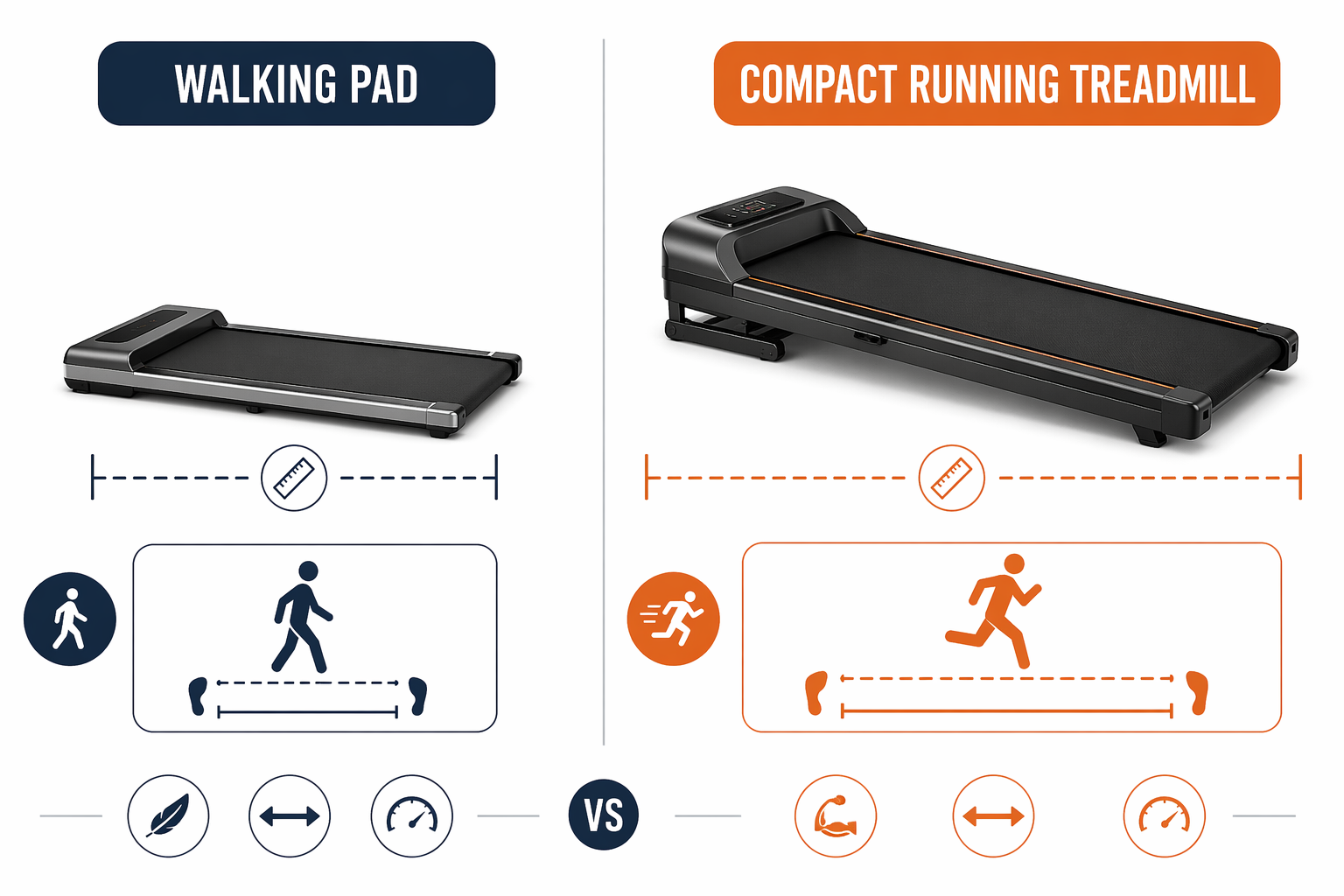
Yes, you can buy a running machine for home that folds away and still supports actual running. The catch is that “compact” only matters after the treadmill clears a more basic test: it needs to hold at least 6+ mph for multiple miles, with enough deck length, motor support, and frame stability for your stride. A short walking pad with a generous speed number is not the same thing as a compressed running treadmill.
For small apartments, the useful split is simple: true compact running treadmills usually give you a 55- to 60-inch deck and a 10- to 12.4-mph top speed, while boosted walking pads prioritize thin storage first and ask your running stride to adapt afterward. That difference is easy to miss online and very hard to ignore after delivery.
The Shortlist: Compact Treadmills That Still Make Sense for Running
| Model | Running deck | Top speed | Motor | Machine weight | Storage profile | Best fit |
|---|---|---|---|---|---|---|
| Echelon Stride-6S | 60 in. | 12.4 mph | Not listed in cited specs | 156 lb | Folds completely flat for vertical storage | Runners who need a real stride length but cannot leave a full treadmill open |
| Horizon T101 | 55 in. | Not listed in cited specs | 2.5 CHP | Not listed in cited specs | Folding home treadmill | Value-focused light running and jogging, especially for runners under 6 ft |
| DeerRun A1 Pro | Shorter compact deck; exact length not listed in cited specs | 10 mph | 3 HP | 86 lb | Folds to 8 in. tall for under-bed storage | Apartment buyers who prize storage and portability over long-stride comfort |
The table is intentionally unforgiving about missing specs. If a treadmill is going into a shared home, the absent number is often the one that matters: deck height for ceiling clearance, weight for moving it alone, folded dimensions for the closet you measured twice, or motor rating for repeated running rather than occasional jogging.
Echelon Stride-6S: The Rare Compact Pick With a Full 60-Inch Deck
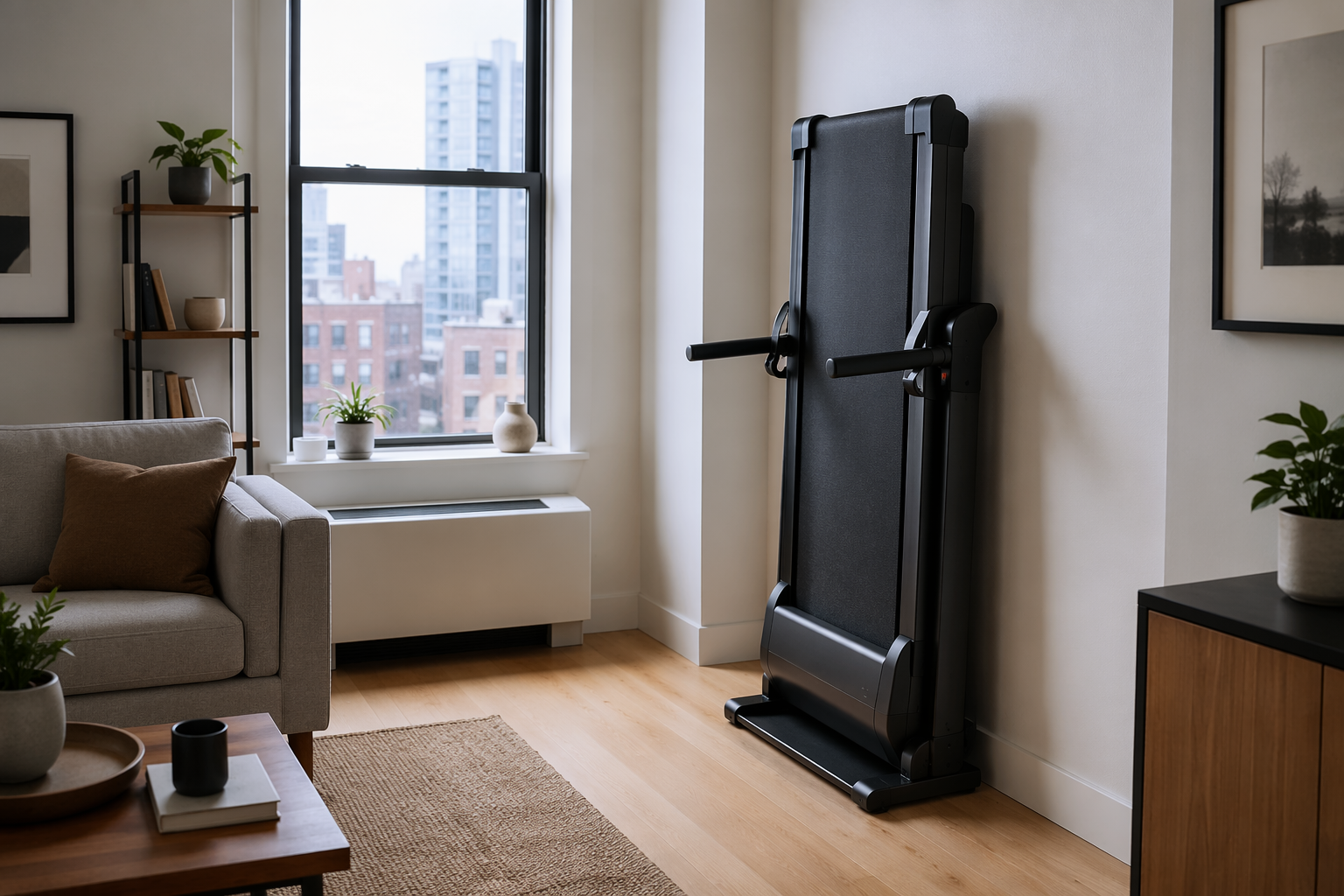
The Echelon Stride-6S is the model that makes the category feel less like a compromise. Runner’s World lists it with a 60-inch running deck, a 12.4-mph top speed, a 156-pound machine weight, and a design that folds completely flat for vertical storage.[1] That combination is unusual because most machines that become truly flat also become less convincing as running tools.
The 60-inch deck is the important number. A taller runner, a faster runner, or anyone whose stride opens up past an easy jog has less room to negotiate with a treadmill belt. On a compact machine, five missing inches can change the way you run: shorter stride, more visual checking, more tension in the shoulders, and that constant half-step awareness of the rear roller. The Stride-6S avoids the most obvious version of that problem.
The weight also works in its favor. At 156 pounds, it is still a piece of furniture you have to plan around, but it is not trying to be an 86-pound under-bed machine and a serious running platform at the same time.[1] For apartment use, that matters. Lighter is easier on moving day; heavier usually feels calmer once the belt is moving.
The published data here comes from third-party review coverage and specs, not hands-on FitAtHome lab testing. That distinction matters most for wobble, motor feel, and real-room noise, which are the things spec sheets rarely describe well. Still, on paper, the Stride-6S is the cleanest example in this group of a compact treadmill that starts with running dimensions instead of trying to stretch a walking-pad idea into running territory.
Horizon T101: The Value Pick With a Clear Ceiling
The Horizon T101 belongs in the conversation because the value story is real. TreadmillReviews.net lists it around $649 and frames it as a best-value compact option for light running, with a 55-inch deck and a 2.5 CHP motor.[2] That is a very different promise from the Echelon: less deck, less motor, less room for the runner to be careless.
A 55-inch deck can work for jogging, especially for runners under 6 feet tall, but it is not a universal running surface.[2] If your home runs are mostly easy miles, run-walk sessions, or winter maintenance jogs, the T101’s compromise may be perfectly reasonable. If you expect faster intervals, a long stride, or frequent multi-mile sessions, the savings become less persuasive.
This is where “best home treadmill” rankings can mislead small-space buyers. A machine can be a strong value and still be the wrong running machine for home if the person using it is too tall, too fast, or too frequent a runner for the belt and motor. The T101 is not disqualified by those limits; it is defined by them.
DeerRun A1 Pro: Excellent Storage, More Conditional Running
The DeerRun A1 Pro is the one that makes a small-apartment buyer pause for the right reason: it folds to 8 inches tall, weighs 86 pounds, lists a 10-mph top speed, and uses a 3 HP motor, according to published specs and compact running-machine review data summarized for this guide. Under-bed storage is not a small convenience when the alternative is a folded treadmill blocking a closet door every day.
That same portability is the warning label. An 86-pound treadmill is easier to move, but low weight can also mean less planted stability at higher speeds. The shorter deck is the bigger constraint for actual running: if your stride length pushes the belt, the 10-mph setting does not make the machine feel like a 10-mph running treadmill.
The A1 Pro makes the most sense for someone who needs storage first and runs in controlled doses: shorter sessions, moderate speeds, compact stride, and a willingness to treat the machine as a space-saving compromise. It is much harder to recommend as the primary treadmill for a serious runner or a long-stride runner unless independent testing confirms stability and belt comfort for that use.
Measure the Room Before You Trust the Fold
A folded treadmill still needs a home when it is open, and open is when mistakes get expensive. Garage Gym Reviews notes that a typical home treadmill footprint is about 77 inches long by 35 inches wide, and recommends planning for 2 feet of clearance on each side and 6 feet behind the machine.[3] That rear clearance is not decorative; it is the space you want if you stumble or drift back.
The measurement that gets skipped most often is ceiling height. Consumer Reports recommends adding the treadmill deck height plus at least 3 to 5 inches to the tallest user’s height, especially when incline is involved.[4] In a basement, loft, or apartment with low ceilings, a treadmill can technically fit the floor plan and still put your head too close to the ceiling once the belt rises.
| What to measure | Why it matters |
|---|---|
| Open footprint | Confirms the treadmill can be used, not just stored |
| Side clearance | Leaves space to step off safely and avoids wall-hugging runs |
| Rear clearance | Reduces injury risk if you lose position on the belt |
| Deck height plus user height | Prevents low-ceiling surprises, especially with incline |
| Folded height or vertical depth | Determines whether storage actually works under a bed, against a wall, or beside furniture |
| Machine weight | Tells you whether “portable” means one-person realistic or two-person theoretical |
Do the open-use measurement first, then the storage measurement. It is easy to become fascinated by an 8-inch folded height and forget that the treadmill still has to sit somewhere safe while you are running on it.
Noise Is Not Just the Sound in Your Room
Noise specs are tricky because the annoying part of treadmill running in an apartment is often transmitted impact, not the motor hum you hear standing next to the console. Runner’s World reported the Sole F80 at 53.8 dB, roughly refrigerator-quiet, while treadmill noise at higher speeds can reach the 70- to 80-dB range in test data cited for this category.[1][4]
That does not mean a quiet motor solves the neighbor problem. Foot strike travels through the frame, the deck, the floor, and sometimes the patience of the person downstairs. A treadmill mat is not magic, but it can deaden transmitted noise and reduce vibration. In a shared building, it should be treated as part of the setup, not an accessory you buy later if someone complains.
Placement matters too. A corner may be the only available location, but corners can amplify vibration through two walls. If you have choices, avoid shared bedroom walls, use the most stable section of flooring available, and test at the speed you actually plan to use. Walking quietly at 3 mph tells you very little about what 7 mph will sound like below you.
How to Choose Between These Three
Start with stride, not storage. If you know you need a 60-inch deck, the Echelon Stride-6S is the most convincing compact option in this set because it preserves the running surface while still folding flat for vertical storage.[1] It is the better direction for runners who want the apartment solution to feel like a treadmill first and a storage trick second.
Choose the Horizon T101 if price matters most and your running fits inside its limits. The 55-inch deck and 2.5 CHP motor make more sense for lighter running, jogging, and shorter runners than for aggressive training.[2] It is a good example of a compromise that can be smart when the buyer is honest about pace, height, and weekly mileage.
Choose the DeerRun A1 Pro only if storage and portability are the deciding constraints. Its 8-inch folded height and 86-pound weight solve a real apartment problem, but the shorter deck and lighter frame make it the most conditional running recommendation here. It may be the right machine for the person with one available under-bed slot; it is not the safest default for every runner who sees “10 mph” on the listing.
Small-space runners have better options in 2026 than they did a few years ago. The right pick depends on which compromise you can live with: paying for a full 60-inch deck in a fold-flat frame, accepting 55 inches for lighter jogging, or prioritizing under-bed storage enough to accept stability and stride-length trade-offs.
References
- The 8 Best Treadmills in 2026, Runner’s World.
- Best Home Treadmills for 2026 (CPT-Tested & Reviewed), TreadmillReviews.net.
- Ultimate Treadmill Buying Guide, Garage Gym Reviews.
- Best Treadmill Buying Guide, Consumer Reports.
Comments
Join the discussion with an anonymous comment.