
The Space Challenge: Why Most Cable Machines Need 30–40+ Sq Ft
Walk into any commercial gym and you'll find a dual-column functional trainer occupying a footprint roughly the size of a compact car. Those machines — the ones with two weight stacks, a wide crossbar, and pulleys at multiple heights — typically demand 30 to 40 square feet of clear floor space. That's a non-starter for anyone training in a spare bedroom, a studio apartment, or a shared living room.
The average price across more than 30 tested cable machines sits at $2,265, according to data from Garage Gym Reviews. That figure alone filters out a large segment of budget-conscious buyers. Combine the price with the spatial demand, and it's easy to see why many apartment dwellers assume cable training is off the table until they have a garage and a larger budget.
But the equipment landscape has shifted. Manufacturers have recognized that the home fitness buyer is no longer exclusively a garage owner with 200 square feet to spare. A new generation of cable machines — wall-mounted smart trainers, portable magnetic-resistance units, single-column towers, and rack-integrated attachments — now makes cable training accessible in spaces as small as a 50-square-foot corner. The trick is matching the right format to your specific spatial and financial constraints.
This guide breaks down five distinct cable machine formats, each with its own footprint, price point, and trade-offs. If you're an apartment dweller or small-space owner who has written off cable training, read on — one of these options will likely fit your space and your budget.
Format 1: Wall-Mounted Smart Trainers (Tonal 2)
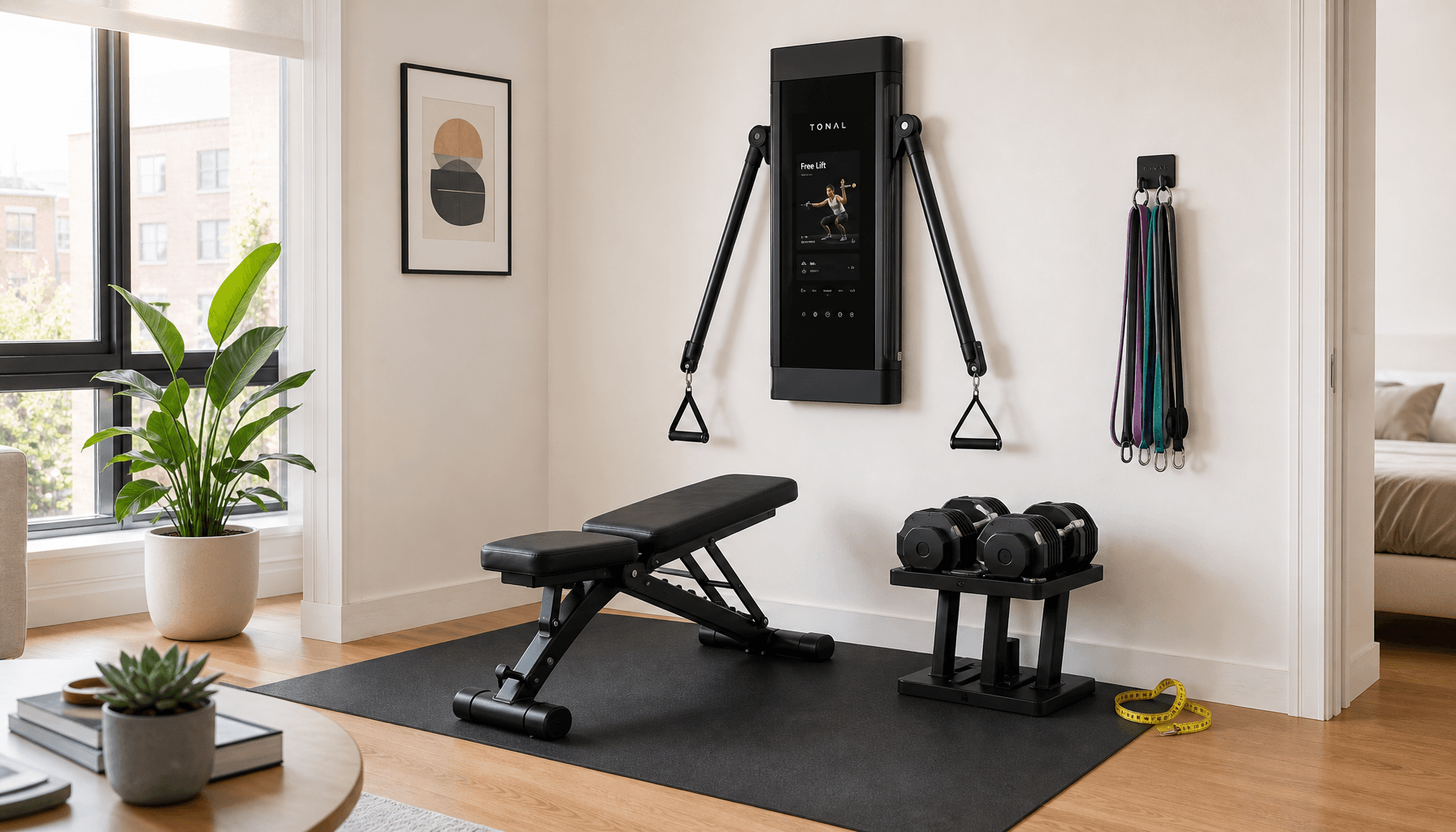
The Tonal 2 represents the most radical departure from the traditional cable machine footprint. Instead of a floor-standing frame, it mounts directly to the wall, protruding just 5.25 inches from the mounting surface. Its dimensions — 21.5 inches wide by 50.9 inches tall — mean it occupies virtually zero floor space when not in use. For a studio apartment or a room where every square foot counts, that's a transformative advantage.
| Spec | Tonal 2 |
|---|---|
| Wall protrusion | 5.25 inches |
| Width | 21.5 inches |
| Height | 50.9 inches |
| Digital resistance | Up to 250 lbs (125 lbs per arm) |
| Side clearance required | 7 feet |
| Floor clearance required | 7 feet |
| Price (approx.) | $4,295 (plus installation and subscription) |
| Subscription | Required (monthly fee for full functionality) |
The clearance requirements are the critical detail that many shoppers miss. While the unit itself is slim, Tonal recommends 7 feet of side clearance and 7 feet of floor clearance for effective use. That means you need a wall with roughly 14 feet of unobstructed width and 7 feet of open floor space in front of it. A narrow hallway or a wall flanked by furniture won't work. Measure your space carefully before committing.
The Tonal 2 delivers up to 250 pounds of digital resistance (125 pounds per arm), with the ability to adjust in as little as one-pound increments. The digital resistance system uses electromagnets to create load, which means no weight stacks, no plates, and no incremental loading. For users who prioritize a clean, minimalist aesthetic and are willing to pay a premium for it, the Tonal 2 is the most space-efficient cable solution on the market — provided your wall and clearance can accommodate it.
Format 2: Portable Magnetic Cable Machines (MAXPRO SC)
If wall mounting isn't an option — whether due to rental restrictions, wall material, or clearance limitations — a portable magnetic cable machine offers a different kind of space solution. The MAXPRO SmartConnect is the most prominent example in this category, and its dimensions tell the story: when folded, it measures 32.3 inches long by 3.6 inches wide by 4.1 inches tall and weighs under 10 pounds. That's roughly the size of a laptop bag. You can store it in a closet, under a bed, or on a shelf between workouts.
| Spec | MAXPRO SmartConnect |
|---|---|
| Folded dimensions | 32.3" x 3.6" x 4.1" |
| Weight | Under 10 lbs |
| Resistance type | Digital magnetic |
| Resistance range | 5–300 lbs |
| Storage footprint | Minimal (closet, shelf, under bed) |
| Setup time | 1–2 minutes |
| Price (approx.) | $499 (base unit) |
The MAXPRO uses digital magnetic resistance, which means no weight plates and no cable changes. Resistance adjusts electronically from 5 to 300 pounds, covering everything from light rehabilitation work to heavy lat pulldowns. The trade-off is that you're working against magnetic resistance rather than the inertia of a weight stack — the feel is smoother and quieter, but some lifters miss the tactile feedback of moving physical mass.
Portability comes with a practical cost: setup and teardown time. While the MAXPRO takes only a minute or two to deploy, that's still a barrier compared to a permanently mounted machine. If you're the type of person who works out first thing in the morning and needs zero friction between waking and training, the setup step may become a deterrent. But if you have limited space and need to stow your equipment between sessions, the portability advantage outweighs the minor inconvenience.
Format 3: Single-Column Plate-Loaded Towers (Bells of Steel Cable Tower 2.0)
For buyers who want a dedicated, permanent cable station without the premium price tag of a smart trainer, the single-column plate-loaded tower is the sweet spot. The Bells of Steel Cable Tower 2.0 occupies roughly 6 square feet — under 2.5 feet by 2.5 feet — and costs around $500 with plates. Strong Home Gym describes it as "the cheapest serious cable station on the market that isn't a no-name Amazon brand."
| Spec | Bells of Steel Cable Tower 2.0 |
|---|---|
| Footprint | ~6 sq ft (under 2.5' x 2.5') |
| Weight | 85 lbs (unit only) |
| Resistance type | Plate-loaded |
| Plate capacity | 250 lbs |
| Cable positions | 33 |
| Pulley ratio | 2:1 (1:1 adapter included) |
| Price (approx.) | $500 (with plates) |
The 2:1 pulley ratio means that a 100-pound plate load feels like 50 pounds of resistance at the handle — the trade-off is smoother cable travel and longer cable extension. The included 1:1 adapter lets you switch to a direct feel for exercises where you want the full weight on the handle. With 33 cable positions, you can replicate most of the exercises available on a full-size functional trainer, including lat pulldowns, rows, tricep pushdowns, and cable crossovers (though the single-column design limits crossover range of motion).
At 85 pounds, the unit is heavy enough to stay planted during use but light enough to move into a corner if needed. It's a permanent fixture in the sense that you won't want to move it daily, but it's not bolted to the floor. For a spare bedroom or a dedicated corner of a living room, the 6-square-foot footprint is manageable — roughly the size of a large armchair.
Format 4: Rack-Mounted Attachments (REP Ares 2.0)
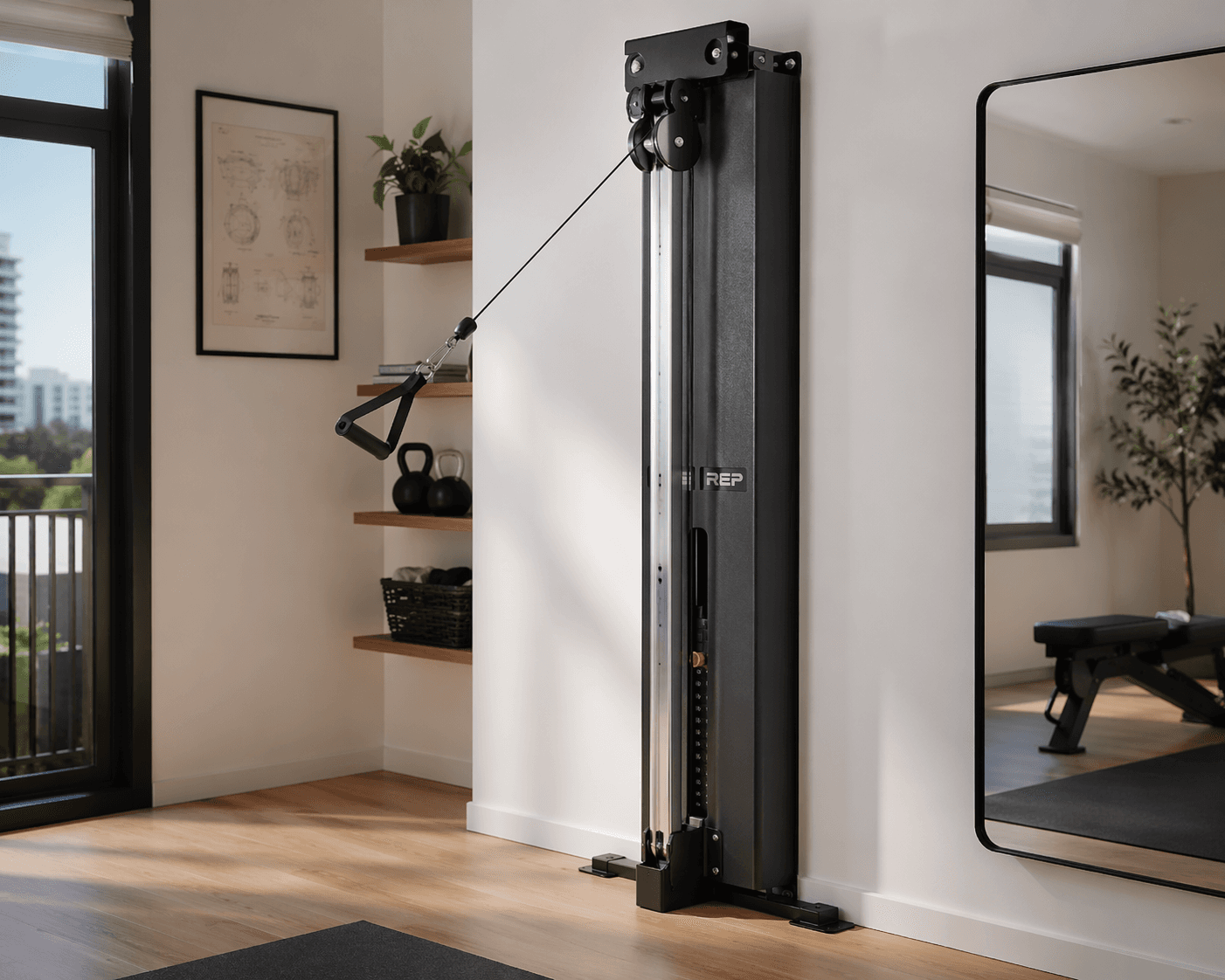
If you already own a power rack — specifically a REP PR-4000 or PR-5000 — the REP Ares 2.0 cable attachment adds cable functionality without consuming a single additional square foot of floor space. The attachment integrates directly into the rack's uprights, adding only 6 inches of depth and 5.2 inches of width to the rack's existing footprint.
| Spec | REP Ares 2.0 |
|---|---|
| Added floor footprint | 0 sq ft (integrates into existing rack) |
| Added depth | ~6 inches |
| Added width | ~5.2 inches |
| Weight stacks | Dual 260 lbs (upgradeable to 310 lbs) |
| Pulley material | Aluminum with brass bushings |
| Compatible racks | REP PR-4000, PR-5000 |
| Price (approx.) | $1,200–$1,500 (attachment only) |
The Ares 2.0 uses dual 260-pound weight stacks (upgradeable to 310 pounds) and aluminum pulleys with brass bushings for smooth operation. The build quality is a significant step up from budget bolt-on pulley systems. Because the attachment shares the rack's footprint, it's the most space-efficient option for anyone who already has a compatible rack and doesn't want to add a second piece of floor-standing equipment.
Format 5: DIY Cable Pulley Systems (~$100)
At the far end of the budget spectrum, a DIY cable pulley system can be assembled for under $100 using a pulley, a carabiner, and a nylon strap, as detailed by Gray Matter Lifting. The storage footprint is essentially zero — the components fit in a small drawer or gym bag. For someone who wants to experiment with cable training before committing to a larger investment, or for a traveler who wants cable exercises in a hotel room, the DIY route is the most accessible entry point.
However, the limitations are significant. A DIY system lacks the stability of a dedicated machine — the anchor point may shift under load, and the pulley can bind or wobble during dynamic movements. Cable fraying is a real concern over time, especially with lower-quality components. The resistance curve is also less predictable: you're limited by the weight plates you can attach, and the friction of the pulley system can make the feel inconsistent.
Budget Comparison Across Formats
The table below summarizes the five formats across the dimensions that matter most for space-constrained and budget-conscious buyers: price, footprint, resistance type, subscription requirements, and best-use scenario.
| Format | Price Range | Footprint | Resistance Type | Subscription? | Best For |
|---|---|---|---|---|---|
| Wall-mounted smart trainer (Tonal 2) | $4,295+ | 5.25" wall protrusion + 7' clearance | Digital (250 lbs) | Yes | Minimalist aesthetic, permanent installation, high budget |
| Portable magnetic (MAXPRO SC) | $499 | Folds to laptop size | Digital magnetic (300 lbs) | No | Apartment storage, portability, shared spaces |
| Single-column tower (BoS Cable Tower 2.0) | ~$500 (with plates) | ~6 sq ft | Plate-loaded (250 lbs) | No | Dedicated permanent station, budget-friendly |
| Rack-mounted (REP Ares 2.0) | $1,200–$1,500 (attachment only) | 0 sq ft added | Weight stack (260–310 lbs) | No | Existing REP rack owners, zero added footprint |
| DIY pulley system | ~$100 | Minimal (drawer/closet) | Plate-loaded (limited) | No | Experimentation, light use, absolute minimum budget |
For a deeper look at total cost of ownership across different home gym equipment categories, see our home gym system cost breakdown, which covers price tiers from $300 to $6,000+.
Workout Considerations for Each Format
Choosing a cable machine format isn't just about space and budget — it's also about what kind of training you actually want to do. Each format imposes different constraints on exercise selection, resistance feel, and workout flow.
Single-Column Limitations
A single-column tower like the Bells of Steel Cable Tower 2.0 gives you 33 cable positions, but all of them originate from a single vertical axis. That means traditional cable crossovers — where both arms pull from opposite sides of the body — are not possible in the same way they are on a dual-column functional trainer. You can still perform crossover-style movements by standing to one side, but the range of motion and angle of pull will differ. For most home users, this is a minor compromise; for someone who prioritizes chest flyes and rear-delt crossovers, it's worth noting.
Portability Trade-Offs
The MAXPRO SC's portability is its greatest strength and its greatest weakness. The ability to stow it in a closet is invaluable in a small apartment. But the 1–2 minute setup and teardown time, combined with the need to anchor the unit (it comes with a door anchor and floor plate), means it's not as grab-and-go as a dedicated machine. If you train at 6 AM and every minute of friction reduces your consistency, the setup step matters.
Resistance Curve Differences
Digital resistance (Tonal 2, MAXPRO SC) provides constant tension throughout the entire range of motion, which is excellent for hypertrophy and time-under-tension work. Plate-loaded resistance (BoS Cable Tower 2.0, DIY systems) has a different feel — the inertia of the plates creates a slight lag at the start of the movement and a different deceleration profile at the end. Weight stacks (REP Ares 2.0) fall somewhere in between, with smooth cable travel but the tactile feedback of moving physical mass. None of these is inherently better; the right choice depends on your training preferences.
Exercise Variety
- Wall-mounted (Tonal 2): Full exercise library with guided programming, but limited to the digital resistance curve and Tonal's attachment ecosystem.
- Portable (MAXPRO SC): Versatile across most cable exercises, but the door anchor limits anchor point height and angle options.
- Single-column tower (BoS Cable Tower 2.0): 33 cable positions cover virtually all standard cable exercises except wide-stance crossovers.
- Rack-mounted (REP Ares 2.0): Dual weight stacks enable true bilateral work (both arms simultaneously) with independent loading.
- DIY: Limited to basic exercises (tricep pushdowns, bicep curls, face pulls) at moderate loads.
Decision Guide: Which Format Fits Your Space and Budget?
Use the decision matrix below to narrow your options based on your two primary constraints: available floor space and total budget.
| Available Space | Budget Under $200 | Budget $200–$600 | Budget $600–$1,500 | Budget $1,500+ |
|---|---|---|---|---|
| Minimal (no permanent floor space) | DIY pulley system | Portable magnetic (MAXPRO SC) | Portable magnetic (MAXPRO SC) | Wall-mounted (Tonal 2) — if clearance allows |
| Small (6–10 sq ft available) | DIY pulley system | Single-column tower (BoS Cable Tower 2.0) | Single-column tower + accessories | Single-column tower + premium attachments |
| Moderate (rack already owned) | N/A | N/A | Rack-mounted (REP Ares 2.0) | Rack-mounted (REP Ares 2.0) + upgraded stacks |
| Dedicated corner (10+ sq ft) | DIY pulley system | Single-column tower (BoS Cable Tower 2.0) | Single-column tower or entry-level functional trainer | Wall-mounted (Tonal 2) or full functional trainer |
Comments
Join the discussion with an anonymous comment.