
Home Workout Tips to Protect Muscle on GLP-1 Weight Loss
Protecting muscle during GLP-1 weight loss comes down to a deliberately small home training structure: two to three full-body strength sessions of about 20–30 minutes a week, basic movement patterns, and roughly 1.2–2.0 g/kg of daily protein. This evidence-backed reference explains that minimum plan and where cardio fits, so beginners have a clear starting point instead of conflicting advice.
- Citation source
- ACSM
- Evidence level
- general guideline
- Recommended frequency
- 2–3 full-body sessions/week; at least one day between sessions
The minimum plan if you’re starting at home
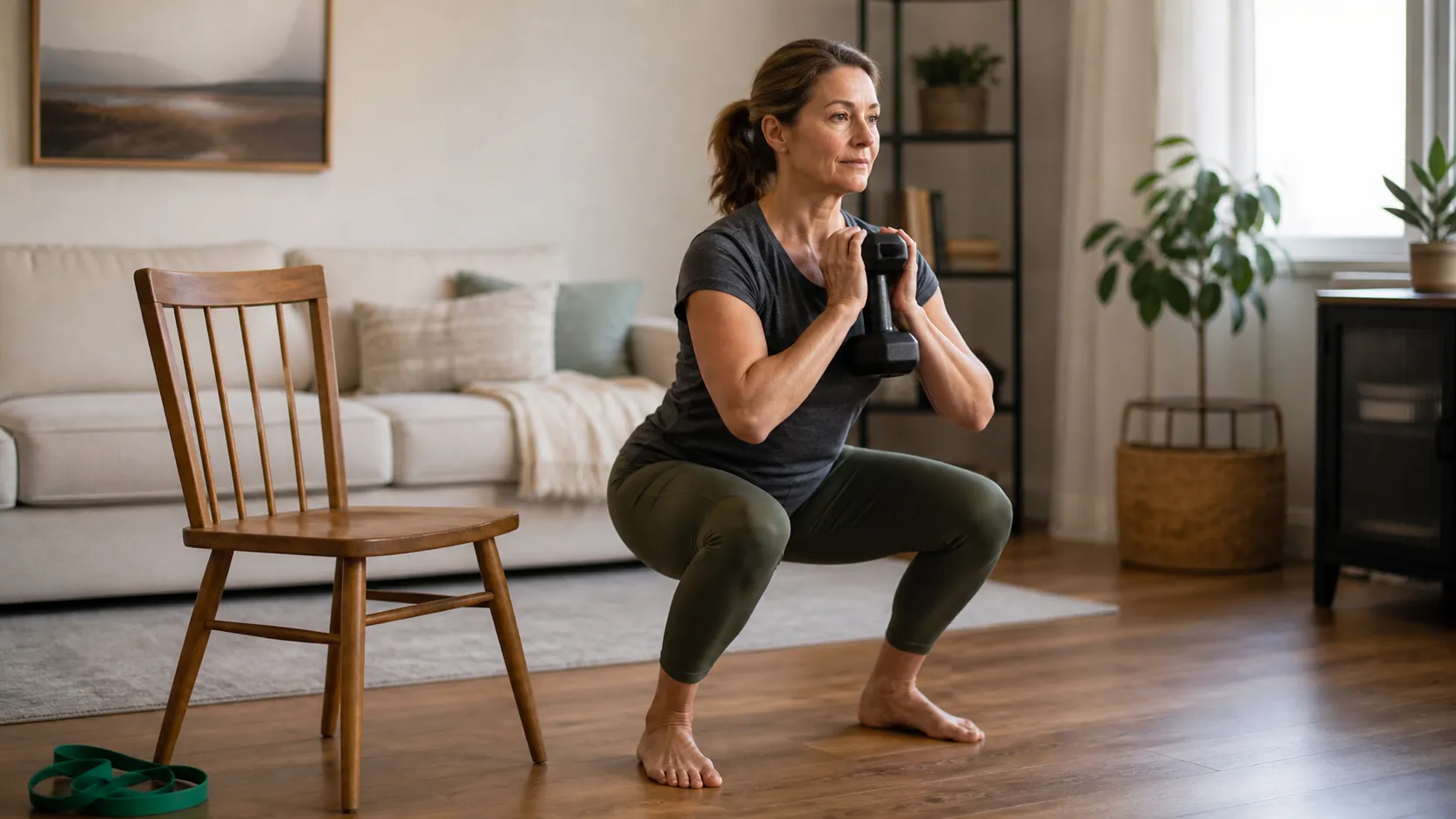
If you are losing weight on a GLP-1 medication and want the simplest home workout structure that protects muscle, start here: two to three full-body resistance sessions per week, about 20–30 minutes each, built around squat, hinge, push, pull, and carry or core patterns. Use a chair, your body weight, resistance bands, or a modest pair of dumbbells. Pair that with a rough daily protein target in the 1.2–2.0 g/kg range, adjusted for your medical situation and what you can realistically eat. Cardio still belongs in the week, but as heart-health and conditioning work, not as the replacement for lifting.
This is general fitness education, not medical advice. Your prescribing clinician should be part of the plan if you have nausea, vomiting, dizziness, very low intake, rapid weight loss, frailty, a history of disordered eating, kidney disease, diabetes medication changes, post-menopausal bone-risk concerns, or any condition that changes how you should train or eat.
Why muscle protection deserves attention during GLP-1 weight loss
Semaglutide and tirzepatide can produce major weight loss. In STEP-1, semaglutide used with lifestyle intervention was associated with 14.9% weight loss at 68 weeks, compared with 2.4% with lifestyle intervention alone. In SURMOUNT-1, tirzepatide was associated with 15.0–20.9% weight loss, depending on dose. These medications are also discussed in the context of diet and physical activity rather than as stand-alone body-composition plans.[1]
The scale change is real, and for many people it is welcome. The quieter question is what kind of tissue is being lost along the way. Reviews and editorials have estimated that lean mass may represent roughly 25–40% of GLP-1-related weight lost, compared with lower proportions often reported in lifestyle interventions, around 15–20%.[2][3] A 2025 meta-analysis of nine randomized controlled trials, including 659 adults, reported that lean mass made up 30.8% of weight lost during GLP-1 therapy, with mean losses of 2.5 kg of lean mass and 5.4 kg of fat mass.[4]
Those numbers should not be read as a personal forecast. They come from specific studies, populations, drug protocols, and measurement methods. They do make one point hard to ignore: when appetite drops and weight comes off quickly, strength training and protein are not cosmetic add-ons. They are the basic signals and raw materials your body uses to keep useful tissue.
That is also why “just walk more” is incomplete advice. Walking is valuable. Cardiorespiratory fitness matters. But muscle preservation asks for loading: legs pushing against the floor, hips hinging, arms pulling, trunks resisting motion, and hands carrying weight. ACSM’s discussion of anti-obesity medications also reframes exercise away from calorie burn and toward strength, function, and muscle quality; it notes that only 34% of surveyed anti-obesity-medication patients met the 150-minute weekly activity guideline.[2]
The weekly strength dose: small enough to repeat
For a beginner at home, the useful target is not an advanced bodybuilding split. It is a repeatable full-body signal two to three times a week. A conservative beginner starting point is surprisingly plain: one controlled set of 12–15 repetitions taken close to fatigue can be enough for many people starting out. That matters because a plan you can repeat for months is more protective than a dramatic first week that disappears.
| If your current capacity is… | Start with… | What it should feel like |
|---|---|---|
| Very low energy, new nausea, or no recent exercise habit | 10–15 minutes of light movement, then build gradually | Easy enough that you finish feeling steadier, not depleted |
| Able to move comfortably but detrained | Two 20-minute full-body strength sessions per week | The last few reps require focus, but your form stays controlled |
| Already tolerating exercise well | Three 20–30 minute full-body sessions per week | You recover between sessions and can add small progressions over time |
Cleveland Clinic’s conservative advice for people beginning exercise while using GLP-1 medication is to start with 10–15 minutes of light activity in the first weeks and build from there.[5] That is a safety valve, not a failure. If your intake has dropped sharply or side effects are active, the first job is to stay safe enough to build consistency.
On strength days, leave at least one day between sessions at first. Monday and Thursday is enough. Monday, Wednesday, and Friday is enough. What matters is that the same major movement patterns show up repeatedly, with better control or a little more load over time.
Build each session from movements, not body parts
A beginner home routine does not need separate “leg day,” “back day,” and “arm day.” It needs a small menu of movements that cover the body. Choose one option from each row, do one controlled set at first, and stop when your form starts to break rather than chasing exhaustion.
| Pattern | Home options | Beginner cue |
|---|---|---|
| Squat | Sit-to-stand from a chair, chair squat, goblet squat | Use the chair to set depth; stand up without dropping into the seat |
| Hinge | Glute bridge, hip hinge drill, dumbbell Romanian deadlift | Move from the hips; keep the load close to your body |
| Push | Wall push-up, counter push-up, incline push-up, dumbbell floor press | Choose an incline that lets you control the whole rep |
| Pull | Resistance-band row, one-arm dumbbell row, seated band row | Pull the elbows back; avoid shrugging every rep |
| Carry or core | Suitcase carry, farmer carry, plank, side plank, dead bug | Brace gently, breathe, and keep the trunk from twisting or sagging |
A 20–30 minute session can be this simple: three to five minutes of easy marching, joint circles, or light walking; one squat pattern; one hinge; one push; one pull; one carry or core drill; then a short cooldown. Start with one set of 8–15 controlled reps per movement, or a short carry or plank you can perform without holding your breath. If that is too easy after a couple of weeks, add a second set to one or two movements before you add complexity.
Practitioner guidance can be useful here as long as it is not mistaken for trial proof. Fit&Well’s interview with a licensed physical therapist assistant presents a six-move routine for GLP-1 users that covers full-body strength and bone-loading work in roughly 50–60 minutes per week. The same piece flags bone-loss concern during rapid weight loss, especially for post-menopausal women.[6] That does not prove one routine is superior, but it supports the practical direction: use simple loaded movements, repeat them, and do not let the entire plan become low-intensity cardio.
Protein: use a range, not a fake-perfect number
Protein targets vary across sports-medicine and clinical-commentary sources. A practical range for many active adults trying to preserve lean mass during weight loss is roughly 1.2–2.0 g/kg/day. Some sources cluster lower, around 1.2–1.5 g/kg/day, and some people need individualized targets because of kidney disease, medication interactions, gastrointestinal symptoms, age, or overall medical risk. The Harvard Chan discussion of diet and exercise with weight-loss medication reinforces the broader point: medication does not remove the need to pay attention to diet quality and activity.[1]
For a 150 lb person, which is about 68 kg, the 1.2–2.0 g/kg range translates to roughly 80–135 g of protein per day. That is a wide range on purpose. The lower end may already be a meaningful improvement for someone who is nauseated or eating very small meals. The higher end may be reasonable for someone tolerating food well and training consistently. It is rarely helpful to pretend that one exact gram target works for every GLP-1 user.
The home-workout implication is simple: do not lift in a protein vacuum. If your appetite is small, protein may need to be planned earlier in the day instead of left to chance at dinner. Easy options can include Greek yogurt, eggs, cottage cheese, fish, poultry, tofu, tempeh, beans paired with grains, protein smoothies, or a protein supplement if your clinician or dietitian agrees it fits your situation. The “best” source is the one you can tolerate repeatedly.
Where cardio fits when the goal is muscle preservation
Cardio is still worth doing. It supports cardiovascular health, conditioning, mood, blood-pressure management, and everyday stamina. General activity guidance often points adults toward 150 minutes per week of moderate activity, and ACSM notes that many surveyed people using anti-obesity medications were not reaching that level.[2] The mistake is treating cardio as the main muscle-preservation tool.
For a beginner, the cleanest arrangement is strength first, cardio around it. On non-lifting days, walk, cycle gently, swim, or do low-impact intervals that do not leave you too drained to lift the next session. If symptoms are active, Cleveland Clinic’s 10–15 minute light-activity starting point is a reasonable way to keep movement in the week while you and your clinician sort out intake and tolerance.[5]
A simple week might look like two strength sessions plus three short walks. If you are already active, it might be three strength sessions plus several moderate cardio sessions. If the choice on a low-energy day is between a 25-minute strength session and a long treadmill session done only to “burn calories,” choose the strength signal and keep the walk easy.
Progress without turning your living room into a gym
Progression does not have to mean buying a rack, joining a gym, or learning a complicated split. At home, progress usually means making the same basic movement slightly more demanding while keeping it recognizable.
- Add reps first: move from 8 controlled reps toward 12–15 before increasing load.
- Add a second set selectively: start with the squat or row rather than doubling the whole workout at once.
- Use a harder variation: move from a wall push-up to a counter push-up, or from a chair squat to a goblet squat.
- Increase load gradually: use a heavier dumbbell, a stronger band, or a slower lowering phase.
- Track recovery: if soreness, fatigue, dizziness, or poor intake is stacking up, hold the dose steady or reduce it.
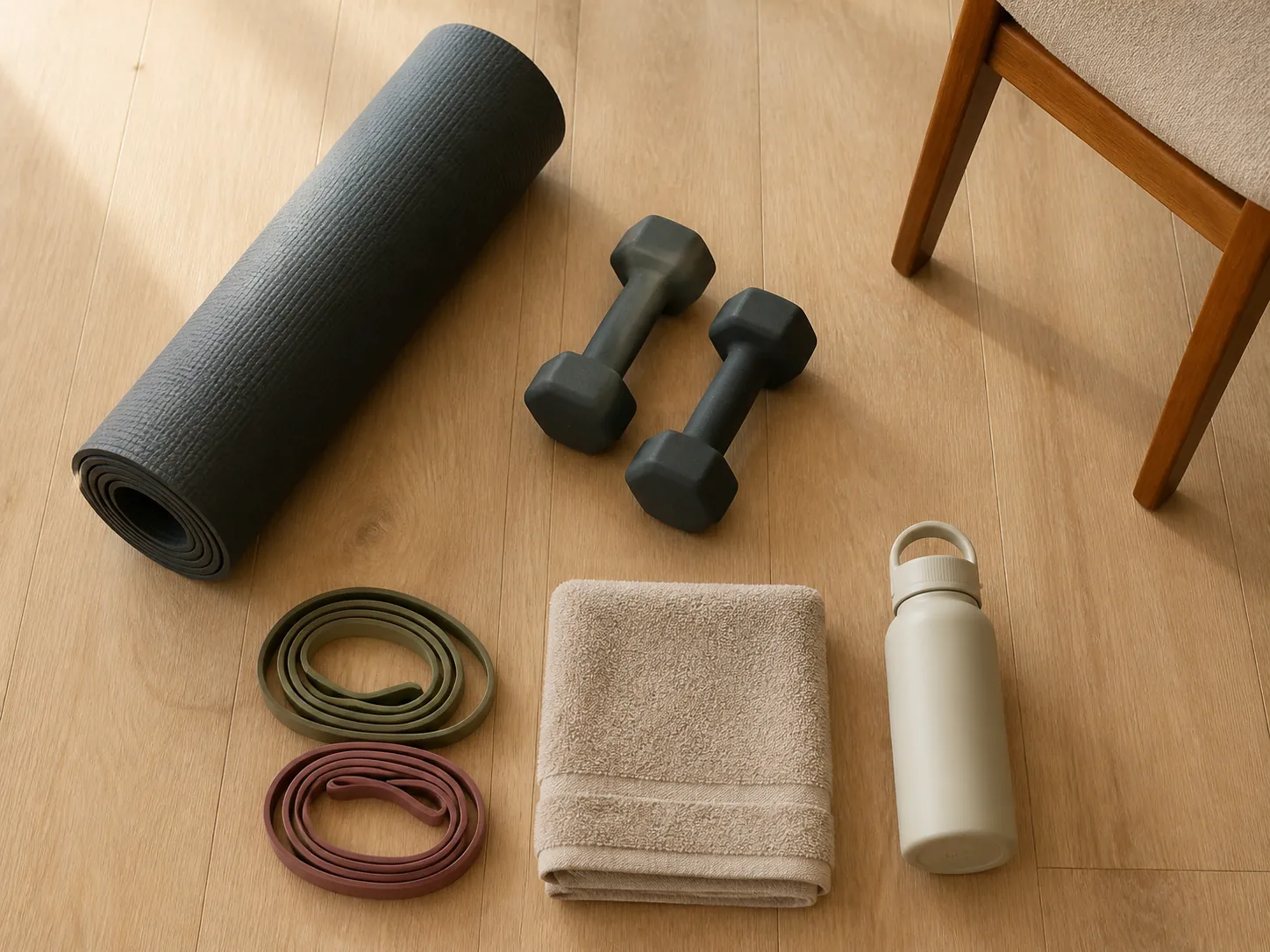
If you want more structure after the first few weeks, a beginner plan can be useful as long as it keeps the same full-body logic. The 8-week home strength training plan for beginners and the 6-week home strength training plan are natural next steps. If your space is tight, a compact setup can stay minimal: a mat, bands, a stable chair, and adjustable or fixed dumbbells. A small-space home exercise equipment guide or a limited-equipment strength app roundup can help if tracking removes friction instead of adding it.
A modest first week that is actually enough
For week one, pick two nonconsecutive days. On each day, do one set of five movements: chair squat, glute bridge, incline push-up, band or dumbbell row, and dead bug or suitcase carry. Keep the session near 20 minutes. Walk easily on two or three other days if you feel well enough. Put protein into the first half of the day instead of discovering at night that you barely ate any.
If that week feels too easy, repeat it and add a little. If it feels hard, repeat it without adding anything. GLP-1 medication may create much of the calorie deficit, but the body still needs a reason to keep muscle and enough dietary material to maintain it. When symptoms, intake, rapid loss, or medical risk complicate that plan, your clinician’s guidance comes before internet fitness advice.
References
- Diet, exercise still important when taking weight-loss medication, Harvard T.H. Chan School of Public Health
- Taking Anti-Obesity Medications? Exercise Is Still Critical for Your Health, ACSM’s Health & Fitness Journal, 2024
- The role of diet, physical activity and exercise in the era of glucagon-like peptide-1 receptor agonists for obesity management, BMJ Nutrition, Prevention & Health, 2025
- About 31% of weight lost by adults during GLP-1 therapy comes from lean mass, Healio, January 27, 2025
- Exercise for GLP-1 Use, Cleveland Clinic
- Six of the best exercises to preserve strength for GLP-1 users, according to an expert, Fit&Well
This is general fitness education, not medical advice. For diagnosis or treatment of pain or injury, consult a qualified clinician.
Pick your next session
A Beginner Breakdance Workout You Can Do at Home
A complete beginner breakdance workout for small apartments: one zero-equipment session built from toprock, the 6-step, basic freezes, and conditioning, sequenced in an injury-aware order with floor and noise notes. Includes a first-month progression and frequency guidance tied to CDC adult activity targets.
GLP-1 Home Workouts in Extreme Heat: A Real Dehydration Risk?
GLP-1 medications suppress thirst, increase GI fluid loss, and cut the water you normally get from food, so "drink when thirsty" stops working as a hydration guide. This article lays out a concrete scheduled-hydration and session-redesign protocol for home workouts in extreme heat, plus the warning signs that mean stop — not a single generic water tip.
Can You Work Out Indoors in a Heat Dome Without AC?
With no AC in a heat-dome apartment, training indoors is safe only when temperature becomes a training variable. Plan sessions for the coolest window, cool the room and body without electricity, choose from three low-heat apartment routines, and stop at the first heat-illness symptom.
Spot something off?
This content sits adjacent to health guidance — tell us if a citation or figure needs a correction.