
Can You Work Out Indoors in a Heat Dome Without AC?
With no AC in a heat-dome apartment, training indoors is safe only when temperature becomes a training variable. Plan sessions for the coolest window, cool the room and body without electricity, choose from three low-heat apartment routines, and stop at the first heat-illness symptom.
- Equipment tier required
- none
- Duration
- 15 min
- Difficulty
- beginner
- Target area
- full body
- Space footprint needed
- 6x6 ft
- Noise level
- low
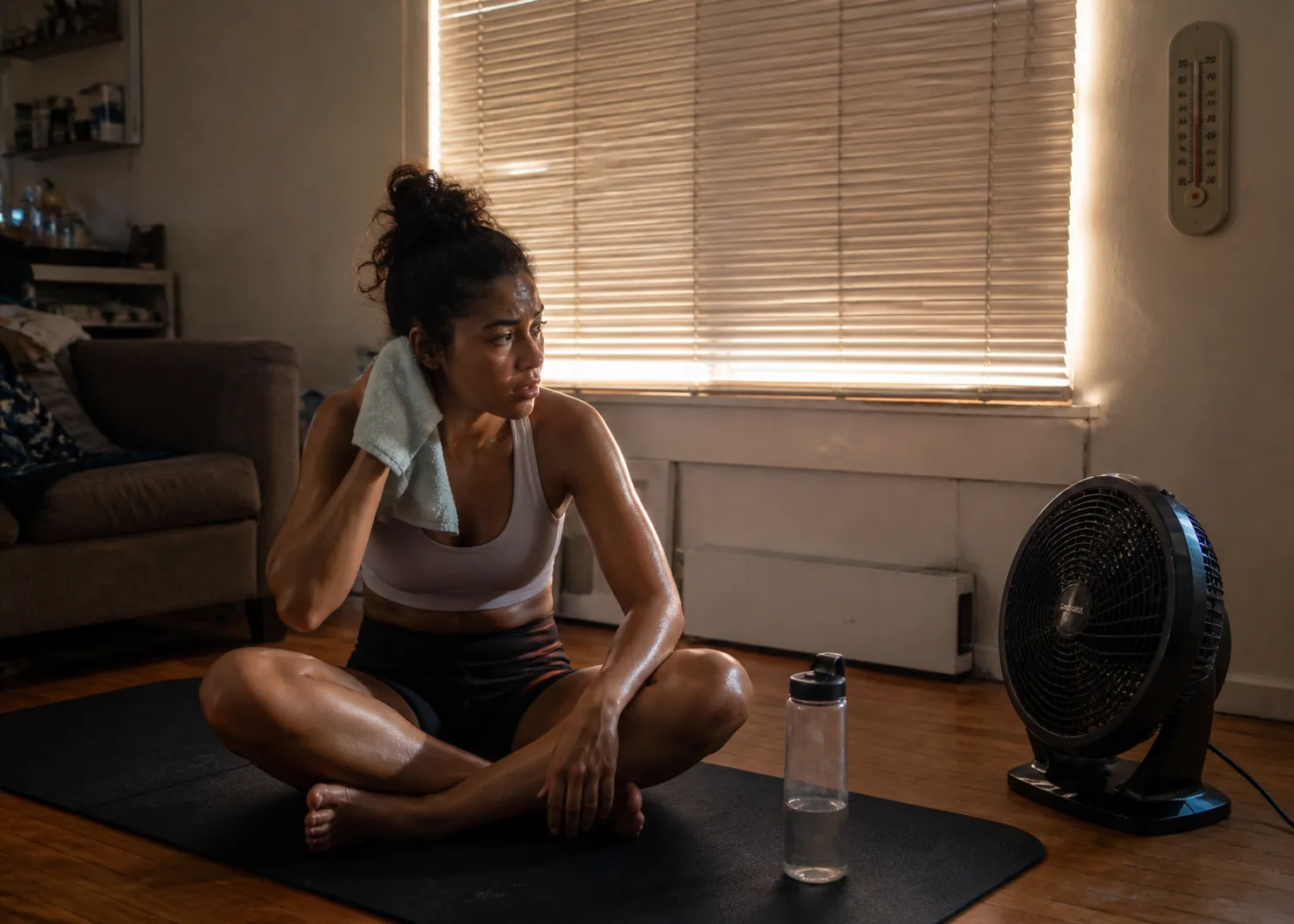
Before you unroll the mat, check the apartment rather than the workout plan. Read the indoor temperature, measure humidity if you have a hygrometer, look at the current official heat alert, and check the CDC/NWS HeatRisk scale. Then ask whether the room has actually cooled since yesterday. In a no-AC apartment during a prolonged heat event, that last question can matter more than whether today's forecast is one degree lower.
“Heat dome” is a media-popularized term, not an official warning category. The underlying pattern is what matters: a warm-season high-pressure system can suppress clouds and leave air stagnant for days, while urban surfaces add and retain heat. [1][2] Map the headline to your local heat watch, warning, advisory, and HeatRisk level. The apartment itself is your immediate environment, and a top-floor or poorly shaded room may stay hot long after outdoor air begins to fall.
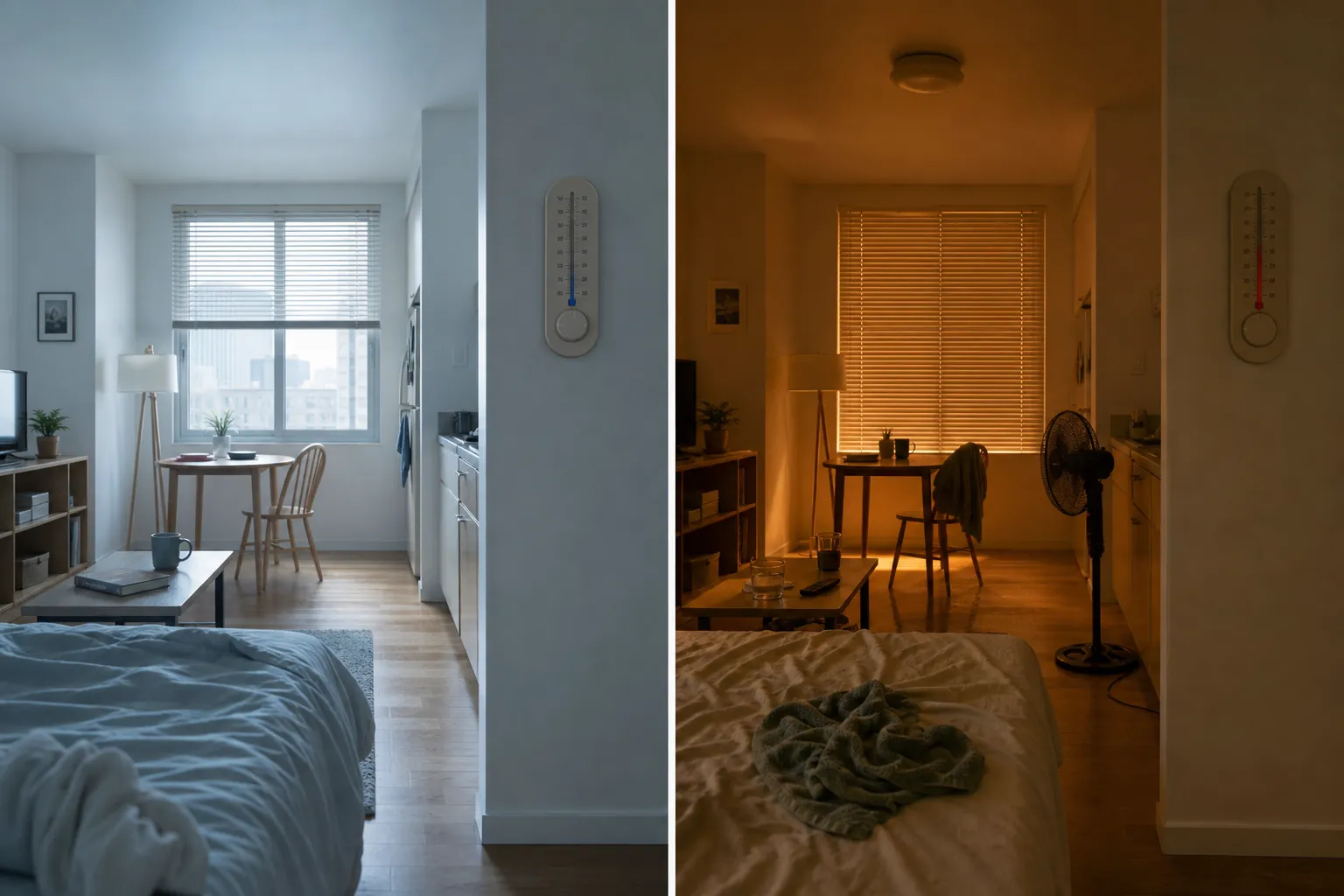
Make the room part of the workout plan
Choose the coolest available training window, usually after overnight ventilation or before direct sun reaches the room. Open windows only while outdoor air is cooler than indoor air; once the outdoor temperature rises, close windows and draw blinds or curtains on the sunny side. CDC and WHO heat guidance both emphasize limiting daytime solar gain and ventilating when conditions are cooler. [3][4]
- Move the mat away from sunny windows, cooking appliances, and electronics that are producing heat.
- Ventilate during the coolest outdoor window, then close windows and blinds before the room begins heating up.
- Keep the workout area uncluttered so you can stop, lie down, or leave for a cooler location without tripping.
- If humidity is high, treat sweat that is sitting on your skin as a warning about reduced evaporation, not proof that you are getting a better workout.
- If you track indoor humidity, the existing guide on ideal indoor humidity for home workouts can help interpret the reading.
A fan is useful for moving air across wet skin, but it is not an automatic cooling system. CDC guidance says fans help only below about 90°F indoors; WHO guidance warns that fans can become harmful when indoor air is hotter than body temperature, and the Lancet review reports age- and medication-specific safe-fan thresholds of 102.2°F for adults ages 18–40, 100.4°F for adults over 65, and 98.6°F for older adults taking anticholinergic medication. [3][4][6] These are source-specific findings, not one universal fan setting. If the room is very hot, use the fan to assist evaporation while cooling your skin, and do not sit in front of it assuming that hotter air is being removed.
Cool the person, not only the apartment
Wet skin, a damp towel around the neck, and cool water on the face, forearms, and legs can improve heat loss without adding electricity. Self-dousing and damp cloths have been found useful even at very high ambient temperatures, provided the person can continue cooling and monitoring symptoms. [6] A cold pack wrapped in cloth can also be placed briefly at the neck or armpits, but it should support cooling rather than encourage you to ignore worsening symptoms.
Drink before you feel desperate for water, but do not treat one hydration number as medical clearance. WHO describes roughly one cup per hour and 2–3 liters per day as general hot-weather guidance; the Red Cross gives about three-quarters of a gallon per day for an average person; CDC advises drinking more than usual and not waiting for thirst. [12][11][3] Exercise changes the calculation: the Lancet review notes that drinking to thirst may replace only about half of sweat losses during heat exercise, and sweat losses above 2% of body weight raise exertional heat-illness risk. [6] People with heart, kidney, or other conditions that restrict fluids should use their clinician's advice instead.
Keep water within reach, take small drinks during longer sessions, and avoid turning a short apartment workout into an hour of forced drinking. For a fuller discussion of fluid and cooldown calculations, use Heat Safety for Home Workouts, by the Numbers.
Choose the lowest-heat tier that still serves the day
Working muscles add metabolic heat to an already difficult environment. OSHA and CDC/NIOSH describe heat stress as an interaction between environmental heat and the heat produced by physical work, while humidity makes sweat evaporation less effective. [7][8][9] That is why “low impact” is not automatically low heat: a fast, dense, continuous routine can be harder on a hot body than slow strength work with long rests.
Use the mildest tier you can complete while breathing comfortably and cooling between efforts. If the room is warmer than yesterday, the blinds could not keep out the afternoon sun, or your resting pulse and perceived effort already feel unusually high, move down a tier or postpone the session. A familiar routine is not a reason to preserve its usual speed.
Tier 1: restorative mobility
This is the default when the room is warm, the previous night offered little relief, or you are unsure how your body will respond. Clear a 6-by-6-foot area and work slowly for about 10–20 minutes. Keep the fan angled across damp skin only if the room temperature makes that appropriate.
- Five slow diaphragmatic breaths, seated or lying down.
- Ankle circles and gentle heel slides for 30–45 seconds per side.
- Cat-cow or a supported standing spinal wave for 6–8 repetitions.
- Hip bridges for 6–10 controlled repetitions, stopping well before muscular fatigue.
- A slow half-kneeling hip shift and shoulder reach for 30 seconds per side.
- Two minutes of quiet breathing and a gradual transition to sitting.
Rest as long as needed between movements. This tier should leave you feeling more mobile, not noticeably hotter. A thin mat over a rug protects the floor and reduces noise; neither the mat nor a resistance band needs to turn the session into a circuit.
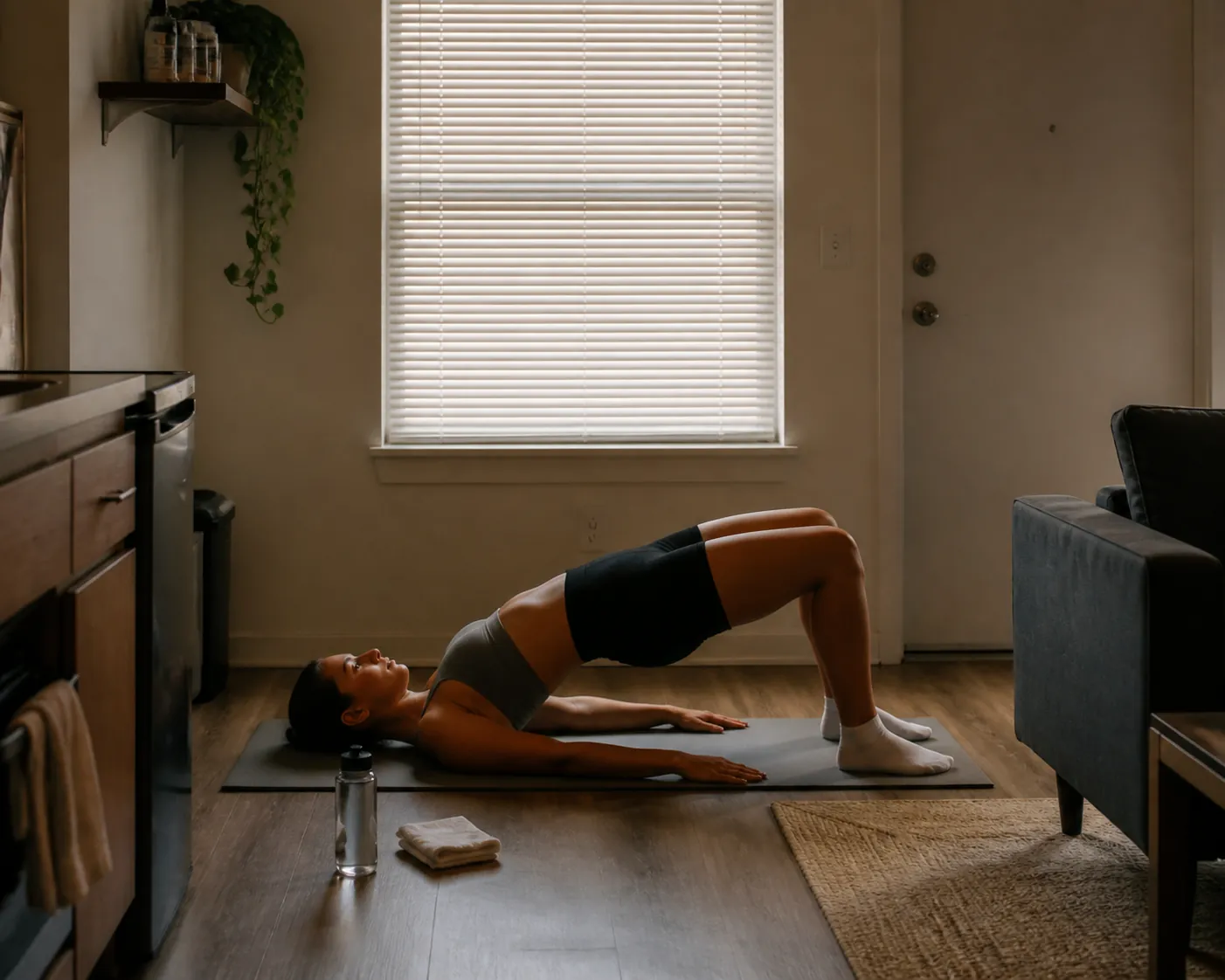
Tier 2: low-impact strength
Use this only after the room and your skin have cooled enough for a controlled session. Perform one or two rounds, with roughly 60–120 seconds of seated or lying rest between exercises. The pace should allow complete sentences.
- Chair or bodyweight squat: 6–10 repetitions.
- Incline push-up against a sturdy counter or wall: 6–10 repetitions.
- Hip bridge: 8–12 repetitions.
- Resistance-band row: 8–12 repetitions, using a band that does not require straining.
- Side-lying leg raise: 6–10 repetitions per side.
Keep transitions deliberate. Do not add a timer simply to make the workout feel complete. The useful adjustment here is lower density: fewer repetitions, lighter resistance, and longer recovery reduce the amount of heat your muscles produce per minute. For similar quiet, floor-friendly patterns, see Quiet weight-loss home workout for a small apartment.
Tier 3: short intervals
This is the most demanding option and the easiest to misjudge. Use it only when the room has cooled, you feel normal at rest, and you can cool your skin immediately afterward. Choose two or three movements such as marching slowly in place, alternating reverse lunges, standing wall presses, and controlled step-outs. Work for 15–20 seconds, then rest for at least 60–90 seconds. Complete no more than four rounds.
There is no jumping, burpee work, sprinting, or rapid floor-to-standing sequence here. If the first interval makes you unusually breathless, flushed, dizzy, or unable to cool during the rest period, end the session rather than reducing the rest until the routine becomes an endurance test. On a hotter day, Tier 1 is the correct replacement—not a failure to train.
The stop rules are more important than the routine
Stop exercising at the first unusual symptom. Move to the coolest available place, sit or lie down, remove excess clothing, wet the skin, and use cool cloths or water. Do not resume because the symptom briefly improves. CDC, the Red Cross, and NWS all identify symptoms such as dizziness, weakness, nausea, cramps, and confusion as reasons to stop activity and cool down. [13][11][14]
| What you notice | Immediate action |
|---|---|
| Dizziness, weakness, nausea, headache, heavy sweating, or muscle cramps | Stop immediately. Sit or lie in a cooler place, wet the skin, loosen clothing, and take fluids if you are alert and able to swallow. Do not restart the workout. |
| Symptoms that worsen, do not improve with cooling, or include fainting or repeated vomiting | Get medical help. Have someone stay with you if possible. |
| Confusion, unusual behavior, loss of coordination, seizure, or unconsciousness | Treat this as an emergency. Call 911, move the person to a cool place, begin active cooling, and do not give fluids to an unconscious or confused person. |
Heatstroke is a medical emergency. Mayo Clinic identifies a core temperature of 104°F or higher as a heatstroke sign, while NWS symptom guidance commonly flags 103°F or higher; NIOSH notes that body temperature can reach 106°F within 10–15 minutes once cooling fails. [10][14][8] These figures are not home testing targets. Confusion, collapse, seizure, or rapidly worsening condition warrants emergency care even when no thermometer is available.
Small equipment can help, but it cannot override the room
Useful no-AC equipment is equipment that supports cooling or keeps the workout quiet: a hygrometer, washable damp towels, a water bottle, a thin non-slip mat, and a light resistance band. A fan can help evaporation within the source-specific limits above. It cannot lower the room's heat load by itself, and it may make conditions worse when the air is hotter than the body.
A portable window unit changes the calculation but does not make a hard session automatically appropriate. WHO gives 80.6°F plus a fan as a benchmark that can feel about 7.2°F cooler, but that is an air-conditioning reference rather than a clearance for exercise. [4] If you have access to a genuinely cooler shared space, that may be the safer place for vigorous training; it should not be the only answer offered to someone who cannot leave the apartment.
For a single hot afternoon, the site's guides on working out in a hot apartment when the heat index is high and how hot is too hot to work out in a no-AC apartment cover the temperature and heat-index layer. A heat dome requires the additional question: did the apartment and your body recover overnight?
When to rebuild normal training
After the event, do not jump from mobility to your usual workout on the first cooler morning. Heat-acclimatization guidance varies: GHHIN and NATA-style approaches commonly describe a gradual 7–14-day ramp, while Mayo Clinic notes that acclimatization can take several weeks. [15][16] The difference reflects different contexts and populations, so use a slower progression if you are unwell, returning after a long break, or taking medication that affects thirst or sweating.
For today, the decision is narrower. If you can cool the room enough to remain comfortable, cool your skin, choose the mildest suitable tier, extend the rests, and finish without symptoms, a conservative session may be reasonable. If the room will not cool, your body is already overheated, or any warning symptom appears, the protocol has done its job: end the workout.
References
- Heat Dome — American Meteorological Society Glossary of Meteorology — https://glossary.ametsoc.org/wiki/Heat_dome
- Heat Island Effect — U.S. Environmental Protection Agency — https://www.epa.gov/heatislands
- About Heat and Your Health — Centers for Disease Control and Prevention — https://www.cdc.gov/heat-health/about/index.html
- Heat and Health — World Health Organization — https://www.who.int/news-room/fact-sheets/detail/climate-change-heat-and-health
- Heat Safety — National Weather Service — https://www.weather.gov/safety/heat
- Reducing the health effects of hot weather and heat extremes: from personal cooling strategies to green cities — The Lancet, 2021 — https://doi.org/10.1016/S0140-6736(21)01209-1
- Heat Stress and Workers — Occupational Safety and Health Administration — https://www.osha.gov/heat
- Heat Stress and Workers — Centers for Disease Control and Prevention / NIOSH — https://www.cdc.gov/niosh/heat-stress/about/index.html
- Heat exhaustion: First aid — Mayo Clinic — https://www.mayoclinic.org/first-aid/first-aid-heat-exhaustion/basics/art-20056651
- Heatstroke — Mayo Clinic — https://www.mayoclinic.org/diseases-conditions/heat-stroke/symptoms-causes/syc-20353581
- Heat Safety Tips — American Red Cross — https://www.redcross.org/get-help/how-to-prepare-for-emergencies/types-of-emergencies/heat-wave-safety.html
- Heat and Health — World Health Organization — https://www.who.int/health-topics/heatwaves
- Heat Illness Prevention — Centers for Disease Control and Prevention — https://www.cdc.gov/niosh/heat-stress/about/illness-prevention.html
- Heat Index Chart and Heat Disorders — National Weather Service — https://www.weather.gov/safety/heat-index
- Manage and Adapt to Heat at Home — Global Heat Health Information Network — https://ghhin.org/resources/manage-and-adapt-to-heat-at-home/
- Heat Acclimatization — Mayo Clinic — https://www.mayoclinic.org/healthy-lifestyle/fitness/in-depth/exercise/art-20048167
What a small equipment investment adds
We don't have a build tagged to this exact tier yet. Browse all builds.
How often should you repeat this?
See our recovery and rest reference for citation-anchored rest-interval guidance.
Spot something off?
Tell us if a movement, tier assumption, or duration didn't match your experience.