
How to Adapt Home Workouts to GLP-1 Weight Loss Side Effects
Maps the GLP-1 side effects that disrupt home training — muscle loss, fatigue, nausea, and dizziness — to concrete adjustments in session timing, intensity, equipment, fueling, and recovery, built around the documented decline in physical activity after starting the medication. Includes home-workout red flags that warrant a clinician consult and a gradual path toward CDC- and ACSM-aligned activity targets.
- Citation source
- ACSM; CDC
- Evidence level
- General guideline
- Recommended frequency
- Resistance training 2–3 sessions/week; aerobic target 150 min moderate or 75 min vigorous per week
The home-fitness problem with GLP-1 weight loss side effects is often quieter than the headlines make it sound. A person does not always stop working out because one session felt awful. More often, the walk gets shorter, the dumbbells stay under the couch, and a few low-energy evenings turn into a new normal.
That leak in weekly movement now has some early data behind it. In an ENDO 2026 conference presentation using All of Us Research Program and Fitbit data, researchers reported that among 753 people analyzed after starting a GLP-1 medication, average daily steps fell from 5,047 to 4,487, and moderate-to-vigorous physical activity fell from 28 to 22 minutes per day. The finding was presented at a conference and had not yet gone through peer review, so it should not be treated as settled population-wide proof. It is still useful because it names the practical risk: activity can drift downward after medication starts unless the workout plan changes with the side effects. [1]
This is not dosing advice, a diagnosis guide, or a reason to overrule the clinician prescribing the medication. If you came here after seeing the FDA-label “home fitness warning” conversation, start with what the GLP-1 home fitness warning actually means. The question here is narrower and more useful on a Tuesday night: if appetite, energy, digestion, thirst, or balance are different, how should the home workout change?
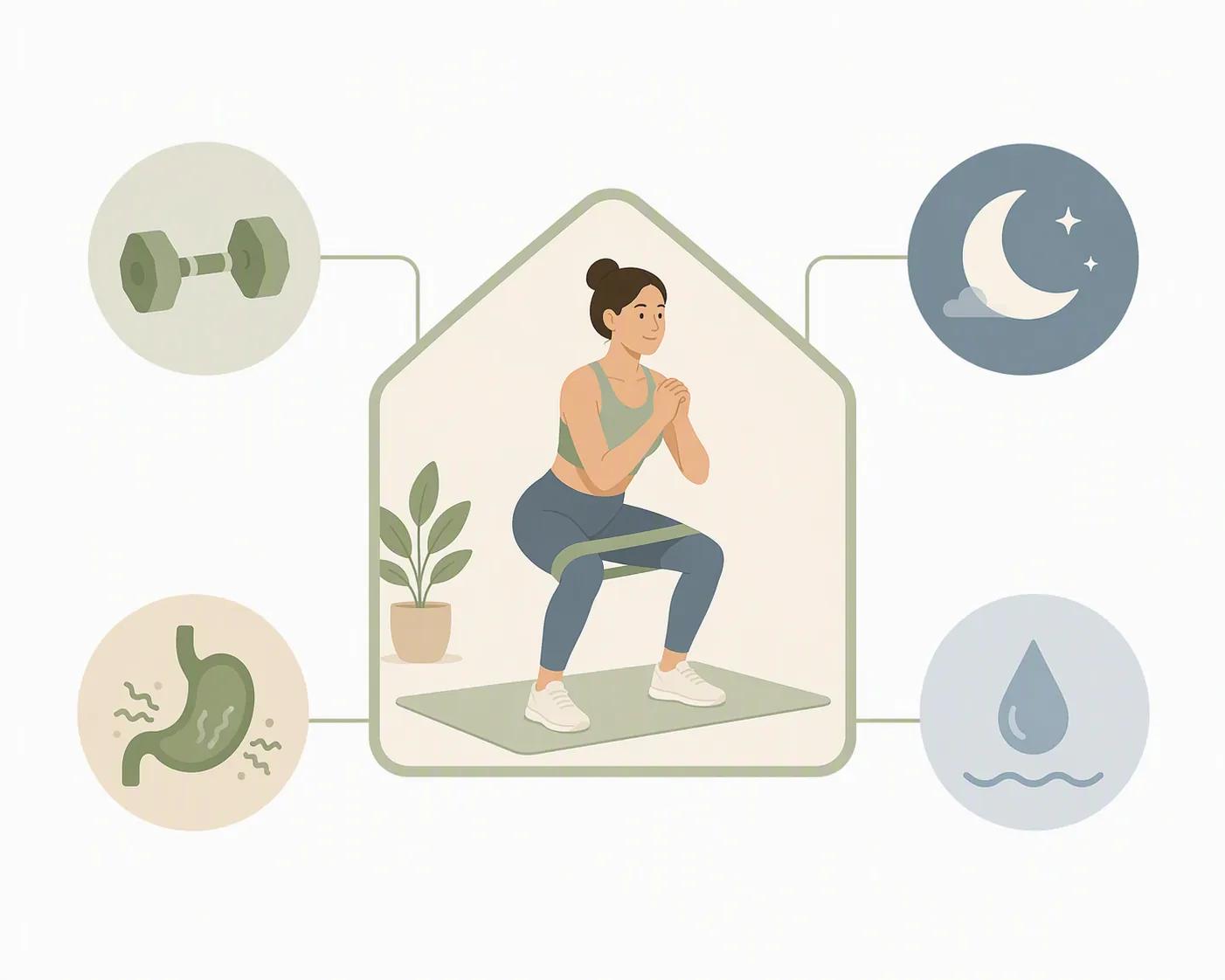
Start by changing the workout dose, not by quitting movement
A GLP-1 home workout plan should assume that some days will need a smaller training dose. That does not mean every symptom is an emergency, and it does not mean symptoms should be ignored. It means the routine needs pre-set options before the body starts negotiating from nausea, dizziness, or under-fueling.
| If this is the issue | How it tends to show up at home | First training adjustment |
|---|---|---|
| Lean-mass or muscle-loss concern | Weight is dropping, but strength sessions are becoming irregular or everything turns into cardio | Prioritize resistance work 2–3 times per week, using bands, dumbbells, chairs, and slower tempo before chasing calorie burn |
| Fatigue | The planned 40-minute workout turns into no workout because energy is gone by evening | Shorten sessions, move them to better-energy windows, and keep intensity below the point where recovery fails |
| Nausea or GI discomfort | Floor moves, jumping, bending, or exercising too soon after eating makes symptoms louder | Separate meals and workouts, choose upright low-impact movements, and skip compression-heavy core work on queasy days |
| Dizziness, dehydration, or low-blood-sugar concern | Standing quickly, intervals, heat, or long sets make you lightheaded or shaky | Schedule fluids, reduce position changes, sit down when needed, and stop for clinician guidance if red flags appear |
The adjustments below are written for a small space: a mat, a chair, bands, maybe adjustable dumbbells, and neighbors who do not need to hear jump squats through the floor. If equipment is the limiting factor, a compact setup matters more than a branded program; the useful question is whether the gear lets you train legs, pushes, pulls, hinges, and carries without taking over the room. For that decision, see how to choose a compact home gym that fits space, budget, and noise tolerance.
Lean mass: protect strength without turning the workout into panic
The lean-mass discussion around GLP-1 drugs needs care because the numbers are real enough to matter and easy enough to misuse. “Lean mass” is not the same thing as “muscle mass.” Depending on the method used, it can include organs, water, connective tissue, and other non-fat tissue. The American College of Sports Medicine has warned against treating body-composition changes from anti-obesity medications as a simple one-number muscle-loss story. [2]
The useful pattern is still clear: significant weight loss can include meaningful loss of lean tissue, and exercise planning should respond. In GLP-1 and exercise literature, lean-mass loss has been reported in different ways across studies: about 25% of weight lost as lean mass in SURMOUNT-1 over 72 weeks, about 22% in a real-world liraglutide cohort, and in STEP-1, lean mass declined 9.7% while fat mass declined 19.3%. Reviews have described broad lean-mass-loss ranges around roughly 15% to 40% of total weight lost, depending on the study and measurement approach. [3]
Mayo Clinic’s public guidance puts the warning in plainer clinical language: more than 30% of weight loss from GLP-1 agonists can be muscle, and that matters because muscle supports strength, physical function, and metabolic health. [4] That does not mean everyone loses the same amount of muscle, or that a scale drop automatically means your strength is disappearing. It means resistance training should move from “nice extra” to the center of the home plan.
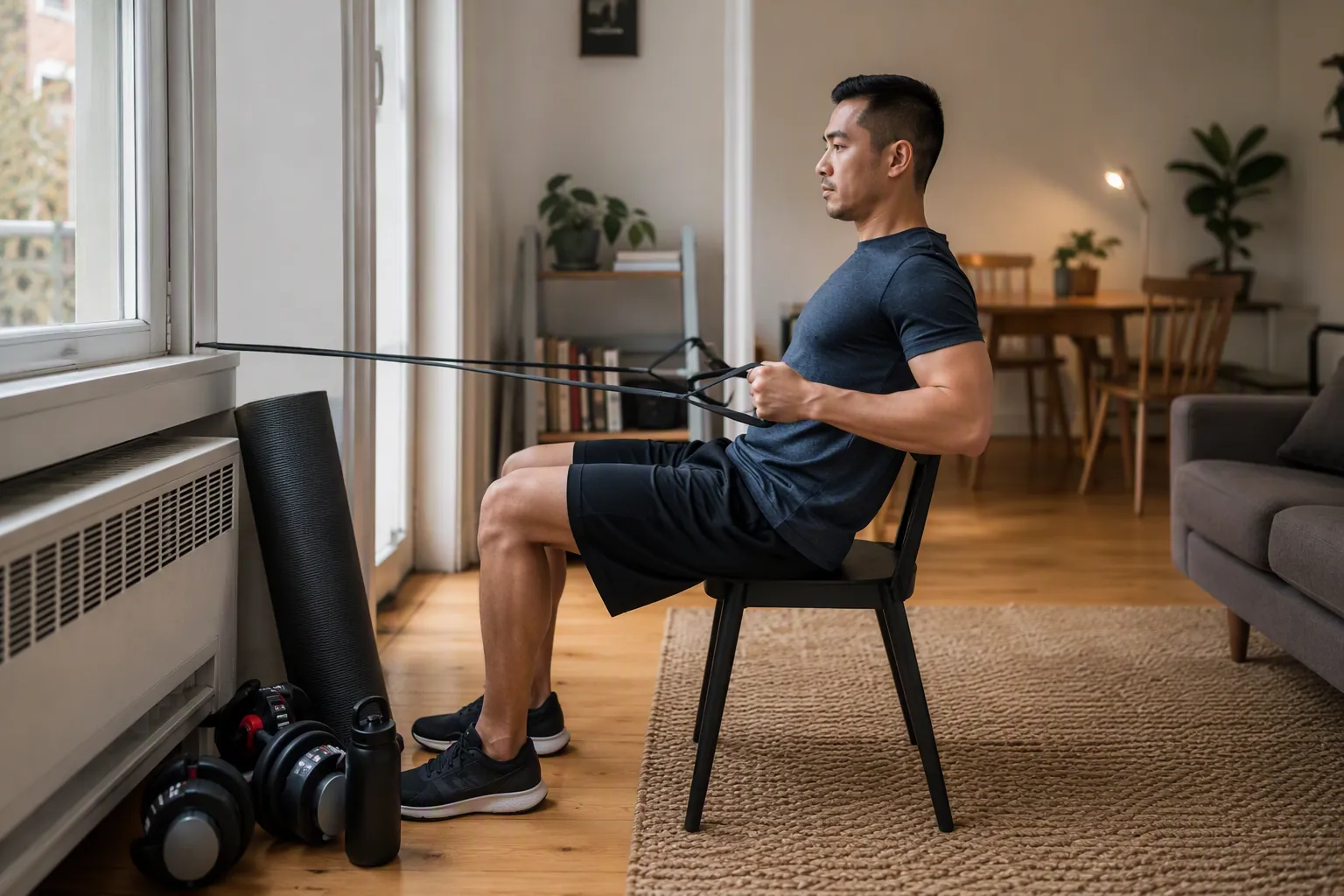
What changes in the living room
The first mistake is to make every home session about burning calories. On a GLP-1, appetite may be lower, meals may be smaller, and recovery may be less predictable. Long sweaty circuits can crowd out the very work that preserves function: squats, hinges, rows, presses, carries, and controlled core work.
A better starting point is two or three short strength sessions per week, often 20 to 30 minutes, with enough effort to challenge the muscles but not so much that the next day becomes unusable. Bands, adjustable dumbbells, a sturdy chair, and bodyweight variations are enough for this. The floor does not need to shake. The goal is repeated mechanical tension, not apartment-friendly theatrics.
- Use chair-supported squats or sit-to-stands instead of jump squats when energy or balance is off.
- Use band rows, one-arm dumbbell rows, or towel-assisted rows so pulling work does not disappear.
- Use Romanian deadlifts with light dumbbells, a backpack, or a slow hip-hinge pattern before loading heavily.
- Use wall push-ups, counter push-ups, floor push-ups, or dumbbell floor presses depending on strength and nausea tolerance.
- Use suitcase carries in a hallway or marching holds in place if space allows, but skip them on dizzy days.
Progression can be boring and still work: one more rep, one slower lowering phase, one slightly heavier dumbbell, one more set after a week that felt stable. If you are older or returning after a long break, the pattern in this simple home muscle-maintenance routine after 50 is closer to what most people need than a punishing fat-loss circuit.
Fueling has to become deliberate
Lower appetite can make protein accidental. That is a problem for strength training because the muscle-preserving signal is not just the workout; it is the workout plus enough recovery material. This does not require forcing down a giant meal before training. It may mean placing protein earlier in the day, using smaller protein servings, or pairing a short session with a tolerable post-workout snack.
If you need a practical way to set that up without turning every meal into math, use this protein guide for people aging and training at home as the supporting piece. The important training habit is simple: do not let a suppressed appetite quietly turn strength sessions into under-fueled tests of willpower.
Fatigue: shorten the session before the routine collapses
Fatigue is one of the side effects most likely to break a home routine because nobody is waiting at the squat rack. Wegovy trial adverse-event reporting listed fatigue in about 11% of participants compared with about 5% on placebo, and patient-facing medical summaries often note that fatigue can be most noticeable during the first 4 to 8 weeks of dose titration. Those figures are trial adverse-event rates and general clinical reporting, not a prediction of what will happen to every person using a GLP-1. [5]
At home, fatigue usually shows up as a timing problem before it shows up as a training-program problem. A perfectly reasonable session written for 6:30 p.m. becomes impossible after a smaller lunch, a long workday, and a medication phase where energy is lower. The fix is not always a different exercise. Sometimes it is a different slot.
| Energy pattern | Better home-workout choice |
|---|---|
| Energy is best in the morning | Do 10–20 minutes of strength before the day drains the tank: two lower-body moves, one push, one pull, and stop while form is still clean |
| Energy dips after meals | Use an easy walk or mobility session after eating and save strength work for a steadier window |
| Evenings are unpredictable | Use a minimum session: one squat pattern, one row, one press, one hinge, one set each |
| Dose-titration weeks feel different | Keep the habit but reduce volume: fewer sets, slower tempo, longer rests, no high-impact finishers |
The “minimum session” matters. For a small-space workout, it might be eight chair squats, eight band rows, six counter push-ups, eight hip hinges, and a few minutes of easy walking around the room. That is not a complete long-term strength program. It is a bridge that keeps the movement pattern alive on a low-energy day.
Fatigue also changes rest intervals. A person who used to move quickly through circuits may need 60 to 120 seconds between sets, especially if food intake is lower. Longer rest is not laziness; it is a way to keep form safe when fuel and energy are less predictable.
What to cut first
When fatigue is the limiting side effect, cut the least useful stress first. That usually means removing jump intervals, burpee-style transitions, long finishers, and extra core circuits that leave you flattened but do not add much strength. Keep the basic strength patterns. Keep easy walking if it feels good. Keep mobility if it helps you start.
Recovery should become more visible during this phase. A short cooldown, a planned meal or snack, fluids, and sleep timing will do more for continuity than another “discipline” reminder. If recovery tends to be the part you skip, use this complete post-workout recovery routine at home as the checklist rather than adding more exercises.
Nausea and GI discomfort: move the workout away from the trigger
Nausea does not need a dramatic workout redesign every time. It often needs better placement. GLP-1 medications can slow digestion and change appetite, and many exercise guides for GLP-1 users advise adjusting workout timing, meal size, and intensity when GI symptoms interfere. [6]
In a cramped room, nausea has very specific enemies: fast up-and-down transitions, prone floor work, jumping, heavy bracing, and intense intervals too close to eating. A queasy stomach is usually not the day for mountain climbers, burpees, sit-ups, or a high-rep kettlebell-style finisher with a dumbbell.
- Train upright when possible: chair squats, wall push-ups, band rows, step-taps, or slow marching.
- Leave more space between meals and harder sessions; if you just ate, use a walk or light mobility instead of intervals.
- Avoid fast floor-to-standing transitions when nausea is active.
- Use nasal-breathing-paced walking or easy cycling if you have equipment, rather than a breathless circuit.
- Stop the session if nausea escalates instead of settling as you warm up.
A useful nausea-day session might be 5 minutes of easy walking indoors, 2 rounds of chair sit-to-stands, band rows, wall push-ups, and gentle calf raises, then a cooldown. It should feel like maintaining the habit, not proving you can out-train your stomach.
Dizziness and dehydration: make fluids and position changes part of the plan
Dizziness is where home workouts need stricter rules. Cleveland Clinic notes that people taking GLP-1 medications may have reduced thirst cues, so hydration often has to be scheduled rather than left to appetite or thirst. Electrolyte support may also help some people, especially when intake is lower or fluid loss is higher. [7]
The home environment can make dizziness more dangerous than it looks. A small room has coffee tables, rugs, pets, dumbbells on the floor, and walls close enough to meet quickly. The workout should reduce both the symptom and the consequences of a stumble.
- Keep water visible before the session starts, not in another room.
- Hydrate earlier in the day instead of trying to catch up during the workout.
- Use a chair, wall, or counter for support during lower-body work.
- Move gradually from floor to standing; avoid repeated plank-to-stand or burpee-style transitions.
- Skip hot rooms, heavy sweat sessions, and breathless intervals when lightheadedness is present.
- Put dumbbells and bands out of the walking path before starting.
Signs that should stop the workout and prompt clinician guidance include dizziness that does not settle, nausea that keeps worsening, trouble breathing, faintness, chest symptoms, or signs of low blood sugar such as shakiness, sweating, confusion, or sudden weakness. This is especially important for people who also use insulin or sulfonylureas, because hypoglycemia risk depends on the full medication picture, not just the workout.
A practical weekly structure while side effects are changing
The public-health target is still a useful destination: adults are generally advised to get 150 minutes per week of moderate-intensity aerobic activity, or 75 minutes of vigorous activity, plus muscle-strengthening work on 2 or more days per week. [8] For someone adjusting to a GLP-1, that target should behave like a direction of travel, not a pass-fail test during a nauseated first month.
A GLP-1-aware home week can start smaller:
- Two 20-minute strength sessions using chair-supported, band, dumbbell, or bodyweight movements.
- Two or three easy walks, indoor walking sessions, or low-impact cardio blocks of 10 to 20 minutes.
- One optional mobility or recovery session on a day when fatigue or nausea makes training intensity a bad trade.
- One fully flexible day reserved for symptoms, sleep debt, travel, or clinician-directed changes.
Exercise-and-GLP-1 reviews increasingly frame the better path as gradual movement, regular resistance training, and long-term maintenance rather than a temporary workout burst during weight loss. Codella and colleagues describe the future of GLP-1 care as one where lifestyle support remains central, including physical activity and resistance exercise. [3]
Maintenance matters because the routine has to survive beyond the active weight-loss phase. In the S-LiTE post-treatment analysis, weight-loss maintenance after stopping liraglutide was better supported when exercise remained part of the intervention than when medication was stopped without the same exercise support. The study is not a template for every home exerciser, but it reinforces the basic point: movement cannot be treated as disposable once the scale is moving. [9]
The safest home-fitness response is not to train through every side effect and not to let side effects erase the week. Keep the routine small enough to perform, strong enough to protect function, and flexible enough to pause when dizziness, worsening nausea, breathing trouble, or low-blood-sugar signs show up. GLP-1 side effects change the workout prescription; they do not automatically cancel movement.
References
- Exercise decreases among people taking GLP-1 medication. Endocrine Society. 2026. link
- A Perspective on Anti-Obesity Medications. American College of Sports Medicine. link
- GLP-1 agonists and exercise: the future of lifestyle prioritization. PMC. 2025. link
- Pros and cons of GLP-1 agonists for weight loss. Mayo Clinic Community Health. link
- GLP-1s and Energy Levels: Is Fatigue a Side Effect? Healthline. link
- Fitness for People Taking GLP-1 Agonists: A Comprehensive Guide. Mass General Brigham. link
- Why Exercise Is Important While Taking GLP-1s. Cleveland Clinic. link
- Adult Activity: An Overview. Centers for Disease Control and Prevention. link
- Healthy weight loss maintenance with exercise, GLP-1 receptor agonist, or both combined followed by one year without treatment: a post-treatment analysis of a randomised placebo-controlled trial. PMC. 2024. link
This is general fitness education, not medical advice. For diagnosis or treatment of pain or injury, consult a qualified clinician.
Pick your next session
Browse all routines to find an appropriately-spaced next session.
Spot something off?
This content sits adjacent to health guidance — tell us if a citation or figure needs a correction.