
How Much Protein Do You Need as You Age and Train at Home?
The standard protein RDA was never built for aging muscles, and training at home doesn't lower your needs. Aim for about 1.2–1.6 g per kg of body weight daily — roughly 90–120 g for a 165-lb person — spread as 25–30 g per meal, and pair it with progressive home strength work.
- Citation source
- Stanford Lifestyle Medicine
- Evidence level
- general guideline
If you’re asking how much protein for healthy aging and home workouts, start here: for healthy adults 50+ doing regular strength training at home, a practical working target is 1.2–1.6 grams of protein per kilogram of body weight per day. That is about 0.54–0.72 grams per pound, or roughly 90–120 grams per day for a 165-pound person. Stanford Lifestyle Medicine gives this same 1.2–1.6 g/kg/day range for adults 50+, including the 90–120 g/day example for a 165-pound adult. [1]
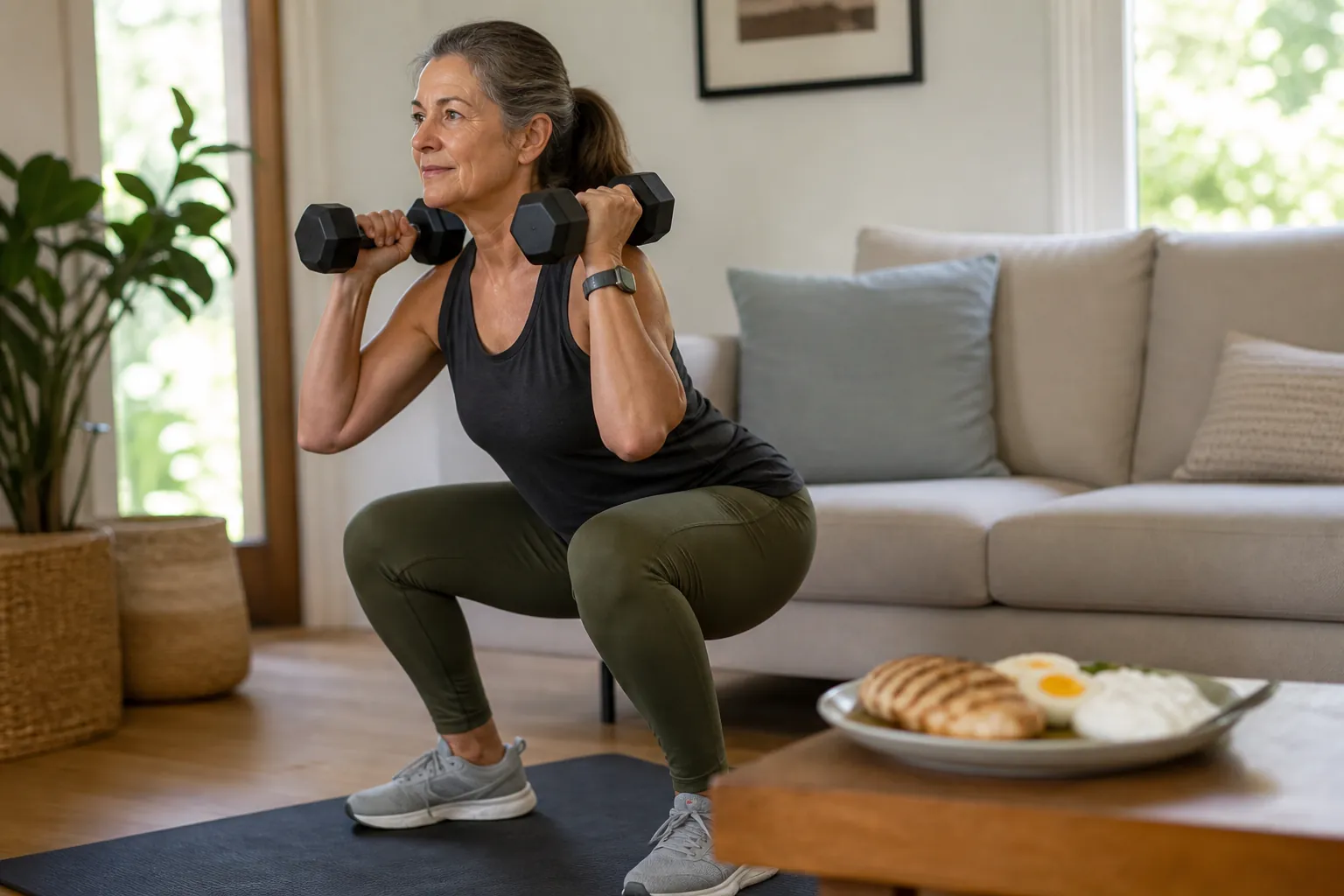
The easiest way to use the target is not to memorize kilograms. Find your body weight, pick the lower end if your training is modest or your appetite is limited, and move toward the higher end if you are consistently doing challenging resistance work and recovering well.
| Body weight | Approx. weight in kg | Daily protein at 1.2–1.6 g/kg | Simple meal target |
|---|---|---|---|
| 120 lb | 54 kg | 65–87 g/day | About 25–30 g at 2–3 meals, plus snacks as needed |
| 135 lb | 61 kg | 73–98 g/day | About 25–30 g at 3 meals |
| 150 lb | 68 kg | 82–109 g/day | About 25–30 g at 3 meals, plus a small add-on if needed |
| 165 lb | 75 kg | 90–120 g/day | About 30 g at 3 meals, plus optional snack or shake |
| 180 lb | 82 kg | 98–131 g/day | About 30 g at 3 meals, plus 10–40 g across snacks or recovery food |
| 200 lb | 91 kg | 109–145 g/day | About 30–40 g at 3 meals, plus snack support |
| 220 lb | 100 kg | 120–160 g/day | About 35–40 g at 3 meals, plus snack support |
For most people, the meal number matters more than the perfect daily decimal. A 90-gram day is much easier to hit as 30 grams at breakfast, 30 at lunch, and 30 at dinner than as a light breakfast followed by a heroic dinner plate.
The RDA did not change; the aging guidance is higher
This is where a lot of protein advice gets muddy. The official U.S. adult RDA is still 0.8 g/kg/day. It has not been raised to 1.2, 1.5, or 1.6. The problem is that the RDA is a baseline adequacy number for adults in general, not a practical target built around aging muscle, resistance training, and preserving strength.
| Guidance source | Population | Protein amount | What to do with it |
|---|---|---|---|
| Official adult RDA | Adults generally | 0.8 g/kg/day | Treat as a baseline, not the best working target for an older strength-training adult |
| ESPEN Expert Group | Healthy adults 65+ | 1.0–1.2 g/kg/day | Shows why aging-focused guidance commonly starts above the RDA |
| PROT-AGE Study Group | Older adults | 1.0–1.5 g/kg/day | Supports a higher range when aging muscle and function are the concern |
| Stanford Lifestyle Medicine | Adults 50+ | 1.2–1.6 g/kg/day | The cleanest fit for adults 50+ who train at home |
| NCOA | Older adults, including exercisers | About 1.0–1.2 g/kg/day for many adults 65+; up to about 1.5 g/kg/day for daily exercisers and about 1.7 g/kg/day for regular weight trainers | Useful context for active older adults, though 1.2–1.6 remains the defensible working range here |
ESPEN’s Expert Group recommended 1.0–1.2 g/kg/day for healthy people 65 and older, while the PROT-AGE Study Group recommendation is commonly reported as 1.0–1.5 g/kg/day for older adults. [2][3] NCOA gives a similar starting range of about 1.0–1.2 g/kg/day for adults 65+, with higher amounts for people who exercise daily or train with weights. [4]
So no, the official RDA did not disappear. It is just a poor stopping point for the person who is 58, doing squats with dumbbells in a spare room, and trying to keep muscle useful for the next decade.
Why aging muscle pushes the target up
The reason to aim higher is not that older adults suddenly need to eat like bodybuilders. It is that aging muscle becomes less responsive to the same protein and exercise signals. Paddon-Jones and Rasmussen describe muscle mass declining by about 3–8% per decade after age 30, and Harvard Health notes that adults who skip strength training may lose roughly 4–6 pounds of muscle per decade. [5][6]
That does not mean decline is automatic or that protein fixes it by itself. It does mean the old “just meet the RDA” answer is too casual for many active older adults. Many are not even clearing baseline advice: Harvard cites a study of about 12,000 adults in which roughly 46% of adults 51+ did not meet daily protein recommendations, and NCOA cites NHANES analysis suggesting about 1 in 3 adults over 50 fall short. [6][4]
That gap matters most when someone is already training. A low-protein breakfast, a salad with little protein at lunch, and most of the day’s protein at dinner may technically include “healthy foods,” but it does not give aging muscle many strong opportunities across the day to repair and adapt.
Training at home does not make the target less serious
A home workout is not automatically light exercise. A set of controlled split squats, push-ups to a hard variation, heavy band rows, or dumbbell Romanian deadlifts can be real resistance training. The room does not decide the protein target. The stimulus does.
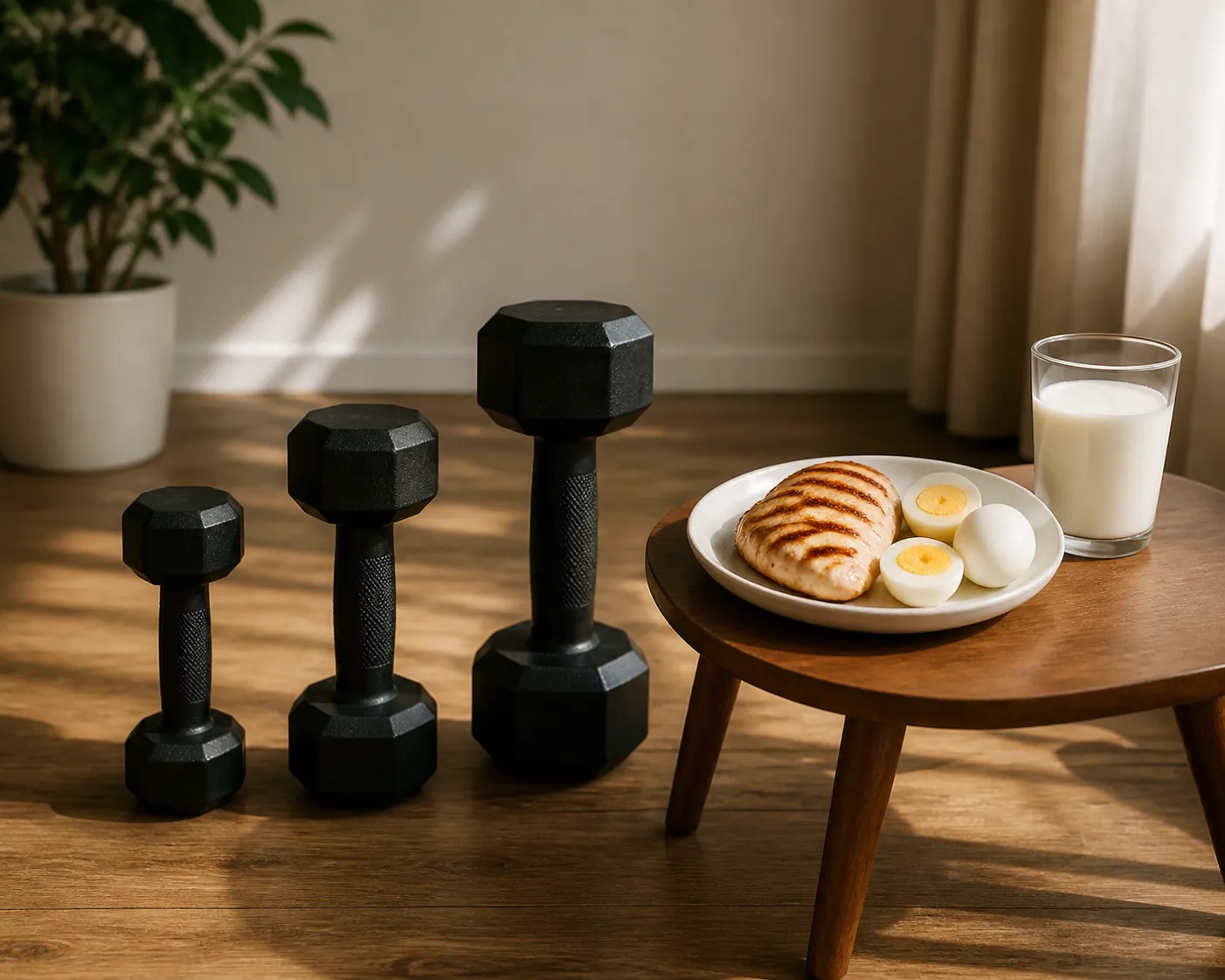
The catch is that the stimulus has to progress. If the same band circuit has felt easy for six months, extra protein has little reason to become new muscle. Progressive home training can mean adding reps, slowing the lowering phase, choosing a harder variation, increasing dumbbell load, shortening rest periods carefully, or adding another challenging set when recovery allows.
The protein-and-training evidence supports that pairing. A 2022 meta-analysis of 74 randomized controlled trials found that extra protein combined with resistance exercise produced small additional lean-mass gains, about 0.5–0.7 kg over control conditions. In adults 65+, the benefit was seen at protein intakes around 1.2–1.59 g/kg/day. The same analysis found no significant lean-mass increase from protein supplementation without resistance exercise. [7]
That is the sensible middle: protein is not magic powder, and home training is not pretend training. Protein supplies the material. Progressive resistance work gives the body a reason to use it.
Use 25–30 grams per meal as the daily anchor
A daily protein target only helps if it survives breakfast. For older adults, a practical anchor is about 25–30 grams of protein at each main meal. Paddon-Jones and Rasmussen describe about 25–30 grams per meal as a useful dose for stimulating muscle protein synthesis in both younger and older adults, while noting that older adults may have a blunted response below about 20 grams. [5]
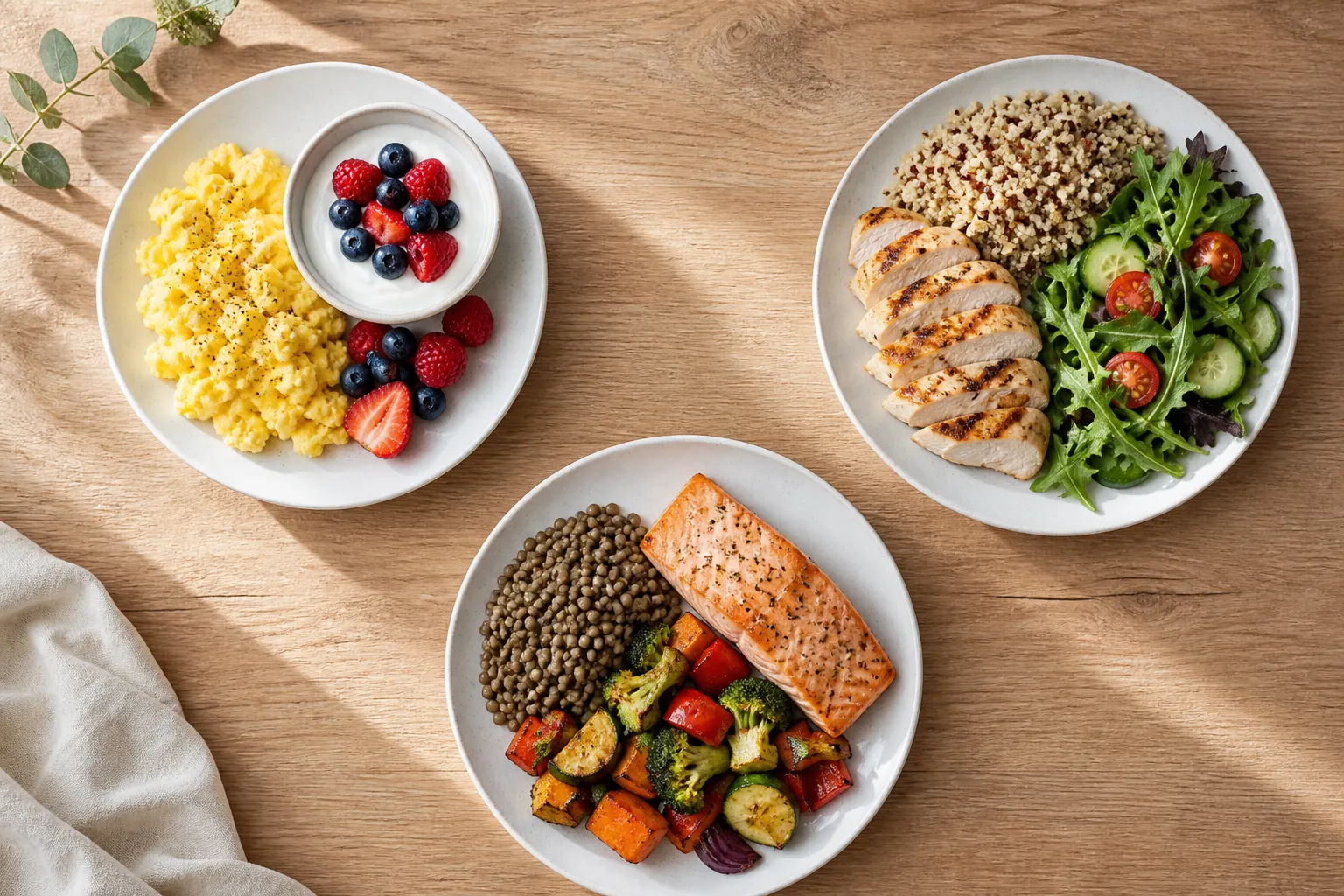
For a 165-pound person aiming for 90–120 grams per day, the day could be as simple as 30 grams at breakfast, 30 at lunch, 30 at dinner, and then an extra snack, shake, or larger meal portion if the higher end is appropriate. The exact foods can vary. Eggs plus Greek yogurt, chicken or tuna at lunch, salmon with lentils at dinner, milk, tofu, cottage cheese, or a protein shake can all fit the math.
Active-aging guidance summarized by GSSI also emphasizes protein at breakfast, at least 30 grams at main meals, and 30–40 grams after exercise in some contexts. [8] The post-workout number is worth knowing, but it should not distract from the bigger fix for most people: stop back-loading nearly all protein into dinner.
If you want the timing question separated from the daily target, use Do You Need a Post-Workout Protein Shake at Home? for the shake-and-window issue. For food-level examples, high-protein tuna salad and spicy rigatoni meal prep are better places to get into actual plates.
A quick way to set your own number
If you do not want to use the table, calculate it once:
- Divide your body weight in pounds by 2.2 to estimate kilograms.
- Multiply that number by 1.2 for the lower end of the daily target.
- Multiply it by 1.6 for the higher end.
- Spread the result across meals, using roughly 25–30 grams per meal as the first anchor.
Example: a 165-pound adult is about 75 kg. Seventy-five times 1.2 is 90; 75 times 1.6 is 120. That person’s working range is therefore about 90–120 grams per day.
Do not make the high end a personality test. The higher end makes the most sense when training is consistent, meals are tolerated well, and total calories are not being cut so aggressively that recovery suffers. If appetite, budget, digestion, or medication schedules make the high end unrealistic, a steady lower-end target spread across the day is still far more useful than vague intentions.
What this advice does not prove
The evidence behind per-meal dosing and post-exercise protein is not a perfect mirror of every living-room workout. Much of it comes from supervised resistance-training studies, often in men, and many protocols look more like gym training than a band-and-dumbbell session at home. Applying the 25–30 gram meal anchor and the 1.2–1.6 g/kg/day daily range to home training is a reasonable synthesis, not proof from a large trial of older adults doing exactly your workout in exactly your spare room.
Protein source is also a separate question. Whey, dairy, eggs, fish, poultry, soy, legumes, and other proteins can all contribute. If you are comparing newer options or supplements, Can insect protein build muscle at home? is the better place for that source-by-source discussion.
The training plan itself matters just as much. If your home workouts need to become more progressive, especially around midlife hormonal changes, see A Perimenopause Strength Training Routine You Can Do at Home.
Medical caveat before you push protein higher
This target is for generally healthy adults. If you have kidney disease, significant kidney concerns, or a condition that requires protein restriction, do not raise protein intake on your own. ESPEN notes that severe chronic kidney disease may warrant lower protein intake, and Harvard Health flags very high protein intakes for people with kidney conditions. [2][6] A clinician or registered dietitian nutritionist can help set a safer range.
For a healthy adult over 50 who trains at home, 1.2–1.6 g/kg/day is the defensible working target. Keep it practical: calculate the number once, build meals around 25–30 grams of protein, and make the home strength work progressive enough that the extra protein has a job to do.
References
- Protein Needs for Adults 50+, Stanford Lifestyle Medicine.
- Protein intake and exercise for optimal muscle function with aging: recommendations from the ESPEN Expert Group, Clinical Nutrition, 2014.
- Protein intake recommendations for older adults in international clinical nutrition guidance, Groenendijk et al., 2024.
- How Much Protein Do Older Adults Need?, National Council on Aging.
- Dietary protein recommendations and the prevention of sarcopenia, Current Opinion in Clinical Nutrition and Metabolic Care, 2009.
- Muscle loss and protein needs in older adults, Harvard Health Publishing.
- Systematic review and meta-analysis of protein intake to support muscle mass and function in healthy adults, Nunes et al., 2022.
- SSE #160: Dietary Protein to Support Active Aging, Gatorade Sports Science Institute.
This is general fitness education, not medical advice. For diagnosis or treatment of pain or injury, consult a qualified clinician.
Pick your next session
Browse all routines to find an appropriately-spaced next session.
Spot something off?
This content sits adjacent to health guidance — tell us if a citation or figure needs a correction.