
Pair GLP-1 Weight Loss With Joint-Friendly Home Workouts
Preliminary ENDO 2026 findings link the biggest post-GLP-1 drops in daily steps and activity to joint and muscle pain — the very people who need exercise most. This article turns that evidence into a joint-friendly home protocol: incremental walking, daily mobility, and two low-noise resistance-band sessions a week that protect muscle without gym equipment.
- Citation source
- ACSM and CDC
- Evidence level
- General guideline
- Recommended frequency
- 2 resistance-band sessions/week; daily 5-10 min mobility; short walking bouts
The most discouraging version of pairing GLP-1 weight loss with home workouts is the one where the medication is working, the scale is moving, and your step count is quietly sinking. The watch keeps asking for more. Your knees, hips, feet, back, or shoulders keep answering no.
That mismatch is not just a motivation problem. Preliminary research presented at ENDO 2026 looked at 753 people who started a GLP-1 medication and had Fitbit data through the All of Us Research Program. In that study-specific group, participants averaged about 52.7 years old and 78.6% were female; daily steps fell from 5,047 before initiation to 4,487 after initiation, while moderate-to-vigorous physical activity dropped from about 28 minutes a day to about 22 minutes a day. The largest activity declines were reported among men and people who reported joint or muscle pain.[1]
That last detail matters. The people most often told to “exercise more” during weight loss may be the same people for whom the usual advice — walk farther, push harder, add a gym plan — is least usable on an ordinary Tuesday morning. ENDO 2026 is conference research, not a peer-reviewed final answer, so it should not be treated as a settled portrait of every GLP-1 user. But it does name a problem many beginners already feel: pain changes whether a plan survives contact with real life.
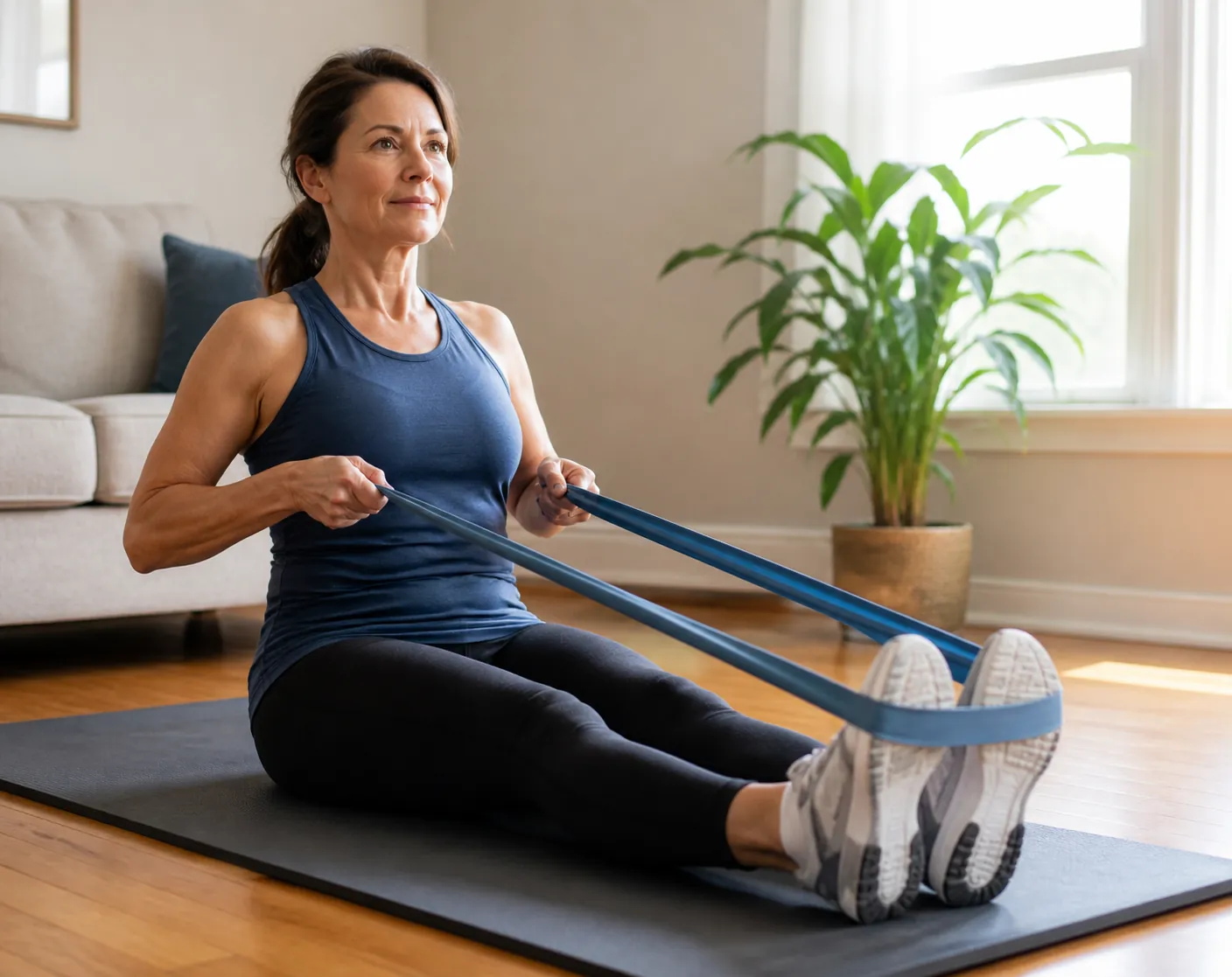
The answer is not to grit your teeth through sharp pain, and it is not to quit movement until your joints feel perfect. The useful middle is a home plan that changes the dose, the surface, and the tool: short walking exposures, daily mobility or range-of-motion work, and two quiet resistance-band sessions each week.
The week has three jobs, not one heroic workout
Adult activity guidance still points toward aerobic work plus muscle strengthening. The CDC recommends 150 minutes a week of moderate-intensity activity and muscle-strengthening work on 2 days a week that trains all major muscle groups.[2] The useful update for home exercisers is that the ACSM’s 2026 resistance-training guidance treats elastic bands, bodyweight, and home routines as legitimate training tools that can improve strength, hypertrophy, and function; they are not consolation prizes for people who failed to join a gym.[3]
For a GLP-1 user whose joints hurt, the weekly structure can stay simple:
| Training job | Home version | Pain-friendly rule |
|---|---|---|
| Aerobic exposure | Short walks indoors, outside, or split across the day | Start below the point where pain changes your gait |
| Joint motion | Daily 5–10 minutes of mobility or range-of-motion | Move slowly enough that you can notice the joint’s response |
| Muscle preservation | Two resistance-band sessions per week | Use seated, supported, and low-grip options when needed |
If you want the broader dosing picture for cardio, the internal guide on how much home cardio you actually need can sit beside this plan. Here, the priority is narrower: keep movement present when pain would otherwise push the whole routine off the calendar.
Restart walking as adjustable exposure
A falling step count can feel like evidence that you are failing. It is more useful to treat it as a load signal. If a single 25-minute walk leaves your knee irritated for the rest of the day, the fix is not automatically more discipline; it may be two 5-minute walks, a flatter route, different shoes, or a hallway loop instead of stairs.
Arthritis walking plans often start smaller than healthy fitness culture likes to admit. One 4-week CreakyJoints walking plan begins with two 5-minute walks and progresses toward three 10-minute walks by week 4, with 1- to 2-minute “step-it-down” alternatives when the planned walk is too much.[4] That is a good model for this situation because it does not make the step count sacred. It makes the return repeatable.
A joint-friendly restart can look like this:
- Pick a starting bout that feels almost too easy: 3–5 minutes after breakfast, after lunch, or when medication-related low energy is least intrusive.
- Repeat that bout for several days before adding time. Do not add time, speed, and hills in the same week.
- If pain changes your stride, shorten the walk immediately. Limping through a walk trains compensation, not fitness.
- If the floor is hard, try supportive shoes. If shoes bother your feet indoors and the surface is forgiving, socks may be enough for gentle hallway walking.
- For apartments, use a quiet loop: hallway, kitchen, living room, repeat. No marching, stomping, step-ups, or jumping required.
This is also where a tracker needs to become a notebook, not a judge. Record the bout length and how the joint feels later: settled, mildly irritated, or worse. A walk that causes dull discomfort during the first minute and then settles may be a different decision from a walk that produces sharp pain or swelling. Mayo Clinic’s arthritis exercise guidance supports low-impact movement, suggests heat before activity and ice afterward for up to about 20 minutes when useful, and gives a clear stop sign for sharp pain.[5]
If you prefer an outdoor progression once your joints are calmer, the same logic can carry over to accessible trail walking. If weather, safety, smoke, or neighbors make indoor movement the only realistic option, borrow the quiet-loop mindset from jump-free apartment workouts rather than waiting for perfect conditions.
Use bands for the muscle-preservation work
Walking helps, but it does not cover the whole muscle-preservation job. During GLP-1 weight loss, resistance training is the part of the plan that tells muscle it is still needed. A 2026 review on GLP-1 receptor agonists and muscle loss describes lean mass as commonly making up roughly one-quarter of weight lost and points to resistance training as a key protective strategy; if you want the protein and lean-mass math, use the separate GLP-1 muscle-preservation guide rather than trying to solve nutrition inside every workout.[6]
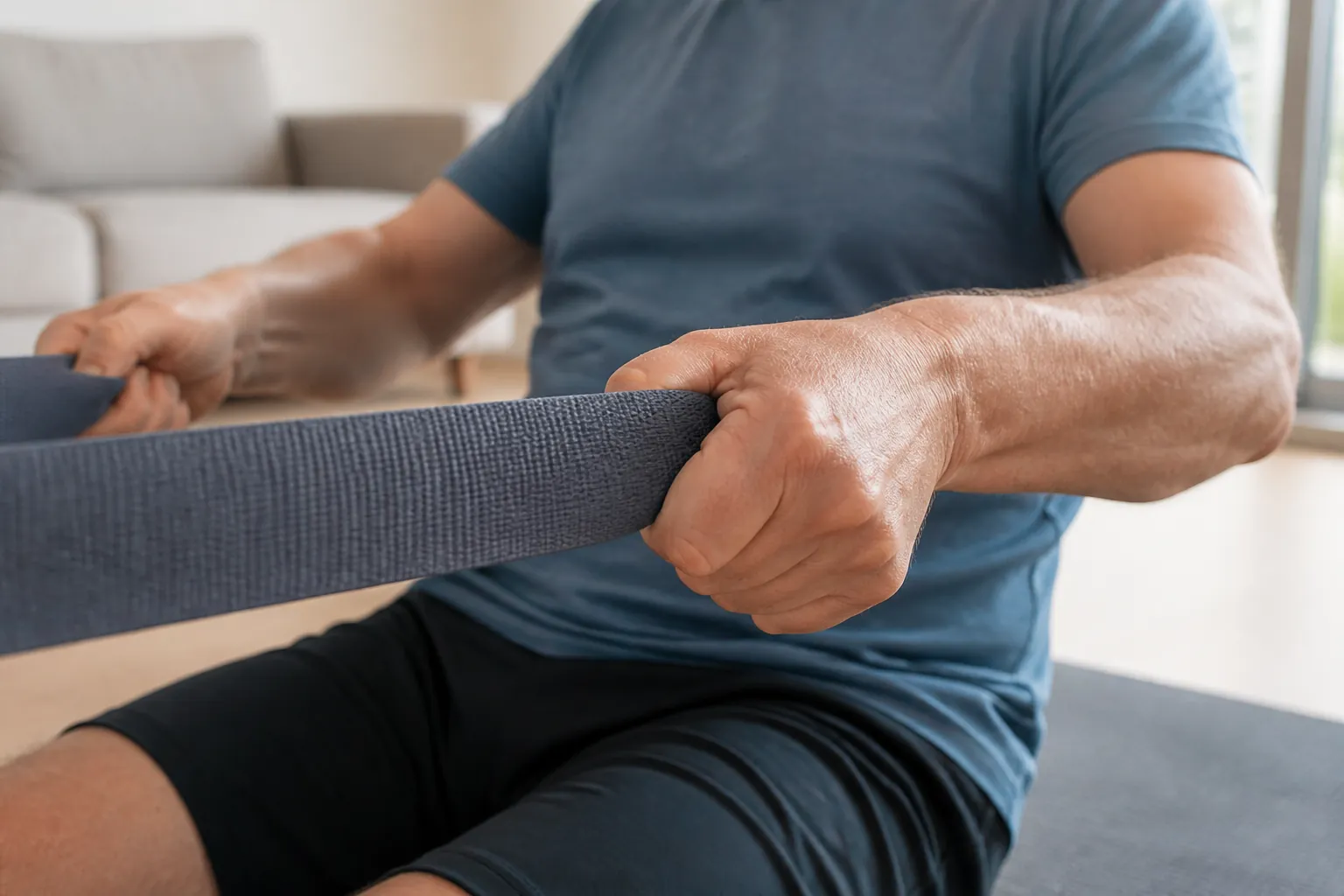
Bands are especially useful here because they can be quiet, cheap, low-footprint, and adjustable. They also let you train seated when knees, balance, fatigue, or downstairs neighbors make standing work a bad idea. Arthritis UK’s resistance-band guidance includes seated routines and grip modifications such as placing the band over the back of the hand or using palm-based grips rather than forcing painful finger clenching.[7]
A two-day band template
Do this twice a week, with at least a day between sessions. The goal is not to feel destroyed afterward. The goal is to train the major patterns often enough that your body has a reason to keep strength while weight is coming down.
- Seated band row: Loop the band around both feet, sit tall, and pull elbows back. If hands ache, use a wider band or wrap it across the palm instead of gripping hard.
- Seated band chest press: Wrap the band around your upper back and press forward. Keep the shoulders low; stop if the front of the shoulder pinches.
- Sit-to-stand or supported chair squat: Use a chair and a countertop if knees need support. If this flares your knees, swap for seated knee extensions without a band.
- Seated or standing band hip abduction: Place the band above the knees if comfortable and press knees gently apart. Keep the range small if hips or knees complain.
- Band pull-apart or external rotation: Use a light band. Think posture and shoulder control, not maximum stretch.
- Heel raises at a counter or seated calf raises: Quiet, small, and useful for lower-leg strength without impact.
For most beginners, one set of each move is enough on the first week. If the joints tolerate it, build toward 1–3 sets of 8–12 repetitions, a range also used in arthritis exercise programming that includes strength work 2–3 times per week.[8] Stop the set with a few good repetitions still available. Bands make it tempting to keep stretching until the movement looks dramatic; painful range is not better range.
A quiet setup matters. Use a mat only where it helps with foot traction or floor comfort; you do not need to live on the floor. Do not anchor a band in a door, around a railing, or on furniture unless the anchor is genuinely secure and cannot snap back. A seated row around the feet is less glamorous than a door-anchored cable imitation, but it is also less likely to damage a rental or surprise your face.
If you already have a general weekly GLP-1 routine, this band plan can replace the strength days in your home routine during GLP-1 weight loss. The substitution is the point: when joints hurt, the plan should become more usable, not more punishing.
Mobility is the daily minimum, not a warm-up you skip forever
Mobility is easy to oversell and easy to dismiss. It will not replace strength training. It will not magically erase arthritis. Its real value is smaller and more practical: it keeps joints moving on days when a walk or band session feels like too much.
Use 5–10 minutes. Sit or stand near support. Move slowly enough that you can feel whether the joint is warming up or warning you.
- Neck turns and shoulder rolls for upper-back stiffness.
- Seated cat-cow or gentle torso rotations for the spine.
- Ankle circles and heel-toe rocks for feet and calves.
- Seated knee extensions through a comfortable range.
- Supported hip shifts or small side steps if standing feels safe.
On a low-energy day, this may be the whole session. That is not a failure of the plan; it is the plan having a lower setting. If you can add a 3-minute walk afterward, add it. If not, stop there and try the next scheduled piece tomorrow.
The decision rule: scale, swap, or stop
Pain does not always mean danger, but it does deserve information-gathering. The plan needs a rule you can use mid-session, not a lecture you remember later.
- Scale if the discomfort is dull, familiar, and settles as you warm up: reduce the range, slow down, use a lighter band, or split the walk.
- Swap if the movement keeps irritating the same joint: seated row instead of standing row, mobility instead of a walk, chair-supported work instead of unsupported squats.
- Stop if pain is sharp, worsening, changes your gait, causes unusual swelling, or feels medically concerning. That is clinician territory, not a home-workout character test.
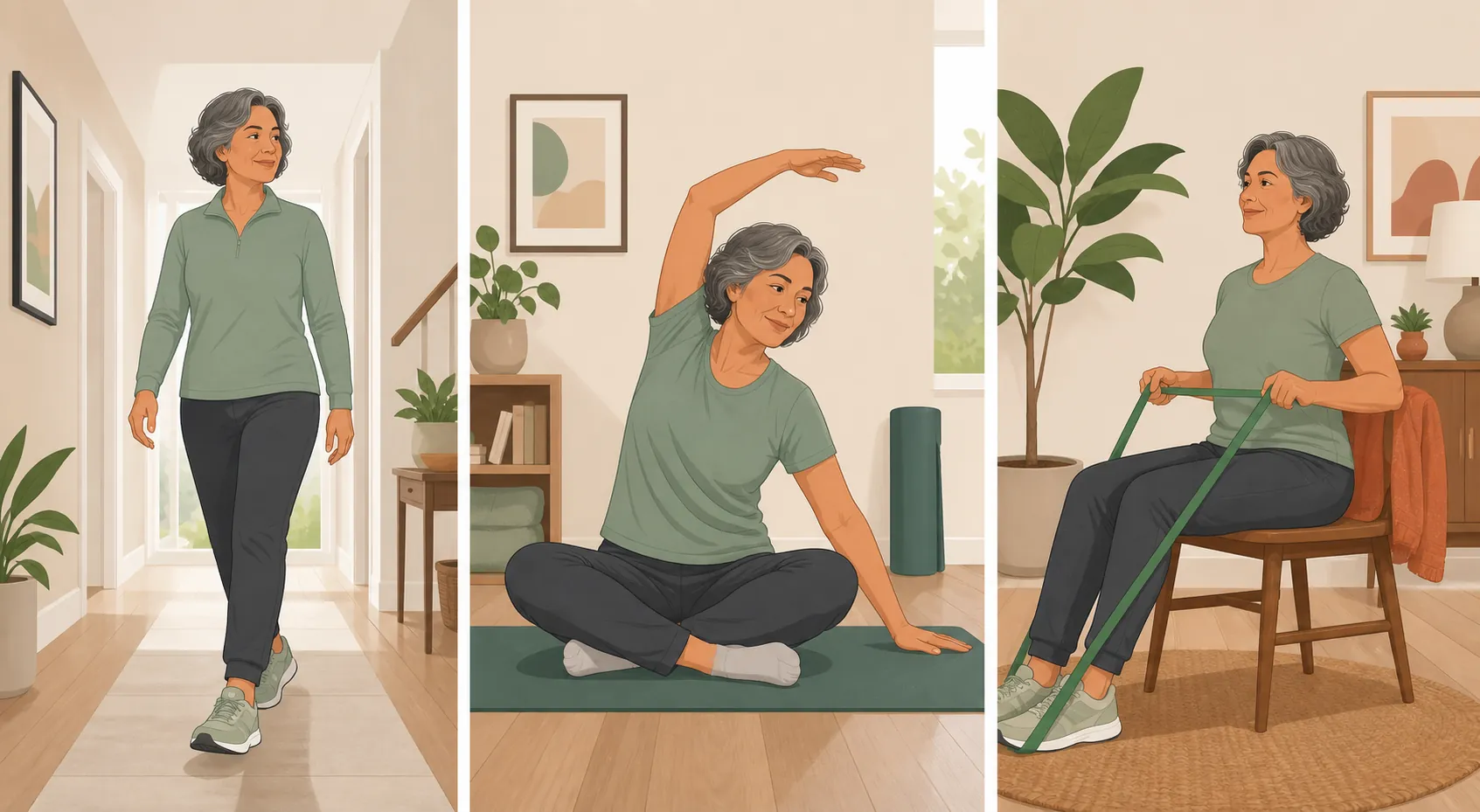
The practical goal is to keep movement in the week while changing the dose. A shorter walk still counts as exposure. A seated band row still counts as strength work. A mobility-only day still keeps the routine alive. For GLP-1 weight loss paired with home workouts, that is often the difference between a plan that looks impressive and a plan that is still happening next month.
References
- Exercise decreases among people taking GLP-1 medication — Endocrine Society, June 2026
- Adult Activity: An Overview — CDC
- ACSM Publishes Updated Resistance Training Guidelines — ACSM, 2026
- Walking Plan for Arthritis — CreakyJoints
- Arthritis pain: Do's and don'ts — Mayo Clinic
- Muscle loss and GLP-1R agonists use — Acta Diabetologica, 2026
- Resistance band workouts for people with arthritis — Arthritis UK, February 2024
- 30-Day Exercise Challenge for Arthritis — Arthritis Research Canada
This is general fitness education, not medical advice. For diagnosis or treatment of pain or injury, consult a qualified clinician.
Pick your next session
Browse all routines to find an appropriately-spaced next session.
Spot something off?
This content sits adjacent to health guidance — tell us if a citation or figure needs a correction.