
How to Preserve Muscle During GLP-1 Weight Loss at Home
About 26–40% of the weight lost on semaglutide or tirzepatide can be lean tissue, but that figure overstates true muscle loss and the major trials included no structured training. This guide turns the trial numbers into a concrete at-home plan — full-body resistance training at least twice a week plus 1.2–1.6 g/kg of protein per day — for protecting muscle while losing weight.
- Citation source
- ACSM
- Evidence level
- Restrained inference from ACSM position stand
- Recommended frequency
- At least 2 full-body sessions per week on nonconsecutive days
The number that usually brings people here is not made up: in DXA body-composition substudies, roughly 26–40% of the weight lost with tirzepatide or semaglutide showed up as lean soft tissue rather than fat. In the STEP-1 semaglutide substudy, participants lost about 6.9 kg of lean soft tissue alongside about 10.4 kg of fat; in the SURMOUNT-1 tirzepatide substudy, participants lost about 5.6 kg of lean soft tissue alongside about 15.9 kg of fat.[1]
That is enough to take seriously. It is not enough to conclude that a GLP-1 medication is “melting muscle.” DXA lean mass is not the same thing as contractile muscle, and the major semaglutide and tirzepatide weight-loss trials did not test a structured resistance-training plan against doing nothing. So the practical question is narrower and more useful: during GLP-1 weight loss, what can you do at home this week to give your body a reason to keep strength-producing tissue?
What the lean-mass number does — and does not — mean
DXA is useful, but its “lean soft tissue” bucket is broad. It includes muscle, but it also includes organs, body water, connective tissue, and fluid inside fat tissue. During weight loss, especially fast weight loss, changes in glycogen and water can move the DXA number without representing a direct loss of muscle fibers.
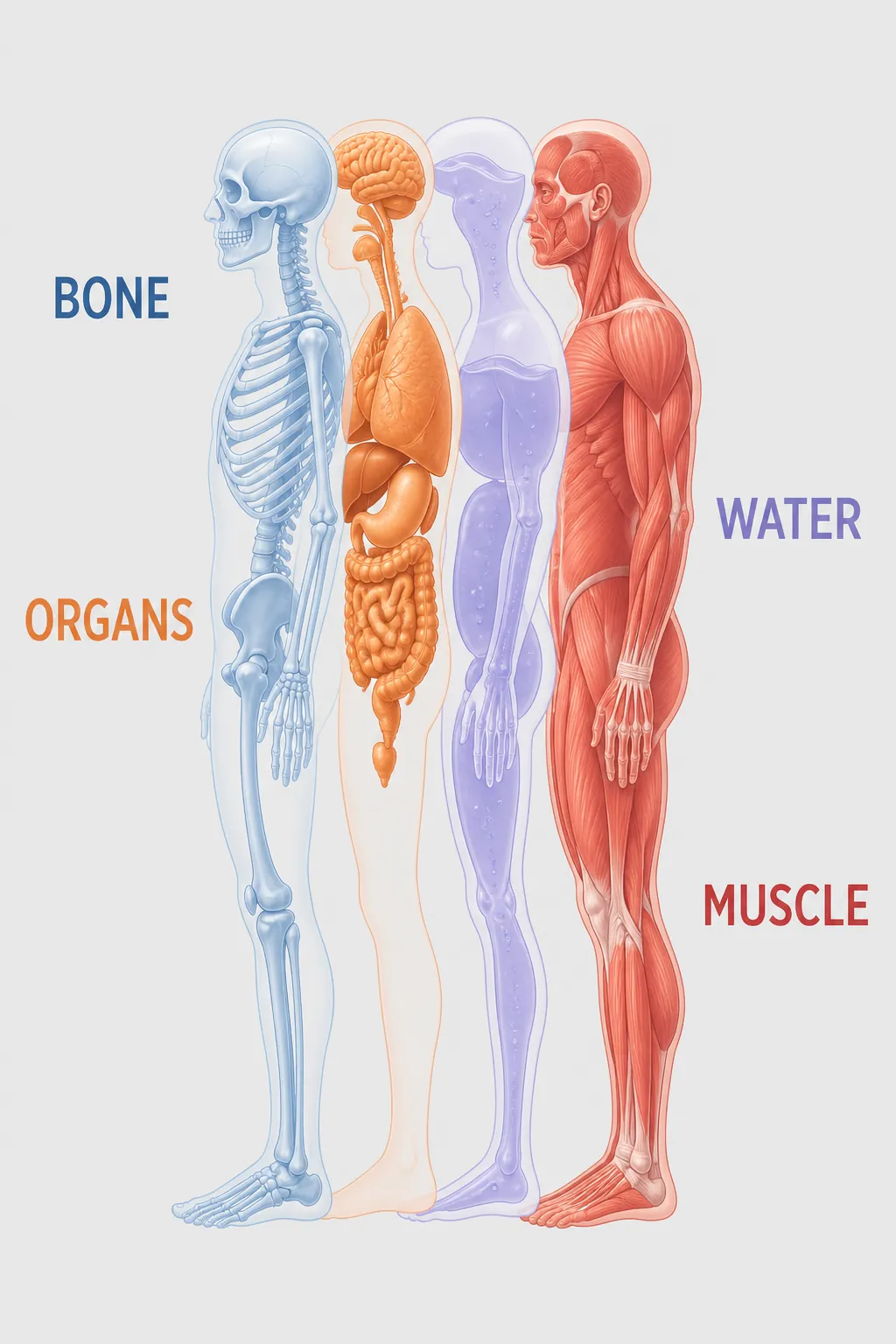
That distinction matters because the percentage can sound worse than the lived reality. A person may see “40% lean mass” and imagine that almost half of the weight loss came from biceps, glutes, and thighs. The measurement cannot support that conclusion. It says a portion of the weight change was non-fat tissue by DXA, not that the same portion was usable skeletal muscle.
The range also varies by source and trial. A systematic review of semaglutide body-composition studies reported lean-loss fractions ranging from about 0% to 40%, which is one reason single-number headlines are shaky.[2] Expert discussions have still treated the signal as clinically relevant: one 2024 roundtable estimated about 10% muscle-mass loss over 68–72 weeks in some GLP-1 weight-loss contexts, comparing that magnitude to roughly two decades of age-related muscle loss at 3–5% per decade.[3]
There is another useful check on the panic: imaging that looks more directly at muscle can tell a less dramatic story. In an MRI analysis from SURPASS-3, thigh muscle volume decreased by 0.64 L with tirzepatide, a change the authors reported as broadly consistent with population-based predictions for the amount of weight lost, while muscle fat infiltration improved.[4] That does not erase the need to train. It does argue against treating every DXA lean-mass kilogram as the same as lost functional muscle.
The missing piece in the big GLP-1 trials
The STEP-1 and SURMOUNT-1 body-composition findings are often discussed as though they reveal what happens when someone takes a GLP-1 medication and does a serious muscle-preservation program. They do not. The major semaglutide and tirzepatide trials were not designed to test a structured, progressive resistance-training countermeasure.
That leaves an evidence gap. No published randomized controlled trial has yet shown that a specific home lifting plan prevents lean-mass loss in adults taking semaglutide or tirzepatide for weight loss. The best answer has to be built from adjacent evidence: resistance training preserves and builds strength and muscle during energy deficit in broader populations, protein supports lean-tissue retention, and the GLP-1 trials show that doing nothing deliberate about lean mass is not a great bet.
There is a small direct clue, but it should stay small. A 2025 case series followed three people using GLP-1 medications who performed home-style training 3–5 days per week with bodyweight work, free weights, and bands over 39–139 weeks; they preserved or added lean soft tissue.[1] That is encouraging documentation, not proof that the same result will happen for most people.
The home plan: two full-body sessions per week
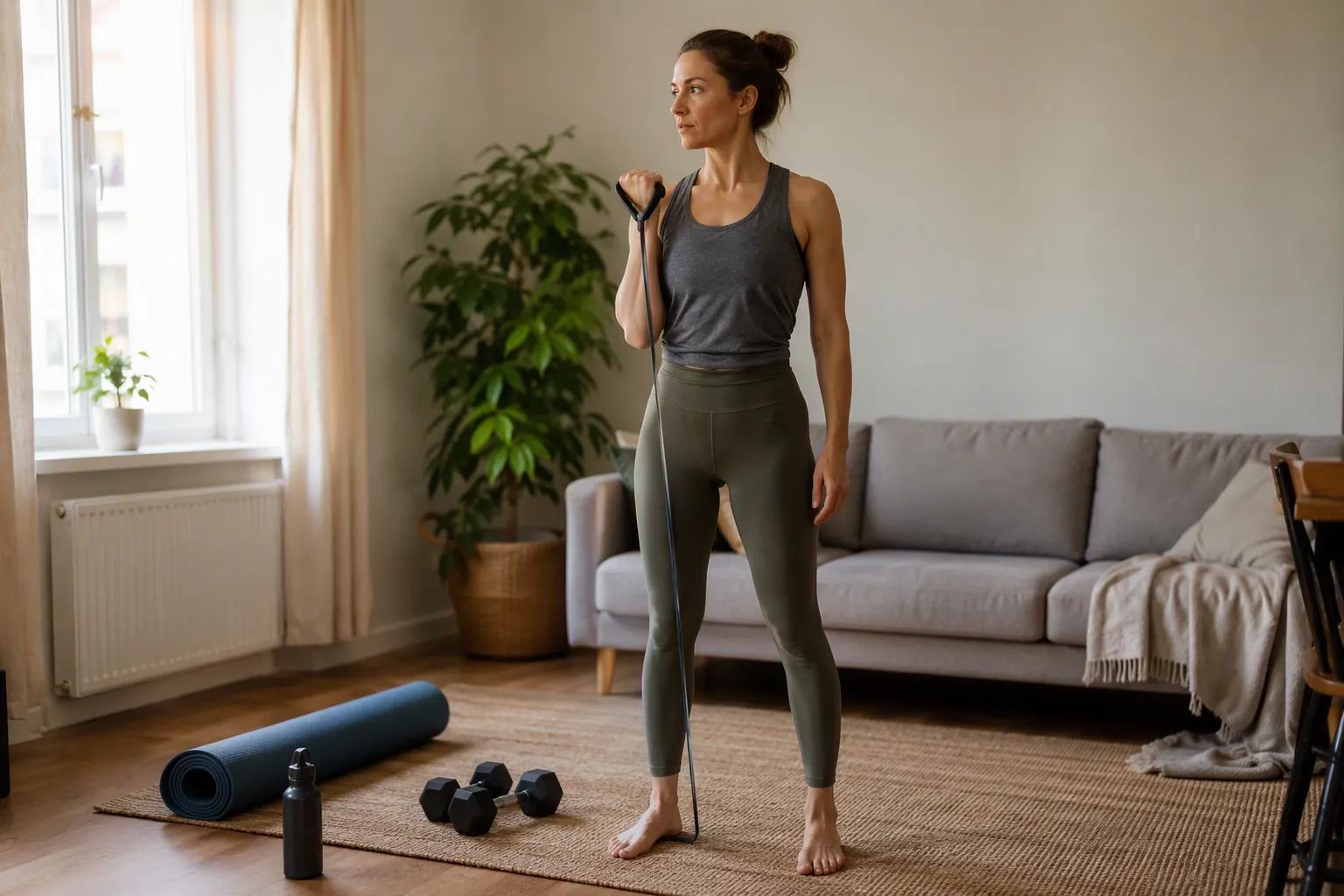
The minimum worth building around is simple: train all major muscle groups at least twice weekly. The 2026 American College of Sports Medicine position stand, which synthesized 137 systematic reviews with more than 30,000 participants, supports resistance training for strength, hypertrophy, and physical function, including home-based and elastic-band training, and recommends about 2–3 sets per exercise for major muscle groups.[5]
For GLP-1 weight loss at home, that turns into two full-body sessions rather than a six-day bodybuilding split. The goal is not to spend more calories. The goal is to send repeated mechanical signals to the muscles most likely to go underused when appetite, food intake, and daily energy drop.
| Movement pattern | Home options | What it covers |
|---|---|---|
| Squat or sit-to-stand | Chair squat, goblet squat, band squat | Quads, glutes, trunk |
| Hip hinge | Dumbbell Romanian deadlift, band good morning, hip bridge | Glutes, hamstrings, back of hips |
| Push | Incline push-up, floor press, band chest press | Chest, shoulders, triceps |
| Pull | Band row, one-arm dumbbell row, towel-supported row variation | Upper back, rear shoulders, biceps |
| Carry or trunk brace | Suitcase carry, dead bug, side plank | Grip, abs, obliques, posture muscles |
| Calf or small lower-leg work | Standing calf raise, single-leg calf raise | Calves and ankle support |
A workable session can be as plain as this: choose one exercise from each row, do 2 sets the first week, and use a load or variation that leaves about 2–3 good reps in reserve. You should finish a set knowing you worked, not needing to sit on the floor for five minutes. The ACSM position stand supports effort that is challenging without requiring routine training to failure.[5]
A twice-weekly template
| Exercise | Sets | Reps or time | Effort target |
|---|---|---|---|
| Chair squat or goblet squat | 2–3 | 8–12 reps | Stop with 2–3 reps in reserve |
| Dumbbell Romanian deadlift or hip bridge | 2–3 | 8–12 reps | Controlled lowering, no back strain |
| Incline push-up or floor press | 2–3 | 6–12 reps | Hard but repeatable |
| Band row or one-arm dumbbell row | 2–3 | 8–15 reps | Pause briefly at the top |
| Suitcase carry, dead bug, or side plank | 2 | 20–45 seconds | Steady breathing, no shaking collapse |
| Standing calf raise | 2 | 10–20 reps | Full range, controlled pace |
Do that on two nonconsecutive days if possible. Monday and Thursday works. Tuesday and Saturday works. If nausea or fatigue makes one session shorter, keep the movement coverage and reduce the sets. One set of squats, hinges, pushes, and pulls is more useful than postponing the whole plan until you feel like the person in a fitness ad.
Progression without turning your bedroom into a gym
Muscle-preservation training needs a reason to adapt. That does not mean every workout must be heavier. It means the body cannot receive the exact same easy signal for months while weight is falling.
- First, make the exercise cleaner: steadier tempo, fuller range of motion, less wobbling.
- Then add reps inside the target range, such as moving from 8 reps to 12 reps.
- Then add a third set to the main movements if recovery is fine.
- Then increase resistance: a thicker band, a heavier dumbbell, a slower lowering phase, or a harder bodyweight angle.
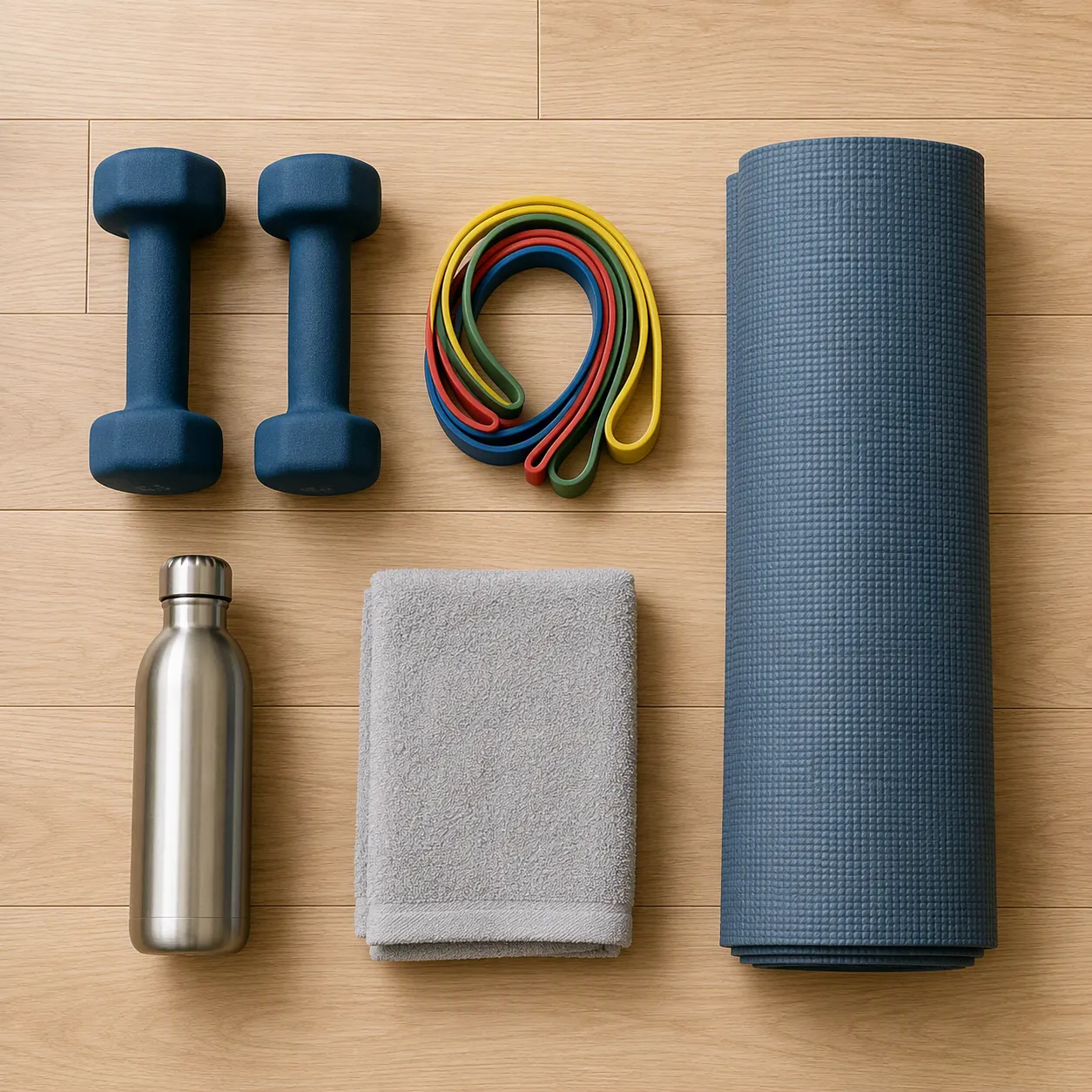
Bands, bodyweight, and dumbbells all fit the job. The ACSM evidence base includes home-based and elastic-band resistance training, so the starting point does not have to be a rack, barbell, or gym membership.[5] If you want a ready-made progression by gear level, use a home gym workout plan by equipment tier rather than shopping first and training later.
For people with almost no equipment, upper-body pulling is usually the missing piece. Push-ups are easy to imagine; rows are the movement people skip. A band anchored safely in a door, a one-arm dumbbell row, or a controlled bodyweight row variation fills that gap. For more options, a no-equipment upper-body workout can help you build around push and pull patterns.
For lower body, do not let “home workout” become code for endless air squats. Include a knee-dominant pattern and a hip-dominant pattern. Squats, split squats, step-ups, Romanian deadlifts, hip bridges, and calf raises cover more of the lower body than one favorite move repeated forever. If leg training is the part you tend to improvise badly, a science-based home leg workout can give you a better exercise menu.
Protein is the second lever
Resistance training supplies the signal. Protein supplies the material. During GLP-1 weight loss, “eat more protein” is too vague to be useful, especially when appetite is lower and portions shrink without much effort.
A practical target is 1.2–1.6 g/kg/day, a range used in GLP-1 clinical guidance discussions for supporting lean mass during weight loss.[3] Sports-medicine-oriented guidance sometimes extends the upper end to about 2.0 g/kg/day, but that does not mean every person should chase the highest number, especially with kidney disease, gastrointestinal side effects, or other medical nutrition concerns.[6]
| Body weight | 1.2 g/kg/day | 1.6 g/kg/day |
|---|---|---|
| 150 lb / 68 kg | About 82 g/day | About 109 g/day |
| 180 lb / 82 kg | About 98 g/day | About 131 g/day |
| 220 lb / 100 kg | About 120 g/day | About 160 g/day |
Spread that across meals instead of trying to rescue the day with one huge serving at night. A simple structure is protein at breakfast, protein at lunch, protein at dinner, and a protein-containing snack if needed. The exact foods can vary: Greek yogurt, eggs, cottage cheese, fish, poultry, tofu, tempeh, lean meat, beans paired with higher-protein foods, or a shake if whole food is not realistic that day.
Coordinate the target with your prescribing clinician or dietitian if you have kidney disease, a history of disordered eating, bariatric surgery, severe nausea, or difficulty keeping food down. Muscle preservation is important, but it does not outrank medical safety.
When fatigue decides the plan for you
GLP-1 weight loss can make training feel different. Eating less can reduce training drive. Nausea can make pre-workout meals awkward. Fatigue is not imaginary; one analysis noted that fatigue was reported roughly twice as often with GLP-1 therapy as with placebo in trials.[7]
The adjustment is not to quit the strength plan. It is to make the plan survivable. Train at the time of day when nausea is lowest. Keep the first set easier and use it as a readiness check. If the warm-up feels unusually heavy, do 1–2 sets per movement and leave. If the workout feels normal, complete the template.
- Hydration: keep water accessible, and ask your clinician about electrolytes if intake is low, vomiting occurs, or lightheadedness appears.
- Sleep: do not use poor sleep as a reason to abandon training forever; use it as a reason to keep more reps in reserve that day.
- Recovery: soreness should not climb every week. If it does, reduce sets before you reduce frequency.
- Meal timing: if full meals are difficult, smaller protein feedings may be easier than forcing a large plate.
Short sessions count when they preserve the habit and cover the major patterns. If your schedule is the barrier, a busy-parent home workout structure is often closer to reality than a perfect program you never start.
What to track besides the scale
Scale weight will usually get most of the attention on semaglutide or tirzepatide. For muscle preservation, it is not enough. You need at least one signal that reflects performance.
- Log the exercises, sets, reps, and band or dumbbell used.
- Note whether each set had about 2–3 reps in reserve.
- Watch repeated movements: chair squats, rows, push-ups, carries, and hinges should not steadily collapse while weight falls.
- Track waist, clothing fit, and daily function, but do not treat them as direct muscle measurements.
If body weight is dropping quickly and your loads, reps, and energy are all dropping too, that is a useful warning. It may mean you need more recovery, more protein, slower progression, medication-side-effect support, or medical nutrition help. It does not automatically mean you need harder workouts.
Equipment: buy last, not first
A pair of adjustable dumbbells, a few bands, or one kettlebell can make progression easier. None of them matters if the weekly pattern is missing. Start with the movements, then buy only what removes a real obstacle: not enough resistance for legs, no good pulling option, loud equipment in an apartment, or gear that is too annoying to set up.
If space is tight, prioritize compact, quiet, stowable equipment. A compact-equipment guide such as small-space home exercise equipment testing is more useful here than a generic best-of list built for garage gyms.
The useful answer under imperfect evidence
The lean-loss numbers from GLP-1 trials deserve attention. They do not deserve panic. DXA lean soft tissue is broader than muscle, published estimates vary, and the major semaglutide and tirzepatide trials did not include the very countermeasure most people can control at home.
The most defensible home response is also the least glamorous: train the whole body at least twice weekly, use 2–3 challenging sets for the major movement patterns, stop short of failure, progress gradually, and keep protein around 1.2–1.6 g/kg/day unless your clinician gives you a different target. That is not a guarantee against lean-mass loss. It is the strongest practical signal you can send while the medical weight loss is doing its job.
References
- Changes in body composition and physical function in individuals treated with glucagon-like peptide-1 receptor agonists and exercise: A case series. PubMed Central. 2025. https://pmc.ncbi.nlm.nih.gov/articles/PMC12536186/
- A systematic review of the effect of semaglutide on lean mass: insights from clinical trials. PubMed. https://pubmed.ncbi.nlm.nih.gov/38629387/
- Muscle loss and protein requirements in incretin-based weight loss therapy: expert roundtable. PubMed Central. 2024. https://pmc.ncbi.nlm.nih.gov/articles/PMC11611443/
- Tirzepatide and muscle composition in SURPASS-3 MRI. The Lancet Diabetes & Endocrinology. 2025. https://www.thelancet.com/journals/landia/article/PIIS2213-8587(25)00027-0/fulltext
- Resistance Training for Health and Fitness: From Science to Practice. American College of Sports Medicine. 2026. https://pmc.ncbi.nlm.nih.gov/articles/PMC12965823/
- Building Muscle While Taking a GLP-1 Medication? Yes, It’s Possible. Princeton Medicine. https://www.princetonmedicine.com/blog/building-muscle-while-taking-a-glp-1-medication-yes-its-possible
- Body composition changes in patients treated with incretin-based therapies: implications for clinical practice. Diabetes, Obesity and Metabolism. 2024. https://dom-pubs.onlinelibrary.wiley.com/doi/10.1111/dom.15728
This is general fitness education, not medical advice. For diagnosis or treatment of pain or injury, consult a qualified clinician.
Pick your next session
A Beginner Breakdance Workout You Can Do at Home
A complete beginner breakdance workout for small apartments: one zero-equipment session built from toprock, the 6-step, basic freezes, and conditioning, sequenced in an injury-aware order with floor and noise notes. Includes a first-month progression and frequency guidance tied to CDC adult activity targets.
GLP-1 Home Workouts in Extreme Heat: A Real Dehydration Risk?
GLP-1 medications suppress thirst, increase GI fluid loss, and cut the water you normally get from food, so "drink when thirsty" stops working as a hydration guide. This article lays out a concrete scheduled-hydration and session-redesign protocol for home workouts in extreme heat, plus the warning signs that mean stop — not a single generic water tip.
Can You Work Out Indoors in a Heat Dome Without AC?
With no AC in a heat-dome apartment, training indoors is safe only when temperature becomes a training variable. Plan sessions for the coolest window, cool the room and body without electricity, choose from three low-heat apartment routines, and stop at the first heat-illness symptom.
Spot something off?
This content sits adjacent to health guidance — tell us if a citation or figure needs a correction.