
Can You Work Out in a Home Gym During a Heat Wave?
A practical, evidence-based guide for home gym owners training without AC during a heat wave. Learn the temperature thresholds that determine when it's safe to exercise, how to cool your space effectively, and when the smartest move is to skip the workout.
- Citation source
- EMD UK
- Evidence level
- general guideline
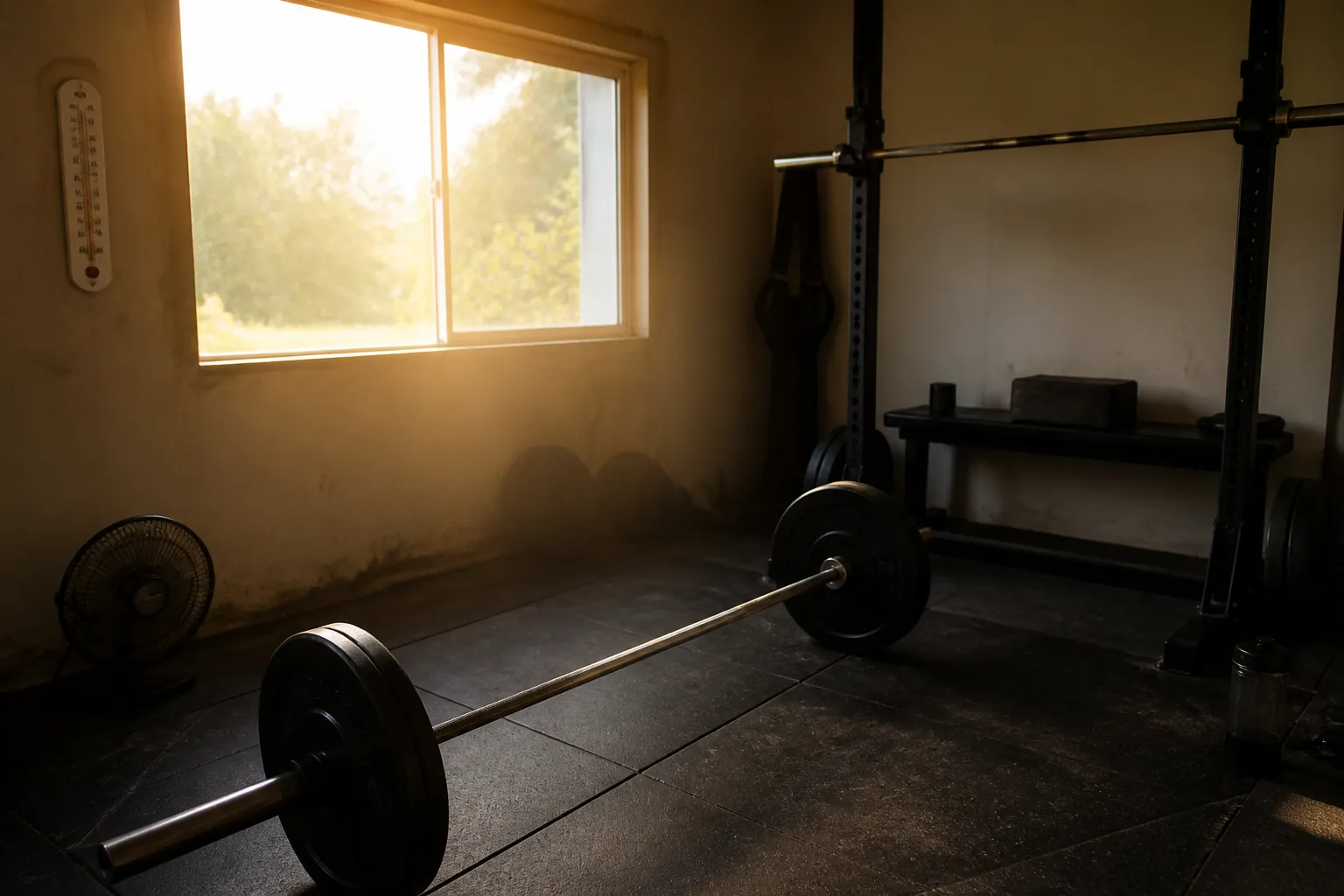
The useful question during a heat wave is not “Can disciplined people train in hot weather?” It is simpler and less flattering: “Can I work out today in this room?” A garage, spare bedroom, shed, or apartment corner without air conditioning can be a different climate from the weather app. Before the warm-up, put a thermometer where you actually lift, ride, row, or do circuits. If you can, check humidity or heat index too. That reading decides the workout.
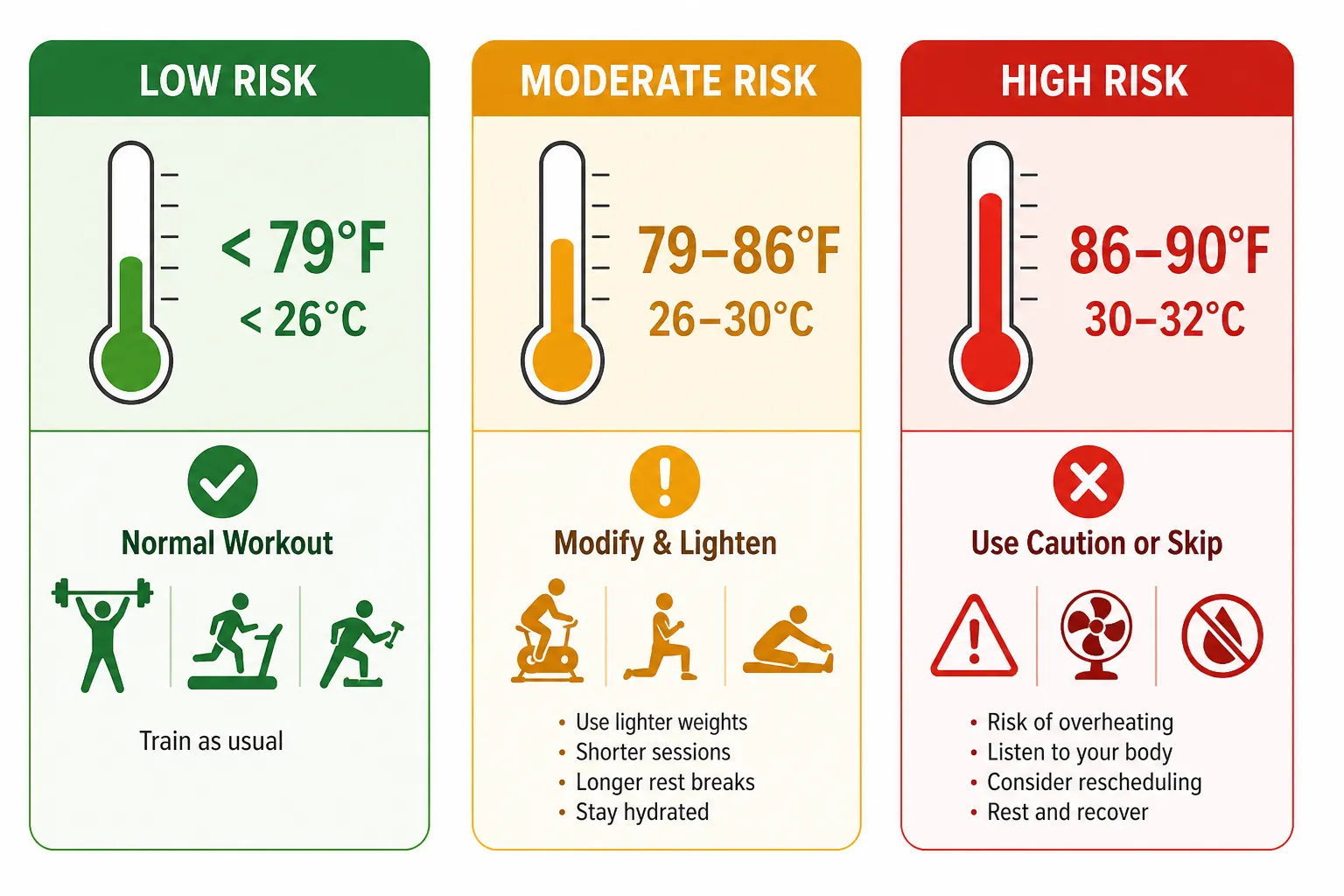
For a practical starting point, use these evidence-informed temperature bands. EMD UK’s guidance for fitness-class settings treats below 26°C / 79°F as generally safe, 26-30°C / 79-86°F as elevated risk, and above roughly 30-32°C / 86-90°F as high risk for exercise settings.[1] That is not a U.S. home-gym law, and it does not replace medical advice. It is still a useful decision frame because your body does not care whether the heat came from a July sun, a closed garage door, or a rubber-floored box with no cross-breeze.
| Measured room temperature | Risk band | Reasonable decision before you start |
|---|---|---|
| Below 79°F / 26°C | Lower risk | Train normally if you feel well, but keep water nearby and monitor the room if it is still heating up. |
| 79-86°F / 26-30°C | Modification zone | Shorten the session, lower intensity, extend rests, avoid maximal intervals, and use cooling tactics before and during training. |
| 86-90°F / 30-32°C | High-risk zone | Choose only a short, easy session if conditions are well ventilated and you are low risk; skip hard lifting, HIIT, metcons, and long endurance work. |
| Above 90°F / 32°C, or high heat index with poor ventilation | Stop-and-rethink zone | Move the workout, delay it, or skip it. Training alone here is a bad bargain. |
Start With the Room, Not the Weather App
The trap is the “only 88 outside” workout. In a poorly ventilated room, trapped air can run 22-27°F hotter than the shaded outdoor temperature, according to BBC Future’s reporting with Ollie Jay of the University of Sydney.[2] That makes a shaded summer afternoon sound manageable while the actual training space is already sitting in the danger zone.
This matters most in home gyms because the usual safety checks are missing. There may be no coach watching your coordination, no front-desk staff noticing that you have stopped making sense, and no training partner to say the set is over. If you train alone, the decision has to be made early, while you are still thinking clearly.
A wall thermometer is not a luxury item here. Put it at about training height, away from direct sun, and read it after the space has been closed up for a while. If the garage door has been baking all afternoon or the apartment room has one small window and a thick mat over concrete, the first reading may be more honest than your optimism.
A Simple Heat-Wave Workout Decision Flow
Do this before changing shoes. It takes less time than arguing with yourself about whether skipping one day will ruin your program.
- Measure the room where the workout will happen, not the hallway, porch, or phone forecast.
- Check humidity or heat index if the air feels heavy; sweating cools you less effectively when evaporation is poor.
- Classify the session: normal, modified, short-and-easy only, or skipped.
- Ventilate first, then pre-cool your body, then start at a lower intensity than planned.
- Stop immediately if symptoms appear, especially dizziness, nausea, confusion, poor coordination, or a sudden change in how you are thinking.
Below 79°F, most healthy adults can usually train as planned if they feel normal and the room is not rapidly heating. Still, leave yourself an exit. Heat illness does not require a dramatic collapse to be real; it often starts as a session that simply feels wrong earlier than expected.
From 79-86°F, keep the habit but change the work. Turn a heavy lower-body day into technique work. Replace intervals with easy Zone 2 cardio. Cut a 45-minute circuit to 20-25 minutes. Add rest between sets before you think you need it. If your plan depends on pushing near failure, grinding under load, or keeping your heart rate pinned, it is the wrong plan for that room.
From 86-90°F, stop being polite about “just modify.” A short mobility session, an easy walk in a cooler location, light technique practice, or a brief low-intensity routine may be reasonable for some healthy, heat-acclimatized people if the room is ventilated and symptoms are absent. Hard conditioning, high-rep circuits, long treadmill sessions, heavy barbell work near failure, and anything that makes you reluctant to stop are poor choices.
Above that, or when the heat index is severe and the room is stagnant, the safest workout may be no workout. If you want a deeper heat-index explanation, FitAtHome’s guide to exercising at home in high heat index is the place to go next. For the decision in front of you today, the important point is that the room has already voted.
Why a Garage Gym Gets So Much Worse Than “Hot”
A garage gym has several ways to punish good intentions. The door and roof absorb heat. Concrete holds it. Rubber flooring can make the space feel less harsh underfoot, but it does not magically make the air safe. A fan pointed at your face may feel useful while doing almost nothing to remove the hot air collecting around you.
The first fix is not a gadget; it is air exchange. Open two points if you have them. Use one fan to pull cooler air in from the shaded side and another to push hot air out. A commercial garage-gym cooling guide from RitFit identifies two-fan cross-ventilation as a high-impact low-cost tactic, with longer-term upgrades such as dehumidification, rubber flooring over heat-radiating concrete, and garage-door insulation also discussed; because this is a brand source, treat it as practical setup advice rather than independent proof that a specific product solves heat risk.[3]
Fan placement matters. A fan that only stirs hot air around a closed garage may make you feel attended to without meaningfully lowering risk. A fan exhausting hot air through a door or window changes the room. In a small apartment, the same principle applies: create a path for air to enter and leave instead of blasting one corner of stagnant air.
There is also a fan limit that people tend to miss. The National Weather Service warns that fans can worsen overheating when the heat index is in the high 90s°F because they can blow superheated air onto the body.[4] That does not mean fans are useless in heat. It means a fan is not a permission slip when the air itself is already too hot and humid to cool you well.
Cool the Space Before You Try to Outwork It
Cooling tactics work best in a hierarchy. Start with the biggest lever: train when the room is coolest. In many homes, that means early morning, not late afternoon. During a heat dome, overnight cooling may fail, which changes the calculation; FitAtHome’s explainer on heat domes versus heat waves covers why the night-before temperature matters.
- Ventilation first: open shaded windows or doors, exhaust hot air, and create cross-flow before the workout starts.
- Timing second: move the session to the coolest usable part of the day, even if that means changing the workout type.
- Pre-cooling third: use a cold towel, cool shower, ice slurry, or hand and forearm cooling before training.
- Hydration support: drink before the session, sip during it, and use electrolytes when the session is long enough to justify them.
- Longer-term fixes: improve insulation, reduce humidity, and make the room easier to ventilate before the next heat wave.
Pre-cooling is not magic, but it can buy margin. BBC Future cites Rebecca Stearns on tactics such as cold towels, ice slurries, and hand or forearm immersion before exercise to extend safer workout time in heat.[2] That margin should be spent on making the session shorter and calmer, not on proving you can still finish the most punishing workout on the calendar.
Hydration is support, not armor. The American Heart Association recommends drinking 16-20 ounces of water about an hour before exercising in warm weather, sipping every 15-20 minutes during activity, and adding electrolytes after about 45 minutes.[5] If the room is too hot, water does not turn a dangerous session into a smart one. It only removes one avoidable problem from a still-stressful environment.
What Kind of Training Still Makes Sense?
The best heat-wave workout is often the one that preserves the habit without demanding the same output. Think of it as maintenance under environmental stress. You are keeping movement in the week, protecting sleep and recovery, and avoiding the particular stupidity of turning a garage into a test of character.
| Original plan | Heat-wave swap | Why it is safer |
|---|---|---|
| Heavy barbell sets near failure | Technique sets at lighter loads with longer rests | Less strain, less grinding, and less time under high cardiovascular load |
| HIIT, metcon, or hard intervals | Easy cardio, mobility, or a short low-intensity circuit | Lower heat production and easier stopping points |
| Long treadmill or bike session | Shorter steady session with a strict time cap | Less cumulative heat exposure |
| High-rep leg day | Upper-body accessories, mobility, or recovery work | Less total metabolic demand in the hottest conditions |
| Competitive benchmark workout | Postpone it | A benchmark done in a bad room measures heat tolerance more than fitness |
If you need an actual routine, choose one that is easy to scale down. A no-equipment circuit, light dumbbell session, or mobility block can be adjusted set by set. A workout built around pride is harder to make safe because the failure point is emotional before it is physical.
Use a timer in hot rooms. Decide the session length before you begin. A 20-minute cap is clearer than “I’ll see how I feel,” especially when feeling bad may arrive after decision-making has already started to dull. Keep rests generous enough that breathing and coordination normalize before the next set.
Avoid exercises that punish a missed cue. Heavy squats, loaded carries through cluttered spaces, treadmill sprints, box jumps, and overhead work are less forgiving when dizziness or coordination changes. In a cool gym with people nearby, that risk is different. Alone in a hot garage, it deserves more respect.
Heat Acclimatization Helps, but It Does Not Make You Heat-Proof
If you have been training in warm conditions regularly, your body may tolerate heat better than it did on day one. Heat acclimatization generally takes about 7-14 days of regular heat exposure and can be lost quickly without continued exposure, according to the Korey Stringer Institute and BBC Future.[6][2]
That timeline is useful because it sets expectations. The first hot week is not the time to prove anything. Start with shorter, easier sessions, then build cautiously if the room temperature, symptoms, and recovery all stay reasonable. A person who trained comfortably in May is not automatically prepared for a sealed garage in late July.
Acclimatization also has boundaries. Illness, poor sleep, alcohol, dehydration, travel, medication changes, and missed exposure can all change how a familiar workout feels. Treat your current condition as part of the environment.
Who Should Be More Conservative?
Some people should set a lower threshold for skipping or moving the workout. Older adults, people with cardiovascular disease, people with kidney disease, those with a history of heat illness, and anyone recovering from illness should talk with a clinician before exercising in significant heat. This article can help with room decisions, but it cannot clear an individual medical risk.
Medication matters too. The American Heart Association notes that beta blockers, diuretics, ACE inhibitors, and calcium channel blockers can affect the body’s response to heat.[5] If you take one of these, do not rely on thirst, sweat, or usual effort cues as if nothing has changed.
For older adults, the margin should be wider, especially during multi-day heat events when the home never fully cools. FitAtHome has a more specific guide to heat dome exercise safety for adults 65+ because the decision is not only about willpower or fitness history.
Stop Signs: Cramps, Exhaustion, and Heat Stroke
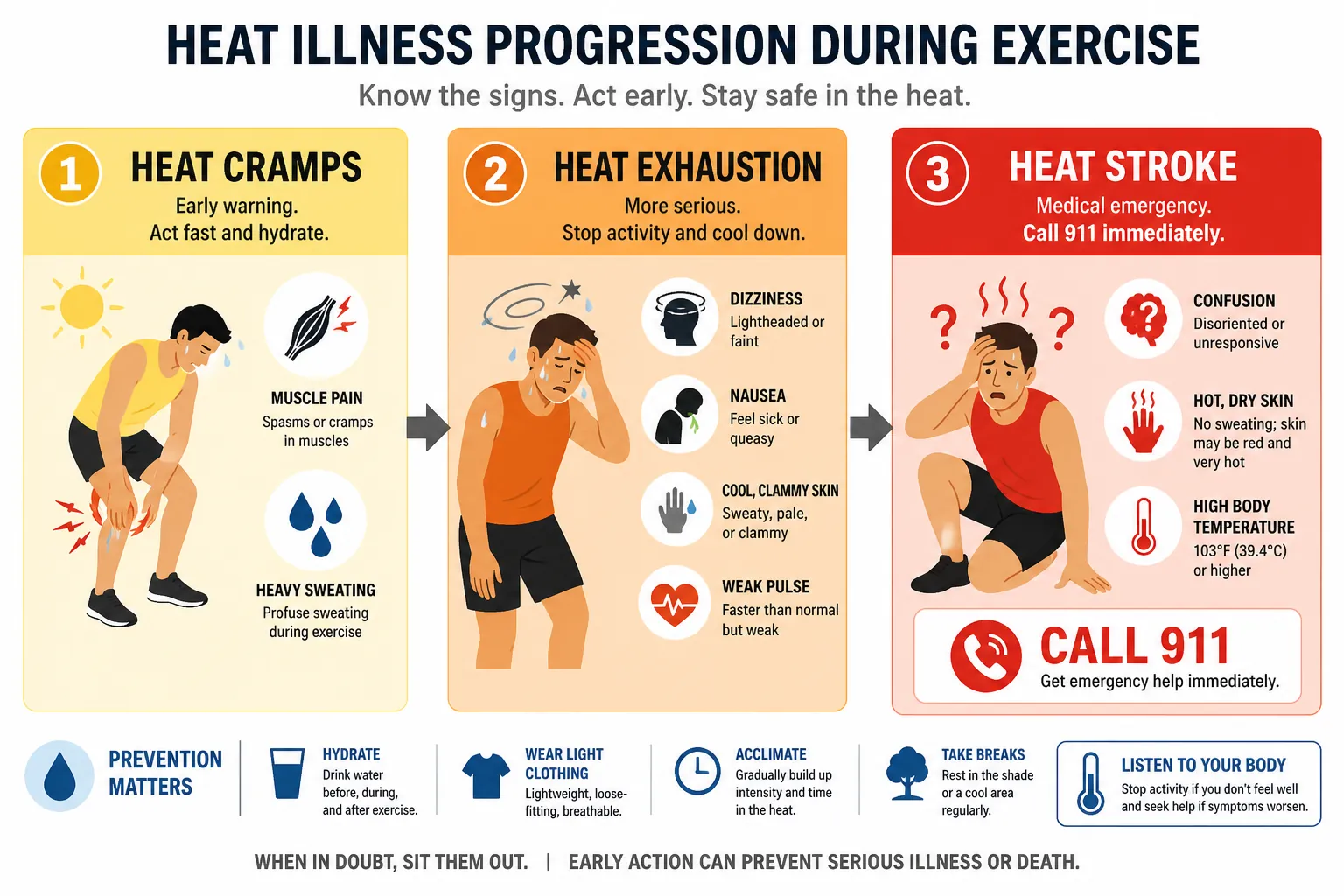
This is the part to know before the workout, not after you are sitting on the floor trying to decide whether the room is spinning. Heat illness can progress from heat cramps to heat exhaustion to heat stroke. NOAA describes heat exhaustion symptoms such as heavy sweating, cool clammy skin, a weak pulse, nausea, dizziness, and headache; heat stroke can involve a body temperature above 103°F, confusion, a throbbing headache, rapid strong pulse, and altered mental state.[7]
| What you notice | What to do |
|---|---|
| Muscle cramps during heat exposure | Stop the workout, move to a cooler place, hydrate, and do not restart hard exercise that day. |
| Heavy sweating, dizziness, nausea, headache, weakness, or cool clammy skin | Treat it as heat exhaustion: stop, cool down, drink if alert and able, and get help if symptoms do not improve. |
| Confusion, altered mental state, poor coordination, fainting, very hot skin, or suspected heat stroke | Call 911 immediately and begin cooling while waiting for emergency help. |
The altered-mental-state piece is the one solo home exercisers need to respect most. Confusion, poor coordination, or acting unlike yourself is not a cue to take a longer rest and try one more set. It is an emergency warning. NOAA reports that during heat stroke, body temperature can reach 106°F or higher within 10-15 minutes.[7]
If you are training alone in a high-risk room, set up a check-in. Tell someone when you start and when you expect to finish. Keep your phone within reach, not across the garage under a towel. The goal is not to make the session dramatic; it is to make sure a preventable emergency does not stay private.
When Skipping Is the Training Decision
There are plenty of days when a home workout during a heat wave is reasonable: the room is below the danger band, air is moving out of the space, you are healthy, the session is shorter, and you are willing to stop early. That is the good version of consistency.
There are also days when the room is too hot, humidity is high, ventilation is poor, symptoms appear, or you are alone with a workout that would be hard to abandon halfway through. On those days, skipping is not a failure of discipline. It is the safest recovery-rest choice available, and it keeps you able to train when the room stops fighting back.
References
- How hot is too hot for fitness classes? — EMD UK
- How keep exercising when it's really hot — BBC Future, 2026
- Garage Gym Cooling: Summer Workout Tips — RitFit
- Heat Illness — National Weather Service
- How to Stay Active in Warm Weather — American Heart Association
- Heat Acclimatization — Korey Stringer Institute
- Heat exhaustion or heat stroke? Know the signs of heat illness — NOAA
This is general fitness education, not medical advice. For diagnosis or treatment of pain or injury, consult a qualified clinician.
Pick your next session
Browse all routines to find an appropriately-spaced next session.
Spot something off?
This content sits adjacent to health guidance — tell us if a citation or figure needs a correction.