
Heat Dome vs Heat Wave: What Home Exercisers Need to Know
Does the type of extreme heat event change how you should exercise at home? This article explains why a heat dome eliminates the usual workaround strategies like early morning sessions or relying on overnight cooling, and how to adjust your workout timing, intensity, and recovery accordingly.
- Citation source
- ACSM, CDC
- Evidence level
- general guideline
You waited until morning. The windows were open. The fan was already pointed at the bench. Then you checked the thermometer in the room you actually train in, not the weather app, and it still read 86°F.
That is the moment when the difference between a heat wave and a heat dome starts to matter for home exercise. In a normal heat wave, the day may be ugly, but the house or apartment can still get some relief overnight. You move the workout earlier, lower the intensity, use airflow carefully, and maybe get through a short session. In a heat dome, the usual escape routes can fail at the same time: the room never cools, the fan stops feeling helpful, sleep gets worse, and yesterday’s heat is still sitting in the walls when you start today’s warmup.
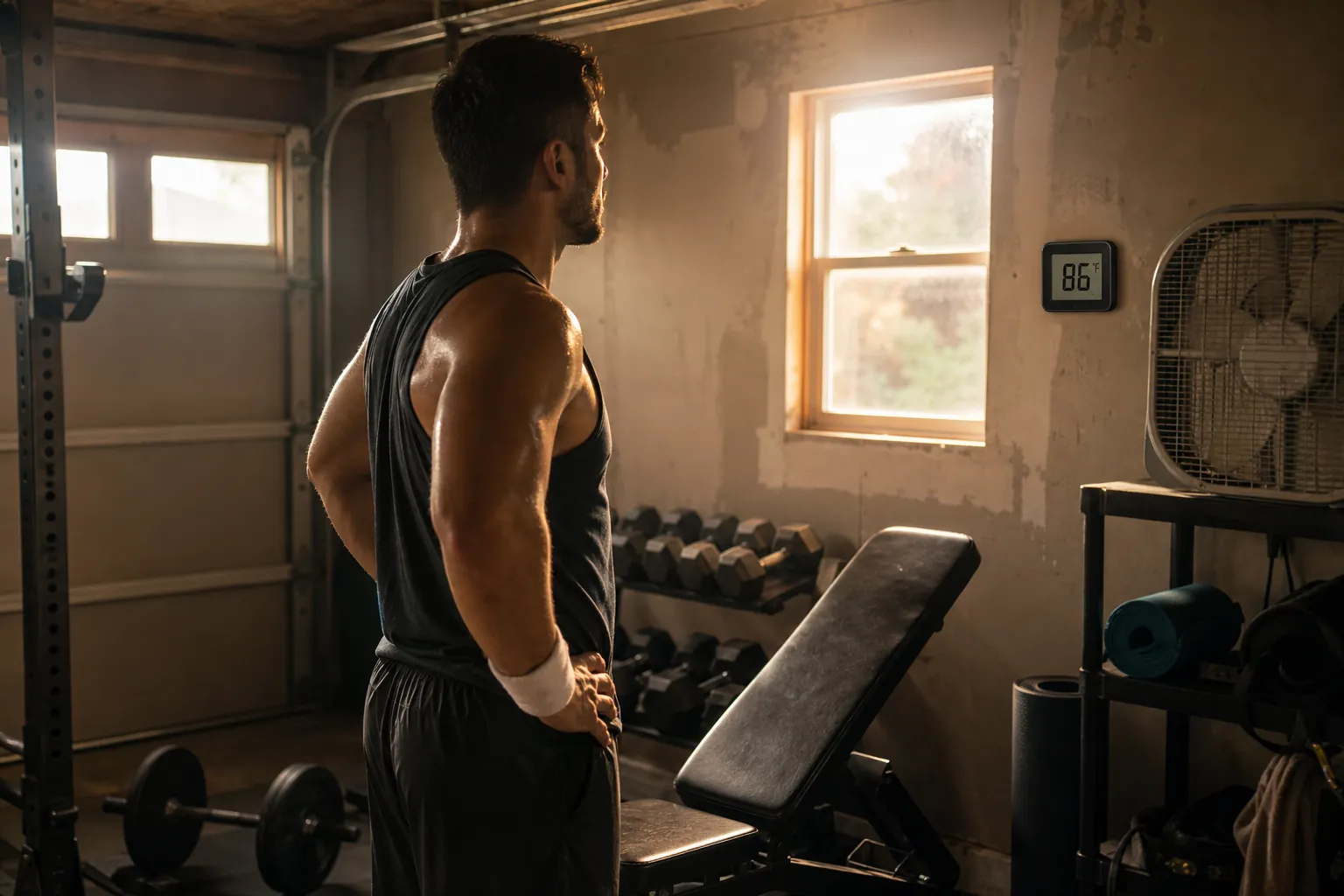
The 2021 Pacific Northwest heat dome is the cleanest example of why “just go early” can be unreliable advice. Portland reached 116°F, Seattle reached 108°F, and overnight lows stayed in the 80s°F in some areas, which meant homes did not get the kind of nighttime reset many people depend on before exercising indoors. [1][2]
The Practical Difference Is Overnight Cooling
A heat wave is a period of unusually hot weather. A heat dome is a specific pattern where high pressure traps hot air over an area, and that trapped heat can persist long enough that buildings keep absorbing heat faster than they release it. UC Davis describes heat domes as events that usually last up to four days, while other summaries describe some heat dome conditions as lasting longer, so duration alone is not the only useful test for a home exerciser. [1][2]
The more useful question is simpler: did your workout space cool down overnight?
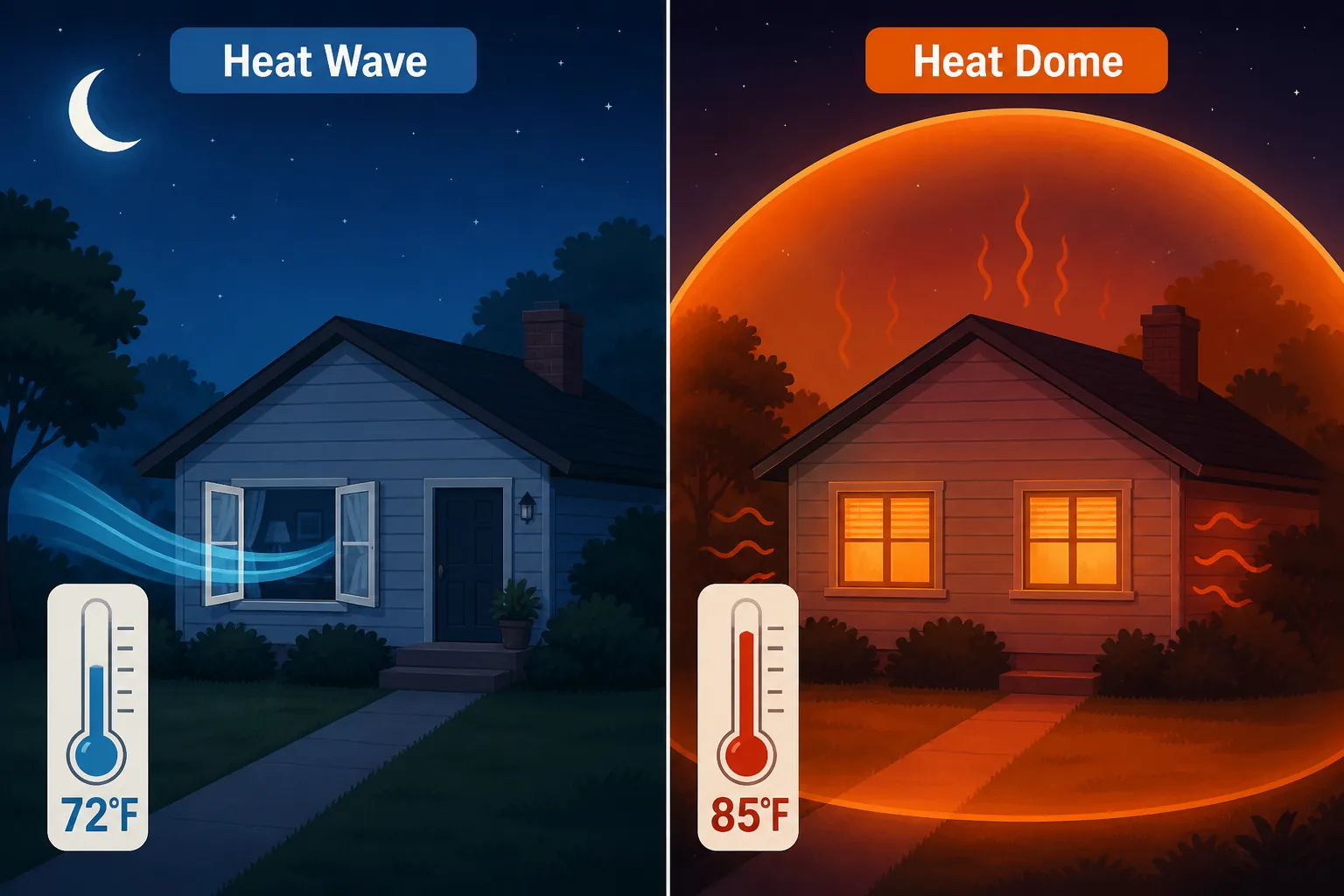
If the room dropped into a tolerable range by morning, you may still be dealing with a serious heat event, but the familiar heat-wave playbook has something to work with. Shorten the session. Train early. Keep the effort submaximal. Put the fan where it moves air across sweat instead of just blowing at your face. Take longer rests. Stop sooner than you would in spring weather.
If the room stayed hot through the night, the decision changes. Morning is no longer a cool window; it is just the least-bad part of a trapped-heat cycle. A garage gym may be worse than the house. A top-floor apartment may hold heat after sunset. A small room with closed blinds may still feel stale because the walls, floor, rack, bench, and stored equipment have all been warming together.
That is why a heat dome is not merely “a hotter heat wave” for someone training at home. It removes the assumption that time of day will solve enough of the problem.
Start With the Room, Not the Forecast
The forecast tells you what is happening outside. Your workout decision depends on the indoor space where your body has to shed heat while moving. That difference matters in a home gym because the “gym” may be a garage, a spare bedroom, a low-ceiling basement corner, or a living room that also holds yesterday’s cooking heat.
Before choosing the workout, check three things in the space itself:
- Current indoor temperature, measured where you train rather than near an air conditioner or open door.
- Whether the room cooled overnight compared with the previous evening.
- Whether airflow feels cooling, neutral, or like a hair dryer.
- How you slept and recovered after the previous hot day.
For a garage setup, this is where broad weather advice often breaks down. The house may be uncomfortable but manageable while the garage is several degrees hotter, especially if the door faces sun or the space has poor insulation. If that is your setup, the more relevant guide is not “exercise before 9 a.m.” but whether the garage has actually dumped enough heat to let sweat and airflow do their job. FitAtHome’s hot home gym safety guide goes deeper on garage-specific temperature dynamics.
| What You Observe | Heat Wave Strategy | Heat Dome Strategy |
|---|---|---|
| Room cools noticeably overnight | Use the coolest window, shorten the workout, lower intensity | Still possible, but keep checking whether cooling continues day to day |
| Room stays hot overnight | The usual early workout may be less reliable | Treat the session as higher risk; reduce intensity or switch to recovery |
| Fan feels cooling on sweaty skin | Use airflow with hydration and longer rests | Use only if indoor temperature remains in a safe range |
| Fan blows hot air in a room above 90°F | Stop relying on fan-only cooling | Move, modify, or skip; fan use can add heat stress |
| Sleep is short or broken for several hot nights | Expect lower training tolerance | Prioritize recovery because heat exposure is accumulating |
Know When a Fan Stops Helping
A fan can be useful when it helps sweat evaporate. That is why home exercisers love them: they are cheap, portable, and easy to move from the squat rack to the mat. But the CDC warns that when indoor air temperature is above 90°F, fans may be counterproductive because they move hot air around and can increase body temperature instead of lowering it. [3]
This is one of the clearest practical divides between a heat wave and a heat dome. During a shorter heat wave, the room may drop below that danger zone by morning, making a fan part of a reasonable cooling setup. During a heat dome, the indoor temperature may remain high long enough that fan-only training becomes a bad bargain. The fan still makes noise and moves air. It may even make the workout feel psychologically more normal. But if the room is above 90°F, the air it moves is part of the heat load.
That does not mean every hot-room workout is automatically off the table. It means the fan cannot be treated as a substitute for a cooler environment. If the fan only makes the room feel slightly less stagnant while the thermometer stays high, adjust the workout around the thermometer, not around the comfort of having air on your skin.
Humidity and Intensity Change the Math
Heat risk is not only about the number on the thermometer. Humidity matters because sweat cools you by evaporating, and humid air makes that process less effective. In exercise guidance cited by CNN, the American College of Sports Medicine flags outdoor temperature above 80°F with humidity above 75% as a high-risk condition for heat injury. [4]
A home gym does not get a pass just because it is indoors. If the indoor space is hot, humid, poorly ventilated, or warmed by stored heat, the body still has to solve the same problem: produce force while getting rid of heat. Heavy sets, circuits, jump rope, indoor cycling, treadmill intervals, and dense bodyweight sessions all raise heat production quickly. Long rest periods help strength work more than they help a fast conditioning session because they reduce continuous heat buildup.
During a standard heat wave, a modified workout might mean keeping the same movement pattern but cutting total work. For example, a lower-body session might change from several hard squat sets plus lunges and conditioning into a few technique-focused squat sets with longer rests and no finisher. During a heat dome, the same athlete may need to go further: mobility, light band work, walking in a cooler indoor location, or a full rest day if the room never cooled.
The point is not to protect a perfect training plan from inconvenience. It is to avoid pretending the body can recover from heat stress, hard exercise, poor sleep, and dehydration as if only one of those things is happening.
Heat Illness Does Not Always Announce Itself Early
Heat illness is commonly described along a continuum from heat cramps to heat exhaustion to heat stroke, and the warning signs can overlap with sensations exercisers are used to tolerating: heavy sweating, fatigue, headache, dizziness, nausea, muscle cramping, or feeling unusually weak. [5]
That overlap is a problem in a home workout because nobody is watching your form drift or asking why you sat down between sets for so long. Beginners have an extra disadvantage: they may not yet know the difference between normal effort and a heat-stressed body starting to lose control. Experienced exercisers have a different problem: they may be too good at explaining symptoms away because the workout is “only” at home.
A heat dome raises the stakes because exposure can stack across days. You may be starting Tuesday’s workout after Monday’s hot room, Monday night’s poor sleep, and a morning that never felt cool. That cumulative pattern is exactly where conservative decisions make sense: reduce the load before symptoms force you to stop, not after.
Hydration Is Necessary, but It Cannot Rescue Every Session
Hydration advice is easy to flatten into “drink more water,” which is not enough during a trapped-heat event. The American Heart Association notes that even mild dehydration of 1% to 2% of body weight can impair cardiovascular function and heat regulation. [6]
For a single hot workout, drinking before and after may be enough for many healthy people. During several hot days in a row, hydration becomes part of recovery debt. You sweat more during chores, sleep poorly, lose appetite, drink inconsistently, and then ask your body to train in the same warm room again. If you also take medications or have a health condition that affects heat tolerance, the safe margin narrows; that is a reason to get medical guidance rather than treat a general fitness article as a personal clearance.
A practical check is whether your plan assumes hydration can compensate for everything else. If the room is still hot, the fan is questionable, sleep was poor, and the workout is intense, water is not a magic permission slip. It is one support in a system that may already be overloaded.
How to Change the Workout Without Abandoning Training
The useful adjustment is not always “skip.” It is matching the session to the conditions that actually exist in the room.
- If the room cooled overnight: train early, shorten the session, keep intensity moderate, extend rests, and avoid finishers that keep your heart rate high.
- If the room stayed hot overnight: switch from performance training to maintenance work, technique practice, mobility, or active recovery.
- If the room is above 90°F and you only have a fan: do not treat the fan as adequate cooling; relocate, delay, or skip the workout.
- If sleep has been poor for multiple hot nights: remove high-intensity intervals, heavy grinders, and long circuits before removing movement entirely.
- If symptoms such as dizziness, nausea, confusion, unusual weakness, or stopped sweating appear: stop exercising and follow heat-illness guidance rather than trying to finish the plan.
This is where comparison language helps. A heat-wave strategy tries to preserve the workout by finding the coolest available window. A heat-dome strategy assumes the cool window may not exist and starts by protecting recovery capacity. For no-AC homes, FitAtHome’s extreme heat workout guide covers broader cooling and modification options; the heat dome layer is deciding when those options are no longer enough.
Do Not Ignore Sleep Just Because the Workout Is Short
A short workout can still be the wrong workout if it lands on top of several bad nights. Heat domes are especially rough because the night is supposed to be the recovery period, and in many homes it becomes a second shift of heat exposure. You lie there sweating, wake up thirsty, run a fan that may or may not be helping, and start the next day already behind.
This matters for strength training, not just cardio. Poor sleep makes heavy loads feel less predictable, slows decision-making, and makes it easier to misread effort. The safer adjustment may be boring: fewer sets, no max attempts, no complex new movements, and no conditioning block after lifting. If the point of the day is to keep the habit alive, ten quiet minutes of mobility in the coolest available room may do that with far less cost than forcing a full garage session.
For a deeper recovery angle, see FitAtHome’s guide to hot weather sleep and fitness gains, then pair it with a normal post-workout recovery routine once the heat load is back under control.
Why This Distinction Is Worth Learning Now
This is not a niche vocabulary lesson. EcoFlow’s summary of EPA data says U.S. heat wave frequency has risen from about two per year in the 1960s to about six per year in the 2020s, and it also notes that heat domes are becoming more common. [1]
For home exercisers, more frequent extreme heat means more mornings where the workout decision has to be made in a real room with real constraints. Not everyone can move to an air-conditioned gym. Not everyone has a cool basement. Not everyone can shift training to 5 a.m. and recover later. The safer skill is learning when ordinary heat workarounds are still reliable and when the building itself has become part of the heat event.
Heat watches and warnings can help you decide how much caution to use before the event peaks; FitAtHome’s heat watch vs. warning workout guide is useful for that earlier decision point. If you want a more hands-on look at what actually changes inside a small home setup, the tested guide to exercising in extreme heat without AC adds that practical layer.
A Simple Home-Training Rule
The label matters only because it changes the reliability of your usual workarounds. If the home cools overnight, a modified heat-wave workout may be reasonable for many healthy exercisers: shorter, easier, earlier, and with more rest than usual. If indoor heat stays elevated through the night, treat the situation more conservatively because recovery, hydration, airflow, and timing are all compromised at once.
Anyone with heart disease, kidney disease, diabetes, pregnancy, medication-related heat sensitivity, prior heat illness, or current heat-illness symptoms should use medical guidance rather than general workout advice. For everyone else, the most useful question before training is still plain: did this room actually recover from yesterday’s heat?
References
- Heat Dome vs. Heat Wave: What's the Difference and Which Is More Dangerous? — EcoFlow
- Dealing with extreme heat while in a heat dome — UC Davis
- About Heat and Your Health — CDC
- US heat wave doesn't have to derail summer fun or fitness — CNN — 2026
- Stay Safe Exercising in the Heat — Mass General Brigham
- How to Be Active Safely in Warm Weather — American Heart Association
This is general fitness education, not medical advice. For diagnosis or treatment of pain or injury, consult a qualified clinician.
Pick your next session
Browse all routines to find an appropriately-spaced next session.
Spot something off?
This content sits adjacent to health guidance — tell us if a citation or figure needs a correction.