
Is high-sugar Fanta bad for your home workout diet?
One 12-ounce can of Fanta packs 160 calories and 44 grams of added sugar — enough to erase most of a 30-minute home workout's calorie burn. The verdict: full-sugar Fanta fits a home workout diet only in small, occasional portions that your calorie and sugar budget can actually absorb.
- Citation source
- CDC; AHA; WHO; Harvard T.H. Chan School of Public Health
- Evidence level
- General guideline; restrained inference
- Recommended frequency
- Occasional 12-oz can only; not daily
If the question is “is Fanta with high sugar bad for a home workout diet,” the honest answer is: not automatically, but often a bad trade. A full-sugar Fanta is not a moral failure and one occasional can does not wreck a diet by itself. The problem is arithmetic. In the U.S., a 12-ounce can of Fanta Orange lists 160 calories and 44 grams of added sugar, while a 20-ounce bottle lists 270 calories and 73 grams of added sugar.[1][2]
Those are U.S.-market numbers. Do not assume they match UK or EU Fanta, because formulas and label values can differ by market. If the bottle in your kitchen is not the U.S. version, the right move is boring but reliable: read that label, not this one.
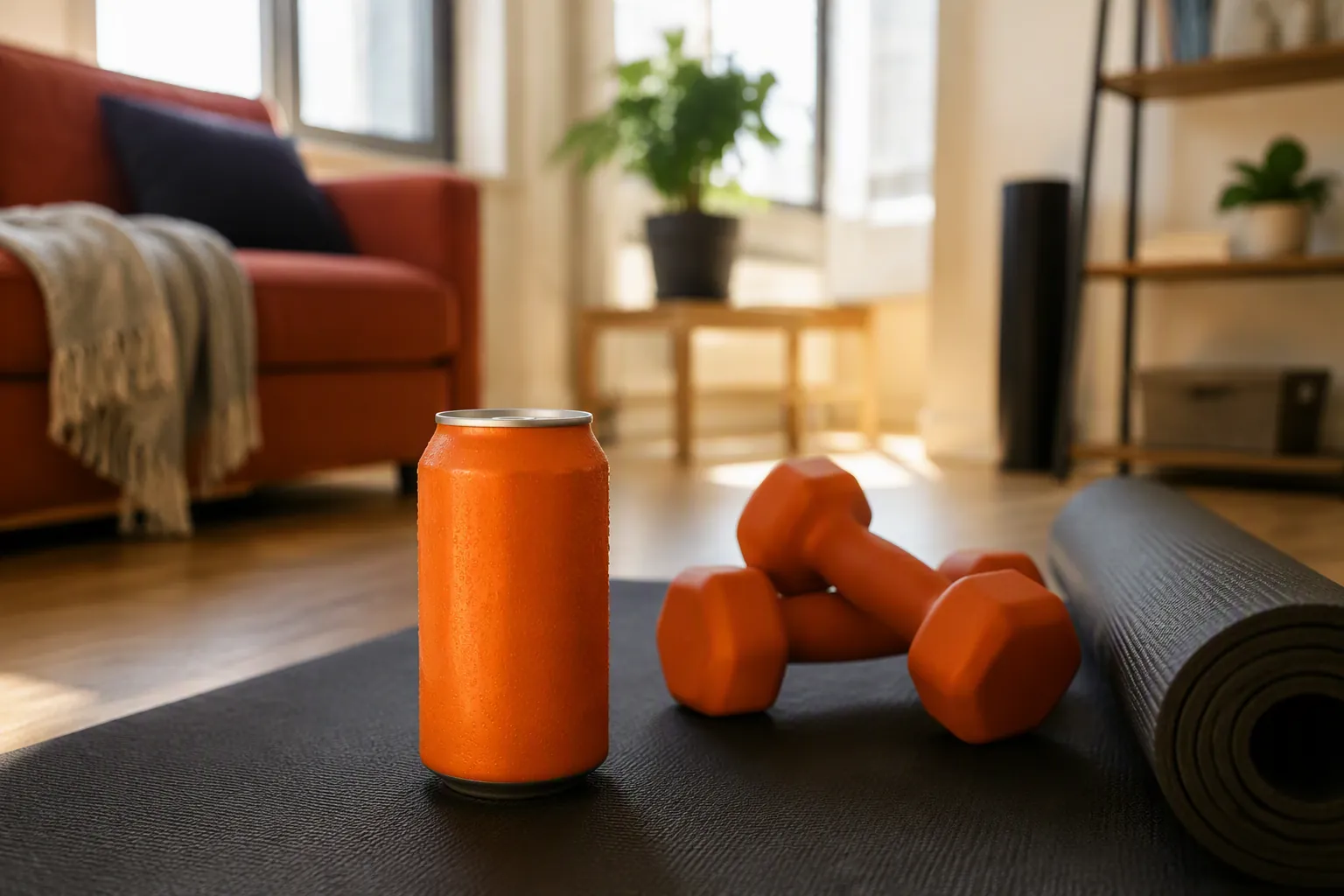
The label math is the part you cannot negotiate with
A can looks small enough to mentally file under “just a drink.” The label does not file it that way. The 12-ounce can gives you 44 grams of added sugar, which the listing marks as 88% of the U.S. Daily Value. The 20-ounce bottle gives you 73 grams of added sugar, marked as 143% of the Daily Value.[1][2]
| Serving | Calories | Added sugar | U.S. Daily Value for added sugar |
|---|---|---|---|
| Fanta Orange, 12-ounce can | 160 | 44 g | 88% |
| Fanta Orange, 20-ounce bottle | 270 | 73 g | 143% |
| Fanta Zero Sugar Orange, 20-ounce bottle | 0 | 0 g | 0% |
The zero-sugar line matters only as a label comparison: Coca-Cola’s U.S. product page lists the 20-ounce Fanta Zero Sugar Orange at 0 calories and 0 grams of sugar.[2] That does not make it a recovery drink, a nutrition strategy, or a required swap. It just shows that the calories and sugar in the regular bottle are not coming from the orange flavor. They are coming from sugar.
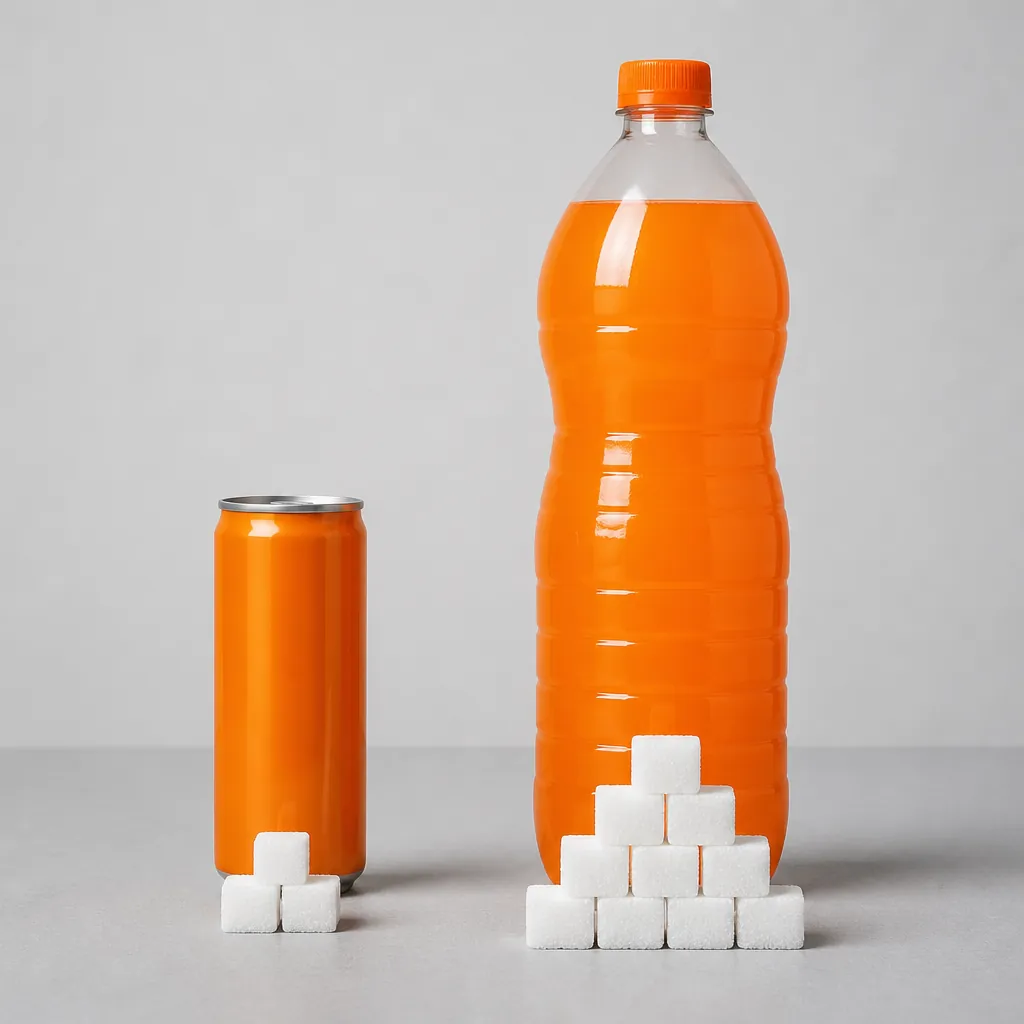
Against daily sugar guidance, the can is already expensive
The American Heart Association recommends no more than 36 grams of added sugar per day for men and 25 grams per day for women.[3] A 12-ounce can of Fanta Orange exceeds both of those numbers: it is 8 grams over the men’s limit and 19 grams over the women’s limit. The 20-ounce bottle is just over double the men’s limit and nearly three times the women’s limit.[1][2][3]
The World Health Organization gives a broader energy-based target: free sugars should stay below 10% of total energy intake, with a further conditional target below 5%. On a 2,000-calorie diet, the 10% level is about 50 grams of sugar.[4] A 12-ounce Fanta at 44 grams uses most of that allowance. A 20-ounce bottle at 73 grams is about 146% of it.[1][2][4]
The CDC’s plain-language example lands in the same neighborhood: a 12-ounce regular soda can contain more than 10 teaspoons of added sugar and about 150 calories.[5] Fanta’s U.S. 12-ounce can is slightly higher than that example at 160 calories and 44 grams of added sugar.[1]
This is why “I only had one” can be true and still matter. One can may be occasional, enjoyable, and perfectly survivable. It is also large enough to occupy the sugar space that many people thought they still had available for the whole day.
Now put the can next to a 30-minute home workout
Calories burned during a workout are estimates, not receipts. Body weight, pace, rest time, range of motion, and how hard the session actually feels all change the number. Still, a reasonable estimate is useful because it keeps the drink from floating around as an abstract treat.
Harvard Health’s 30-minute activity chart estimates that people weighing 125 to 185 pounds burn about 180 to 252 calories from vigorous weight lifting, 240 to 336 calories from vigorous calisthenics, and 270 to 378 calories on an elliptical trainer.[6] Many apartment workouts fall somewhere around those kinds of efforts: dumbbell circuits, bodyweight intervals, step-ups, resistance bands, or a compact cardio machine.
| 30-minute activity estimate | Estimated calories burned for 125–185 lb person | What a 160-calorie can offsets | What a 270-calorie bottle offsets |
|---|---|---|---|
| Vigorous weight lifting | 180–252 | About 63–89% | About 107–150% |
| Vigorous calisthenics | 240–336 | About 48–67% | About 80–113% |
| Elliptical trainer | 270–378 | About 42–59% | About 71–100% |
That table is not saying your workout “doesn’t count” if you drink soda afterward. It is saying the calorie margin is thinner than it feels. If your home session burned around 180 calories, a 160-calorie can leaves very little net energy gap. If your bottle is 270 calories, it can exceed the estimated burn from some 30-minute strength sessions.[1][2][6]
This matters most during weight loss or recomposition, where the goal is usually to keep training quality high while maintaining an overall calorie deficit or at least avoiding an accidental surplus. A drink that takes up most of a workout’s energy cost is not automatically forbidden. It just needs to be counted with the same seriousness as a snack.
For a sense of what a realistic short home session can look like, compare the numbers above with a practical routine such as this home muscle-maintenance workout. The point is not the age label; it is that many effective home workouts are compact, repeatable, and not magical calorie furnaces.
Liquid calories are easy to undercount because they do not ask for much room
The single-drink calculation is only half the issue. The bigger problem is what tends to happen when sugary drinks become routine. Harvard’s Nutrition Source summarizes the behavioral problem plainly: fluids do not provide the same fullness as solid food, the body does not seem to register liquid calories the same way, and people often do not compensate by eating less later.[7]
That does not mean one Fanta causes a specific amount of fat gain. It means the usual “I’ll just eat a little less later” plan is weaker than it sounds, especially after work, after training, when dinner is still happening, and when the drink felt earned. A soda can disappear in a few minutes without changing how large the next meal looks on the plate.
The long-term evidence is cautious but consistent enough to take seriously. Harvard’s Nutrition Source notes that one daily sugary drink, if not offset elsewhere, could add up to about 5 pounds of weight gain in a year. It also summarizes a 20-year study of 120,000 men and women in which each additional 12-ounce serving of a sugary beverage per day was linked with roughly one extra pound of weight gain every four years. The same source reports that people who drink one to two cans of sugary drinks per day have about a 26% greater risk of developing type 2 diabetes than people who rarely consume them.[7]
Those are population findings and associations, not a prediction for your next can. They are useful here because they explain why frequency matters more than the emotional weight of any one drink. Once a 160-calorie can becomes a daily habit, it is no longer a small exception. It is a regular line item.
Hydration is a separate job
Fanta is a fluid, but that does not make full-sugar Fanta a smart default recovery drink. For a typical home workout, the basic recovery question is usually simpler: replace fluid, eat enough protein and regular food across the day, and get ready for the next session. A soda can sit beside that routine as an occasional preference, but it does not need to be promoted into workout fuel.
If recovery is the real concern, start with the boring pieces first: water, a meal that fits your plan, and enough rest. This post-workout recovery routine at home is a better place to sort out what should happen after training than trying to make a soda carry the recovery plan.
When full-sugar Fanta can fit, and when it starts working against you
A 12-ounce can may fit a home workout diet if the rest of the day has room for it. That is a calorie-budget statement, not a health halo. WHO’s adult-weight commentary frames the weight effect of free sugars through excess energy intake, which is why the same can has different consequences depending on what happens to the whole day’s intake.[8]
The practical test is simple enough:
- If it is an occasional 12-ounce can and you count the 160 calories, it can coexist with a weight-loss or recomposition plan.
- If it is a 20-ounce bottle, it is no longer a small add-on: it brings 270 calories and 73 grams of added sugar.
- If it follows most workouts because the workout felt difficult, it can quietly turn exercise into calorie maintenance rather than calorie progress.
- If you are trying to stay near AHA-style added-sugar limits, even the 12-ounce can already uses more than the full daily limit for women and more than the full daily limit for men.
There is also a difference between planned and reactive. Planned means you know the can is 160 calories, you want it, and the rest of the day still works. Reactive means the drink arrives after every hard session because effort feels like it needs a prize. The first can be managed. The second is where the math starts making decisions for you.
If your wider nutrition setup is already complicated, it may help to separate the soda question from the rest of the diet instead of turning everything into one guilt pile. For more on how food choices interact with training and recovery, see the site’s guide to nutrition and home-workout consistency, or this piece on low-carb dieting, cholesterol, and home workouts. Neither makes soda disappear from the label. They just keep the decision inside the whole pattern where it belongs.
So the verdict is modest. High-sugar Fanta is not categorically bad for a home workout diet, and an occasional small serving can fit if the broader calorie and sugar budget can absorb it. Treating a full-sugar can as routine workout fuel is much harder to defend: in the U.S. label version, one 12-ounce can may offset much of a 30-minute home session, and the 20-ounce bottle can exceed the full day’s sugar budget before dinner is even considered.
References
- Fanta Orange Soda, Foods Co.
- Fanta Products, Coca-Cola.
- How much sugar is too much?, American Heart Association.
- Guideline: Sugars intake for adults and children, World Health Organization, 2015.
- Rethink Your Drink, Centers for Disease Control and Prevention.
- Calories burned in 30 minutes for people of three different weights, Harvard Health Publishing.
- Sugary Drinks, The Nutrition Source, Harvard T.H. Chan School of Public Health.
- Sugar-sweetened beverages and adult weight, World Health Organization.
This is general fitness education, not medical advice. For diagnosis or treatment of pain or injury, consult a qualified clinician.
Pick your next session
Browse all routines to find an appropriately-spaced next session.
Spot something off?
This content sits adjacent to health guidance — tell us if a citation or figure needs a correction.