
How Little Exercise at Home Actually Lowers Cholesterol?
Wondering how little exercise you need at home to improve your cholesterol? This article breaks down the minimum effective dose backed by science, showing that even small increases in daily movement produce measurable benefits—no expensive equipment or gym required.
- Citation source
- American Heart Association
- Evidence level
- Formal position stand
If you do not go to a gym, the smallest useful thing you can do at home is not a heroic workout. It is adding 5–10 minutes of real movement to a day that otherwise would not have had it. The American Heart Association’s physical activity guidance is clear that every extra 5–10 minutes of daily activity brings health benefits, and its scientific statement reports that increasing physical activity lowers LDL cholesterol by an average of 3–6 mg/dL.[1]
That does not mean a few living-room squats “fix” cholesterol. It means the door is not locked until you reach 150 minutes a week. For a sedentary person, a quiet 10-minute walk around the apartment, step-ups on the bottom stair, low-impact marching during one show, or a short bodyweight circuit is not fake. It is the beginning of the dose.
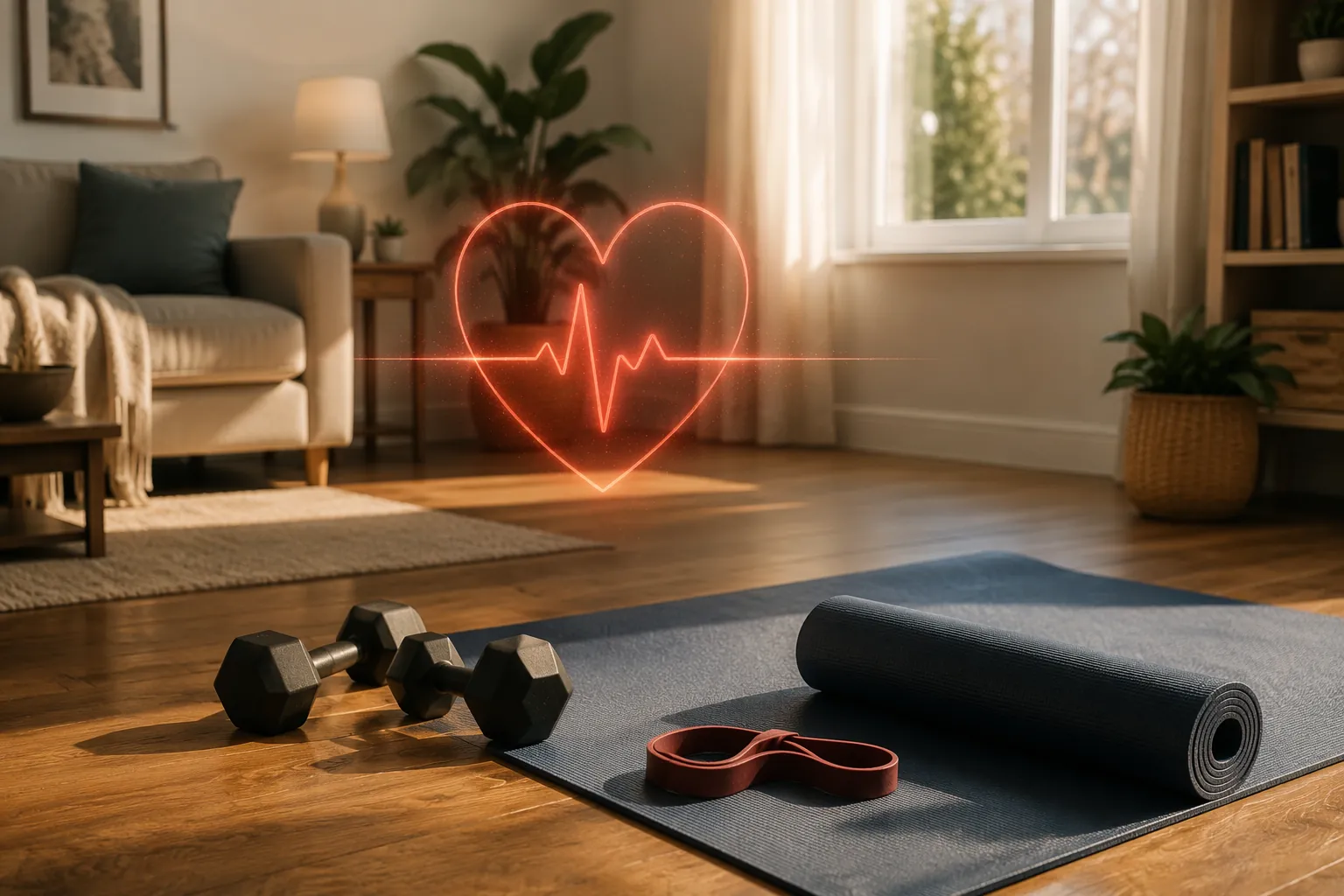
What “minimum effective” really means for cholesterol
For cholesterol, “minimum effective dose” is not a magic number where nothing works below it and everything works above it. It is better understood as the smallest repeatable increase in movement that starts pushing your risk profile in the right direction.
LDL, often treated as the main cholesterol number to lower, usually does not collapse from exercise alone. The AHA’s average LDL reduction of 3–6 mg/dL is modest, but it is still measurable and meaningful enough to count, especially when it comes from a habit you can repeat without commuting, changing clothes, or buying equipment.[1]
The time frame matters. Cleveland Clinic cardiologist Erik Van Iterson, director of cardiac rehabilitation, says people may start to see results after about 12 weeks of consistent exercise and dietary changes.[2] That is a useful expectation because cholesterol is not a same-week feedback system. You may feel better after a few sessions, but a lab result usually needs a longer run of repeated behavior.
This is also where the promise needs a guardrail. Harvard Health has noted that in several controlled trials, dietary changes reduced LDL while exercise alone did not show a significant LDL effect; the stronger cholesterol improvement came from combining diet and exercise.[3] So home exercise belongs in the plan, but it should not be asked to do the entire job of food changes, medication decisions, sleep, genetics, and medical follow-up.
The starter dose and the full target are not enemies
The full AHA target remains the better long-term destination: at least 150 minutes per week of moderate-intensity aerobic activity or 75 minutes per week of vigorous aerobic activity, plus two days of muscle-strengthening activity.[1] If your life can support that now, it is worth aiming for it.
The problem is what that number sounds like when you are starting from almost nothing. A person with a lab result in one hand and an unused resistance band under the couch does not usually need a lecture about the ideal week. They need a first week that does not collapse by Tuesday.
| Where you are now | A useful home starting point | How it moves toward the guideline |
|---|---|---|
| Mostly sedentary | 5–10 minutes of easy movement most days | Builds the habit and adds nonzero activity |
| Lightly active but inconsistent | 10–15 minutes after a regular cue, such as lunch or bedtime | Turns occasional movement into a repeatable weekly base |
| Able to tolerate more | Two or three 10-minute bouts in a day | Begins approaching the 150-minute weekly target |
| Already near the target | Longer moderate sessions plus two strength days | Matches the full AHA recommendation more closely |
At home, moderate intensity usually means you are breathing harder but can still speak in short sentences. It might be brisk walking in place, a low-impact cardio video, repeated sit-to-stands from a chair, step-ups, light dancing, or cycling on a stationary bike if you have one. The exact format matters less than whether the session actually happens again tomorrow.
If you want a structured progression, a simple no-equipment plan such as a home workout plan for busy parents can remove some decision fatigue. If you only have a few minutes and are tempted by ultra-short routines, it helps to understand what the science says about the 7-minute workout before treating it as a complete cholesterol plan.
Why 12 weeks is a fair first checkpoint
A cholesterol plan needs enough time to become visible in bloodwork. Cleveland Clinic’s “about 12 weeks” expectation is not a guarantee that every person will see the same number move by the same amount. It is a practical checkpoint: long enough to test consistency, short enough that the effort does not disappear into some vague future.[2]
A 12-week study of 115 male Australian Army recruits found that moderate-intensity exercise increased HDL-C by 6.6% and decreased LDL-C by 7.2%.[4] Those results are encouraging, but the population matters. Young male recruits are not the same as older sedentary adults, postpartum parents, people with joint pain, or apartment dwellers trying not to wake the downstairs neighbor.
Still, the study is useful for one reason: it shows that cholesterol markers can shift over a measured training block, not only after years of perfect behavior. For a home exerciser, that supports a grounded experiment: choose a repeatable routine, keep it going for roughly 12 weeks, and review your lab trend with a clinician instead of judging the whole effort by how motivated you felt in week two.
Aerobic work should carry most of the cholesterol load
If you are looking for natural ways to lower cholesterol, exercise at home should usually start with aerobic movement. That does not require running or jumping. It means sustained movement that raises your breathing and heart rate: brisk walking indoors or outside, low-impact cardio, stair walking, step-ups, marching, dancing, or cycling.
The evidence is strongest for aerobic exercise when discussing HDL and broader cholesterol changes. A 2013 meta-analysis in Sports Medicine reported that high-intensity aerobic exercise raised HDL by about 4.6% on average across 51 interventions, while also noting that the analysis excluded people taking cholesterol-lowering medication.[5] That last detail is not trivia. If you use a statin or another lipid-lowering drug, your lab changes reflect more than exercise alone.
Intensity also has to be interpreted sanely at home. “High intensity” in a study is not the same as throwing yourself into burpees in a living room after six inactive months. A beginner can start with moderate movement and gradually add harder intervals later, if joints, balance, space, and recovery allow it.
Small spaces are not a disqualifier. If your constraint is an apartment, a child asleep in the next room, or no equipment beyond a phone, a guide to free workout apps for small spaces may be more useful than a perfect plan that assumes a garage gym.
Strength training helps, but be careful with the HDL promise
The AHA’s weekly activity target includes two days of muscle-strengthening work, and that part should not be ignored.[1] At home, this can be simple: chair squats, wall push-ups, incline push-ups on a counter, hip hinges, calf raises, rows with a resistance band, or slow carries with household objects.
The cholesterol-specific case for resistance training is more cautious than the general health case. A 1999 resistance-training study reported decreases in total cholesterol from 4.6 to 4.26 mmol/L and LDL from 2.99 to 2.57 mmol/L after 14 weeks of training at 85% of one-repetition maximum, but the sample was limited.[6] That is enough to take strength work seriously, not enough to claim that a few band exercises will reliably produce the same lipid shift for every beginner.
A 2026 McMaster Optimal Aging review also separated the claims: aerobic exercise likely increases HDL in middle-aged and older adults, while resistance training and stretching alone likely do not improve HDL specifically, even though resistance training still supports overall health.[7] So the clean home formula is aerobic movement as the base, strength training as the support.
A practical first week at home
The first week should be almost too easy to argue with. The goal is not to prove discipline. It is to create a week that contains more movement than last week.
- Pick one daily cue: after coffee, after lunch, after work, or after a child’s bedtime.
- Move for 5–10 minutes at an easy-to-moderate pace.
- Use quiet options if needed: marching, step-touches, chair squats, wall push-ups, or low-impact cardio.
- Repeat most days before adding duration.
- When 10 minutes feels normal, add another 5 minutes or a second short bout.
A person with 11 usable minutes after bedtime does not need a full routine menu. They need the mat already visible, the shoes easy to find, and a session quiet enough that it does not create a new household problem. If soreness becomes the reason you stop, use a basic at-home recovery routine rather than turning recovery into another demanding project.
When to scale up
Scale when the current dose is boringly repeatable. That may mean going from 5 minutes to 8, from 10 to 15, or from one short bout to two. It may also mean adding one strength session before you add more cardio minutes, especially if you feel better with variety.
A reasonable progression is to build toward 20–30 minutes on more days of the week, then let the weekly total approach the AHA target over time. The important distinction is psychological as much as physiological: the 150-minute target is a destination, not the entrance fee.
If you enjoy harder training, you can eventually use more vigorous home options, including intervals or programs such as a no-equipment MMA workout program. That is optional. For cholesterol management, the more urgent problem for many beginners is not finding the toughest workout. It is making movement ordinary enough to survive a messy week.
What not to overpromise
Exercise improves cardiovascular risk in more ways than a cholesterol panel can show. The AHA scientific statement reports that physically active people have a 21% lower risk of cardiovascular disease and a 36% lower risk of cardiovascular death.[1] Those are large public-health findings, but they do not let any single article promise that your LDL will fall by a specific amount from a specific living-room routine.
Your starting LDL, diet, medications, body weight changes, genetics, menopause status, alcohol intake, smoking, sleep, and medical conditions can all affect the result. The best exercise plan for cholesterol is therefore not the one with the most impressive label. It is the one you can repeat long enough to become part of a broader cholesterol plan.
If you are sedentary, start with 5–10 minutes at home today. Repeat it. Build toward the AHA target when you can. Give the habit about 12 consistent weeks before expecting your labs to tell the story. And treat exercise as one natural way to lower cholesterol, not as a substitute for dietary changes or medical guidance.
References
- AHA Physical Activity Guidelines and 2021 Scientific Statement, American Heart Association, 2021.
- Does Exercise Lower Cholesterol?, Cleveland Clinic, May 2026.
- How to lower your cholesterol without drugs, Harvard Health Publishing, 2020.
- Training-Induced Changes in Blood Lipids and Their Associations With Training Load in Young Australian Army Recruits, Journal of the American Heart Association, 2022.
- Differential Effects of Aerobic Exercise, Resistance Training and Combined Exercise Modalities on Cholesterol and the Lipid Profile, Sports Medicine, 2013.
- Effects of 14 weeks of resistance training on lipid profile and body fat percentage in premenopausal women, 1999.
- Exercise and HDL cholesterol: what type of exercise works best?, McMaster Optimal Aging Portal, February 25, 2026.
This is general fitness education, not medical advice. For diagnosis or treatment of pain or injury, consult a qualified clinician.
Pick your next session
Browse all routines to find an appropriately-spaced next session.
Spot something off?
This content sits adjacent to health guidance — tell us if a citation or figure needs a correction.