
Can home workouts keep muscle on a low-protein diet?
Can a lower-protein diet for longevity cost you the muscle you built at home? For healthy middle-aged exercisers, the evidence says progressive home training can largely offset the loss — if per-meal protein is adequate and high-risk groups are excluded.
- Citation source
- Annals of Internal Medicine
- Evidence level
- restrained inference
- Recommended frequency
- 3 sessions/week
If you came here wondering whether home workouts can preserve muscle during protein restriction, your worry is reasonable. Lower-protein eating may look attractive in longevity circles, but muscle is not automatically protected because a pair of dumbbells sits under the sofa.
The useful answer is narrower than either side of the internet usually admits: for healthy middle-aged adults, moderate protein restriction can coexist with keeping muscle, but only when progressive resistance training is treated as the protective stimulus. The workout is not decoration. It is the signal telling the body that the tissue still has a job.
That does not mean eating as little protein as possible. It means staying near a defensible floor, concentrating protein into meals that can actually stimulate muscle protein synthesis, and lifting hard enough at home that the body has a reason to maintain strength.

The clearest test: low protein with lifting versus low protein without it
The most direct human evidence is not a glossy longevity experiment. It is a 2001 randomized controlled trial in adults with moderate chronic renal insufficiency, which makes it both unusually relevant and impossible to overgeneralize. Participants ate a low-protein diet of 0.64 g/kg/day. One group also did resistance training three times per week. After the intervention, the training group increased muscle fiber size by about 23% and strength by about 32%, while the nonexercising control group lost about 13% strength. [1]
That contrast matters more than the headline number. Both groups were eating low protein. The difference was the training stimulus. In the group that lifted, muscle adapted upward despite a diet that would normally raise concern. In the group that did not, strength moved the wrong way.
The catch is important: chronic kidney disease is not the same as being a healthy 45-year-old doing rows, split squats, push-ups, and band work at home. People with kidney disease are often prescribed protein restriction for medical reasons, and that should not be copied without supervision. Still, the trial answers the exact physiological question most home lifters care about: when protein is reduced, does resistance training change the muscle outcome? In this study, it clearly did.

A 2026 Cell Press review of protein restriction makes the same practical point at a higher level: exercise can largely offset the lean-mass loss associated with low-protein diets in humans. [2] That does not turn every low-protein plan into a muscle-safe plan. It means the diet and the training cannot be evaluated separately.
Home training is not the weak version of the answer
The Castaneda trial was supervised, so it does not prove that casual living-room workouts produce the same result. But home-based resistance training has enough evidence to belong in the conversation, especially when the exercises are progressive rather than random.
A 2025 Glasgow pilot randomized controlled trial tested home-based resistance training during weight loss. Compared with weight-loss-only controls, the home-training group improved grip strength by 2.7 kg and sit-to-stand performance by 5.9 repetitions. [3] That is not a protein-restriction trial, and the study was small, so it should not be stretched into proof that any home program protects muscle on any diet. It does show something useful: people can create measurable strength and function changes outside a gym.
For this specific tradeoff, the home program has to look like training, not movement snacks sprinkled around a low-protein diet. Three progressive sessions per week is a reasonable working target because it matches the dose used in the direct low-protein resistance-training trial and is realistic for people with jobs, knees, neighbors, and limited floor space.
- Use compound patterns: squat or split-squat, hinge, row, press, loaded carry, and a trunk exercise.
- Progress something: load, reps, range of motion, tempo, sets, or exercise difficulty.
- Take the main sets close enough to fatigue that the body has to adapt, while leaving room to recover.
- Track at least two simple markers, such as push-up reps, row load, split-squat reps, or timed sit-to-stand performance.
If you need a routine frame rather than a nutrition argument, start with a basic progressive plan and then adjust food around it. FitAtHome has covered practical longevity-style home programming in Bryan Johnson-style home workout adaptations and small-apartment workout setups. The point here is simpler: a low-protein experiment without progressive loading is not the same experiment.
The protein floor is not just a daily total
The phrase “low protein” causes trouble because it gets used for several different things. A medically supervised 0.64 g/kg/day kidney-disease diet, a longevity-style intake below 10% of calories, a moderate 0.8–1.0 g/kg/day experiment, and an older adult simply failing to eat enough protein are not interchangeable.
For a healthy middle-aged home exerciser, the defensible zone is not “as low as possible.” It is closer to 0.8–1.0 g/kg/day, with the lower end treated cautiously and the upper end looking more comfortable if training performance matters. A meta-analysis of 47 studies including 3,218 adults with overweight or obesity found that protein intakes at or below 1.0 g/kg/day increased the risk of muscle-mass decline during weight loss, while intakes at or above 1.3 g/kg/day supported gains. [4] That population and context do not map perfectly onto every lean, stable-weight home lifter, but the warning is useful: dropping below roughly 1.0 g/kg/day is where you should stop pretending the margin is generous.
| Protein target | What it means in practice | How cautiously to treat it |
|---|---|---|
| Around 0.8–1.0 g/kg/day | A moderate-restriction range a healthy middle-aged exerciser might consider while training progressively. | Reasonable as a self-experiment boundary if recovery, strength, body weight, and meal quality are monitored. |
| 0.64 g/kg/day | The intake used in the chronic renal insufficiency resistance-training trial. | Not a casual longevity target; this belongs in a medical-supervision frame. [1] |
| Below 10% of calories | The category used in the NHANES longevity association for adults aged 50–65. | An epidemiological category, not a home-lifter prescription. [8] |
| At or above 1.3 g/kg/day | A higher intake associated with better muscle-gain support in the weight-loss meta-analysis. | More relevant when gaining or maximizing muscle is the priority. [4] |
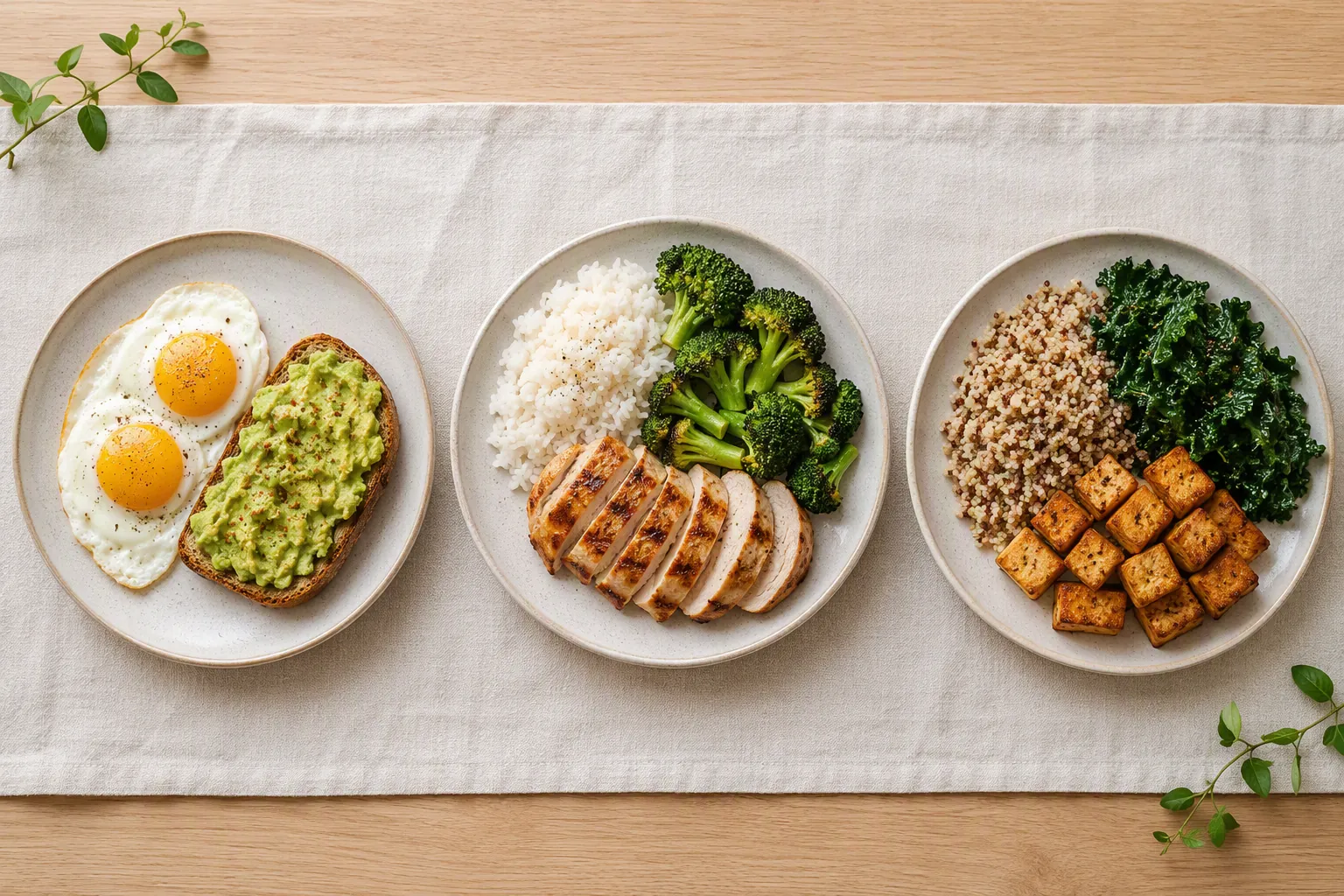
Daily grams also hide a meal-level problem. If you spread a smaller protein budget too thin, each meal may be too weak to send a clear muscle-building signal. Research on post-exercise protein dosing suggests that a meaningful meal dose often lands around 25–30 g of high-quality protein, and leucine is a key amino-acid trigger for muscle protein synthesis, with roughly 2.5 g often discussed as a useful threshold. [5][6]
That does not mean every person needs the same breakfast, or that plant-based meals cannot work. It means a lower-protein day should be built around meals that count. Eggs, Greek yogurt, fish, poultry, tofu, tempeh, seitan, lentils paired with higher-protein grains, or a carefully chosen protein powder can all fit, depending on diet style and tolerance. If you are using shakes, the useful question is whether the shake helps you hit a real meal dose rather than whether it has a “longevity” label. For more on timing versus total intake, see FitAtHome’s guide to the post-workout protein shake at home.
Training helps here, too. Exercise can improve the muscle’s sensitivity to amino acids, which is one reason resistance training is so important when protein intake is being held down. [7] A small protein budget paired with hard sets is a different biological situation from the same budget paired with no loading.
The longevity case is interesting, but it is not a permission slip
The reason this question keeps coming up is not imaginary. In a Cell Metabolism analysis using NHANES data, low protein intake, defined as less than 10% of calories, was associated with about 74% lower all-cause mortality and about fourfold lower cancer mortality among adults aged 50–65. The same paper reported that the association reversed after age 66. [8]
Mechanistically, protein restriction is often discussed through pathways such as mTOR, FGF21, and IGF-1, which are plausible and actively studied in aging biology. [9] But that is still not the same as a randomized trial showing that a healthy home exerciser who lowers protein to a specific target will live longer and keep all their muscle. Much of the lifespan case comes from animal work, mechanistic reasoning, and epidemiology.
That distinction matters because muscle is not an aesthetic side project after midlife. Strength, power, balance, and the ability to get off the floor are practical assets. A longevity plan that makes those worse has a real cost, even if the bloodwork looks tidy for a while.
Who should not treat this as a self-experiment
The older the reader, the less forgiving this tradeoff becomes. In the Newcastle 85+ Study, protein intake below 1 g/kg/day was associated with lower grip strength in very old women. [10] That does not mean every older adult needs bodybuilder protein, but it does mean “lower protein for longevity” ages badly as a blanket rule.
The conservative aging anchor points the other way: the ESPEN expert group recommended higher protein intake plus exercise to support optimal muscle function with aging. [11] Frail older adults, people with unintentional weight loss, and anyone already struggling with strength or appetite should not borrow a midlife longevity experiment and hope dumbbells cover the gap.
The same caution applies to pregnant readers, people recovering from surgery or injury, people with active illness, and anyone with kidney disease outside medical supervision. The Castaneda trial is encouraging precisely because resistance training helped a medically supervised low-protein group; it is not a reason to self-prescribe a kidney-disease diet.
A practical decision rule
If you are a healthy adult in roughly the 30–60 range, training consistently at home, and curious about the longevity argument for lower protein, the cautious experiment is not extreme restriction. It is something closer to 0.8–1.0 g/kg/day, with progressive resistance training about three times per week and at least a couple of meals built around meaningful protein portions.
Watch the boring markers: strength on your main lifts, body weight trend, waist measurement, appetite, recovery, soreness that does not clear, and whether daily tasks feel easier or harder. If rows, push-ups, split squats, hinges, or carries are sliding backward for weeks while protein is low, do not explain it away with a longevity podcast clip.
The trained-versus-untrained evidence is the line worth keeping. Moderate protein restriction and muscle retention can fit together, but skipping the training changes the risk profile. Home workouts are not a decorative compromise in a longevity diet; they are the condition that makes the compromise remotely defensible.
References
- Resistance training to counteract the catabolism of a low-protein diet in patients with chronic renal insufficiency: a randomized, controlled trial, Annals of Internal Medicine, 2001
- The hallmarks of protein restriction, Cell Press, 2026
- Home-based resistance training during weight loss in adults with obesity: a pilot randomised controlled trial, PMC, 2025
- The effects of dietary protein intake on muscle mass in adults with overweight or obesity: a systematic review and meta-analysis, PubMed, 2024
- Ingested protein dose response of muscle and albumin protein synthesis after resistance exercise in young men, American Journal of Clinical Nutrition, 2009
- The Role of Leucine in Muscle Protein Synthesis and Beyond, PMC, 2024
- Exercise overcomes muscle anabolic resistance by restoring muscle protein synthesis sensitivity, PMC, 2021
- Low Protein Intake is Associated with a Major Reduction in IGF-1, Cancer, and Overall Mortality in the 65 and Younger but Not Older Population, Cell Metabolism, 2014
- Dietary protein restriction improves metabolic health and extends lifespan, eBioMedicine, 2019
- Low protein intake is associated with reduced muscle strength in the oldest old: the Newcastle 85+ Study, PMC, 2018
- Protein intake and exercise for optimal muscle function with aging: Recommendations from the ESPEN Expert Group, Clinical Nutrition, 2014
This is general fitness education, not medical advice. For diagnosis or treatment of pain or injury, consult a qualified clinician.
Pick your next session
Browse all routines to find an appropriately-spaced next session.
Spot something off?
This content sits adjacent to health guidance — tell us if a citation or figure needs a correction.