
How to do recovery exercises at home after a hysterectomy
A phase-by-phase home exercise plan for hysterectomy recovery — what to do in the first days, how to progress walking and pelvic floor exercises, and the warning signs that mean stop and call your provider.
- Citation source
- NHS and RCOG
- Evidence level
- Restrained inference
- Recommended frequency
- 10 long and 10 short pelvic floor squeezes at least 3 times daily after clearance
You are home after a hysterectomy, and the first exercise question is usually not about fitness. It is whether you can roll out of bed without grabbing your belly, cough without panicking, walk to the bathroom without overdoing it, and know when a symptom means stop.
This at-home plan uses NHS, RCOG, NHS Trust physiotherapy leaflets, and peer-reviewed recovery-limit commentary. It is not a substitute for your surgeon’s discharge instructions. The calendar helps organize recovery, but it does not clear you by itself: each phase depends on your surgery route, catheter status, wound status, bleeding, pain, fever, and your own provider’s restrictions.

Stop the exercise you are doing and call your provider if you have heavy vaginal bleeding, fever over 100.4 F, worsening pain, incision redness, swelling, or drainage, or difficulty urinating. Those signs matter more than finishing a walk or reaching a week-by-week target.
Hysterectomy recovery is common enough that vague advice affects a lot of households: a 2021 National Health Interview Survey data brief reported a 14.6% age-adjusted hysterectomy prevalence among U.S. women aged 18 and older.[1] But common does not mean standardized. Recovery instructions differ after abdominal, laparoscopic, robotic, and vaginal surgery, and they also differ by what was repaired at the same time.
The first days: circulation, breathing, coughing, and tiny core work
The first home exercises after hysterectomy are not workouts. They are low-intensity recovery tasks: keeping circulation moving, clearing your chest, protecting your abdomen when you cough, and reminding your deep abdominal muscles how to switch on without bracing.
The NHS says walking is encouraged from the day after surgery, while RCOG says there is no reason not to start walking on the day you return home, assuming your own team has not told you otherwise.[2][3] That permission is useful, but it should not be stretched into “push through.” In the first days, walking may mean getting up for the bathroom, making a slow lap of the room, or walking a short hallway with someone nearby.
| Exercise | How to do it at home | Dose from cited physiotherapy guidance |
|---|---|---|
| Ankle pumps | Lying or sitting, point and pull your feet to move the ankles. | 30 seconds each hour, from Bedfordshire Hospitals NHS Trust. |
| Deep breathing | Breathe in slowly, let the lower ribs widen, hold briefly, then breathe out without forcing. | Hourly breathing with a 3-second hold, from Bedfordshire Hospitals NHS Trust. |
| Huffing and supported coughing | Hold a pillow firmly over your abdomen, then huff or cough with support rather than gripping your belly. | Use when you need to clear your chest, from Bedfordshire Hospitals NHS Trust. |
| Abdominal hollowing | Gently draw the lower abdomen inward as if narrowing the waist; avoid holding your breath. | Hold up to 10 seconds and repeat up to 10 times, from Bedfordshire and Gloucestershire NHS physiotherapy leaflets. |
| Pelvic tilting | Lying with knees bent, gently flatten and release the lower back against the bed. | Hold up to 10 seconds and repeat up to 10 times, from Bedfordshire and Gloucestershire NHS physiotherapy leaflets. |
| Bent-knee fall-outs and knee rolling | With knees bent, let one knee move only a small way out to the side, or let both knees roll gently together within comfort. | Repeat up to 10 times, within comfort, from NHS Trust physiotherapy leaflets. |
These are protocol-level physiotherapy dosages, not a test of whether you are recovering “fast enough.” Bedfordshire Hospitals NHS Trust is the clearest source for the first-day and hourly items, and Gloucestershire Hospitals NHS gives similar gentle abdominal and pelvic movement advice after gynecological, bladder, and pelvic floor surgery.[4][5]

Supported coughing deserves its own small moment because it is where many people freeze. If you need to cough, sneeze, laugh, or clear your throat, press a folded pillow or cushion over the lower abdomen first. The point is not to make coughing painless. It is to give the sore abdominal wall something steady to meet instead of a sudden, unsupported jolt.
For the gentle abdominal exercises, stay below effort that makes you hold your breath, bear down, or grip your glutes. A coordinated light tightening is enough. If the movement increases bleeding, pulls sharply at an incision, worsens pelvic heaviness, or makes pain climb instead of settle, stop and use your provider’s instructions.
Walking builds early, but it is not a contest with the calendar
Walking is usually the main recovery exercise after hysterectomy because it is simple, measurable, and useful without asking the healing tissues to lift, twist, or strain. In the first week, the practical question is whether you can walk a little, rest, and feel no worse later that day or the next morning.
RCOG’s vaginal hysterectomy recovery guidance says many women can manage 30 to 60 minutes of walking by weeks 2 to 4, but that sentence should be read as reassurance, not a performance standard.[3] A pelvic-floor physiotherapist’s walking guide gives a more cautious practical progression: about 5-minute walks in weeks 1 to 2, around 10 minutes continuously by the end of week 2, then adding about 5 minutes per week toward 20 minutes by week 4 and up to 30 minutes by week 6.[6]

Those two sources can sit together if you let symptoms gate the plan. A good walk in hysterectomy recovery is one you can repeat without a flare. If 5 minutes outside leaves you shaky, heavier in the pelvis, or more sore for the rest of the day, the next walk should be shorter or indoors. If several short walks feel easy, combining them into one longer walk can wait until your body has shown you it tolerates the total amount.
- Start with flat, familiar surfaces before sidewalks with curbs, hills, dogs, or traffic.
- Use time, not pace: slow walking still counts.
- Split the day into several short walks if one continuous walk increases symptoms.
- Treat new heavy bleeding, fever, worsening pain, urinary trouble, or wound changes as a stop-and-call sign, not a reason to “walk it off.”
If you are used to structured plans, it may help to think of this like other phased home recovery work: the plan exists to organize safe exposure, not to prove toughness. FitAtHome uses the same clearance-first idea in guides such as meniscus tear recovery timelines and foot injury recovery exercises, but hysterectomy recovery has its own pelvic, abdominal, urinary, and bleeding signals. Do not borrow progressions from another injury and paste them onto abdominal surgery.
Pelvic floor exercises: ask when to start, then keep them gentle
Pelvic floor advice is the place where a tidy article can become misleading. Sources do not all give the same start time. RCOG says pelvic floor exercises can begin gently once the catheter has been removed and you are passing urine normally, using 10 long squeezes up to 10 seconds plus 10 short squeezes at least 3 times a day, progressing from lying or sitting to standing.[3] Hinge Health’s pelvic floor guidance frames gentle pelvic floor work as something many people begin around 6 weeks once cleared.[7] Michelle Kenway’s practical hysterectomy materials also place more emphasis on provider clearance around the 4- to 6-week window.[6]
That disagreement does not mean pelvic floor work is unsafe or useless. It means you should ask your surgeon or pelvic health physical therapist a very specific question: “Given my surgery and catheter status, should I start gentle pelvic floor contractions now, or wait until my follow-up clearance?”
When you are cleared to start, think coordination before strength. A pelvic floor contraction should feel like a gentle lift and close around the vagina and anus, not a full-body brace. Let the belly, buttocks, and inner thighs stay as quiet as possible. Release fully between repetitions; a pelvic floor that cannot let go is not being trained well.
- Use RCOG’s dose only if your provider has cleared that timing: 10 long squeezes up to 10 seconds, then 10 short squeezes, at least 3 times daily.[3]
- Start lying down or sitting if standing makes you brace or bear down.
- Breathe normally; do not hold your breath to make the squeeze stronger.
- Do not practice by stopping urine mid-stream; RCOG specifically advises against that habit.[3]
- Stop and ask for help if pelvic floor work increases pelvic pressure, pain, urinary symptoms, or bleeding.
Weeks 2 to 6: repeat the basics, widen ordinary movement slowly
After the first days, most home recovery exercise is still a small menu: walking, breathing when you feel guarded, gentle abdominal activation, and pelvic floor work if cleared. The difference is that ordinary movement starts to widen. You may be standing longer at the sink, taking stairs more steadily, or walking outside instead of only around the bedroom.
This is also the stretch where people are most tempted to test chores. Lifting rules vary by institution and procedure, so copying a generic number from the internet is not a safe shortcut. The research review by Nygaard and colleagues found that post-operative restrictions such as lifting, intercourse, and driving are largely expert opinion and vary widely; among surveyed surgeons, 88% to 99% restricted lifting for a mean of 5 to 7 weeks, with ranges from 1 to 26 weeks.[8]
For exercise, that uncertainty argues for boring consistency rather than improvising harder home workouts. Keep walks easy enough that you can speak comfortably. Keep abdominal work low-load and symptom-free. Skip sit-ups, planks, heavy resistance work, loaded carries, hard twisting, and breath-holding unless your provider has specifically cleared them.
| If this is happening | What to do with exercise |
|---|---|
| Bleeding becomes heavy or suddenly increases | Stop and call your provider. |
| Pain worsens during or after the session | Stop, scale back, and follow your discharge instructions; call if it does not settle or is concerning. |
| You develop fever over 100.4 F | Stop and call your provider. |
| The incision becomes red, swollen, draining, or more painful | Stop and call your provider. |
| You have difficulty urinating | Stop and call your provider. |
| You feel tired but symptoms do not worsen | Rest, shorten the next session, and progress more slowly. |
Week 6 and beyond is a clearance gate, not a finish line
Six weeks is often treated like a magic date, but it is better handled as a medical checkpoint. Before returning to harder exercise, heavier lifting, intercourse, or higher-impact workouts, use your follow-up visit and written discharge instructions. If you had complications, additional prolapse or bladder repair, persistent bleeding, wound concerns, urinary trouble, or significant fatigue, your phase may not match the calendar.
The internal-tissue reason is not imaginary. Nygaard and colleagues summarized abdominal fascia healing data showing fascia regains only 51% to 80% of original tensile strength at 6 weeks and 73% to 93% by 20 weeks, and it never returns fully to pre-wound strength.[8] That does not mean you should stay still for months. It means feeling more normal is not the same as being fully healed.
Once cleared, the next layer is usually gradual return rather than a jump back to pre-surgery training. Walking can become longer or slightly brisker. Gentle mobility can become more complete. Strength work can restart with light, controlled movements that do not make you bear down. Low-impact cardio ideas may fit later in recovery, but only after the surgical restrictions are lifted; a general low-impact cardio framework is not a replacement for post-op clearance.
A simple home flow to follow
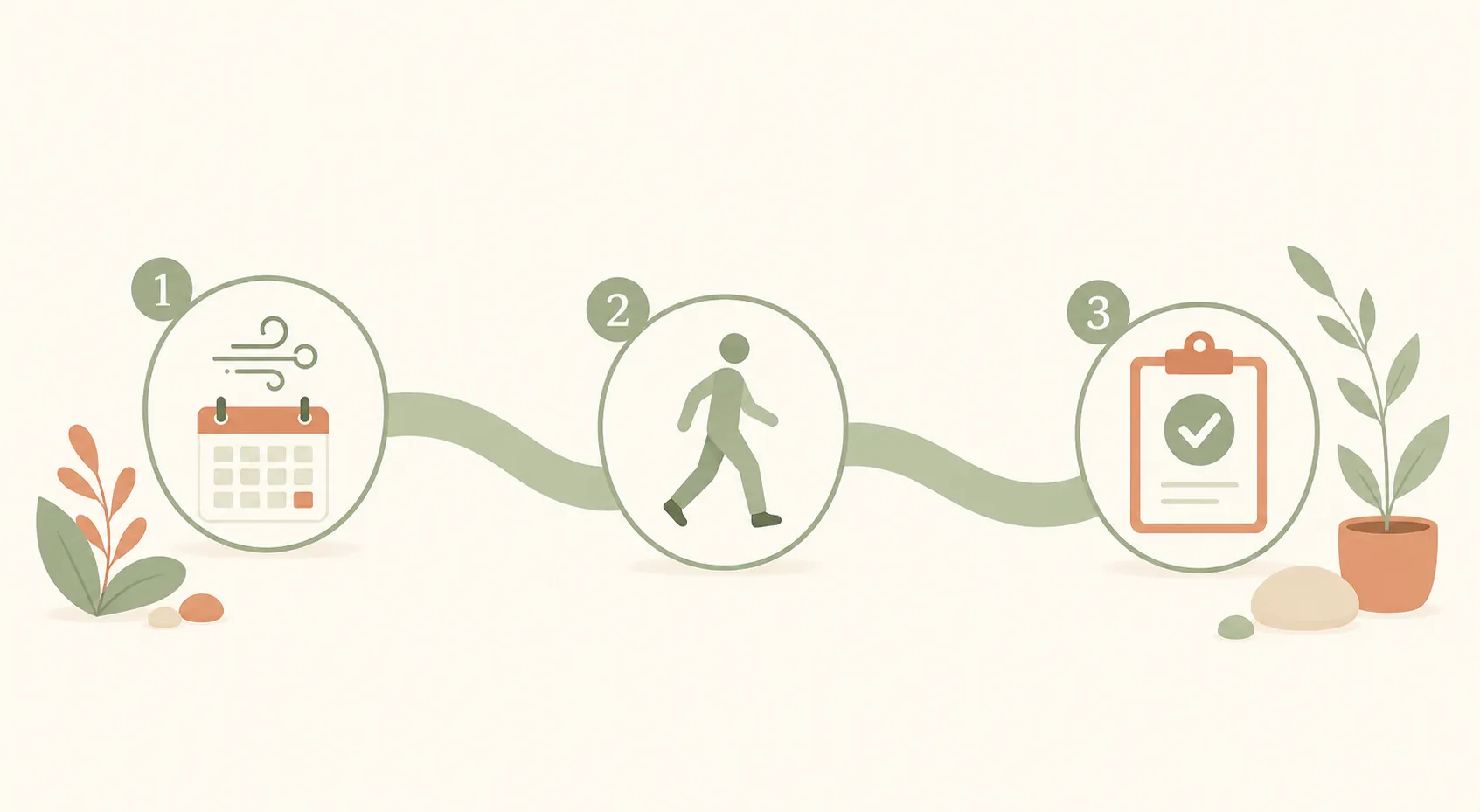
| Recovery phase | Main home exercise focus | Gate before progressing |
|---|---|---|
| First days home | Ankle pumps, deep breathing, supported coughs, short walks, gentle abdominal activation. | No stop signs; pain, bleeding, urination, fever, and wound symptoms are stable. |
| Weeks 1 to 2 | Several short walks, continued breathing and gentle abdominal work, pelvic floor only if cleared for your surgery and catheter status. | Walks do not worsen symptoms later that day or the next morning. |
| Weeks 2 to 6 | Gradually longer easy walking, gentle core coordination, pelvic floor progression if cleared. | Written restrictions still followed; no heavy bleeding, fever, worsening pain, urinary trouble, or wound changes. |
| Week 6+ | Possible gradual return to more activity, light strength, and fuller cardio choices. | Medical clearance, especially before heavier lifting, impact, intercourse, or abdominal loading. |
The safest version of recovery exercises after hysterectomy at home is not total stillness, and it is not a fitness challenge. It is a named-protocol plan done beside your own surgical instructions: breathe, pump the ankles, support the cough, walk early but gently, coordinate the abdominal and pelvic floor muscles when cleared, and let symptoms and medical follow-up decide when the next phase starts.
References
- Hysterectomy Prevalence Among Women Aged 18 and Over: United States, 2021, CDC National Center for Health Statistics, 2024.
- Hysterectomy - Recovery, NHS.
- Vaginal hysterectomy - recovering well, Royal College of Obstetricians and Gynaecologists.
- Exercises that can be carried out after a hysterectomy, Bedfordshire Hospitals NHS Trust.
- Exercise advice following gynaecological, bladder and pelvic floor surgery, Gloucestershire Hospitals NHS Foundation Trust.
- Walking After a Hysterectomy, Pelvic Exercises.
- Pelvic Floor After Hysterectomy: What to Expect and How to Heal, Hinge Health.
- Activity Restrictions After Gynecologic Surgery: Is There Evidence?, Obstetrics and Gynecology, 2013.
This is general fitness education, not medical advice. For diagnosis or treatment of pain or injury, consult a qualified clinician.
Pick your next session
Browse all routines to find an appropriately-spaced next session.
Spot something off?
This content sits adjacent to health guidance — tell us if a citation or figure needs a correction.