
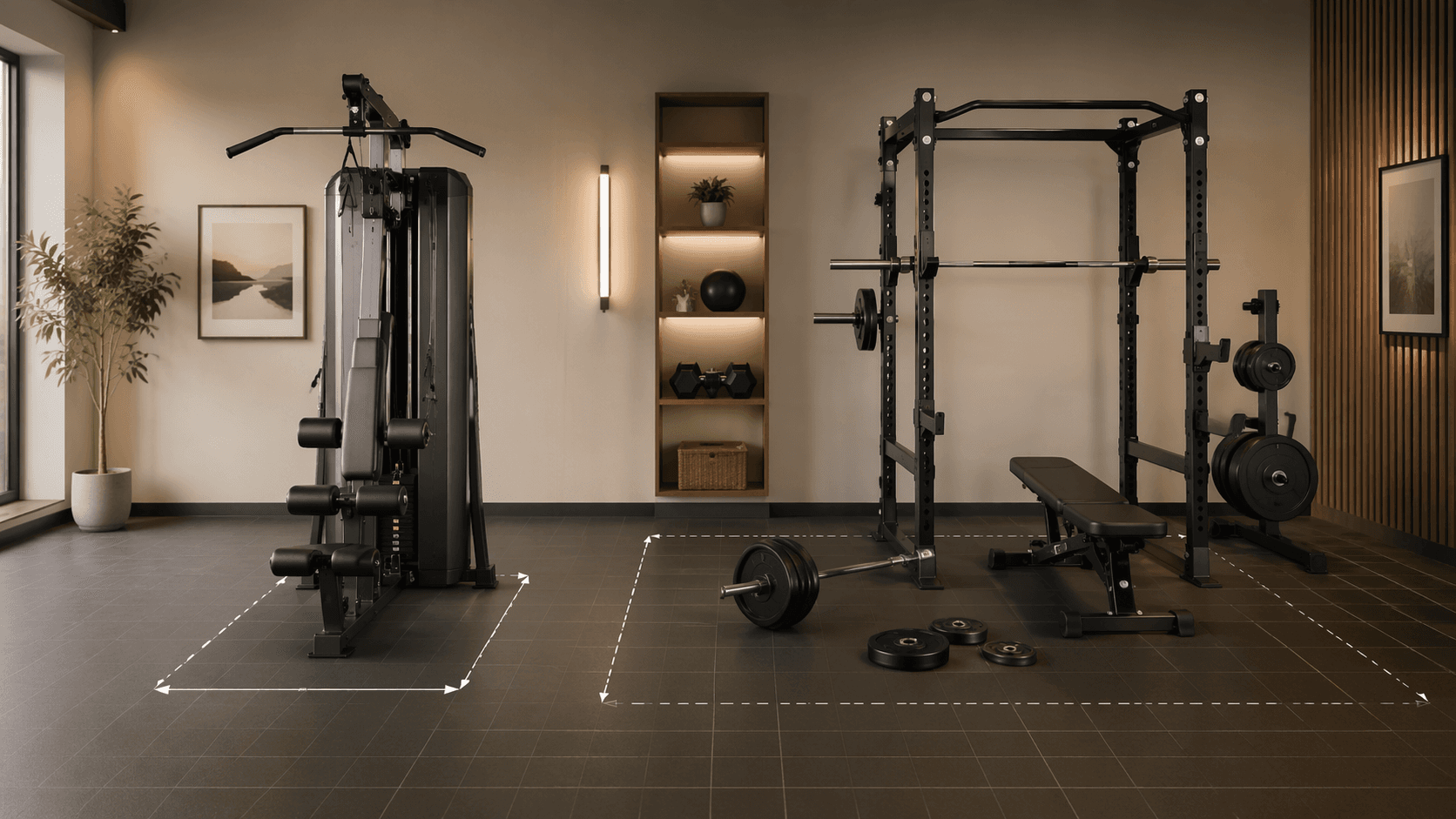
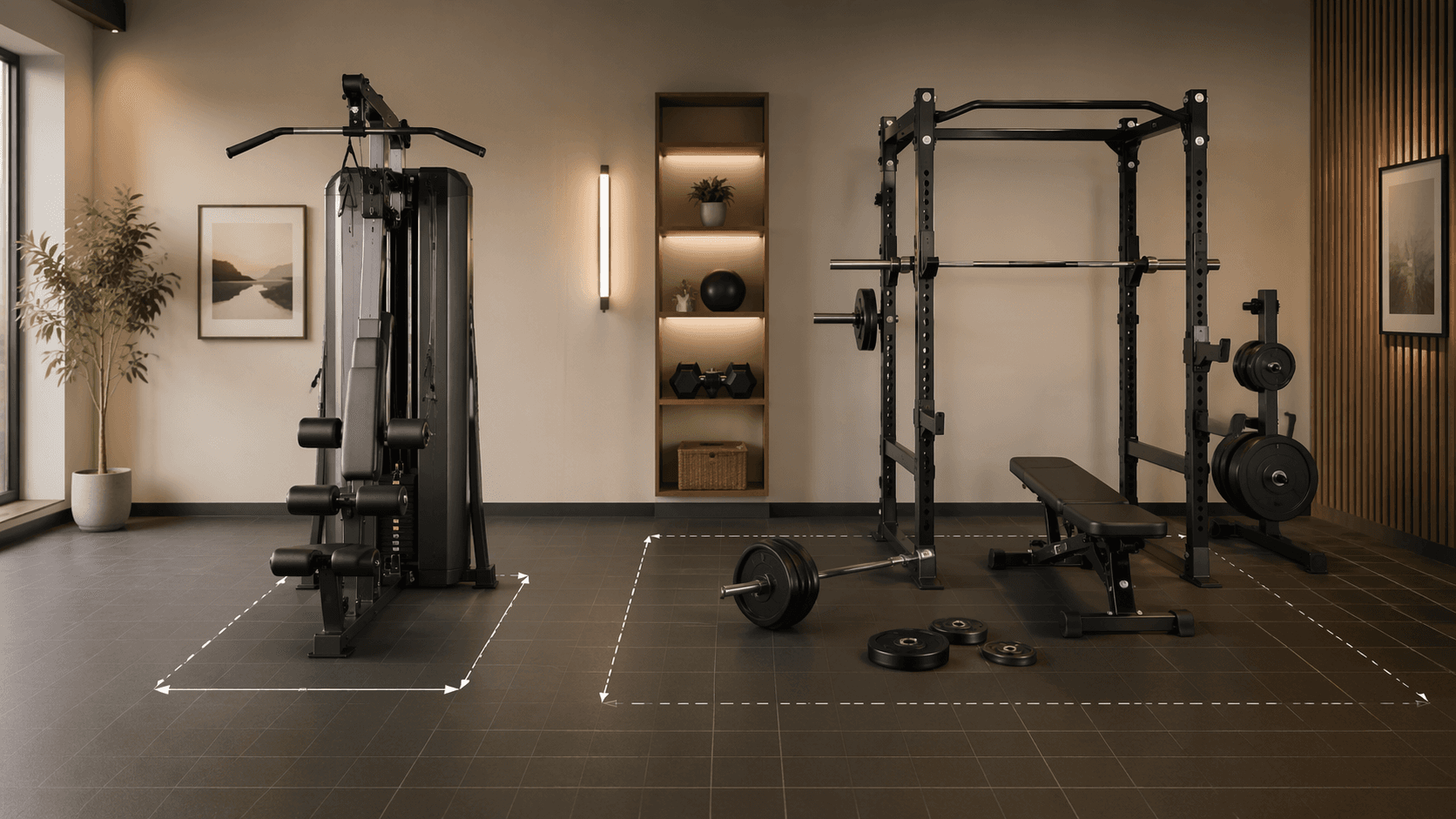
The All-in-One vs. Separate Equipment Decision: Why It Matters
If you are in the market for a home gym, you have likely run into the central tension of the category: do you buy one all-in-one machine that promises to do everything, or do you assemble a modular setup piece by piece? The answer is not a simple "this is better than that." It depends on three measurable constraints: the ceiling height and floor space you can dedicate, the weight loads you expect to handle, and whether you see your gym as a finished purchase or an evolving project.
This article is for buyers who are past the initial research phase and are now weighing a specific purchase decision. We will compare the real costs, the actual footprints, the resistance ceilings, and the upgrade paths of both approaches. The goal is not to crown a winner but to give you the breakeven thresholds that tell you which path fits your situation. For those specifically limited to small spaces, our guide to compact approaches covers a similar decision in tighter quarters.
Price Comparison: All-in-One vs. Modular Build
The upfront cost difference between an all-in-one machine and a modular free-weight setup is narrower than many buyers assume, especially when you account for the fact that a quality all-in-one includes multiple stations in a single frame. According to data from Garage Gym Reviews, the average cost of a home gym machine across their tested roundup is approximately $1,855. That figure sits in the middle of a wide range.
| Approach | Representative Product | Upfront Cost | What's Included |
|---|---|---|---|
| All-in-One (Plate-Loaded) | Bells of Steel All-in-One Home Gym | $1,300 – $1,900 | Cable crossover, squat station, pull-up bar, plate-loaded resistance (300 lb cable capacity) |
| All-in-One (Selectorized) | Major Fitness B17 Flying Fortress | $4,200 | Dual 260 lb weight stacks, Smith machine, cables, J-hooks with 1,500 lb capacity |
| All-in-One (Smart / Digital) | Speediance Gym Monster | $3,199 | 220 lbs of digital resistance, foldable footprint, touchscreen, subscription optional |
| Modular Build (Rack + Bar + Plates + Bench) | PRx Profile PRO Rack + accessories | $1,800 – $2,600 | 11-gauge steel rack (1,000 lb capacity), Olympic bar, 255–300 lbs of plates, adjustable bench |
The modular build in the table uses the PRx Profile PRO Squat Rack at $1,100 as its foundation. Adding an Olympic barbell ($200–$300), 255–300 lbs of bumper or iron plates ($300–$500), and an adjustable bench ($200–$400) brings the total to roughly $1,800–$2,600. That is competitive with the lower end of the all-in-one market and significantly cheaper than a dual-stack or smart gym.
However, the modular price does not include a cable attachment, a lat pulldown station, or a leg press — features that are built into most all-in-one machines. If you add a cable tower or functional trainer to the modular build, the cost gap narrows or reverses. The all-in-one's value proposition is consolidation: you pay a premium for a single frame that does the work of three or four separate pieces of equipment.
Space Comparison: Real Footprint Dimensions
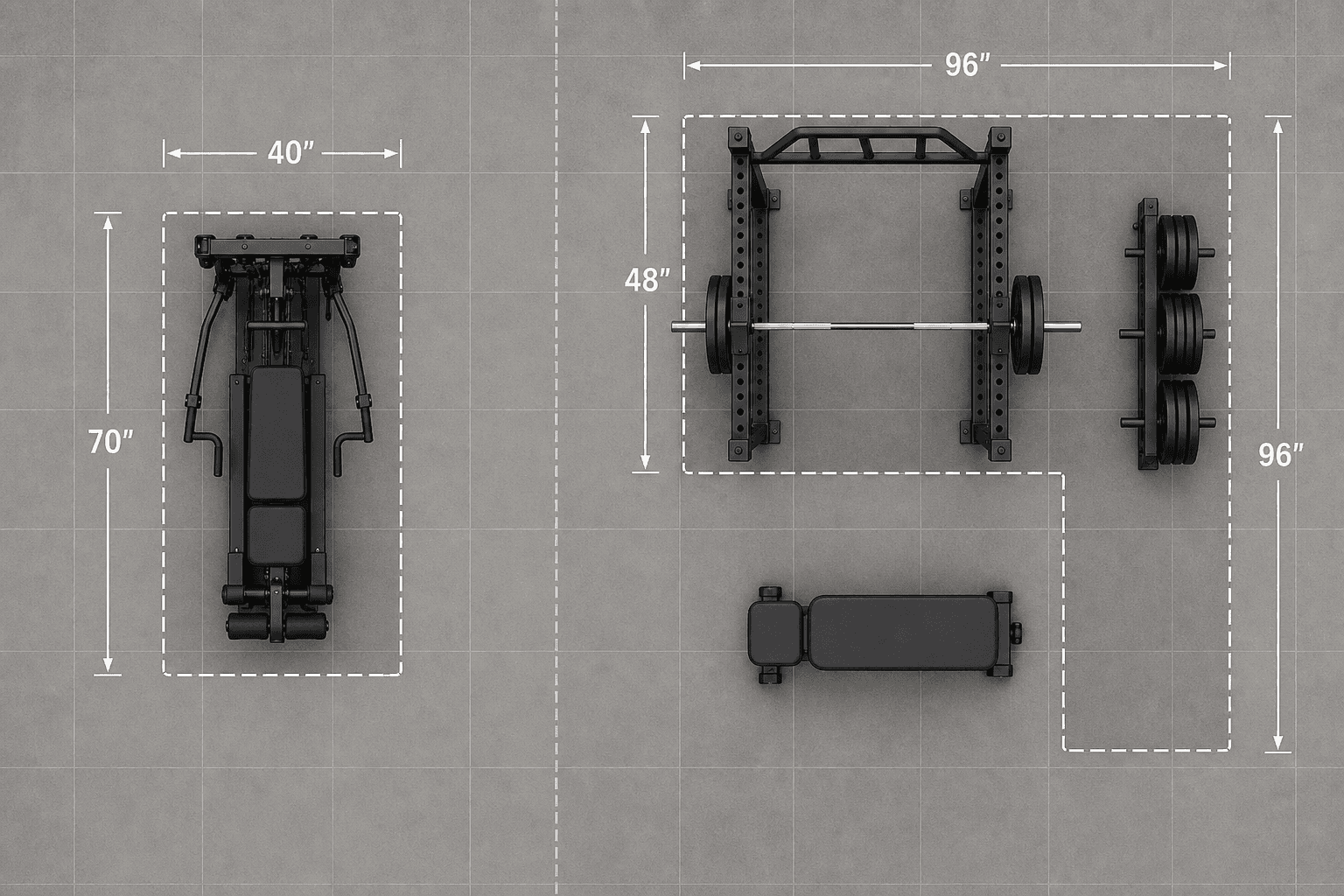
Floor space is where the all-in-one machine has its clearest advantage. A typical multi-station gym requires an area of about 7 feet by 10 feet, according to FitnessFactory.com. That single rectangle contains the entire workout — squat, bench, cable work, leg press, pull-ups — all within that boundary.
A modular free-weight setup, by contrast, spreads its components across a larger area. The power rack itself occupies roughly 4 by 6 feet, but you also need space for a bench to slide in and out, a barbell to extend beyond the rack during squats and presses, plate storage (either on the rack or on a separate tree), and a deadlift platform or area where you can drop the bar. The total working area for a modular build is closer to 8 by 10 feet, and that does not include clearance for swinging a barbell into a front rack position or walking out a heavy squat.
| Dimension | All-in-One Machine | Modular Free-Weight Setup |
|---|---|---|
| Minimum Floor Area | ~7' x 10' (70 sq ft) | ~8' x 10' (80 sq ft) plus clearance |
| Ceiling Height Required | 72–84 inches (most units) | 90+ inches for overhead press inside rack |
| Storage Efficiency | Single footprint, no separate storage needed | Requires plate tree or rack-mounted storage |
| Setup Complexity | Unbox, assemble, level | Multiple boxes, separate assembly, floor matting |
Ceiling height is a critical and often overlooked variable. Many all-in-one machines, especially those with cable towers or Smith machine rails, have a height of 72 to 84 inches. The Speediance Gym Monster, for example, stands 72.83 inches tall. That fits in most basements and spare rooms. A power rack, however, is typically 90 to 96 inches tall, and you need additional clearance above that to load plates onto a barbell for an overhead press. If your ceiling is under 8 feet, a standard power rack may not work for standing overhead movements.
Resistance Ceiling: Weight Stack Limits vs. Free Weights
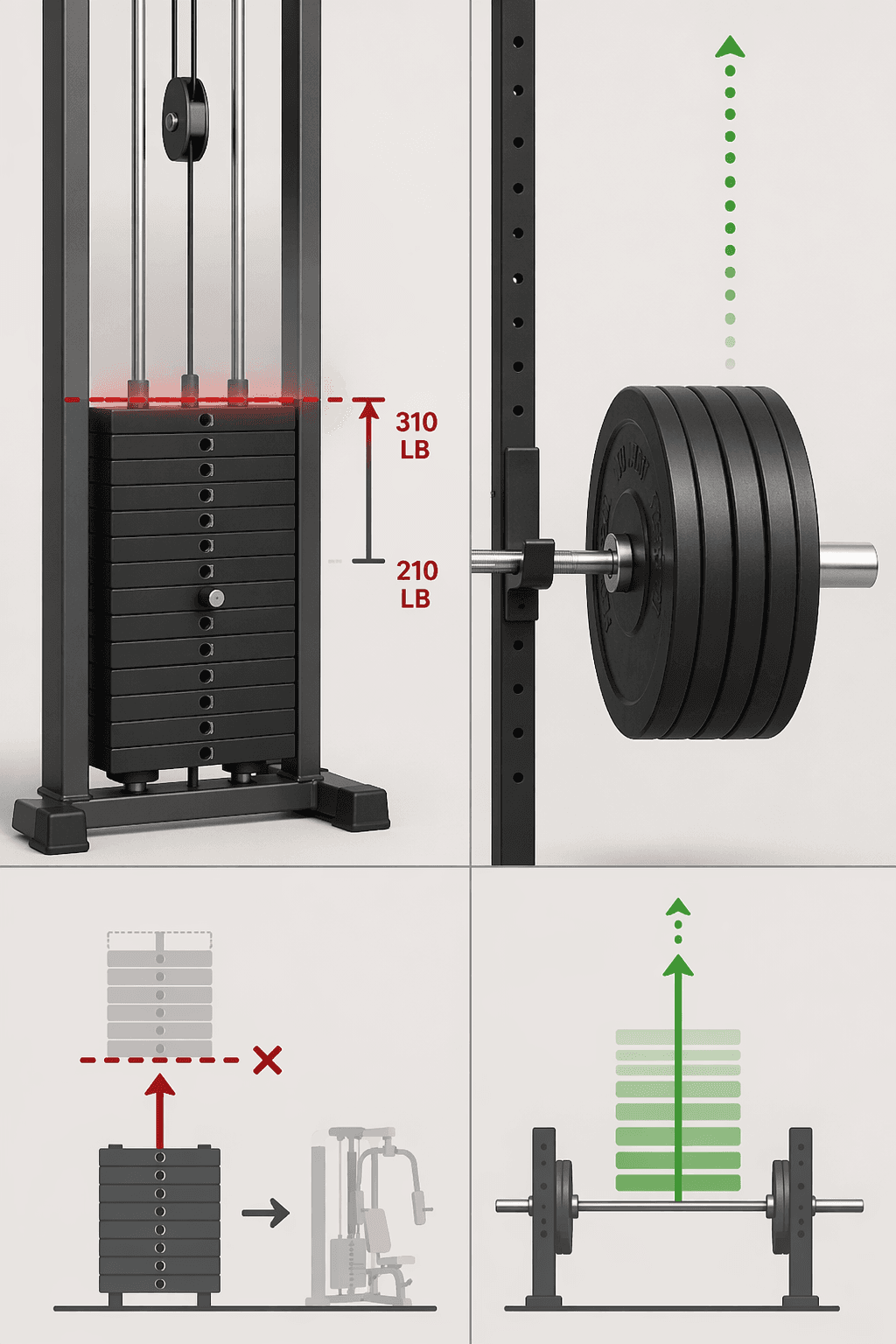
The most significant long-term limitation of selectorized all-in-one machines is the weight stack. Most consumer-grade units cap out between 210 and 310 pounds per stack. The Body-Solid EXM2500, for instance, has a single 210 lb stack. The Major Fitness B17 offers dual 260 lb stacks. The Bells of Steel All-in-One, when configured with a weight stack, comes with 210 lbs. These numbers are sufficient for the vast majority of users on upper-body cable movements, but they become a hard ceiling for lower-body exercises like squats, deadlifts, and leg presses.
A 210 lb maximum on a leg press or squat movement is roughly equivalent to an intermediate-level lifter after 12–18 months of consistent training. Once you can leg press 210 lbs for 10–12 reps with good form, the machine has nothing left to give you. You cannot add more weight. You are stuck.
Free weights have no such ceiling. A standard Olympic barbell can hold 600+ lbs of plates. A power rack rated for 1,000 lbs (like the PRx Profile PRO) will never be the limiting factor in your training. If you are a lifter who expects to squat or deadlift more than 300 lbs within a few years, the modular path is the only path that does not require you to sell and replace your entire setup.
Upgrade Path and Long-Term Flexibility
The upgrade path is where the modular approach separates itself most clearly. An all-in-one machine is a closed system. If you outgrow its weight stack, want a different cable ratio, or decide you prefer a different type of resistance, you do not upgrade the machine — you replace it. The entire unit goes, and you start over.
A modular build allows incremental upgrades over years. You can start with a budget barbell and upgrade to a bearing-based bar later. You can add more plates as your strength increases. You can swap a flat bench for an adjustable one, or add a cable tower, or replace your rack's J-hooks with safety straps. Each upgrade costs a fraction of a full replacement.
- Steel gauge matters for long-term rigidity. All-in-one machines typically use 12- to 14-gauge steel. The Major Fitness B17 uses 12- and 14-gauge. The Body-Solid EXM2500 uses 12-gauge. Dedicated power racks often use 11-gauge steel, which is thicker and more rigid. The PRx Profile PRO rack uses 11-gauge steel and carries a 1,000 lb weight capacity.
- Smart gyms add a subscription cost that changes the total cost of ownership over time. The Speediance Gym Monster, for example, costs $3,199 upfront and may require a monthly subscription ($0–$49/month depending on the plan) for full access to its training library and tracking features. Over 5 years, a $29/month subscription adds $1,740 to the total cost.
- Warranty terms differ significantly. All-in-one machines often have limited lifetime warranties on the frame but shorter coverage on cables, pulleys, and moving parts. Modular components (racks, barbells, plates) typically have longer or more comprehensive warranties on individual parts.
The Breakeven Analysis: All-in-One vs. Gym Membership
For many buyers, the decision to buy a home gym is also a decision to cancel a gym membership. The breakeven analysis against the average gym membership cost of roughly $65 per month (based on the 2024 U.S. Health & Fitness Consumer Report) provides a useful financial frame.
| Machine Cost | Monthly Membership Equivalent | Breakeven Point |
|---|---|---|
| $1,300 (Bells of Steel, plate-loaded) | $65/month | ~1.7 years |
| $1,855 (average home gym cost) | $65/month | ~2.4 years |
| $3,199 (Speediance Gym Monster) | $65/month | ~4.1 years |
| $4,200 (Major Fitness B17) | $65/month | ~5.4 years |
A $1,855 machine (the average from Garage Gym Reviews' roundup) breaks even in roughly 2.4 years. A $4,200 machine takes about 5.4 years. If you plan to stay home for at least 3 to 5 years, the all-in-one makes financial sense compared to a membership. If your timeline is shorter, or if you are comparing against a cheaper gym ($30–$40/month), the breakeven point extends further.
This analysis does not include the cost of a modular build, which has its own breakeven calculation. A $2,000 modular setup breaks even in about 2.6 years against a $65/month membership. However, the modular setup retains resale value better than an all-in-one machine because individual components (rack, barbell, plates) can be sold separately.
Decision Framework: Which Path Is Right for You?
Use the following thresholds to match your situation to the right approach. These are not general preferences — they are specific conditions that determine which path will serve you better over the life of your home gym.
- Choose an all-in-one machine if: you have limited floor space (under 80 sq ft), a standard ceiling height (under 8 feet), and you do not expect to outgrow a 210–310 lb weight stack for your primary lifts. The all-in-one wins on simplicity, single-footprint efficiency, and setup speed.
- Choose a modular free-weight build if: you have a garage, basement, or dedicated room with at least 8-foot ceilings, you plan to squat or deadlift over 300 lbs within a few years, or you want the ability to upgrade components incrementally over time. The modular build wins on long-term flexibility, resistance ceiling, and upgrade cost.
- Consider a plate-loaded all-in-one (like the Bells of Steel) as a middle ground if you want the space efficiency of an all-in-one but need more resistance flexibility than a selectorized stack provides. You get the single footprint with the ability to use your own plates.
- Avoid smart gyms with mandatory subscriptions if you are budget-conscious over a 5-year horizon. The subscription cost can add 30–50% to the total cost of ownership, erasing the upfront price advantage.
Comments
Join the discussion with an anonymous comment.