
Building a new in-ground lap pool is the clean answer on paper and the expensive answer in real life: U.S. Masters Swimming puts backyard lap-pool construction at roughly $40,000 to $100,000 or more.[1] That is why the better first question is not “Can I build a lap pool?” It is “Can I convert the backyard pool I already paid for into a pool I will actually swim in three mornings a week?”
For many homeowners, yes. But the answer depends less on ambition than on tape-measure facts: pool length, usable width, depth, wall construction, deck access, electrical access, and how much you care about a natural lap-swim feel. A 36-foot rectangle and a 17-foot kidney pool are not solving the same problem, even if both are “backyard pools.”
The Four Realistic Conversion Paths
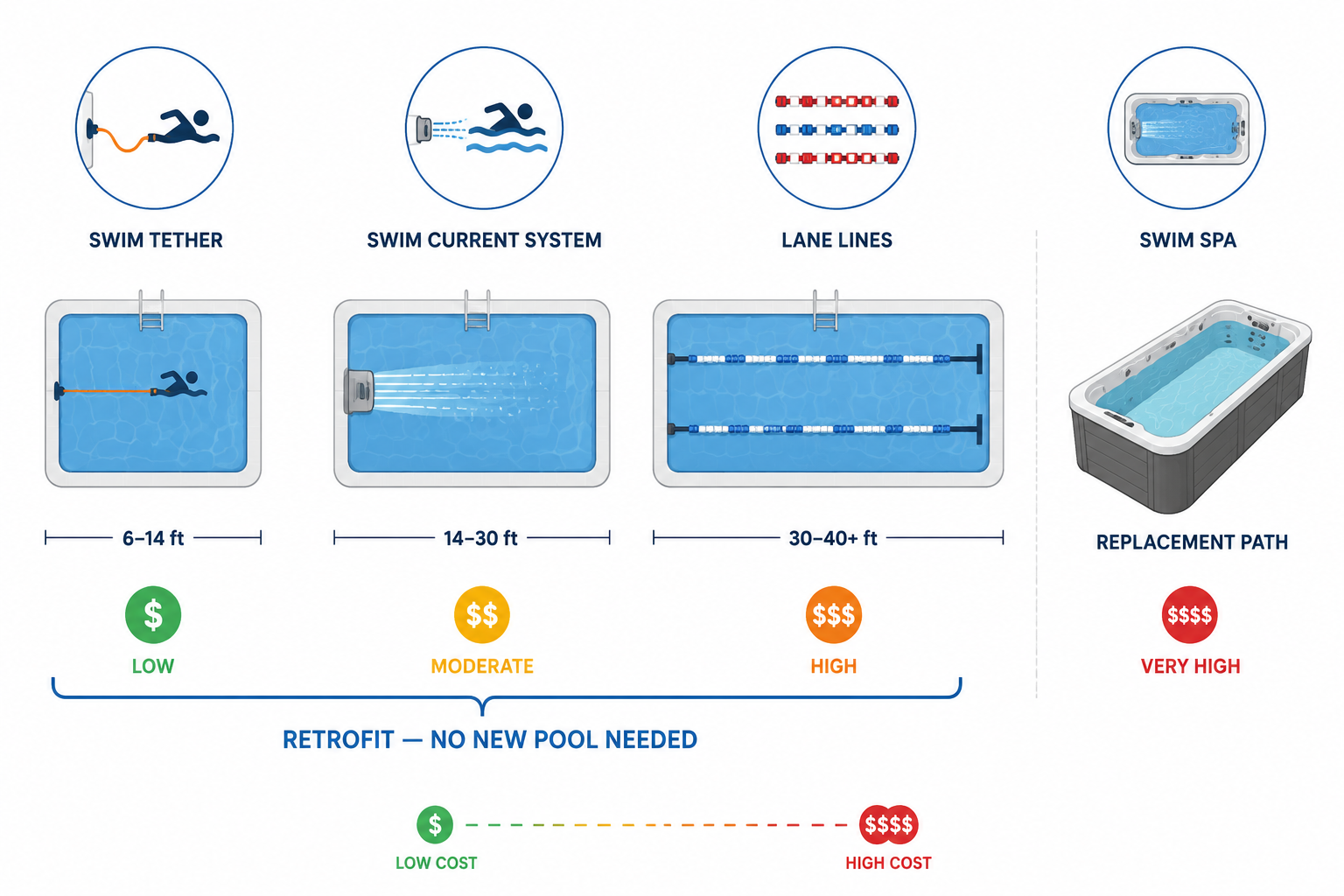
There are four practical ways to turn an existing backyard pool into a lap-swim workout space. Three are true retrofits. One, the swim spa, is better treated as a replacement path when the existing pool is too short, damaged, or not worth modifying.
| Option | Minimum pool size | Typical cost | Installation effort | Swim feel | Best fit |
|---|---|---|---|---|---|
| Swim tether | As short as 6 ft for Swim Tether ST1; 10 ft for ST3 | $215–$299 for complete Swim Tether systems | Low; removable; no electricity | Stationary resistance, not true lap travel | Small or awkward pools, renters with permission, low-friction fitness use |
| Swim current system | Generally 14 ft or longer | $2,000–$17,000 installed | Medium to high; often professional installation and electrical work | Closest retrofit to continuous swimming | Short-to-medium pools where real laps are not practical |
| Lane lines and wall anchors | Best at 30–40 ft or longer, with about 8 ft lane width | About $400+ per quality lane line, often $400–$800 with anchors depending on setup | Low to medium; anchor installation needed | Most like lap swimming if the pool is already long enough | Long rectangular pools or long freeform pools with a usable straight path |
| Swim spa | Separate unit, not a pool-length retrofit | $20,000–$60,000 | High; delivery, pad, electrical, possible removal or redesign | Purpose-built current swimming in a compact vessel | Existing pool is too small, failing, or being replaced anyway |
The table hides one uncomfortable truth only because tables are too tidy: length rules almost everything. Lane lines are wonderful when the pool is already long enough. They are nearly decorative when it is not. Current systems are the serious middle ground. Tethers are the cheapest tool that still lets you train, and they deserve more respect than they usually get.
Start With Pool Length, Not Equipment
Before shopping, measure the longest straight swimmable path in the pool, not the prettiest diagonal on a real-estate photo. Then measure usable width and depth along that path. Standard pool-dimension guidance commonly puts a single lap lane at about 8 feet wide, while lap-pool discussions commonly point to 30 to 40 feet as a practical minimum for continuous lap swimming.[2][3] Small-pool guidance also places useful swimming depth around 4 to 5 feet rather than a shallow lounging shelf.[4]
Those are not sacred Olympic rules. They are sanity checks. If you have 32 feet of straight water, wall-to-wall swimming can be reasonable. If you have 18 feet, you will spend more time turning than swimming unless a current system or tether keeps you in place. If you have 9 feet, the honest question is whether you want a resistance workout or a replacement vessel.
If the pool is under 14 feet
A sub-14-foot pool is not a lap pool waiting for the right lane stripe. It is a small body of water that may still support swim training if you remove travel from the equation. This is where a tether becomes the practical first look. Swim Tether states that its ST1 pole system can work in pools as short as 6 feet, while its ST3 needs 10 feet; its complete systems are listed at $215 to $299.[5]
That does not make the experience identical to swimming down a lane. You are held in place, resistance changes with body position, and pacing by distance disappears. But if the alternative is not swimming at all, a stable pole-and-belt tether can be the difference between a usable backyard workout and another abandoned fitness idea.
If the pool is 14 to 30 feet
This is the most interesting range because the pool is big enough to justify better equipment but too short to behave like a satisfying lap lane. Retrofit current systems such as Fastlane-style units, BaduJet-style units, and Riverflow-style pumps are built for this problem: they move water toward the swimmer so the swimmer can hold position and swim continuously.
Endless Pools states that its Fastlane Swim system can be installed in many existing pools, with a manufacturer-stated top speed of 1:08 per 100 yards.[6] Riverflow presents its system as a swim-in-place current option for pools where the swimmer faces a generated flow.[7] Those are product claims, not neutral lab comparisons across every backyard installation. They are still useful, as long as they are treated as compatibility and performance claims to verify with an installer rather than magic words.
If the pool is 30 to 40 feet or longer
Now lane swimming starts to make sense. A straight 30- to 40-foot stretch is still shorter than a competition pool, but it can support repeated lengths, turns, drills, and steady work without pretending a five-stroke crossing is a lap. In this range, lane lines and anchors may be the cleanest conversion because they organize the water without adding pumps, electricity, or a machine at the wall.
Width matters here. A single lane around 8 feet wide gives the swimmer enough room to avoid clipping hands on walls or steps, and depth in the 4- to 5-foot range keeps the stroke from feeling cramped in ordinary fitness swimming.[2][4] Freeform pools can work if they have a long, straight, unobstructed corridor. A curved pool with benches, tanning ledges, and stairs interrupting the path may measure long on the outside and still swim short.
Swim Current Systems: The Most Convincing Retrofit, With the Most Homework
A swim current system is the conversion that most closely answers the dream version of this project: keep the existing pool, add a current, and swim without flip-turning every few seconds. For a 14- to 30-foot pool, it is often the only upgrade that can make continuous freestyle feel plausible rather than improvised.
The basic idea is simple. A propulsion unit or pump system pushes a broad stream of water toward the swimmer. The swimmer faces the current and adjusts effort against the flow. Better systems try to make that current wide and smooth enough that the swimmer is not constantly fighting turbulence, sliding sideways, or shortening the stroke to stay centered.
Costs vary widely because the products and installations vary widely. Current-system and endless-pool-alternative pricing places installed retrofit swim-current options in the broad range of about $2,000 to $17,000, while separate endless-pool or swim-spa-style alternatives can run much higher.[6][8] That range is too wide to use as a quote. It is a warning to get a site-specific price.
The installation questions are not cosmetic. A contractor or manufacturer needs to know whether the pool wall can accept the unit, whether there is suitable deck space, how electrical service will be run, whether plumbing is involved, and whether the pool shape gives the current a clean path. A rectangular pool with a clear end wall is a different job from an older freeform pool with stone coping, limited deck access, and no convenient electrical route.
Electricity is part of the operating cost, too. Swim-jet consumption estimates run roughly 300W to 1,200W per session, or about $30 to $60 per month for daily use. That is not outrageous compared with a new build, but it belongs in the decision because the current system is the only true retrofit here that keeps asking for power after installation.
The swimmer’s experience is the payoff. A good current system lets you settle into a continuous rhythm, change effort, and use more normal stroke mechanics than a tether usually allows. It also removes the turn problem from short pools. For serious swimmers, though, “continuous” is not the same as “identical to a lane.” You still lose wall turns, distance pacing, and the feel of moving through still water.
The homeowner version of due diligence is blunt: ask the installer where the unit mounts, what structural assumptions they are making, what electrical work is included, what the monthly power estimate assumes, what happens if the pool wall is not compatible, and whether the quoted current speed is measured at the product or at the swimmer. If those answers are vague, the brochure is doing more work than the equipment.
Swim Tethers: Cheap, Useful, and Not a Fake Solution
A tether is the lowest-friction way to convert a backyard pool for swim workouts. The swimmer wears a belt or harness attached to a fixed point, usually by a cord or pole system, and swims against the restraint. No plumbing. No pump. No electrical work. No construction project quietly becoming a patio renovation.
The price difference is the obvious attraction. Swim Tether compares its $215 to $299 complete systems with swim jets and endless-pool-style systems costing thousands to tens of thousands of dollars.[5] Because that comparison comes from a tether manufacturer, it should not be treated as independent testing. The basic cost gap, however, is hard to ignore.
Pole-based systems are usually more stable than the cheapest elastic belt setups because the attachment point has height and structure. Swim Tether states that low-cost elastic alternatives often cost $20 to $60, can degrade within 6 to 12 months, and can compromise body position.[5] Again, that is vendor-provided comparison data, but it matches the common-sense problem with bargain elastic: if the line pulls from an awkward angle or changes tension unpredictably, the swimmer compensates.
A tether is best when the pool is short, the budget is tight, the homeowner wants a removable setup, or the goal is general conditioning rather than precise pace work. It can support freestyle, backstroke, breaststroke, and butterfly in principle, but the feel is different. There is no glide down the lane, no turn, and no real distance unless you track time, stroke count, or effort instead.
That tradeoff is acceptable for more people than pool-equipment marketing tends to admit. If a $250 tether gets used four mornings a week and a $12,000 current system never gets approved by the household budget committee, the tether is the better fitness purchase.
Lane Lines Work When the Pool Is Already Almost There
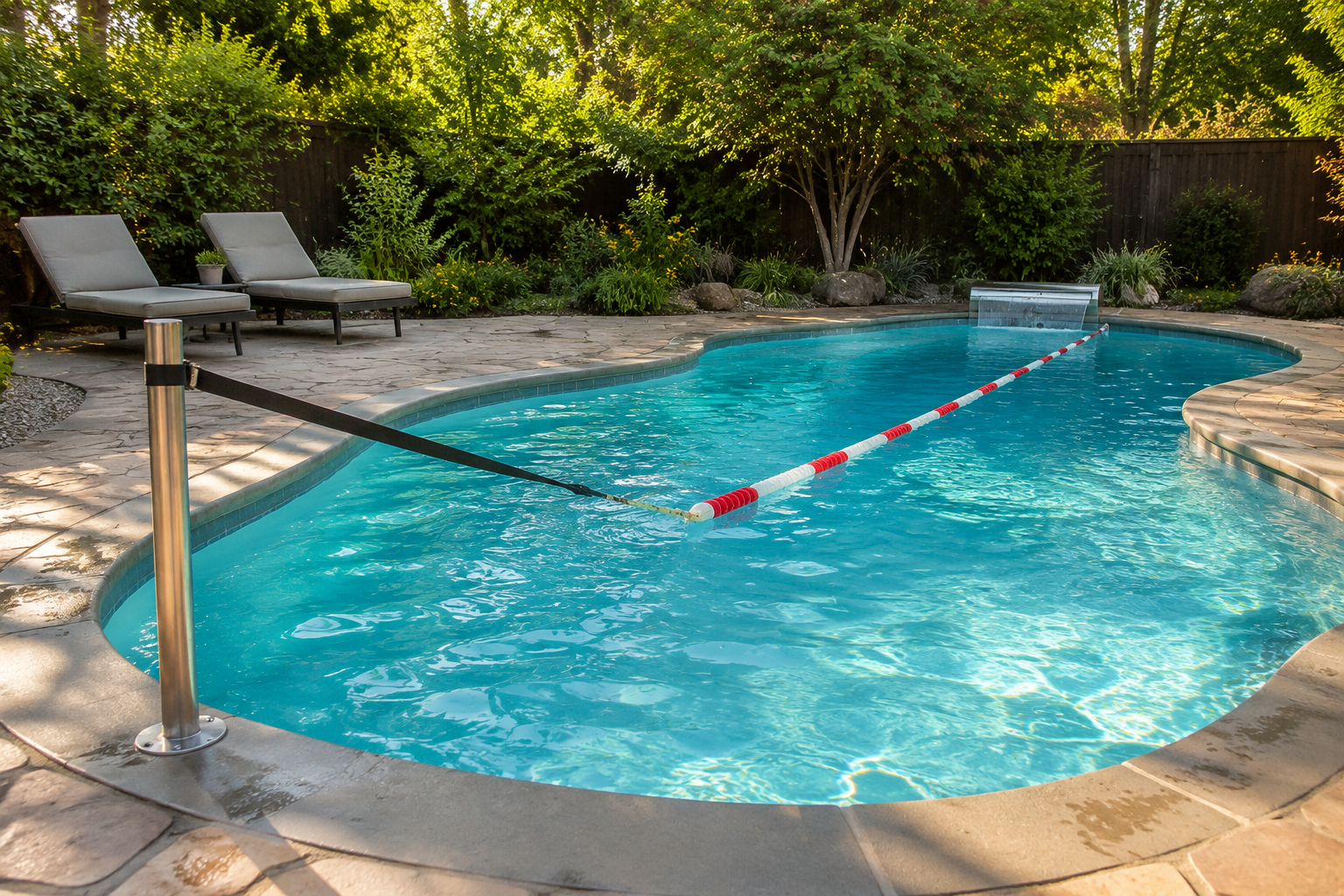
Lane lines are elegant because they do not try to turn the pool into a machine. They define a path, calm surface chop, and make the pool feel more intentional for training. In the right pool, that is enough.
The catch is that lane lines do not create length. If the pool is 20 feet long, adding a professional-looking floating line gives you a better-looking 20-foot swim, not a lap pool. This option belongs at the top of the list only when the pool already offers a straight 30- to 40-foot path, useful width, and enough depth to swim without adjusting every stroke.
A quality lane line is not just a rope with floats. Competitor Swim describes 6-inch wave-quelling discs as part of lane-line function and places quality lane lines at about $400 or more per line.[9] Add wall anchors and installation details, and a practical backyard lane-line conversion often lands around $400 to $800, depending on what the pool already has.
The anchor question matters. Some pools already have attachment points. Many do not. Drilling or installing anchors into a pool wall or deck is a small job compared with a current system, but it still needs to be done correctly. The line should be tensioned, removable when the pool is used socially, and placed where steps, ladders, benches, and returns do not turn it into a nuisance.
Choose lane lines if the pool is long enough and you want the simplest lap-like experience. Skip them as the primary solution if your main problem is short length. They can pair nicely with a current system for orientation, but by themselves they do not solve the short-pool problem.
Where Swim Spas Fit: Replacement, Not Retrofit
Swim spas appear in almost every comparison because they solve the compact-swimming problem neatly: a purpose-built vessel, built-in current, controlled dimensions, and no need to persuade an old backyard pool to become something else. But that is exactly why they are not really a conversion of the existing pool.
A swim spa makes sense when the current pool is too small for even a satisfying tether setup, structurally failing, expensive to maintain, or already on the chopping block. The research materials place swim spas around $20,000 to $60,000.[10] That is still often below a custom new lap-pool build, but it is a replacement purchase with delivery, pad, electrical, access, and landscaping implications.
For the homeowner trying to use an existing pool, the swim spa is the boundary marker. If every retrofit option is a bad fit, then stop calling the project a conversion and price it as a new piece of equipment.
A Practical Decision Matrix
Once the pool is measured, the decision usually narrows quickly. The matrix below is not a substitute for an installer’s site visit, but it keeps the shopping process from drifting into fantasy.
| Your pool situation | Best first option | Why |
|---|---|---|
| Under 14 ft long, structurally sound | Swim tether | It works in very short water, costs the least, and avoids construction. |
| 14–30 ft long, good wall/deck access | Swim current system | It solves the short-lap problem better than lane lines and feels more natural than a tether. |
| 30–40+ ft straight swim path, about 8 ft usable width | Lane lines and anchors | The pool already has enough length; organization matters more than propulsion. |
| Long enough pool, but poor water organization or chop | Lane line upgrade | Wave-quelling discs and a defined lane can improve training without adding equipment noise or power use. |
| Short pool, serious swimmer, higher budget | Current system quote, then tether as fallback | A current offers the best continuous-swim retrofit, but compatibility and cost decide the outcome. |
| Damaged, tiny, or impractical existing pool | Swim spa or new-build comparison | The project has moved beyond retrofit economics. |
Budget is the second filter. If the ceiling is a few hundred dollars, the realistic choices are tether or, for a long-enough pool, a basic lane-line setup. If the ceiling is several thousand dollars and the pool is at least 14 feet, a current system is worth quoting. If the budget has crossed into $20,000 and the existing pool still fights every option, compare a swim spa with broader pool renovation rather than pretending a retrofit is still the obvious path.
Training seriousness is the third filter. General fitness swimmers can tolerate more compromise. They can swim by time, use a tether, and still build aerobic work. Competitive or pace-focused swimmers will notice the missing turns, altered body position, current feel, and lack of true distance. They may still choose a retrofit, but they should choose it with fewer illusions.
What to Check Before You Buy Anything
- Measure the longest straight swim path, not the pool’s overall length.
- Confirm usable width; a single lap lane commonly needs about 8 feet to feel workable.
- Check depth along the swim path; 4 to 5 feet is a useful practical benchmark for fitness swimming.
- Identify steps, benches, ladders, tanning ledges, lights, returns, and drains that interrupt the stroke path.
- For current systems, ask whether the wall, deck, coping, and electrical service can support the specific product.
- For lane lines and tethers, confirm anchor points, removable hardware, and whether the setup interferes with normal pool use.
Local quotes matter because pool construction is annoyingly specific. Two pools with the same water length can have different answers once wall material, coping, nearby electrical service, deck condition, and equipment access enter the conversation. This is also where national cost ranges should stop pretending to be budgets.
The Sensible Answer for Most Backyard Pools
If the pool is already long enough, use the length you have: install proper anchors and a quality lane line, and spend the saved money on actually swimming. If the pool is too short but at least around 14 feet, get a real quote for a current system and pay close attention to installation details, not just current speed. If the pool is tiny, awkward, or the budget is tight, start with a tether and see whether the habit sticks.
Converting a backyard pool to lap swimming is usually possible without building a new $40,000-plus lap pool. The best version is not the one that photographs most like a resort lane. It is the one that fits the pool, the budget, and the swimmer who has to show up when the novelty has worn off.
References
- How Much Does a Backyard Swimming Pool for Lap Swimming Cost? — USMS
- Swimming Pool Dimensions — SwimOutlet.com — SwimOutlet.com
- Lap Pools | Ecopool — Ecopool
- Guide to Inground Pools for Small Backyards | Latham Pool — Latham Pool
- Swim Tether vs. Swim Jets & Endless Pools | Honest Comparison — Swim Tether
- Fastlane Swim | Backyard Lazy River — Endless Pools — Endless Pools
- Swim In Place — Riverflow Pumps — Riverflow Pumps
- Endless Pool Cost in 2026: Full Price Breakdown and Cheaper Alternatives — iGarden
- Choosing the Right Swimming Lane Lines for Your Pool — Competitor Swim
- Swimming at home: Comparing lap pool options — Michael Phelps Swim Spa
Comments
Join the discussion with an anonymous comment.