
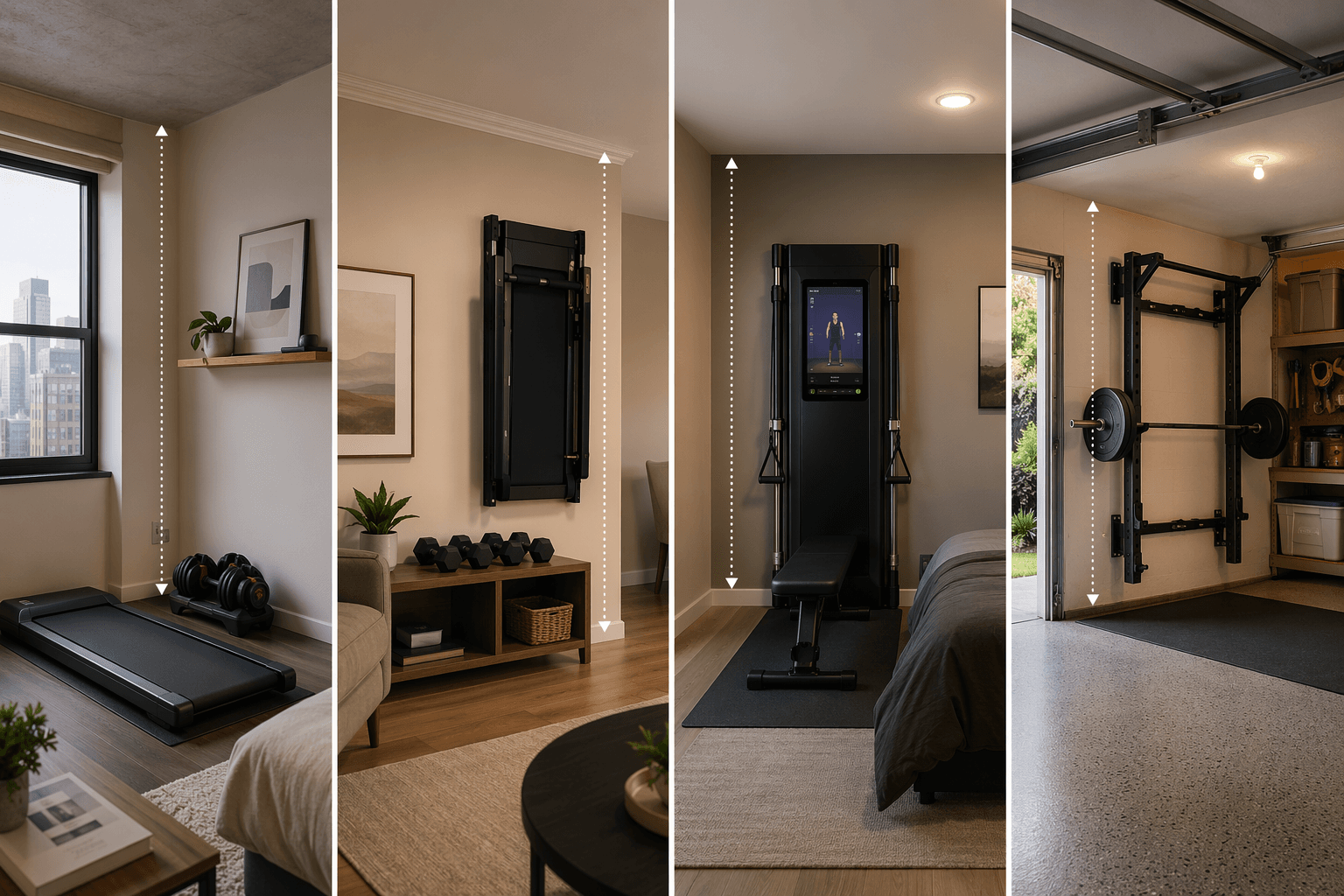
The worst way to shop for at home gym equipment is to start with a product list. That is how people end up with a bench that blocks a closet, a treadmill that cannot be used after 8 p.m., or a rack that technically fits until someone needs to park the car.
Start with the room. More specifically, start with the part of the room you can actually use. Total square footage is mostly a vanity number here. A 120-square-foot spare bedroom with a bed in it may be less useful than a 6-foot garage wall with nothing in front of it. A studio apartment may have enough open floor for a yoga mat but not enough permanent clearance for anything with arms, uprights, or a moving deck.
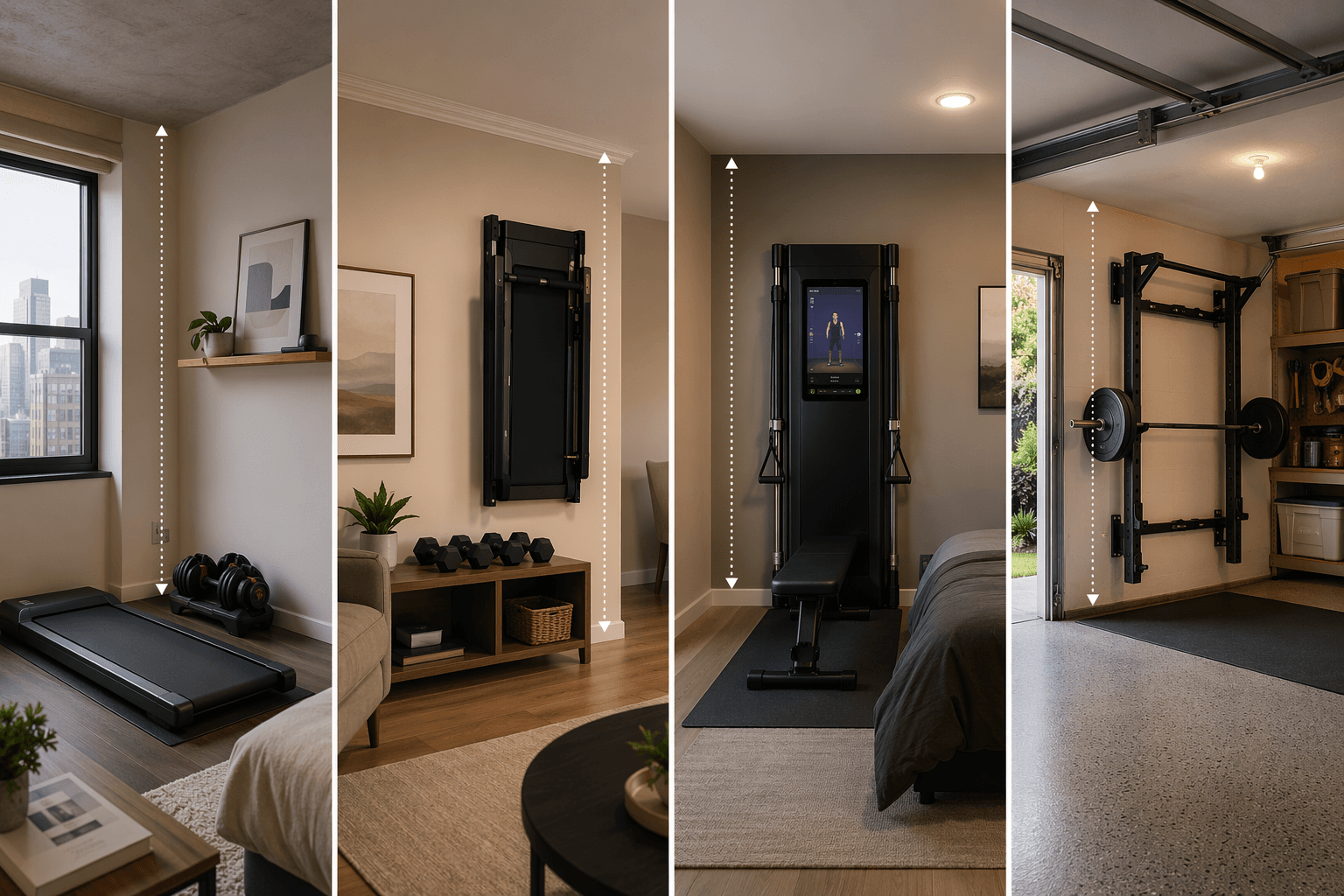
Measure the space you can use, not the room you own
Before looking at dumbbells, racks, cable machines, or digital resistance systems, take five measurements and make one household decision. This is the part that saves you from buying equipment that is strong on paper and irritating in real life.
| What to check | How to measure it | Why it matters |
|---|---|---|
| Usable floor area | Measure the rectangle that stays clear during a workout, excluding door swings, closet access, furniture paths, and the space needed to walk around equipment. | Most home gym mistakes come from counting total room size instead of the working footprint. |
| Ceiling height | Measure from finished floor to the lowest obstruction, including beams, lights, ducts, or garage door tracks. | Pull-up bars, overhead pressing, tall all-in-ones, and folding racks all become different decisions under a low ceiling. |
| Door and hallway clearance | Measure the narrowest doorway, stair turn, and hallway angle the equipment must pass through. | If it cannot enter the apartment or basement without a fight, its listed footprint is irrelevant. |
| Noise tolerance | Decide whether you share a floor, wall, or ceiling with neighbors or sleeping family members. | Dropping weights, running decks, and impact cardio are different problems in apartments than in garages. |
| Storage requirement | Decide whether the setup can stay out permanently, fold against a wall, or disappear after each session. | A home gym that must be moved daily needs different equipment than a dedicated training room. |
Once those answers are honest, most choices narrow quickly. A studio apartment should not be asked to behave like a garage. A living-room corner should not be treated like a private weight room. A spare bedroom gives you options, but it still has door swings and furniture. A garage wall may support serious barbell training, but only if the car can still come back inside.
Studio apartment: keep the equipment ceiling low on purpose
A studio apartment is the least forgiving room type because it has no backup room. If the bench is in the way, it is in the way of living. If cardio is loud, the downstairs neighbor hears your training plan. If the equipment looks bad, it looks bad from the bed, the couch, and the kitchen.
For studios under 400 square feet, the practical ceiling is adjustable dumbbells, a folding bench, resistance bands, and quiet compact cardio such as a walking pad or foldable bike. Garage Gym Reviews’ apartment-focused equipment guidance points toward low-impact, compact, and stowable choices rather than full racks or full-size cardio machines for this kind of setting.[1]
That means no power rack. Not a “maybe if you rearrange.” No. A rack wants floor clearance, barbell clearance, plate storage, ceiling height, and a tolerance for metal-on-metal noise. A full-size treadmill has a similar problem: the deck may fit, but the operating space, impact noise, and visual bulk usually do not. This is where buying less can be the more serious decision.
The studio setup that survives daily life usually looks like this:
- Adjustable dumbbells instead of a dumbbell rack.
- A folding bench that can slide under a bed, stand in a closet, or live behind a door.
- Bands or suspension-style accessories for pulling patterns that dumbbells do not cover well.
- A walking pad, foldable bike, or magnetic-resistance cardio option instead of impact-heavy running.
- A mat only if it has a real storage spot; rolled mats leaning in corners become clutter faster than people admit.
Digital resistance can make sense in a studio, but only at the upper edge of what the room can tolerate. Speediance’s own apartment gym guide presents the Gym Monster as a compact all-in-one option, and the listed unfolded dimensions are 49 inches deep by 28 inches wide by 73 inches high.[2] Those dimensions are useful, but the source is branded content from the company selling the machine. Garage Gym Reviews’ independent testing of home gyms gives more useful context for judging whether a compact all-in-one is realistic in a small room, including how machines behave in actual training setups rather than just in product renderings.[3]
For a studio, a machine in that size range is the largest plausible all-in-one category, not the default recommendation. It still needs a permanent or semi-permanent parking place. It still changes the look of the room. It still asks you to keep a clear rectangle in front of it. If that clear rectangle is also the only place to open a dresser, work at a desk, or walk to the bathroom at night, the machine may technically fit and still be wrong.
Noise should decide more than horsepower here. Digital resistance systems and magnetic-resistance cardio reduce the floor thumping that makes apartment workouts tense. That does not make them silent, and it does not excuse training at rude hours, but it removes the worst offender: repetitive impact traveling through the floor.
If your goal is lower-impact strength, mobility, or Pilates-style training in the same kind of tight room, the storage-first logic is similar. A separate guide to At-Home Pilates Equipment for Small Apartments applies the same basic rule: the equipment has to go somewhere when the apartment goes back to being an apartment.
Living-room corner: judge everything by how it behaves after the workout
A living-room corner is not just a smaller gym. It is shared territory. Someone may want to watch TV without staring at a pile of plates. A partner may reasonably object to a bench living permanently in the walkway. Guests may not care about your knurling preferences. This is the room type where “folds away” and “replaces clutter” matter more than the maximum exercise list.
Wall-mounted folding equipment can work here if the wall is appropriate and the household accepts the look. The PRx Profile PRO is a useful example because it folds to 9 inches deep when not in use, while its unfolded dimensions are 53 inches wide by 29.25 inches deep by 89 inches high. Garage Gym Reviews lists it with a 1,000-pound capacity and a 4.6-out-of-5 rating.[3]
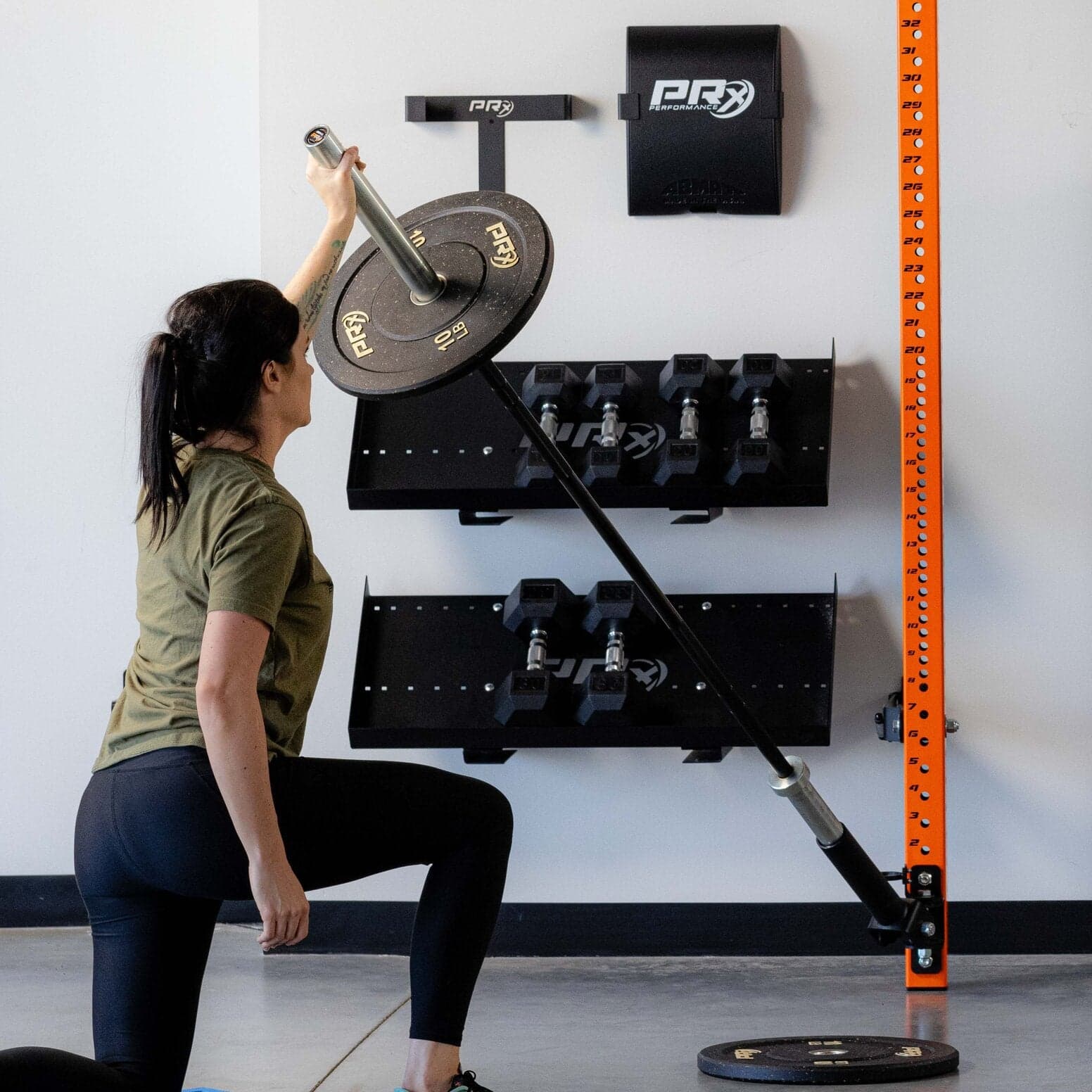
That 9-inch folded depth is the number to care about first. The 1,000-pound rating is impressive, but it only matters if the rack can live on the wall without turning the living room into a storage unit. The unfolded depth also matters because squatting, benching, loading plates, and walking around the bar all require more room than the rack’s frame alone.
Adjustable dumbbells are often the cleaner living-room answer. NÜOBELL-style adjustable dumbbells cover 5 to 80 pounds in a footprint of about 17 inches by 7.5 inches per dumbbell, replacing 16 individual pairs.[3] That replacement effect is not a marketing detail; it is the whole point. Sixteen pairs of dumbbells are not a living-room corner. They are a furniture decision.
The best living-room corner setup is usually assembled around a fast reset:
- One pair of adjustable dumbbells with a dedicated stand or low-profile storage spot.
- A folding bench only if it can be stored without blocking a door, heater, bookcase, or media console.
- A wall-mounted rack only if folded depth, wall structure, ceiling height, and household tolerance all check out.
- Bands, handles, and small accessories in one bin, not scattered across the room.
There is a small etiquette test that works better than most product specs: after a workout, can the room look normal in two minutes? If the answer is no, the setup may be too ambitious for shared space. That does not mean you cannot train hard in a living room. It means the equipment has to surrender the room when training is over.
Spare bedroom: choose the training system before choosing the machine
A spare bedroom is the first room type where multiple good answers can exist. With roughly 100 to 200 square feet dedicated mostly to training, you can think in systems: guided digital resistance, barbell work, or cable variety. The mistake is trying to do all three in a room that still has a closet, window, door swing, and maybe a guest bed.
A compact all-in-one such as the Speediance Gym Monster gives you guided resistance in a relatively small footprint. Garage Gym Reviews lists the machine at a 49-inch by 28-inch footprint, 220 pounds of digital resistance, and a 4-out-of-5 rating.[3] That makes more sense in a spare bedroom than a studio because the machine can keep its training zone without being folded, moved, or negotiated around every day.
A folding rack approach makes sense if barbell training is the priority. It asks more from the room: wall structure, ceiling height, bar length clearance, plate storage, and safe space to bail or re-rack. It also rewards the room with heavier progression and familiar lifts. This is where a spare bedroom becomes a real gym room rather than a storage corner with weights in it.
A compact cable tower is the quieter middle path. The Bells of Steel Cable Tower is listed at 31 inches deep by 28.5 inches wide, with plate-loaded pricing from $435, and supports movements such as lat pulldowns, rows, and cable flyes.[3] In a spare bedroom, that kind of machine can be more useful than another bench or cardio unit because it adds pulling and cable angles without taking over the whole floor.
| If the spare bedroom is for... | Start with... | Watch for... |
|---|---|---|
| Guided strength training | Compact digital resistance all-in-one | Permanent training clearance in front of the machine |
| Barbell lifting | Folding rack, bench, bar, and plates | Ceiling height, wall mounting, plate storage, and bar path |
| Bodybuilding-style variety | Compact cable tower plus dumbbells | Pulley clearance, loading space, and whether the room still has usable walking paths |
| General fitness | Adjustable dumbbells, bench, bands, and one cardio option | Accessory creep; small items can consume the room faster than one large machine |
Spare bedrooms tempt people into buying one of everything. Resist that. Pick the dominant training style first, then let the remaining equipment support it. A compact cable tower plus adjustable dumbbells can be excellent. A digital resistance machine plus a bench can be excellent. A folding rack plus plates can be excellent. All three together in a small spare room usually becomes a room where every workout starts by moving something.
Garage wall: the car gets veto power
A garage looks generous until the car, trash bins, bikes, tools, freezer, holiday boxes, and garage door track all make their claims. The rule is simple: if the equipment prevents the vehicle from returning, it is not a garage solution. It is a driveway lifestyle choice.
The garage wall is where folding racks earn their praise. A PRx-style wall-mounted rack can give you a full barbell setup during the workout and then fold back toward the wall afterward. For a single-car garage, that storage behavior is often more important than the rack’s maximum capacity because the car has to reclaim the bay.
All-in-one machines can also work in garages, especially when the user wants guided resistance or cable-style training without a full plate-and-barbell ecosystem. Across more than 50 tested home gym models, Garage Gym Reviews reports an average all-in-one footprint of 39 inches deep by 40 inches wide by 64.5 inches high.[3] That average is helpful as a reality check: many “compact” machines still occupy a permanent block of garage floor.
There are also ultra-compact resistance options for garage owners who have wall space but not floor space. The X3 Bar is listed at 10 inches long by 19 inches wide by 1 inch high, while the Beyond Power Voltra I measures 12.7 inches by 5.5 inches by 3.9 inches.[3] Those are not equivalent to a full rack, and they should not be sold as if they are. They are different answers for people who need resistance training to live in a cabinet, on a shelf, or against a wall.
For garage planning, think in lanes:
- A wall lane for folding equipment, hooks, plate storage, and accessories.
- A lifting lane that exists only during the workout.
- A vehicle lane that must remain recoverable when the workout is over.
- A door and utility lane for water heaters, electrical panels, freezers, and exits.
Garage owners who want to build in phases rather than buy everything at once should start with the wall, not the wish list. The deeper layout decisions are covered in Garage Workout Equipment: A Phased Build Guide for Single-Car Garages, which is the better next read if the car still needs to sleep inside.
A quick way to match equipment to your room
If you are deciding this week, do not compare every machine against every other machine. Compare each machine against the room’s ceiling.
| Room type | Best starting point | Usually avoid | Main reason |
|---|---|---|---|
| Studio apartment | Adjustable dumbbells, folding bench, bands, quiet compact cardio | Power rack, full-size treadmill, large plate storage | No separate training room, high noise sensitivity, limited storage |
| Living-room corner | Adjustable dumbbells, folding bench, carefully chosen wall-mounted gear | Permanent clutter, wide dumbbell sets, equipment that cannot reset quickly | The room has to return to normal after training |
| Spare bedroom | Compact all-in-one, folding rack, or cable tower depending on training style | Trying to combine every system at once | Flexible but still bounded by doors, ceiling, and walking paths |
| Garage wall | Folding rack, wall storage, compact all-in-one, or ultra-compact resistance | Anything that blocks the car or utility access | The workout zone must disappear or compress when the garage is used as a garage |
Price belongs after this table, not before it. A premium compact machine can be a smart buy if it solves the real constraint. A cheaper rack can be a bad buy if it owns the room. June 2026 prices on home gym equipment move with sales, model changes, and bundles, so treat any current price as a final filter rather than the organizing principle.
The right at home gym equipment is the strongest setup your actual room can tolerate, store, and let you use consistently. Measure the usable space, decide whether the equipment can stay out or has to vanish, and then shop inside that boundary. The room is not a detail. It is the equipment spec that comes first.
References
- Best Workout Equipment for Apartments (2026) — Garage Gym Reviews
- Apartment Home Gym Guide — Speediance
- Best Home Gyms (2026) Personally Tested — Garage Gym Reviews
Comments
Join the discussion with an anonymous comment.