
Don't Just Check the Folded Height
A friend bought a popular folding treadmill for his basement. He checked the folded height: 71 inches. His ceiling was 84 inches. Plenty of room, he thought. He didn't check the clearance needed while running. The deck sits about 8 inches off the floor. At a full stride his head reaches another 4 feet above that. Add 2 feet of safety clearance above the highest running position. That's 86 inches. He had 84. The machine went back. He lost the shipping cost and a weekend.
The mistake wasn't budget or brand. It was ignoring the folding mechanism. That treadmill used a vertical-lift design — the type that demands the most overhead clearance while in use. The real first filter for a small-space buyer should be the folding type, not the name on the side.
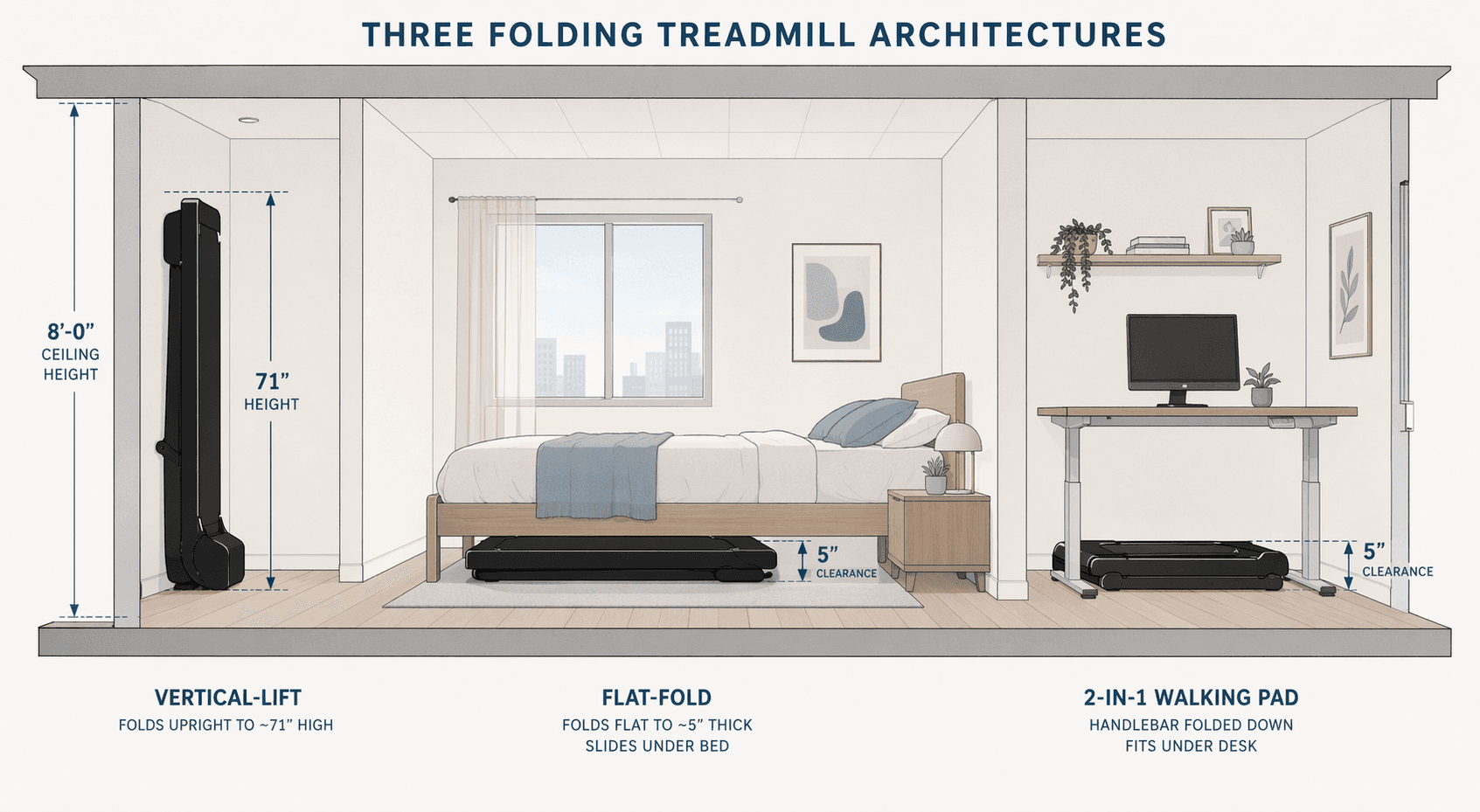
Three Folding Types, Three Different Clearance Rules
There are three distinct architectures: vertical-lift, flat-fold, and 2-in-1 under-desk. Each one fits a different set of room constraints. The table below compares representative models. But first, a few key differences you won't see on a product page.
Vertical-lift treadmills fold upright, about 71–72 inches tall when stowed. They need the least floor space for storage, but they demand the most overhead clearance while running. For a 6-foot person, add the deck height (~8 inches) and 2 feet of safety clearance: you need about 86 inches of ceiling height. That's over 7 feet. If your ceiling is 8 feet, you might barely fit. Forget basements with 7-foot ceilings.
Flat-fold models, like the Echelon Stride-6, fold to about 10 inches thick. They slide under a bed or sofa, but their unfolded footprint is still large — over 5 feet long by 32 inches wide. They work best if you have low ceilings but enough floor area to leave the treadmill out, or if you can lift it into storage each time.
2-in-1 under-desk treadmills, such as the UREVO Strol 2E and WalkingPad C2, fold to about 5 inches. They can fit under a desk or a low bed. But their decks are short (around 18 x 40 inches) and top speeds vary. The WalkingPad C2 maxes at 3.7 mph — brisk walking only. The UREVO hits 6.2 mph, which allows light jogging but still not a full run. If you plan to run, a 2-in-1 will disappoint.
| Folding Type | Example Model | Folded Height | Unfolded Footprint (L x W) | Deck Size | Max Speed | Motor |
|---|---|---|---|---|---|---|
| Vertical-Lift | Horizon 7.4 AT | 71 in. | 42 x 37 in. | 60 x 22 in. | ~12 mph | 3.5 CHP |
| Vertical-Lift | Sole F63 | 72 in. | 50 x 35 in. | 60 x 20 in. | ~12 mph | 3.0 CHP |
| Flat-Fold | Echelon Stride-6 | ~10 in. (flat) | 64.25 x 32 in. | 20.5 x 60 in. | 12.5 mph | 2.5 HP |
| 2-in-1 Under-Desk | UREVO Strol 2E | 5.1 in. | 54.7 x 26.4 in. | ~18 x 40 in. | 6.2 mph | ~2.0 HP |
| 2-in-1 Under-Desk | WalkingPad C2 | 5.4 in. | 32.5 x 20.4 in. | 18 x 40 in. | 3.7 mph | 1.0 HP |
Published specs vary by model year. Always measure your own space. And stick to the safety rule: at least 2 feet of clearance above your highest running position. Trust the numbers you measure, not the ones on a product page.
So measure your ceiling height and storage depth first. Then match the mechanism. Brand and price come after that. Low ceilings? Skip vertical-lift. Tight storage slot but enough floor space? Flat-fold works. Only walk and need a machine that disappears? A 2-in-1 is worth considering — but only if you're okay with a short deck and a slow top speed.
Comments
Join the discussion with an anonymous comment.