
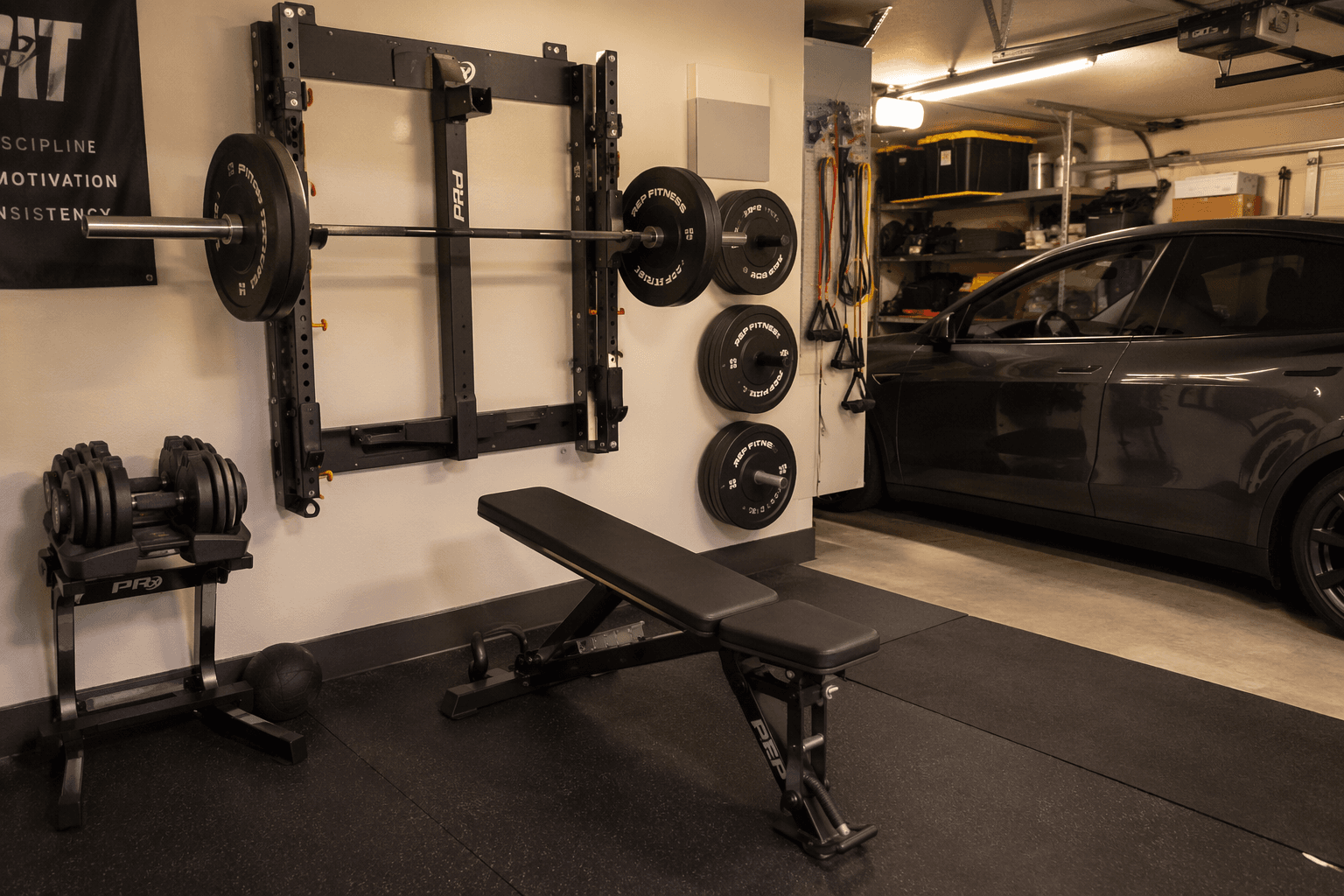
A single-car garage sounds generous until the tape measure comes out. The gross rectangle may look like a gym on paper, but the usable workout zone is whatever survives the car door swing, storage bins, water heater clearance, mower handles, bikes, and the path everyone still needs to walk through. That is where most plans for garage workout equipment get too optimistic: they count the garage, not the open floor.
The workable answer is smaller and more specific than “use compact gear.” A real barbell-based strength setup can fit in roughly 50 square feet of active floor space if the main pieces fold or live on the wall: a wall-mounted folding rack, a folding bench, wall plate storage, adjustable dumbbells, and rubber flooring under the training zone. The catch is physical, not motivational. You need enough ceiling height, you need a wall that can take a properly mounted rack, and you need to put things away after the session.
Start with the active footprint, not the garage size
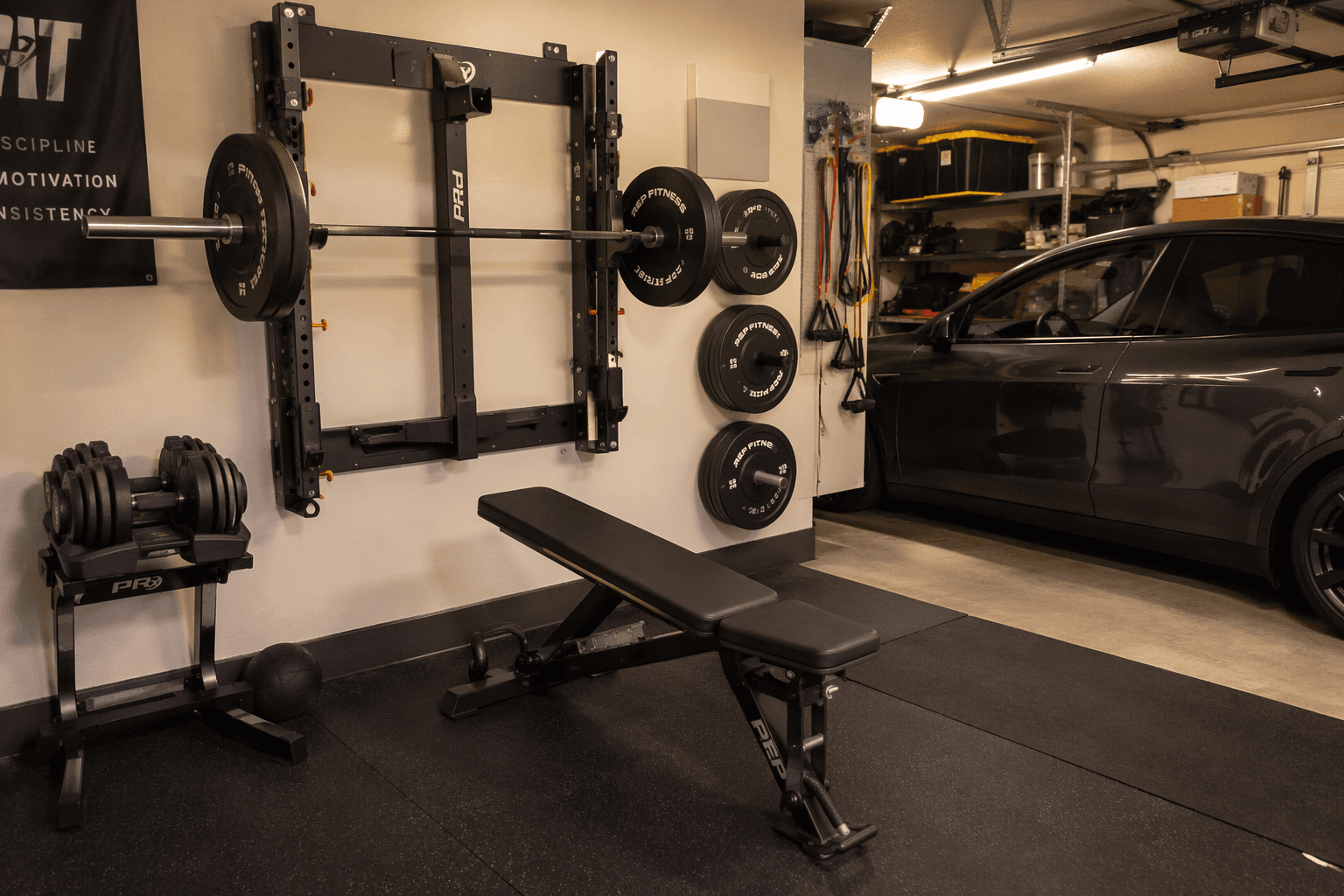
For this kind of setup, the important number is not the total square footage of the garage. It is the rectangle you can clear when training starts. A 7-by-7-foot zone gives you about 49 square feet for the rack in use, bench position, bar loading, and enough body room to squat, bench, and press without treating the lawn mower as a spotter.
That does not mean every 49-square-foot patch is safe. A barbell is wider than the person lifting it, plates need room to slide on and off, and the bench has to line up with the rack without the lifter’s head ending up under a shelf. If the only open patch is a narrow aisle between the car and the wall, it may be fine for dumbbells and mobility work but wrong for a rack.
Ceiling height is the other early check. Standard garage ceilings are often in the 8- to 9-foot range, but garage doors, openers, tracks, storage platforms, and sloped concrete can steal usable height. An 8-foot ceiling is a practical threshold for many compact strength setups, but overhead pressing, pull-ups, and tall lifters may still be limited. Measure where the rack will actually stand, not at the prettiest empty corner.
The smallest full-strength version is built around a folding rack
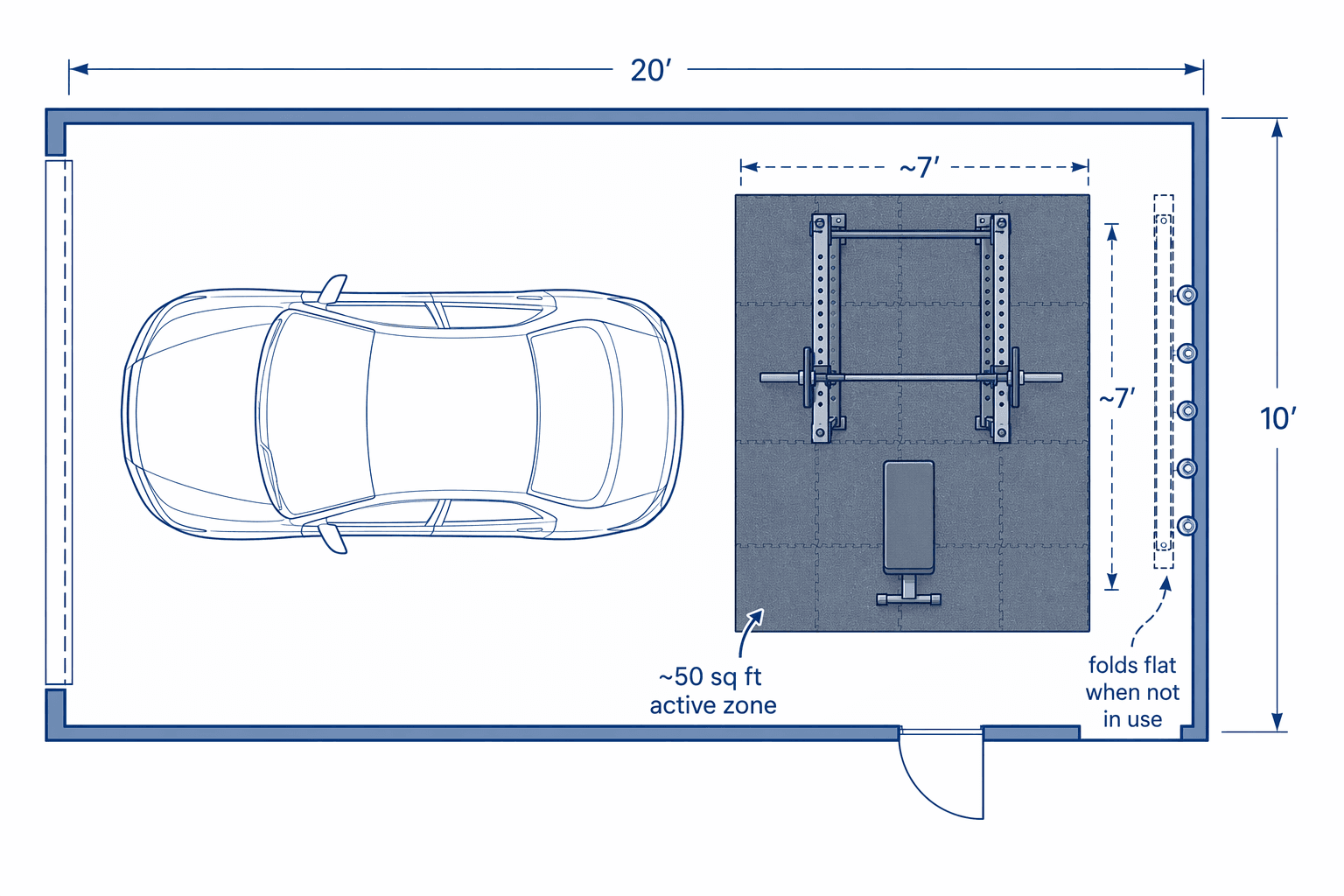
The rack is the piece that decides whether this becomes a real strength station or just a pile of useful equipment. A barbell and plates can live in a corner. A bench can fold. Dumbbells can sit on a stand. A rack, if it stays open all the time, claims the garage whether anyone is training or not.
That is why the wall-mounted folding rack is the central move for an under-100-square-foot garage gym. The Rogue RML-3WC Fold Back Wall Mount Rack is the clean example: it mounts to the wall, folds back when not in use, and extends when it is time to squat or bench. Rogue’s product page positions it as a fold-back wall-mounted rack rather than a freestanding cage, which is exactly the distinction that matters in a shared garage.[1]
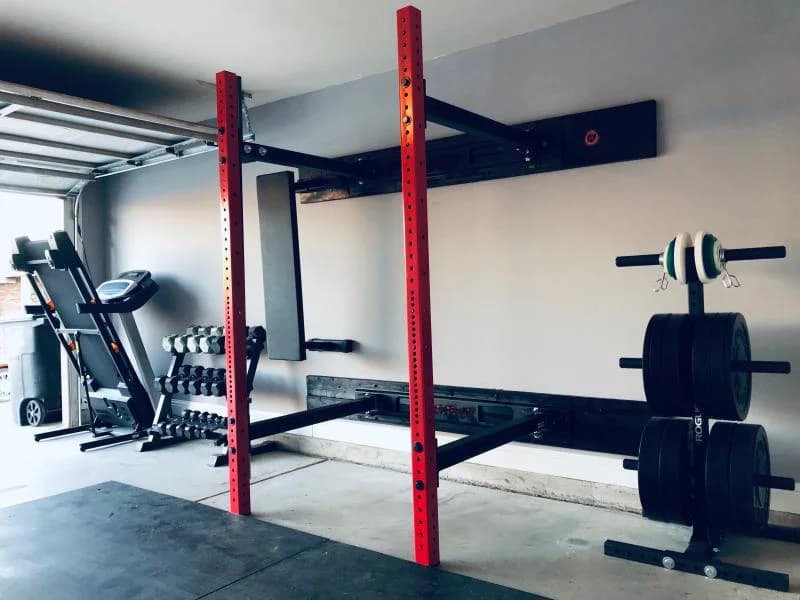
The “under 50 square feet” claim should be read as a layout claim, not a universal guarantee. It works when the rack folds to the wall, the bench folds or stores vertically, plates are on wall pegs, and dumbbells are consolidated. It does not work if the rack has to stay open, the plates sit on the floor, and the bench becomes a permanent coffee table for paint cans.
A compact freestanding rack can still be the better answer in some garages. Garage Gym Reviews lists the REP PR-1100 at $380, with a 700-pound capacity and a 48.5-inch depth, and identifies it as a strong budget choice for compact home gyms.[2] That is a useful option if you cannot mount into the wall or if you want a more traditional rack. Just be honest about the trade: even a compact freestanding rack is still furniture. It does not disappear after deadlifts.
A three-phase build that does not require buying the finished gym first
The cleanest small-garage build is phased. Not because phases sound tidy, but because a garage gym has to prove itself in the room before it deserves more equipment. Prices below are current reference points from the cited product and review sources, not guaranteed totals. Shipping, sales, tax, and package changes can move the real number quickly.
| Phase | Approximate budget | What changes | Main constraint solved |
|---|---|---|---|
| Phase 1 | About $600 | Barbell, starter plates, and a bench | You can train the main barbell patterns, but without a rack you are still limited |
| Phase 2 | About $1,200 | Add a folding wall rack or compact rack, plus rubber flooring | The setup becomes a true squat-and-bench station |
| Phase 3 | About $2,200 | Add adjustable dumbbells and either a compact cable option or a cardio piece | Accessory training expands without filling the garage with single-purpose gear |
Phase 1: barbell, plates, bench
The first phase should buy training, not decoration. A barbell, enough plates to make the early months useful, and a stable bench can cover floor press or bench variations, rows, deadlifts, Romanian deadlifts, hip thrusts, curls, and loaded carries if the garage has a clear lane. This is not the final form of the gym, but it is enough to find out whether the space is actually being used.
The missing piece is squatting and benching from safeties or J-cups. Without a rack, the barbell work is useful but incomplete. That is why Phase 1 should not sprawl. Do not buy six specialty handles and a plate tree before you know where the rack will land. Keep the gear count low and leave the wall you intend to use for the rack as uncluttered as possible.
Phase 2: the rack and floor make it a garage gym
Phase 2 is where the setup changes character. Adding the rack turns the barbell from a deadlift-and-row tool into a full strength station. Adding rubber flooring makes the concrete less punishing, keeps plates and benches from grinding directly into the slab, and gives the workout zone a defined edge.
Horse stall mats are the practical default because they are durable, easy to clean, and inexpensive compared with many gym-branded flooring systems. Garage Gym Reviews cites Tractor Supply stall mats at roughly $50 for a 4-by-6-foot sheet at 3/4-inch thickness.[3] Two sheets create an 8-by-6-foot area; adding a third gives more bar-loading and bench room. They do not heat the garage, dry humid air, or make winter concrete pleasant. They simply solve the floor problem well for the money.
This is also the phase where the wall has to be treated seriously. A folding rack is only clever if it is mounted correctly. That usually means locating structural framing or using the manufacturer’s recommended stringer approach, keeping the rack plumb, and leaving enough side clearance to load plates. If that sentence already sounds like trouble because the wall is blocked by plumbing, a water heater, or rented-garage restrictions, the compact freestanding rack deserves another look.
Phase 3: accessories have to earn their footprint
Once the rack, bar, plates, bench, and floor are working, the next temptation is to start rebuilding a commercial gym in miniature. This is where a small garage punishes loose buying. Anything that cannot fold, stack, hang, or replace several other items has to justify itself.
Adjustable dumbbells usually pass that test. REP says its QuickDraw adjustable dumbbells replace up to 12 pairs of fixed dumbbells, with listed pair pricing ranging from $335 to $576 depending on the version.[4] In a garage where the same strip of floor has to become a parking buffer later, replacing a row of fixed pairs is not a convenience. It is the difference between having dumbbells and having dumbbells in the way.
A cable attachment or compact cardio machine is a harder call. A cable option adds pulldowns, rows, triceps work, curls, and rehab-style movements without needing a second rack-sized footprint if it integrates cleanly with the existing setup. A cardio piece only makes sense if it stores vertically, rolls out of the car path, or replaces something you already know you will use often. In this room, “nice to have” is not enough.
What the garage looks like during training and after
The active layout is simple: rack open, bench pulled into position, bar on the J-cups, plates loaded from the wall, dumbbells accessible but not scattered. The stowed layout is the entire point: rack folded back, bench vertical or folded flat against the wall, plates back on pegs, dumbbells on their stand, bar stored horizontally on the rack or on wall hooks if the setup allows it.
- During a workout: the rack arms, bench, barbell sleeve clearance, and lifter movement claim the floor.
- Between workouts: the rack, bench, plates, dumbbells, and bar should return to the wall or a single storage line.
- Before buying anything else: mark the active footprint with painter’s tape and open the car door, garage door, and any nearby cabinets.
That last step catches more mistakes than spec sheets do. A rack can fit by depth and still be wrong because the garage door track cuts through pull-up space. A bench can fold beautifully and still block the freezer when stored. Wall plate pegs can save floor space and still be annoying if they land where the bar sleeve needs to pass.
The best small-garage layouts usually put storage and lifting on the same wall. That keeps the workout zone from spreading. Plates near the rack reduce the number of steps while loading. Dumbbells on a stand keep handles at a sane height and stop the floor from becoming a toe trap. The folding bench should have a defined parking place, not a vague promise that it will “go somewhere.”
Where the under-100-square-foot promise breaks
Some garages are poor candidates for this exact setup. Low overhead tracks, a ceiling under the practical working height for the lifter, weak or unavailable mounting surfaces, permanent utility equipment on the only usable wall, or a required car position that leaves only a narrow aisle can all beat good equipment choices. That is not a discipline problem. It is a room problem.
Climate is another boundary. Rubber mats help protect the floor and make cleanup easier, but they do not control humidity or temperature. Bare steel in a damp garage still needs attention. Upholstery, handles, and plate sleeves may need wiping down. In hot or cold regions, the limiting factor may be whether the garage is tolerable enough to train consistently, not whether the rack technically fits.
The same caution applies to cost comparisons. A garage gym can become cheaper than a commercial gym over time, especially if multiple people use it, but the break-even point depends on local dues, equipment choices, shipping, resale value, and how often the setup is used. The older $58-per-month average often cited in home-gym discussions is useful directionally, not as a clean 2026 return-on-investment number.
The buying order that preserves the garage
If the room passes the tape-measure test, the buying order is straightforward: barbell and plates first, bench next, rack and flooring as the major upgrade, then adjustable dumbbells, then only the accessory piece that solves a real programming gap. The wall-mounted rack path is the most space-disciplined version. The compact freestanding rack path is more forgiving for installation but less forgiving for parking and storage.
The practical threshold is this: if you have at least an 8-foot ceiling, can mount a folding rack securely, and are willing to fold and store equipment after training, a full garage strength setup under 100 square feet is realistic. If one of those conditions fails, the answer is not to buy more clever gear. It is to change the layout, choose a less rack-dependent setup, or admit that this particular garage is setting the limit.
References
- Rogue RML-3WC Fold Back Wall Mount Rack, Rogue Fitness.
- The Best Budget Home Gym Equipment of 2026, Garage Gym Reviews.
- Best Home Gym Flooring, Garage Gym Reviews.
- How to Build an Amazing Home Gym in a Small Space, REP Fitness.
Comments
Join the discussion with an anonymous comment.