
The Complete Compact Home Gym Decision Framework: How to Match Equipment to Your Space, Budget, and Training Style
Stop starting with product lists. This decision framework helps you match compact home gym equipment to your unique space, budget, training goals, and living situation—so you buy right the first time.
Items included: —
A friend of mine bought the Speediance Gym Monster last year. He measured his floor space — a 4x6 foot corner in his living room — and it fit just fine. He did not measure his ceiling. The machine stands 72.83 inches tall when unfolded. His ceiling is 74 inches. He can look straight at the top handle, take a deep breath, and that is all the clearance he has. No overhead press. No pull-downs with arms fully extended. He has a $2,500 paperweight that takes up half his living room. I’ve seen this exact mistake hundreds of times. It’s not the product’s fault. It’s because people start with a product list instead of their own constraints.
The typical “best compact home gym” search returns a dozen lists. They rank the Speediance, the Tonal, the PRx rack, the X3 Bar. What they don’t tell you: the Tonal 2 needs 7x7 feet of clear floor space — that rules out any room narrower than 7 feet. The PRx Profile PRO Squat Rack needs 89 inches of ceiling height when unfolded — that eliminates every apartment with 8-foot ceilings. And the average home gym costs between $1,000 and $2,000; a mistake at that price stings. People grab the top-rated product and then try to make it fit. That is backwards.
What You Actually Need to Check
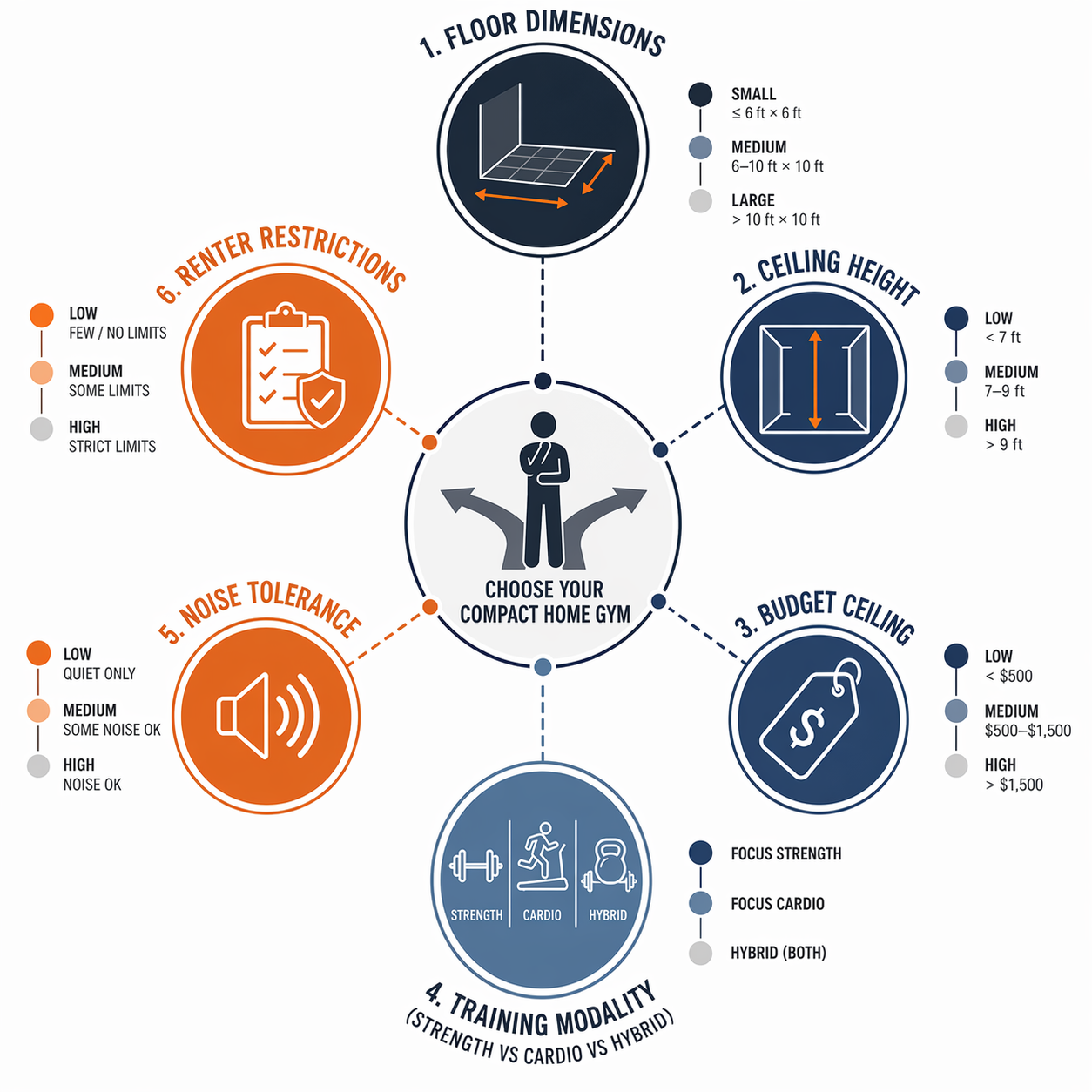
There are six constraints that, taken together, tell you exactly which equipment category fits. Check them in this order. If you skip one, you risk repeating my friend’s story.
Each constraint narrows the field. Together, they eliminate most products on the best lists. That’s a good thing — it means the few remaining options are genuinely suited to you.
How to Get the Numbers
You don’t need a contractor’s tape. A standard tape measure and a notepad are enough. Measure the floor length and width at the tightest point where equipment will sit. Measure the ceiling height at the tallest point where you’ll reach — include any ceiling fan or light fixture at its lowest point. Measure the doorway width for both the room and the building entrance; the Concept2 RowErg at 95 inches long may not fit through a standard door. Mark the equipment footprint with painter’s tape and live with it for a day before buying.
The Decision Matrix – Match Your Profile to a Category
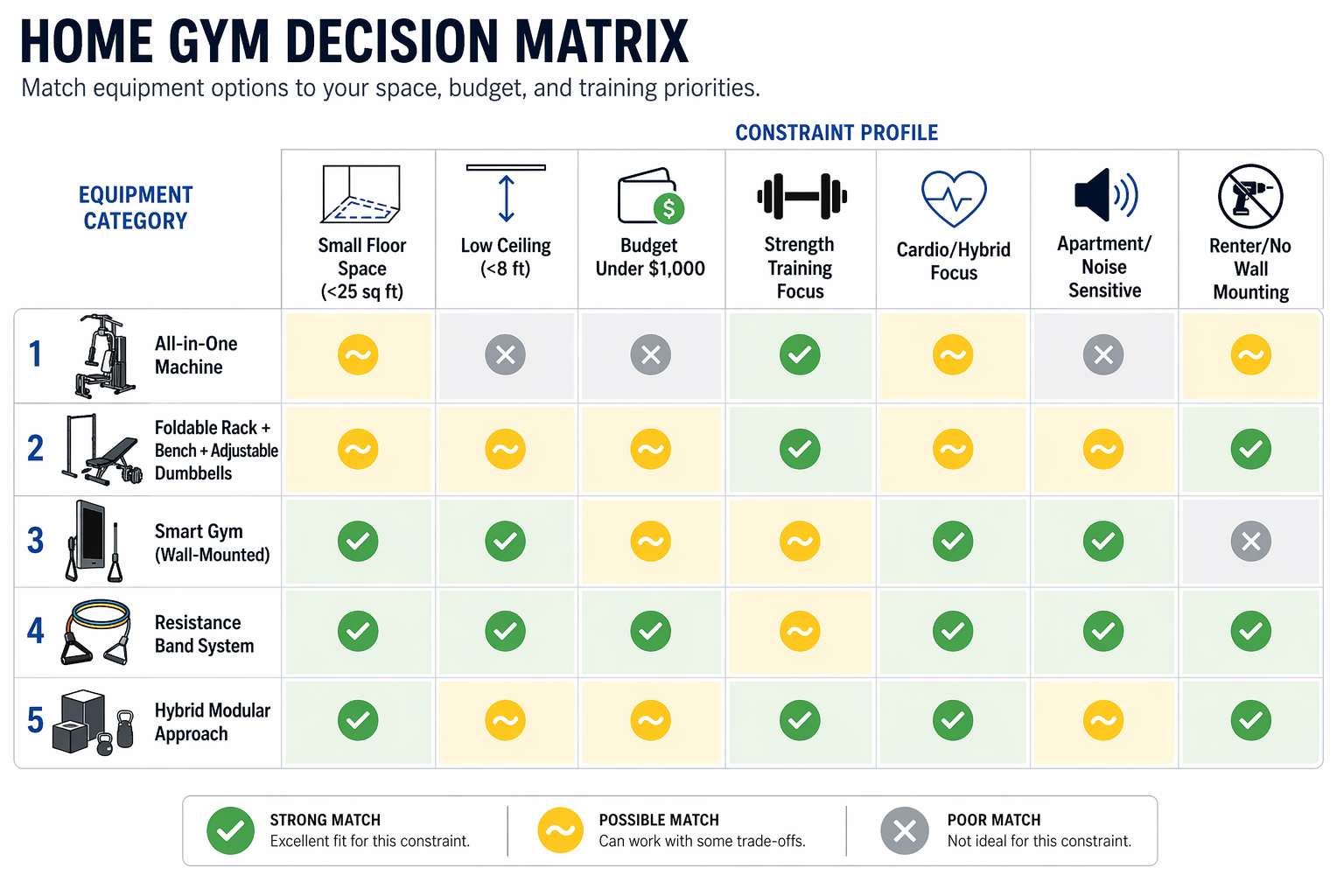
Now that you have your numbers, find your row in the matrix below. The columns are the five equipment categories. The rows are common constraint profiles. Green means strong match. Yellow means possible with caveats. Gray means avoid.
| Constraint Profile | All-in-One Machine | Foldable Rack + Dumbbells | Wall-Mounted Smart Gym | Resistance Band System | Hybrid (Dumbbells + Bands + Bench) |
|---|---|---|---|---|---|
| Small floor space (<20 sq ft) | Yellow (needs clearance) | Green (folds flat) | Gray (needs wall mount) | Green (tiny footprint) | Green |
| Low ceiling (<80") | Gray | Yellow (skip pull-up bar) | Gray | Green | Green |
| Budget <$1,000 | Gray | Gray (rack+weights>$1k) | Gray | Green ($549 X3 Bar) | Green ($400 dumbbells + $40 bar + $200 bench) |
| Strength training focus | Green | Green | Green | Yellow (caveat for advanced) | Green |
| Cardio/hybrid focus | Yellow (some offer rowing) | Gray | Gray | Green (bands + jump rope) | Green (elliptical option) |
| Noise sensitive | Green (magnetic available) | Yellow (weight dropping) | Green (quiet cable) | Green (no impact) | Green |
| Renter, no wall mount | Green | Gray (needs wall anchor for safety) | Gray | Green | Green |
This matrix is a starting point. For a deeper breakdown of each category — including specific product comparisons, pricing, and trade-offs — read 3 Compact Home Gym Archetypes Compared. The framework tells you which category to look at first.
Three Real Profiles – See the Framework in Action
Profile 1: Apartment Renter, 8x10 ft, 7.5 ft Ceiling, $800 Budget, Noise Sensitive
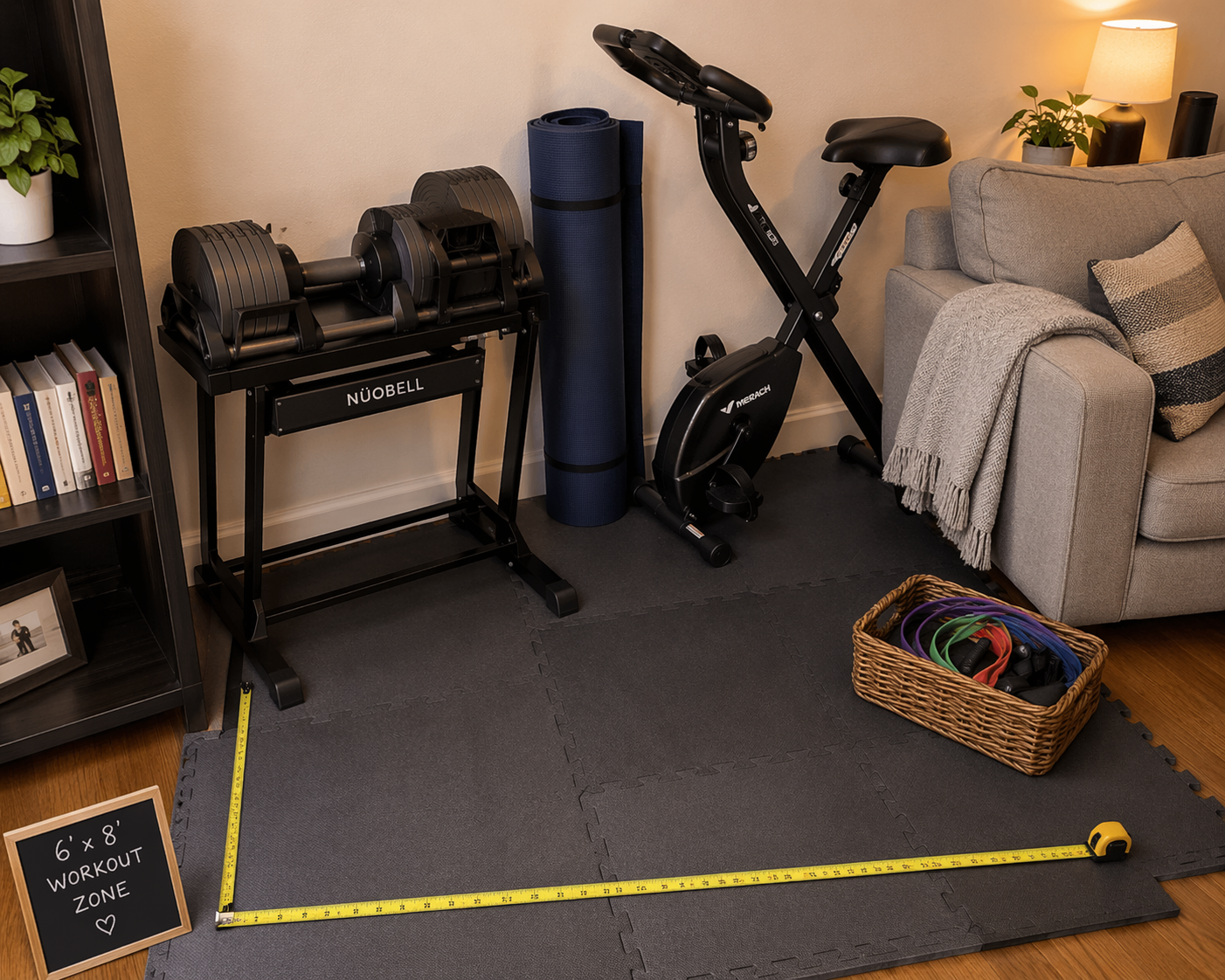
Constraints: small floor, low ceiling, low budget, cannot drill, noise must be minimal. The matrix points to the hybrid category — adjustable dumbbells, resistance bands, a folding bench. Specific picks: NÜOBELL adjustable dumbbells (5–80 lbs, footprint 17" x 7.5"), around $400. A 5-band set with door anchor, under $50. A folding weight bench like the REP Nighthawk (stows upright taking 1.8 sq ft), around $200. Floor protection: Amazon Basics foam tiles at about $1 per square foot — cover a 6x8 ft area for $48. Total under $700. For cardio, a Niceday magnetic elliptical at $600 if the budget stretches, or use bands for jumping jacks. No wall mounts, no noise complaints.
Profile 2: Garage Owner, 10x12 ft, 8.5 ft Ceiling, $2,500 Budget, Strength Focus
Constraints: decent floor space, ceiling supports overhead pressing, higher budget, strength training primary. The matrix selects the foldable rack + dumbbells category. The PRx Profile PRO Squat Rack (53" W x 29.25" D x 89" H, folded depth 9") is designed for this: wall-mounted, folds flat when not in use. It’s $1,300. Add REP QuickDraw adjustable dumbbells (5–60 lbs, cradle 1.2 sq ft) at $600. A REP AB-5200 adjustable bench at $200. Rubber floor mats from Amazon or Tractor Supply, about $150 for 24 sq ft. Total ~$2,250, with room for a barbell and plates later. This gives a proper squat rack, bench, and heavy dumbbells in a garage that still parks a car.
Profile 3: Bedroom Corner, 6x8 ft, 8 ft Ceiling, $1,200 Budget, Noise Concerns
Constraints: very small footprint, moderate ceiling, mid-range budget, quiet needed. The matrix points to the resistance band system, the only category that truly disappears into a drawer. The X3 Bar ($549) provides up to 300 lbs of force (600 with Elite Band) in a 10" x 19" footprint. Add a Perfect Fitness Doorway Pull-Up Bar ($40, 300 lbs capacity). A folding bench (REP Nighthawk, $200). A mini elliptical or folding exercise bike (LEIKE, under $200). Floor mats ($50). Total ~$1,000. No wall mounts, no heavy impacts, entire setup stored in a closet. For general fitness, the meta-analysis evidence supports it; advanced lifters may need more.
The sources I used — Garage Gym Reviews, BarBend, and WIRED — test equipment extensively. GGR alone tested over 50 home gym machines in 2025. Their dimension and capacity data is reliable. But they also use affiliate links; their “best” picks are influenced by commissions. I cross-checked specs against manufacturer data and against each other. The recommendations above come from that cross-check, not from a top-seller list. Treat any single-source recommendation as a starting point.
For budget-specific breakdowns and full product comparisons, refer to The Complete Guide to Building an Affordable Home Gym in a Small Space and 3 Compact Home Gym Archetypes Compared.
Layout and Storage – Making It Work
Once you have the equipment, the question is how to live around it. Store vertically: the Concept2 RowErg stands on end, the PRx rack folds to 9 inches deep, the Speediance folds to 15 inches. Stack the bench: the REP Nighthawk takes 1.8 sq ft upright instead of 9 sq ft. Use floor protection: interlocking foam tiles ($1/sq ft) protect floors and reduce noise; for heavy weights, rubber tiles (1/2") are better. If you rent, avoid glue-down mats. Check your lease before buying a wall-mounted rack — if you cannot drill, skip the PRx and Tonal. For a deeper dive, read Home Gym Flooring for Small Spaces and Apartments.
Final Summary
When you start with your constraints — not with a ranked list — you end up with a gym that actually works in your space, under your budget, and for your goals. That is the difference between a $2,500 paperweight and a piece of equipment you use every day.
If you already know which direction the matrix sent you, read 3 Compact Home Gym Archetypes Compared for a detailed comparison of all-in-one, wall-mounted, and component-based systems.
Some links on this page are affiliate links — they may earn us a commission at no extra cost to you. Our tier and tests are decided before we ever check which links pay; see our full affiliate disclosure.
Spot something off?
Noise and floor-damage claims carry real deposit-risk consequences if we get them wrong — tell us if your experience with this build didn't match what's above.