
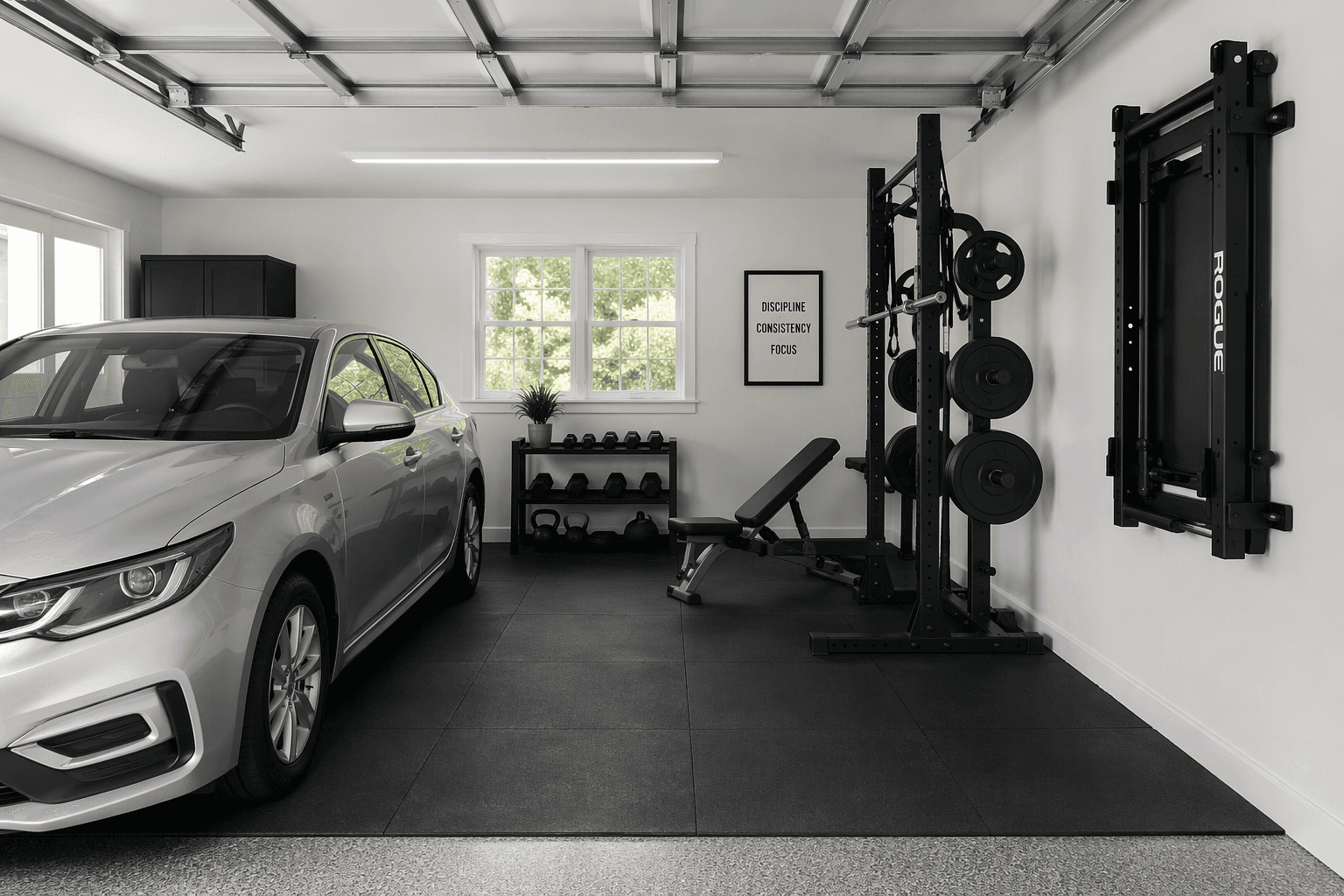
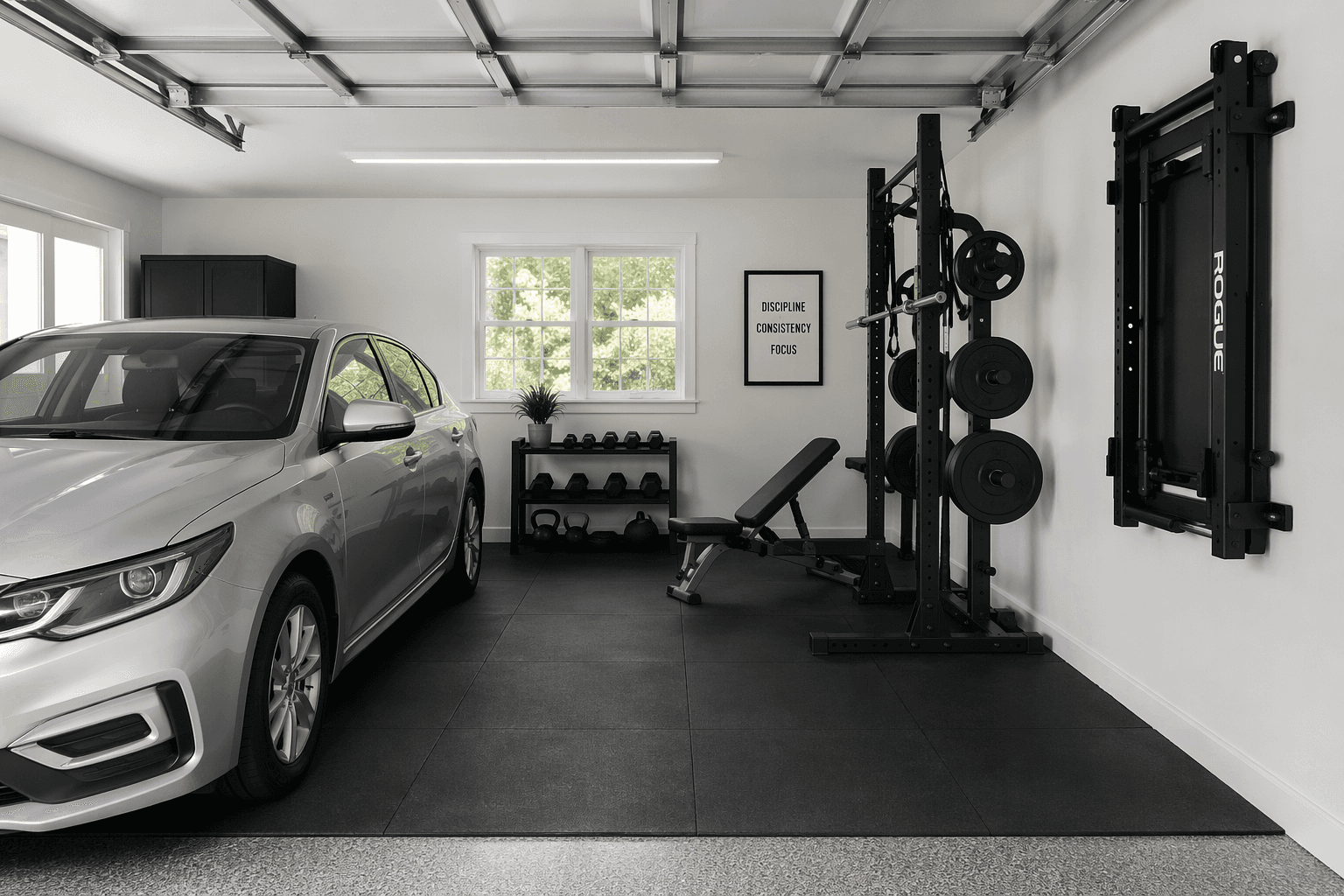
Before buying garage workout equipment, measure the garage in the condition it actually lives in: car parked, trash bins in place, bikes still hanging where they hang, garage door open and closed, and the lowest overhead obstruction identified. A single-car garage can hold a useful strength-and-cardio setup and still let the car come back in, but only if each purchase is judged by storage footprint, use footprint, true ceiling clearance, and usefulness per square foot.
That second state is where a lot of small-garage builds fail. A rack that feels compact during squats may still block a door, trap a car outside, or turn every evening into a rearranging job. The better buying question is not “Can this fit?” It is “Can this fit, be used safely, and then get out of the way?”
Start with the three constraints that decide almost every purchase
For a small garage, the useful filter is narrower than a normal home-gym checklist. Judge every major item on three axes:
- Storage footprint vs. use footprint: what it occupies during a workout, and what it occupies when the garage has to function as a garage again.
- Ceiling-clearance demand: whether the equipment and the exercises it invites still work after flooring thickness, garage door rails, beams, ducts, and openers are accounted for.
- Versatility per square foot: how many useful training jobs one item performs compared with the space it permanently claims.
Temperature and humidity matter too, especially in a garage that is not conditioned, but they should not be allowed to distract from the core mistake: buying equipment before knowing where it rests, where it moves, and what it blocks.
Storage mode matters more than the showroom footprint
A rack is usually the defining purchase in a garage gym because it determines what happens to the wall, the floor, the ceiling, and the car. In a dedicated room, a full rack can simply live where it lives. In a single-car garage, the rack is either a working station or a daily obstacle.
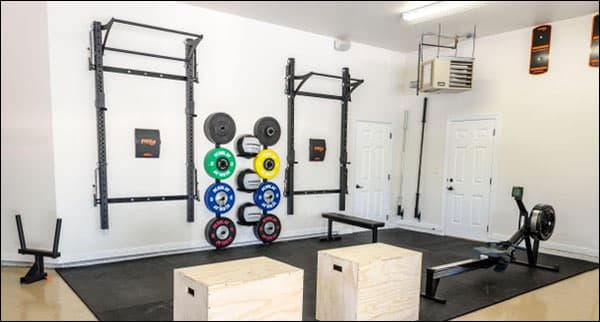
Folding wall racks exist for exactly this problem. The PRx Profile is the cleanest example of the category: in its folded position, it projects about 9 inches from the wall, which is the sort of number that changes whether a garage can still accept a vehicle after training [1]. The tradeoff is cost and installation seriousness. You are paying for the folding mechanism and for the fact that the floor comes back when the rack is stowed.
Rogue’s RML-3WC solves the same car-sharing problem differently. It folds to about 22 inches from the wall, so it does not disappear as completely as the PRx Profile, but it still reclaims the central floor area that matters most when a car has to pull in [2]. For many garages, 22 inches is acceptable against the right wall; for a narrow garage with shelving, a side door, or a water heater nearby, it can still be too much. That is why the tape measure matters more than the brand name.
The Rogue RML-390F is the interesting compromise. It avoids wall mounting and bolting, which is a real advantage for renters, people who do not want to drill into block or studs, and anyone who wants rearrangeability. But its flat-foot design keeps roughly a 4-by-4-foot footprint on the floor even when nobody is training [3]. That can be a perfectly rational trade if drilling is off the table. It is not the same kind of space-saving choice as a folding rack.
| Rack type | Storage behavior | Best fit | Main tradeoff |
|---|---|---|---|
| PRx Profile folding rack | About 9 inches from wall when folded | Car-sharing garages where floor recovery is the priority | Premium price and wall installation |
| Rogue RML-3WC folding rack | About 22 inches from wall when folded | Garages with enough wall depth for a folded rack | Still protrudes enough to matter in tight layouts |
| Rogue RML-390F flat-foot rack | Permanent floor footprint of about 4 by 4 feet | No-bolt setups and users who value repositioning | Does not disappear after the workout |
A useful planning reference is an 8-by-8-foot working zone for a compact training area, drawn from small home-gym setup guidance [4]. In a 12-by-20-foot single-car garage, that can work if the rack folds to the wall, the bench stores upright or tight to the side, plates stay on wall storage or a compact tree, and the cardio piece can stand up or roll away. It does not mean every 12-by-20 garage works automatically. A washer, side-entry door, freezer, steps into the house, or the garage door track can ruin the neat rectangle.
This is where a layout check is worth doing before any checkout page. Mark the working zone with painter’s tape, open the garage door, walk around the parked car, fold a cardboard box to the rack’s stored depth, and see what becomes annoying. If you need a more detailed fit test, use The Garage Gym Reality Check before choosing the rack.
Low ceilings quietly eliminate good equipment
A garage ceiling that measures “about eight feet” is not the same as eight usable feet. Rubber flooring may take away some height. A garage door rail may be lower than the ceiling. A beam, opener, duct, or light fixture may decide where overhead pressing, pull-ups, and rack height actually work. Low-ceiling guidance for home gyms emphasizes measuring true clearance from the finished floor to the lowest obstruction, not just wall-to-ceiling height [5].
This matters most with racks, pull-up bars, overhead presses, and tall cardio machines. A compact rack may fit on paper and still put the pull-up bar too close to the ceiling for a usable rep. A rower may be fine. A ski trainer, treadmill incline, or overhead cable movement may not be. Gray Matter Lifting’s compact setup guidance uses 84 inches as a working-space reference for some smaller builds, which is a helpful warning line for garages under 8 feet [4].
Measure in this order:
- Finished floor to the lowest ceiling obstruction, after accounting for rubber mats.
- Floor to the garage door rail when the door is open and when it is closed.
- Rack height, including pull-up bar position and any attachments.
- Your own reach with arms overhead, especially if overhead pressing is part of the plan.
- Bench position inside the rack, because moving a bench even a few inches can change whether the bar path clears a rail or opener.
If the garage is under 8 feet, the purchase list should change before the credit card comes out. Prioritize a shorter rack or squat stand that still meets your training needs, use seated overhead pressing if standing presses are not realistic, and be careful with cardio machines that add body height during use. Buying a taller rack because it is on sale is not a bargain if the pull-up bar lives in the garage door track.
Adjustable dumbbells earn their floor space
Fixed dumbbells are pleasant to use and terrible to store in a small garage once the set grows. Twelve or more pairs need a rack, a wall, and a level of floor commitment that rarely makes sense when the car still has a claim on the room. Adjustable dumbbells are not just a budget substitute here; they are one of the cleanest examples of versatility per square foot.
Garage Gym Reviews’ 2026 budget equipment guide lists QuickDraw adjustable dumbbells at $416 for a 5-to-60-pound range, REP x PÉPIN FAST dumbbells with a 10-to-125-pound range, and PowerBlock options covering 5 to 90 pounds [6]. Those are not identical products, and the right choice depends on how heavy you train, how fast you need changes to be, and whether the handle shape bothers you. But the category solves the same garage problem: one compact station replaces a long run of fixed pairs.
| Adjustable dumbbell example | Listed range or price | Why it matters in a small garage |
|---|---|---|
| QuickDraw | $416; 5–60 pounds | Strong value if moderate loading covers most training |
| REP x PÉPIN FAST | 10–125 pounds | Heavier ceiling for lifters who would otherwise outgrow lighter adjustables |
| PowerBlock | 5–90 pounds | Compact block-style storage with a broad useful range |
Pair adjustable dumbbells with an adjustable bench that stores upright or against a wall, and a small garage suddenly has pressing, rowing, split squats, incline work, curls, carries, and accessory training without a dumbbell tree. If your rack choice is still uncertain, dumbbells and a bench are also easier to buy early because they remain useful in almost any final layout.
For a broader way to compare compact strength tools beyond dumbbells, use The Complete Compact Home Gym Decision Framework after the garage measurements are done.
Flooring is one of the few easy calls
Garage flooring does not need to be precious. Horse stall mats are the practical default because they are dense, durable, widely used in garage gyms, and dramatically cheaper than many branded gym-flooring packages. Tractor Supply pricing commonly places 4-by-6-foot sheets around $50 to $60, with regional variation [7].
For a small garage, the useful move is usually to mat the working zone rather than the entire room. Cover the rack and bench area, leave space for the car path if needed, and avoid creating a raised lip where tires, doors, or rolling storage constantly catch. Mats also reduce the damage from plates and dumbbells, but they do not make aggressive dropping safe in every garage. Concrete, neighbors, framing, and the equipment itself still have opinions.
Plates, cardio, and accessories should be chosen after the footprint is known
Once the rack, dumbbells, bench, and flooring are mapped, the remaining purchases should serve the layout rather than compete with it. Plates need storage as much as they need a bar. Wall-mounted plate storage can be efficient if the wall is structurally suitable and the plates do not interfere with the folded rack or car door. A compact plate tree is easier to move but consumes floor space permanently.
Cardio is similar. The best small-garage cardio machine is often the one that stores vertically, rolls cleanly, or lives against a wall without blocking the car. A rower is a common fit because many models can stand upright, but the storage height still has to be checked against the ceiling and the garage door track. A fan bike may be brutally effective and mechanically simple, but it is not small when it lives in the walking lane.
Accessories should face a harsher test. Bands, a jump rope, collars, a landmine attachment, and a few handles can justify themselves. A specialty machine that performs one movement and cannot fold, roll, or hang needs a very good reason to enter a garage that still parks a car.
Temperature and humidity modify the plan, but they do not replace it
An uninsulated garage can make good equipment miserable to use. The first improvement is usually sealing the garage door because air gaps are immediate and obvious. Insulation guidance for garage gyms commonly points to R13 fiberglass for walls, with wall insulation cost ranges around $400 to $1,000, and R30 minimum guidance for ceilings [8][9].
That work affects comfort, corrosion risk, and consistency. It does not make a permanent 4-by-4-foot rack footprint smaller, and it does not create pull-up clearance under a garage rail. Handle climate after the layout is honest. Otherwise, the garage becomes better insulated around equipment that still does not fit.
A sane purchase order for a small garage
The safest buying sequence narrows the field before money is committed:
- Measure true clearance and map storage mode with the car present.
- Choose the rack style only after deciding whether the footprint must disappear, fold partially, or remain fixed.
- Buy flooring for the actual working zone, not the fantasy full-room gym.
- Add adjustable dumbbells and a bench because they carry a large share of training with minimal permanent footprint.
- Add plates, bar, storage, and cardio only after checking what remains open when the rack is in use and when it is stored.
- Improve sealing, insulation, fans, heat, or dehumidification once the physical layout is settled.
If you already know what fits and only need help deciding what to buy first, move to the Garage Gym Equipment Priority Tier List. If the limiting factor is money rather than layout, How to Set Up a Garage Gym on a Budget is the better next stop.
Use June 2026 prices as benchmarks, not promises
Equipment prices in this category move with sales cycles, freight promotions, bundles, and regional availability. June 2026 figures are useful benchmarks, not guarantees. Tax and shipping can add roughly 5% to 15%, which is enough to change whether a folding rack still beats a cheaper fixed-footprint option for your budget [6].
A practical small-garage shortlist usually looks like this: a folding rack or compact strength station, adjustable dumbbells, an adjustable bench, plates or resistance tools that match the strength setup, durable rubber flooring, and one cardio option that can stow without taking over the walking lane. That can be a complete garage workout equipment setup. It only works if storage mode, ceiling clearance, and car-sharing are treated as buying requirements rather than cleanup problems.
References
- PRx Profile folding rack product specifications, PRx Performance, link
- Rogue RML-3WC folding rack product specifications, Rogue Fitness, link
- Rogue RML-390F flat-foot rack product specifications, Rogue Fitness, link
- How To Start Your Home Gym In 2026 - FAQ, Gray Matter Lifting, link
- How to Build a Home Gym for Low Ceilings Without Wasting Space, RitFit Sports, link
- The Best Budget Home Gym Equipment of 2026, Garage Gym Reviews, link
- Horse stall mat pricing, Tractor Supply, link
- Best Insulation for Garage Gym in 2026, RitFit Sports, link
- How to Insulate a Garage Gym, Garage Gym Reviews, link
Comments
Join the discussion with an anonymous comment.