
A compact home gym is only compact if it works after the first week: the equipment still fits where you actually live, the noise does not make every workout feel like a negotiation with the downstairs neighbor, and the total cost does not keep expanding after the box arrives. Treat those three constraints together. Floor footprint, noise tolerance, and budget are not separate shopping filters; each one changes what the other two can realistically support.
That is why a “best overall” pick is usually less useful than a fit profile. Under 25 square feet in an upstairs rental is a different decision from 50 square feet on a concrete slab. A $700 starter budget behaves differently if the setup requires a monthly subscription. A machine that looks tidy in a garage review can become a problem in a wood-frame apartment if its normal use includes metal-on-metal clank or dropped plates.
The four compact home gym strategies
Most small-space setups fall into four strategy families. The labels matter less than the tradeoffs they bring into the room.
| Strategy | Typical fit | Where it can fail |
|---|---|---|
| All-in-one machine | One station for cable, resistance, or guided strength work; often easier to keep organized | Can dominate a small room even when marketed as compact; moving it later may be difficult |
| Modular build | Adjustable dumbbells, bench, bands, mat, storage, and possibly a folding rack added over time | Looks cheap at first, then grows into clutter or noise if storage and flooring are ignored |
| Smart or digital system | Small footprint, guided workouts, quieter resistance, and easy session start-up | Higher upfront price or subscription cost; resistance ceiling may matter for stronger lifters |
| Band and bodyweight setup | Lowest space demand, low noise, easy storage, renter-friendly when not anchored permanently | Less satisfying for people who need heavy progressive loading or traditional barbell feel |
If you already know you are choosing between a single station and a pieced-together setup, the deeper fork is covered in all-in-one vs. modular home gym. If your first question is broader than space—training goal, experience level, and general equipment categories—the broader home exercise equipment decision matrix is a better starting point. Here, the lens is narrower: what survives the room, the building, and the budget.
Noise should come before brand preference
Noise is the constraint that most often gets discovered too late. A machine can fit the corner perfectly and still be a bad apartment choice if every rep sends impact through a wood subfloor. Directional testing across four New York City apartments found digital resistance systems at 38–57 dB, weight stack machines at 62–88 dB, and free-weight plate drops at 98–112 dB on subfloors; the same testing found wood subfloors amplifying noise by 15–22 dB compared with concrete slab conditions.[1]
Those numbers should not be treated as universal lab values. They came from a specific set of apartments and floor assemblies, so a concrete high-rise, basement room, or single-family house can behave differently. But the direction is useful: impact and metal contact travel badly; controlled resistance and bands are easier to live with.
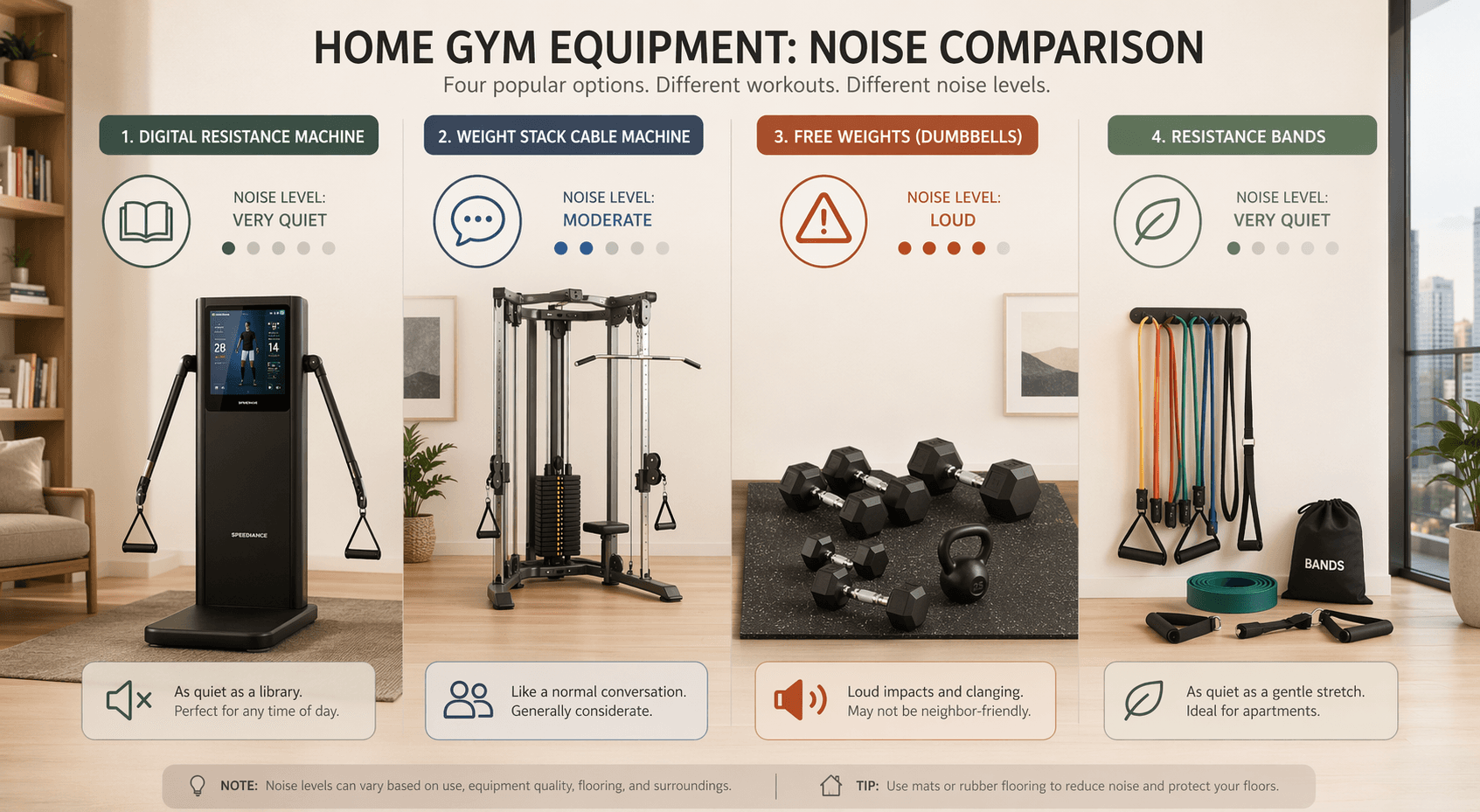
The practical difference is not just loud versus quiet. It is predictable versus sudden. A digital resistance machine has motor sound and cable movement. A weight stack may be fine during slow reps and irritating when plates return sharply. Adjustable dumbbells can be quiet if set down carefully on dense rubber, but a missed rep or rushed transition changes the whole acoustic profile. Plate-loaded training is the least forgiving in shared buildings because the worst sound is not the average rep; it is the drop.
| Noise situation | Safer strategy | Be careful with |
|---|---|---|
| Upstairs apartment, wood subfloor, sensitive neighbors | Band/bodyweight, smart digital resistance, carefully controlled cable work | Plate-loaded systems, heavy dumbbell drops, fast weight-stack returns |
| Apartment on concrete slab or ground floor | Digital, cable/stack, modular dumbbells with matting | Assuming concrete makes all impact harmless |
| Detached home, garage, or basement | Most strategies become possible | Still consider household noise and flooring protection |
This is also where resistance type matters more than marketing category. Digital systems are often quieter and cleaner to start, but commonly carry a fixed resistance ceiling. Cable and stack systems avoid subscriptions and can feel more traditional, but mechanical noise is part of the package. Plate-loaded systems expand well, but they ask for more space and more forgiveness from the building. Bands can be very quiet and tiny, though they introduce wear, replacement, and a different strength curve.
Footprint is not just square footage
Floor area matters, but the better question is how the space behaves between workouts. Some equipment has a workout footprint and a storage footprint. Wall-mounted and folding systems are attractive because they can return floor area to the room: Garage Gym Reviews lists the PRx Profile PRO at a 9-inch folded depth and the Speediance Gym Monster at a 14.96-inch folded depth.[2][3]
A shallow folded profile can be the difference between a room that still functions and a room that becomes “the gym room” by accident. But folded depth is not the whole footprint. You still need clearance to train, open doors or arms, adjust benches, step back from cables, and move around without clipping a desk, bed, radiator, or closet door.
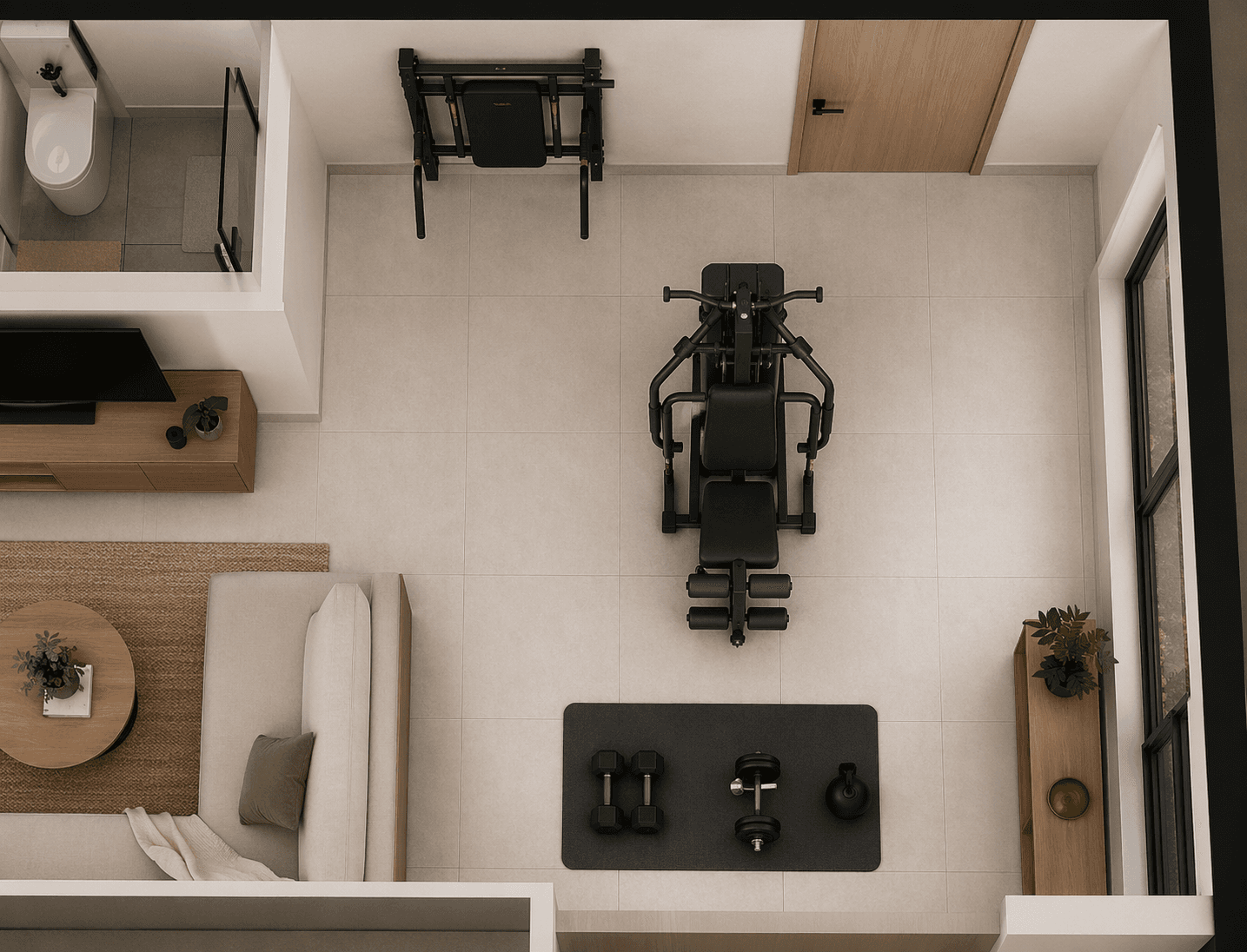
| Available training space | What usually fits best | What to verify before buying |
|---|---|---|
| Under 25 sq ft | Bands, suspension trainer if anchoring is allowed, adjustable dumbbells, fold-flat bench, some wall-mounted or digital systems | Door swing, storage depth, noise path through the floor, whether anchors are allowed |
| 25–50 sq ft | Compact all-in-one, smart gym, cable trainer, modular dumbbell-and-bench setup, folding rack in some rooms | Working clearance, bench path, cable angles, folded versus open dimensions |
| 50+ sq ft | Larger all-in-one, rack-based modular build, heavier free weights, plate-loaded options where noise allows | Floor loading, impact control, storage, and whether the space must still serve another purpose |
In very small rooms, the best equipment is often the equipment that disappears cleanly. A bench that folds flat under a bed may beat a better bench that lives permanently in the walkway. Adjustable dumbbells may beat a larger cable machine if the cable path blocks furniture. A wall unit may beat both if the wall is usable, the lease allows mounting, and the floor can tolerate the way you train.
Budget comes last, but it still decides
Budget should not be ignored; it just should not be the first filter. If a cheap setup is too loud to use, it was not cheap. If a premium machine has a footprint that forces you to fold, roll, or rearrange furniture before every session, the price bought friction.
Garage Gym Reviews reported an average home gym machine cost of $1,855 across more than 50 tested units, while using $65 per month as an average gym membership comparison; at those figures, the rough break-even point lands around two to three years depending on equipment choice.[2]
That average is useful, but it leans toward tested machines rather than the lowest-cost possible setup. A band-and-mat setup can sit far below it. A smart gym can exceed it once subscriptions are included. A modular build may start low, then creep upward through a better bench, heavier dumbbells, storage, mats, collars, or a rack.
| Budget tier | Most sensible compact strategy | Cost traps to check |
|---|---|---|
| Lowest practical spend | Bands, mat, door-free bodyweight options, maybe adjustable dumbbells added later | Band replacement, poor storage, buying temporary gear twice |
| Midrange | Modular dumbbells and bench, compact cable option, used equipment where pickup is realistic | Flooring, storage, shipping, upgrades that turn the setup into a larger system |
| Premium | Smart/digital system, refined all-in-one, foldable wall-mounted station | Subscription fees, service limits, resistance ceiling, moving or installation constraints |
For digital systems, the subscription line deserves special attention. Smart resistance subscriptions commonly run $40–60 per month, with many systems offering roughly 200–250 pounds of resistance. That can be perfectly reasonable for someone who values guidance, quiet operation, and fast setup. It is less attractive for someone who wants to keep the system for years without recurring fees or who already knows they will outgrow the resistance ceiling.
How the three constraints change each other
The mistake is to score space, noise, and budget separately, then average them. In a real room, one hard constraint can veto the others. If you are above another unit on a wood subfloor, the noise limit may rule out the cheapest heavy-free-weight path. If you have under 25 square feet, a bargain used machine may still be a bad buy because it has nowhere to live. If you have a premium budget but hate subscriptions, some elegant digital systems stop being elegant.
Start with the least flexible condition. Renters often have two: noise and lease restrictions. Garage Gym Reviews cites National Apartment Association data that 39 million Americans live in apartments, and its apartment-equipment guidance emphasizes the importance of compact, neighbor-aware choices.[4] REP Fitness also notes renter-specific issues such as space, noise, and anchoring; suspension trainers, for example, can become less simple when wall or ceiling mounting is not allowed.[5]
Once the hard vetoes are clear, the decision becomes cleaner. A quiet setup that fits but costs more may be rational if it removes the main reason you would skip workouts. A cheaper setup may be better if it leaves room to move and does not depend on permanent installation. A larger all-in-one may be reasonable in 50+ square feet on a forgiving floor, but the same machine can be absurd in a bedroom corner where the bench path blocks the closet.
Match your profile to a strategy
Use the profiles below as a starting filter, not as a product ranking. The goal is to identify the next category to research, not to crown one universal compact home gym.
| Your constraint profile | Best next strategy | Why |
|---|---|---|
| Under 25 sq ft, upstairs apartment, wood subfloor, tight budget | Band/bodyweight plus carefully chosen adjustable dumbbells if noise can be controlled | Lowest footprint and lowest neighbor risk; avoid dropped-weight dependence |
| Under 25 sq ft, noise-sensitive building, premium budget | Smart/digital resistance or shallow wall-mounted system if mounting is allowed | Quiet operation and fast start-up matter more than maximum load |
| 25–50 sq ft, moderate noise tolerance, no subscription preference | Compact cable/stack machine or modular dumbbell-and-bench build | Enough room for better exercise variety without committing to a large rack |
| 25–50 sq ft, wants coaching and minimal setup time | Smart gym | Guidance and session convenience can protect consistency in a small room |
| 50+ sq ft, ground floor or concrete slab, strength-focused | Modular rack, plate-loaded system, or larger all-in-one | Space and floor conditions support heavier loading, though impact still needs management |
| Rental with uncertain lease rules | Non-anchored modular setup | Avoids wall damage, installation disputes, and expensive removal |
If your profile points toward a smart system, compare resistance style, subscription cost, and load ceiling before comparing screens and class libraries. The smart home gym comparison guide is the better follow-up once you know digital resistance fits your room and building.
If your profile points toward a bigger system type—rack, all-in-one, or smart gym—the next question is architecture. A compact room does not forgive the wrong base system. The home gym system buyer’s guide is useful after this constraint screen, not before it.
A quick room test before you buy
Before choosing a product, tape the open footprint on the floor, not just the stored dimensions. Add the bench path, your stance, cable travel, door swings, and storage. Then do a noise rehearsal with what you already own: step-ups, controlled dumbbell set-downs if you have them, jumping-free conditioning, and mat movement. You are not measuring laboratory decibels; you are finding out whether the room encourages quiet, repeatable training.
- If the taped layout blocks daily life, choose a smaller strategy before buying a better version of the wrong one.
- If the floor transmits impact easily, prioritize digital, cable, band, or slow-tempo dumbbell training over plate-loaded plans.
- If the budget only works by ignoring mats, storage, delivery, installation, or subscriptions, the budget is not complete.
- If your training goal is the main unresolved issue, use a goal-based guide such as the home gym decision guide by training style after you have ruled out strategies your space cannot support.
The right compact home gym is the one whose compromises match your actual constraints. For some people, that is a sleek digital machine. For others, it is an unglamorous band-and-dumbbell setup that can be used at 6 a.m. without apology. The better choice is the one that fits the room, stays tolerable to the building, and remains affordable after the first purchase.
References
- Best Home Gym Small Spaces Digital, Home Gym Layouts
- Best Home Gyms, Garage Gym Reviews
- Best Compact Exercise Equipment, Garage Gym Reviews
- Best Workout Equipment for Apartments, Garage Gym Reviews
- Apartment Home Gym Guide, REP Fitness
Comments
Join the discussion with an anonymous comment.