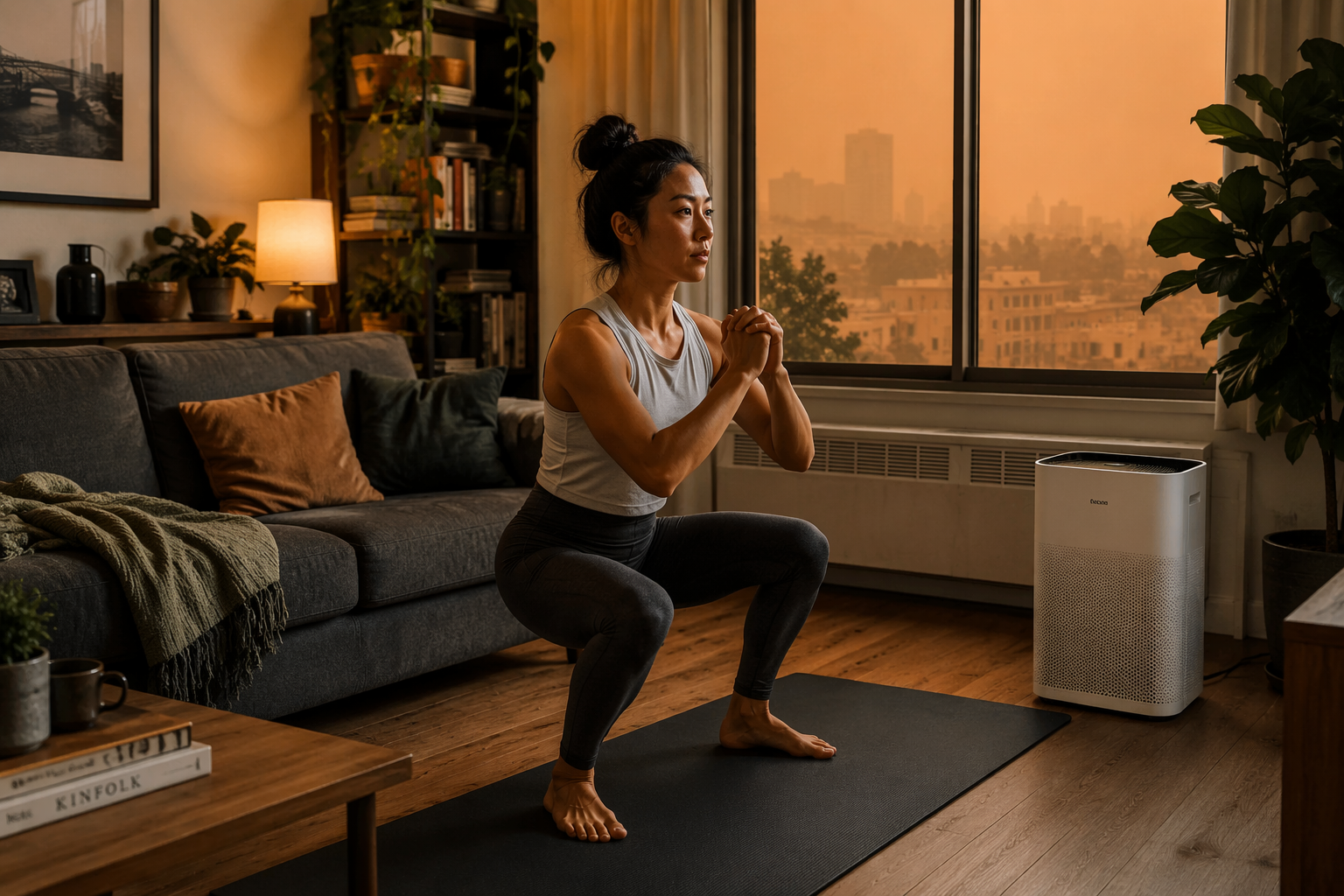
Check the AQI before you change clothes. That one minute decides whether today is an outdoor training day, a filtered-room bodyweight day, or a low-intensity movement day. The usual advice to “just work out indoors” skips the part that matters in a small apartment: smoke can leak through windows, cooking can spike particles, and a jump-heavy circuit can turn a narrow living room into a downstairs-neighbor problem.
For a home workout during an air quality alert, the cleanest rule is this: when AQI reaches 151 or higher, move exercise indoors. If you are in a sensitive group, make that pivot at 101. Sensitive groups include people with asthma, COPD, heart disease, older adults, children, teenagers, pregnant people, and anyone whose clinician has told them air pollution is a personal risk. AirNow’s AQI categories are built around health concern levels, and wildfire-smoke guidance treats higher AQI as a reason to reduce exposure, not bargain with it.[1]
Use The AQI To Change The Workout, Not Cancel The Whole Day
| AQI color | AQI range | What it means for exercise today |
|---|---|---|
| Green | 0-50 | Outdoor exercise is generally the easiest call for most people. Still check local smoke, pollen, heat, and your own symptoms. |
| Yellow | 51-100 | Most people can exercise outside, but sensitive exercisers should reduce duration or intensity if symptoms show up. |
| Orange | 101-150 | Sensitive groups should move indoors or choose a very light session. Others should avoid long, hard outdoor efforts. |
| Red | 151-200 | Move the workout indoors. Keep the session controlled, especially if your indoor air is not filtered. |
| Purple | 201-300 | Treat this as a low-exposure day. A short filtered-room mobility or strength session is more sensible than chasing intensity. |
| Maroon | 301+ | Prioritize clean air and health. Skip strenuous exercise unless you have a genuinely clean indoor environment and specific medical guidance. |
The reason exercise changes the stakes is not mysterious. During exercise, GU Energy Labs notes that people may breathe 10 to 20 times more air than at rest, and heavier effort often shifts breathing from the nose to the mouth. That matters because mouth breathing bypasses some of the nose’s particle-filtering function for fine particulate matter such as PM2.5.[2] A quick jog in bad air is not the same exposure as standing outside to pick up a package.
The American Lung Association’s guidance is blunt in the useful way public-health guidance should be: pay attention to air quality, adjust exercise when pollution is high, and take symptoms seriously.[3] That does not mean every alert day has to become a couch day. It means the workout has to match the air you actually have, not the routine you planned yesterday.
Indoor Is A Location, Not A Guarantee
A compact apartment can be a good fallback, but it is not automatically clean. Smart Air measured PM2.5 across gyms and found an average of 21.5 micrograms per cubic meter, which it reported as 43% above World Health Organization limits.[4] A gym has more space and ventilation equipment than most living rooms; the useful lesson is not that gyms are uniquely bad, but that “inside” is too vague to be a safety plan.
There is also the uncomfortable apartment reality: the same sealed room that keeps smoke from pouring in can trap particles from cooking, candles, cleaning, dust, and old HVAC filters. EPA material cited by Filterbuy warns that indoor air can be 2 to 5 times more polluted than outdoor air in some circumstances.[5] That figure should keep the advice honest. A filtered, sealed room is different from an unfiltered sealed room.
One more caution belongs here, but it should stay proportional. AtmoTube reported lab findings that aerosol particle emissions can rise sharply during exercise, including a 100-fold increase under some conditions.[6] That does not prove your solo mat workout is unsafe. It does support a practical habit: avoid crowded, poorly ventilated indoor exercise spaces during alert days, and do not invite three people over for a hard circuit in the smallest room you own.
Set Up The Room Before You Start Sweating
Do the air setup before the warm-up. Once your breathing rate rises, the room conditions matter more, and the fix is less convenient. A yoga mat footprint is enough for the workout itself; the air plan needs a little more intention.
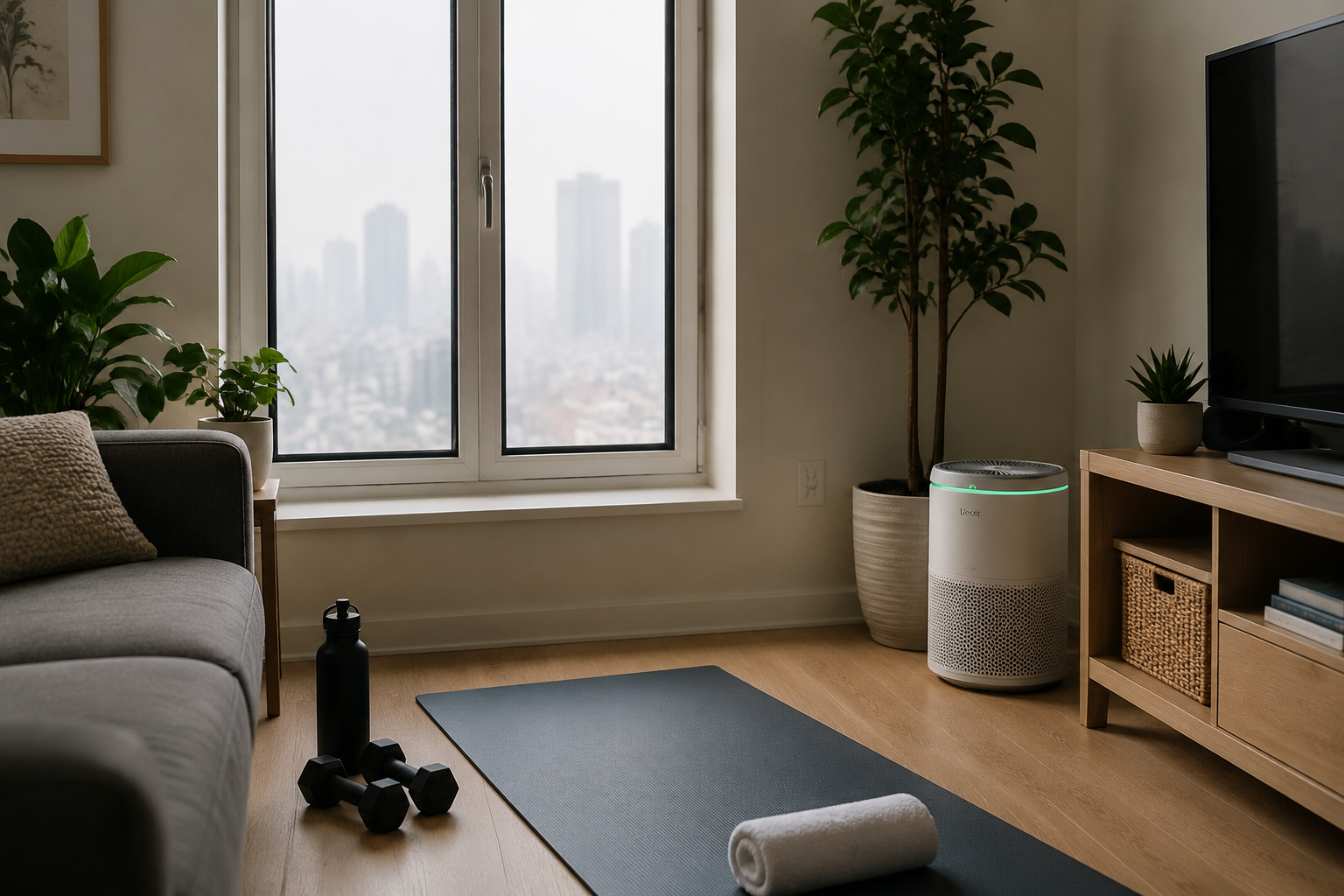
- Close windows and exterior doors. If smoke leaks through a window AC unit or a drafty frame, seal the obvious gaps as well as you can before training.
- Run a HEPA purifier for about 30 minutes before the workout if you have one. Put it in the room where you will exercise, not across the apartment.
- Avoid cooking, frying, burning candles, spraying cleaners, or vacuuming right before or during the session. Those choices can add particles at the exact time you are breathing harder.
- Check HVAC settings. If your system allows recirculation, use it during smoke-heavy periods rather than pulling in outdoor air.
- Clear one mat-width path. Move the coffee table, tuck shoes under the sofa, and leave enough room for a plank, a lunge, and a slow step-back without clipping furniture.
If you do not have a purifier, do not pretend the room has become clean just because the window is closed. The better compromise is a shorter, lower-intensity session with windows sealed, no indoor particle sources, and a willingness to stop if your chest, throat, or breathing feels off. That is still more controlled than a hard outdoor workout at Red AQI, but it is not the same as training in a filtered room.
Choose The Workout By Air Confidence, Not Mood
Small-space workout formats from Nerd Fitness and 12 Minute Athlete show how much can fit into a bodyweight session without machines or a full room.[7][8] For an alert day, the constraint is tighter: the session should fit on one mat, avoid unnecessary floor impact, and match your air setup.
| Best fit | Use this option | Intensity |
|---|---|---|
| You are not in a sensitive group, AQI pushed you indoors, and the room is filtered | Silent HIIT | Moderate to hard, no jumping |
| You want to maintain training without breathing as hard | Bodyweight strength | Moderate, controlled |
| AQI is very high, indoor air is uncertain, or symptoms are possible | Yoga or mobility | Low |
Option 1: Silent HIIT For A Filtered Room
Use this only when you are not in a sensitive group, you have moved indoors because outdoor AQI is unhealthy, and you have done the room setup. The goal is not to crush yourself; it is to keep the training signal without bringing smoke exposure and apartment noise into the same bad decision.
- Warm up for 3 minutes: marching in place, shoulder circles, hip hinges, and easy squats.
- Do 30 seconds of slow squats, then rest 20 seconds.
- Do 30 seconds of reverse lunges, then rest 20 seconds.
- Do 30 seconds of plank shoulder taps, then rest 20 seconds.
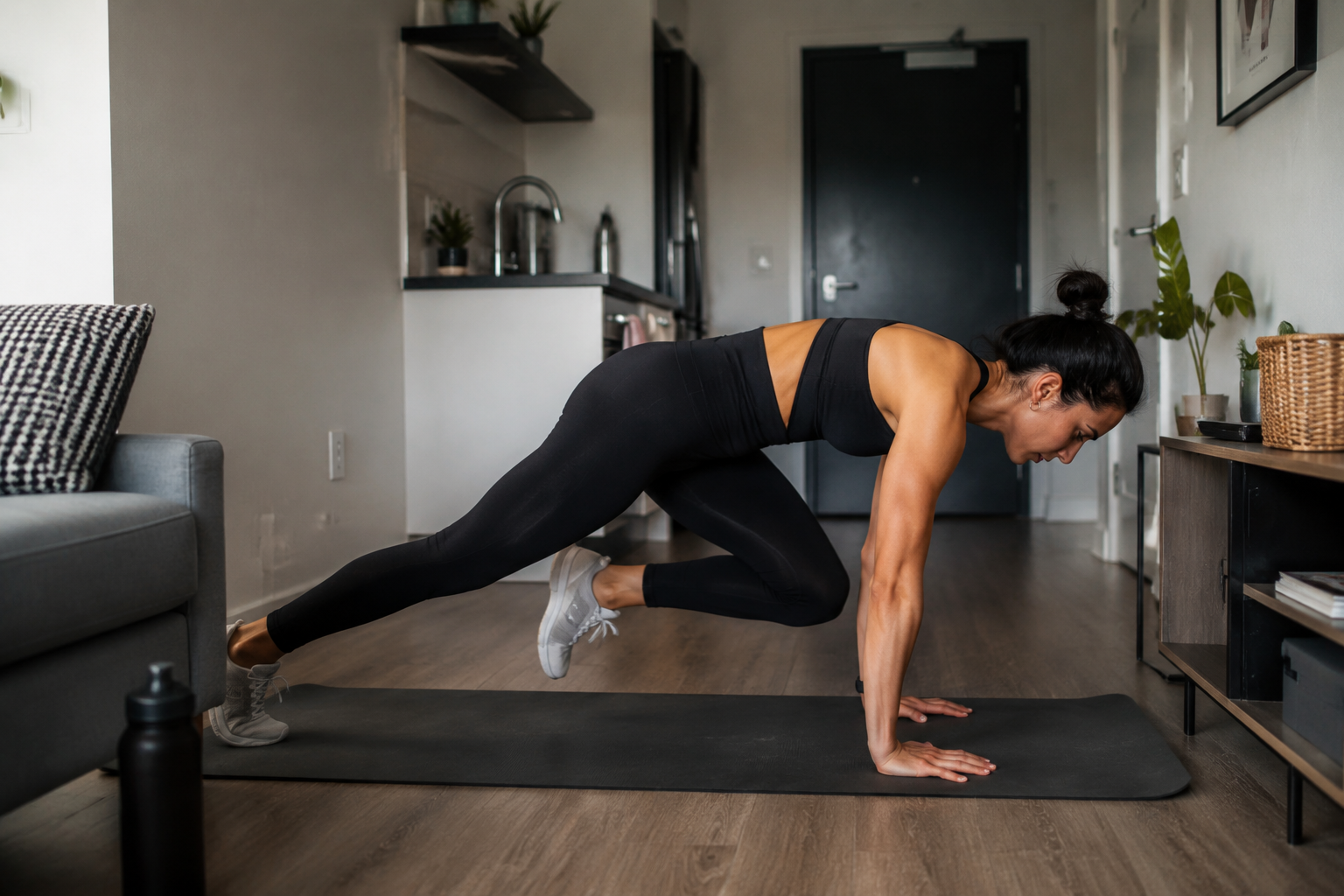
- Do 30 seconds of slow mountain climbers, then rest 40 seconds.
- Repeat for 3 to 5 rounds, stopping before breathing becomes ragged or symptoms appear.
Keep both feet quiet. Squats should end with heels planted, reverse lunges should step back instead of drop, and mountain climbers should move like a plank drill rather than a sprint. If the mat slides, slow down. If the floor thumps, the exercise is too fast for the room.
Option 2: Bodyweight Strength When You Want Less Breathing Stress
Strength work is the better alert-day default for many apartments because it gives you rests on purpose. You still work, but you are not trying to keep your heart rate pinned while indoor air is imperfect.
- Push-ups: 6 to 12 reps from the floor, a sofa edge, or a wall.
- Glute bridges: 10 to 15 reps, pausing at the top instead of rushing.
- Split squats: 6 to 10 reps per side, using a chair or wall for balance if needed.
- Hollow holds or dead bugs: 20 to 30 seconds with steady breathing.
- Rest 60 to 90 seconds after each round and repeat 2 to 4 times.
This is also the easiest option to make neighbor-safe. Slow the lowering phase of push-ups, step carefully into split squats, and use a folded towel under the knees or elbows if the mat is thin. If you want a full progression after the alert day, the site’s quiet-strength plan, Build Muscle Without Making Noise, is the better place to go deeper than this single-session version.
Option 3: Yoga Or Mobility For Higher-Risk Days
When AQI is Purple or Maroon, when you are in a sensitive group, or when your indoor air setup is only “windows closed and hoping,” choose the quieter answer. A mobility flow keeps the routine alive without forcing the heavy breathing that made outdoor exercise a bad idea in the first place.
- Start with 2 minutes of nasal breathing if comfortable, lying on your back with knees bent.
- Move through cat-cow, child’s pose, and thread-the-needle.
- Add low lunges, hamstring stretches, and supported hip openers.
- Finish with easy spinal twists and a few minutes of stillness.
Skip hot-yoga intensity, breath-of-fire drills, and long holds that make you strain. The point is to come out looser and calmer, not to prove that a smoke day can still become a personal record.
Apartment Modifications That Deserve More Than A Footnote
Jumping jacks, burpees, jump squats, and high knees often appear in bodyweight routines because they are simple. They are also the first moves to cut in a small apartment during an air alert. They increase impact, noise, and breathing demand at the same time.
| Instead of | Use | Why it works better today |
|---|---|---|
| Jumping jacks | Step jacks | Lower impact and easier to keep quiet |
| Burpees | Squat to plank step-back | Keeps the full-body pattern without the jump |
| Jump squats | Tempo squats | Builds leg fatigue without floor thumps |
| Running mountain climbers | Slow knee drives from plank | Turns cardio chaos into controlled core work |
| High knees | Marching with strong arm drive | Raises effort without pounding |
A mat helps, but it is not soundproofing. If your floor transmits every heel drop, stack a second mat or towel under the working area and use tempo instead of bounce: three seconds down, one-second pause, steady rise. In a tight room, control is not a beginner modification. It is the adult version of making the workout fit the building.
After The Workout, Keep Managing The Air
Do not fling the window open just because the circuit is over. If outdoor AQI is still unhealthy, keep the room sealed and leave the purifier running. Rehydrate, let your breathing settle, and take a shower when you can, especially after wildfire-smoke exposure, to rinse particles from skin and hair.
If your throat burns, your chest tightens, you wheeze, or you feel unusually lightheaded, stop the session rather than downgrading it midstream. Sensitive groups should be even quicker to stop. The win on an alert day is not squeezing in the hardest possible workout; it is keeping enough routine without adding avoidable exposure.
For a broader AQI decision primer, start with Swap Your Outdoor Workout for This Home Routine When Air Quality Is Bad. For today, the order is simple enough: read the AQI, seal and filter the room if possible, choose the lowest sensible intensity, train on one mat, and keep the air clean after you are done.
References
- AQI Basics, AirNow.gov
- Running in Smoke: How to Adjust Your Training Based on AQI, GU Energy Labs
- 4 Things to Know About Exercising in Poor Air Quality, American Lung Association
- Air Pollution in Gyms: How Bad Is It?, Smart Air
- Indoor Air Quality Can Be 2-5 Times Worse Than Outdoor Air, Filterbuy
- Study: Exercise Can Increase Aerosol Particle Emissions 100-Fold, AtmoTube
- Beginner Bodyweight Workout, Nerd Fitness
- Bodyweight Workouts, 12 Minute Athlete
Comments
Join the discussion with an anonymous comment.