
When the AQI turns bad right before your run, the useful question is not whether indoor workouts are “better.” It is what you can do in the next hour without turning a pollution problem into a harder-breathing problem. Use the AQI as the first filter, then choose the shortest workout that keeps the habit alive.
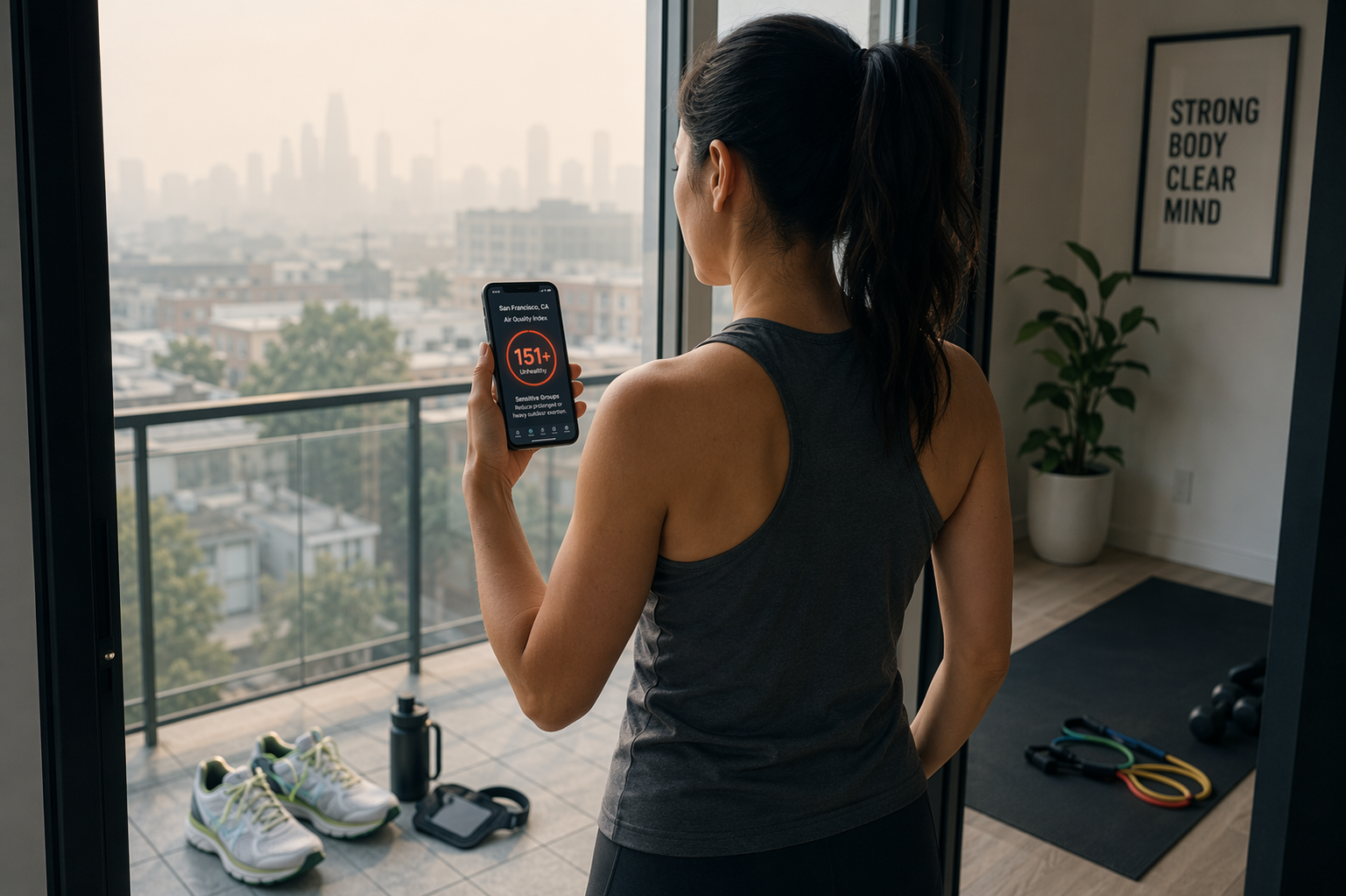
The AQI-to-workout switch
This is the quick version. It follows the standard AQI color bands used in public health guidance, then translates each band into a workout decision instead of a weather lecture.[1][2]
| AQI tier | Outdoor decision | Best indoor workout when air quality is bad |
|---|---|---|
| Green, 0–50 | Do your normal outdoor workout. | No switch needed unless local smoke, odors, symptoms, or a personal condition says otherwise. |
| Yellow, 51–100 | Most people can continue, but pay attention if you are sensitive to pollution. | Keep your regular plan or move inside for easy mobility, yoga, or light strength if your breathing feels off. |
| Orange, 101–150 | Healthy adults can consider a shorter outdoor session; sensitive groups should move indoors.[2] | Choose a short indoor strength session, floor flow, or controlled-tempo circuit. If you go outside, keep it easy and brief. |
| Red, 151–200 | Stop outdoor exercise. | Cap the indoor session around 20–30 minutes. Use isometric holds, slow-tempo strength, yoga, or a brief circuit with no sustained heavy breathing. |
| Purple, 201–300 | Skip outdoor exercise. | Make it a short maintenance session: mobility, breathing-controlled floor work, easy yoga, or a few low-intensity strength sets. |
| Maroon, 301+ | Do not train outdoors. | Rest, mobility, or the lowest-effort indoor movement that does not make you breathe hard. If indoor air is also poor, resting is training discipline, not failure. |
The red tier is the real decision point. At AQI 151 and above, the workout is no longer a question of toughness. The goal is to avoid pulling more polluted air deep into the lungs while still doing enough movement that the day does not become a total loss.
Why the line is about breathing, not motivation
At rest, a typical person breathes about 15 times per minute and moves roughly 12 liters of air. During exercise, breathing can rise to 40–60 breaths per minute and around 100 liters of air. That is roughly an eightfold increase in air — and pollutants — moving through the lungs.[1]
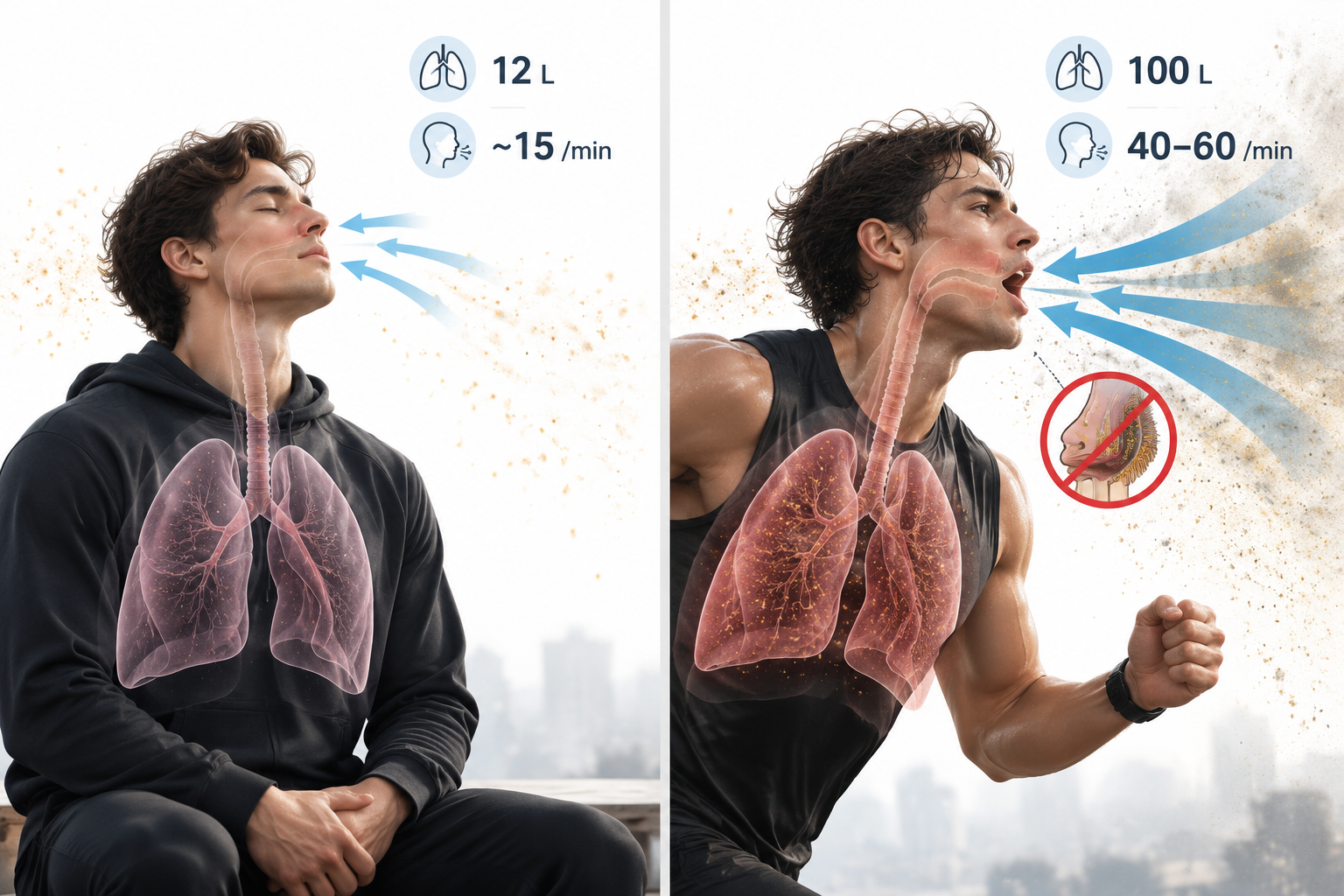
Exercise also changes how that air gets in. As intensity rises, mouth breathing becomes more likely, which reduces the filtering role of the nose and lets more particles bypass the upper airway.[3] That is why a polluted-day workout cannot be judged only by pace, mileage, or calories. The more important question is how long you are breathing hard.
The AQI does not measure your personal dose. It tells you the air outside is worse. Your dose depends on how much air you move, how long you keep moving it, and whether you are indoors in air that is actually cleaner. That is the reason the best indoor workouts when air quality is bad tend to be shorter, more controlled, and less cardio-driven as the AQI climbs.
Do not assume indoors means clean
Moving inside is usually the right move at red AQI, but it is not a magic reset. Indoor air can still carry outdoor particles that leak in through doors, windows, ventilation gaps, and building systems. The EPA has reported that indoor air can be 2–5 times worse than outdoor air in some cases.[4]
Gyms are not automatically better either. One analysis of eight Portuguese gyms found average PM2.5 levels of 21.5 µg/m³, which was 43% above the WHO 24-hour guideline of 15 µg/m³; total volatile organic compounds were reported at 134% above the WHO limit.[5] That study does not prove every gym is dirty, and it does not tell you what your apartment air is today. It does kill the lazy advice to “just go indoors” without checking the actual room you are using.
For a small apartment, the practical check is simple: close windows, avoid cooking or cleaning right before the workout, use the cleanest room you have, and skip anything that makes you breathe hard if smoke smell, visible haze, or symptoms show up indoors. If you want a fuller setup plan, use a dedicated guide to prepare your home gym for safe workouts in poor air quality. But you do not need to build a perfect room before making today’s decision.
Red AQI: keep the session short and quiet
At AQI 151–200, outdoor exercise is the part to cut. Not reduce. Cut. The indoor replacement should avoid sustained heavy breathing, which means this is not the day to prove that your living room can become a spin studio.
A useful red-tier cap is 20–30 minutes. That is not because 31 minutes suddenly becomes dangerous; it is because duration adds exposure, and fatigue tends to push breathing higher. The longer the session runs, the more likely a reasonable fallback turns into the same cardio load you were trying to avoid.
The safest choices are exercises that create muscular effort without long stretches of high ventilation. Think planks, side planks, wall sits, glute bridges, slow squats, slow push-ups, dead bugs, bird dogs, controlled yoga, and short circuits with generous rest. This is an evidence-informed way to apply the breathing-rate problem; it is not based on a study proving that one specific plank workout is safest at one specific AQI.
A red-tier small-space session
- 3 minutes: easy joint circles, cat-cow, hip hinges, and slow nasal breathing.
- 8 minutes: alternate wall sit, glute bridge hold, forearm plank, and dead bug. Rest before breathing gets heavy.
- 6 minutes: slow-tempo squats and incline push-ups, using a controlled 3-second lower and 3-second rise.
- 3 minutes: child’s pose, easy spinal rotation, and relaxed walking around the room.
If that feels too easy, add tension before you add speed. Hold the squat lower. Slow the push-up. Pause longer in the bridge. The point is to train muscle without turning the whole session into a breathing test.
Where brief HIIT fits, and where it does not
There is a tempting argument for short, hard workouts on bad-air days: if the workout is much shorter, the total exposure window shrinks. Public Health Institute experts, discussing diesel-exhaust cycling studies, noted that 10–20 minute high-intensity interval sessions produced less cumulative pollutant exposure than longer moderate-intensity sessions.[6]
That does not make HIIT automatically safe in wildfire smoke or in a stale apartment. Diesel exhaust and wildfire smoke are not identical, and “less cumulative exposure than a longer workout” is not the same as “low exposure.” Still, the usable principle is solid enough: when pollution is high, a shorter session can be smarter than a longer one, especially if you keep the hard breathing brief and stop before the workout sprawls.
So use HIIT carefully. At orange AQI, a short indoor circuit may be reasonable for healthy adults if the room air seems acceptable and symptoms stay quiet. At red AQI, make it very brief or choose strength holds instead. At purple or maroon, HIIT usually misses the point.
What to do at each tier if you have no home gym
The fallback does not need equipment. It needs a floor patch, a timer, and the willingness to stop chasing the workout you planned when the air changed. If you want a ready-made routine, use this home routine for bad air quality days for the workout details. The decision rules stay the same.
| If the AQI is... | Choose this | Avoid this |
|---|---|---|
| Green | Normal run, ride, walk, hike, or indoor workout. | Overthinking a normal training day. |
| Yellow | Normal workout if you feel fine; easy indoor work if you are sensitive. | Ignoring throat irritation, chest tightness, unusual coughing, or asthma symptoms. |
| Orange | Short outdoor easy effort for healthy adults, or indoor strength, yoga, and floor work. | Long outdoor tempo work, hill repeats, hard rides, or “just one more mile” logic. |
| Red | 20–30 minutes indoors: isometrics, slow strength, yoga, or a very brief circuit. | Outdoor exercise and sustained indoor cardio. |
| Purple | Short mobility, gentle yoga, dead bugs, bird dogs, light stretching. | Any workout that keeps you breathing hard. |
| Maroon | Rest or very gentle indoor movement only if the room air is tolerable. | Trying to preserve fitness with intensity. |
Best low-breathing options
- Isometric holds: wall sits, planks, side planks, glute bridge holds, hollow holds.
- Slow-tempo strength: squats, split squats, push-ups, hip hinges, calf raises, all done without rushing.
- Floor work: dead bugs, bird dogs, bear crawls, side-lying leg raises, controlled core rotations.
- Yoga and mobility: slower flows, long holds, hip openers, thoracic rotations, hamstring work.
- Brief circuits: only when the AQI tier and indoor air make sense; keep them under 20 minutes and rest before breathing stays elevated.
The cleanest decision is usually the fastest one: check the AQI, switch based on the tier, and pick the lowest-breathing-demand workout that still preserves the habit. On red days and worse, that usually means less time, less ventilation, and more control.
References
- The AQI Dilemma: Is it Safe to Exercise? — GU Energy Labs
- Four Things to Know about Air Quality and Exercising Outdoors — American Lung Association
- Exercise and air quality: 10 top tips — PMC
- Should You Exercise Outside in Air Pollution? — US EPA
- How Safe is the Air Quality in Gyms? — Smart Air
- Experts Offer Advice on Working Out During Wildfire Smoke Events — Public Health Institute
Comments
Join the discussion with an anonymous comment.