
A small home gym behaves differently on a bad-air day than the rest of the house. The rubber mat is close to your face during floor work. The door may be shut to keep smoke out or noise down. Sweat raises humidity. Dust gets kicked up from storage bins, chalk, old carpet, or a walking pad belt. Then the workout starts, and the person in the room is no longer breathing like someone watching TV.
That is the real planning problem behind an indoor workout during poor air quality: not whether a purifier is good in the abstract, but whether the room is being prepared before training, controlled during training, and cleared afterward. For most apartment corners, spare bedrooms, garage bays, and basement zones, the workable retrofit has three layers: reduce what the room emits, filter what can be filtered, and operate the space differently when outdoor AQI is poor.
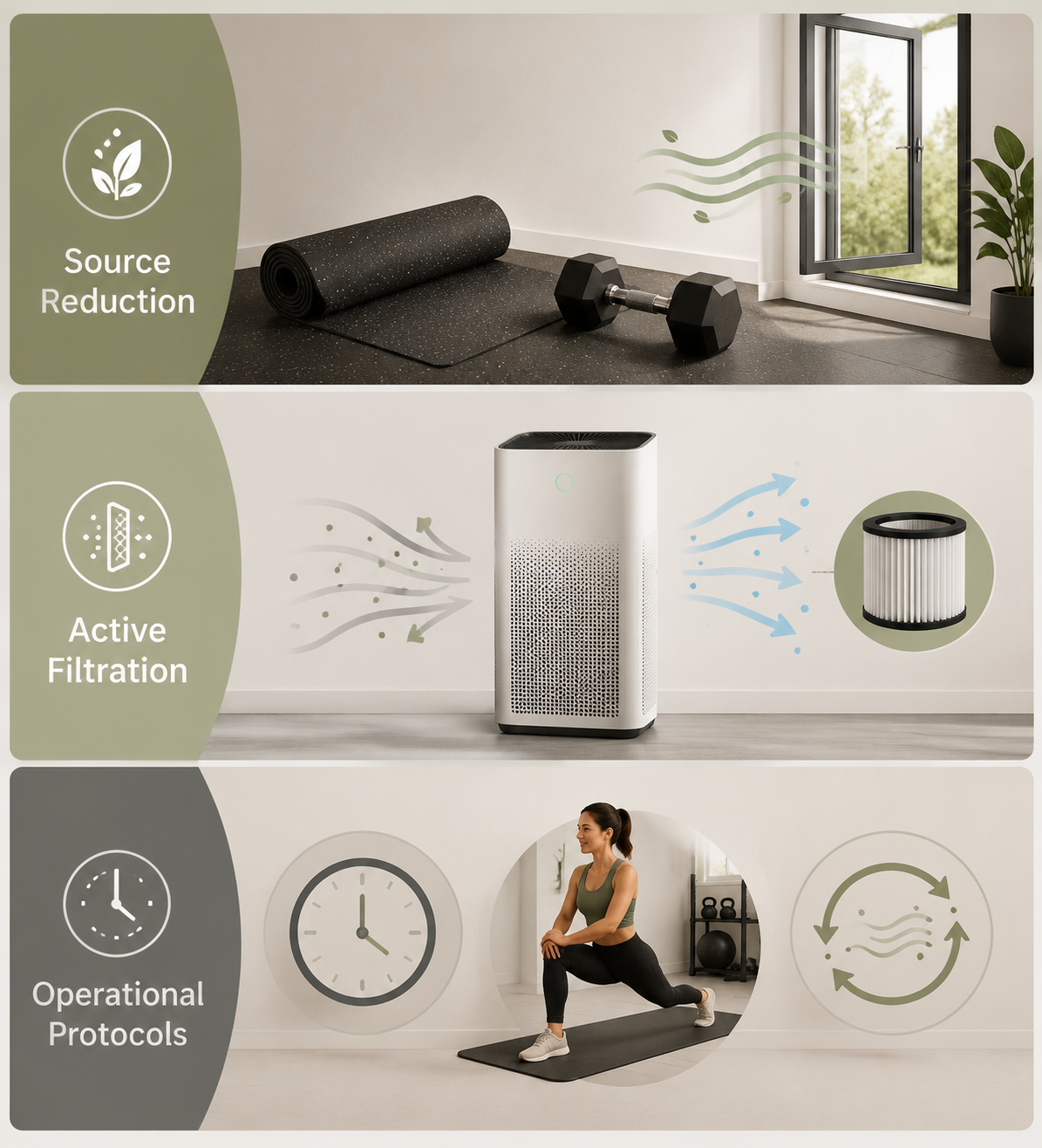
Start by lowering what the room adds
The cheapest air-quality upgrade is often the one bought before the purifier: fewer smelly, dusty, or moisture-trapping materials in the room. New rubber gym flooring can off-gas volatile organic compounds including formaldehyde, toluene, and carbon disulfide, with the heaviest release concentrated in the first week; airing mats outdoors for 3–7 days before installation can substantially reduce the indoor VOC load.[1]
That matters most in the rooms people actually use for home gyms: under a bed, beside a desk, next to the water heater, or in a garage bay that closes tight in winter. If the floor still smells strongly when you walk in, the room is not ready just because the mat is flat.
- Choose low-VOC rubber flooring when possible, and air it out before it comes inside.
- Avoid vinyl upholstery where you have a practical alternative, especially on benches or compact machines kept in closed rooms.
- Keep chalk use minimal unless the room has filtration and cleanup built into the routine.
- Skip dusty storage in the training zone; cardboard boxes, old rugs, and open shelves turn into particle reservoirs.
- Favor compact tools that do not shed much material: adjustable dumbbells, resistance bands, a washable mat, and a foam roller.
For a room that is still being laid out, solve space and air together. A tight setup can work, but only if airflow paths are not blocked by racks, bikes, bins, or a purifier shoved behind a bench. If the layout itself is still undecided, a compact plan like building a home gym in under 50 square feet should come before buying another machine.
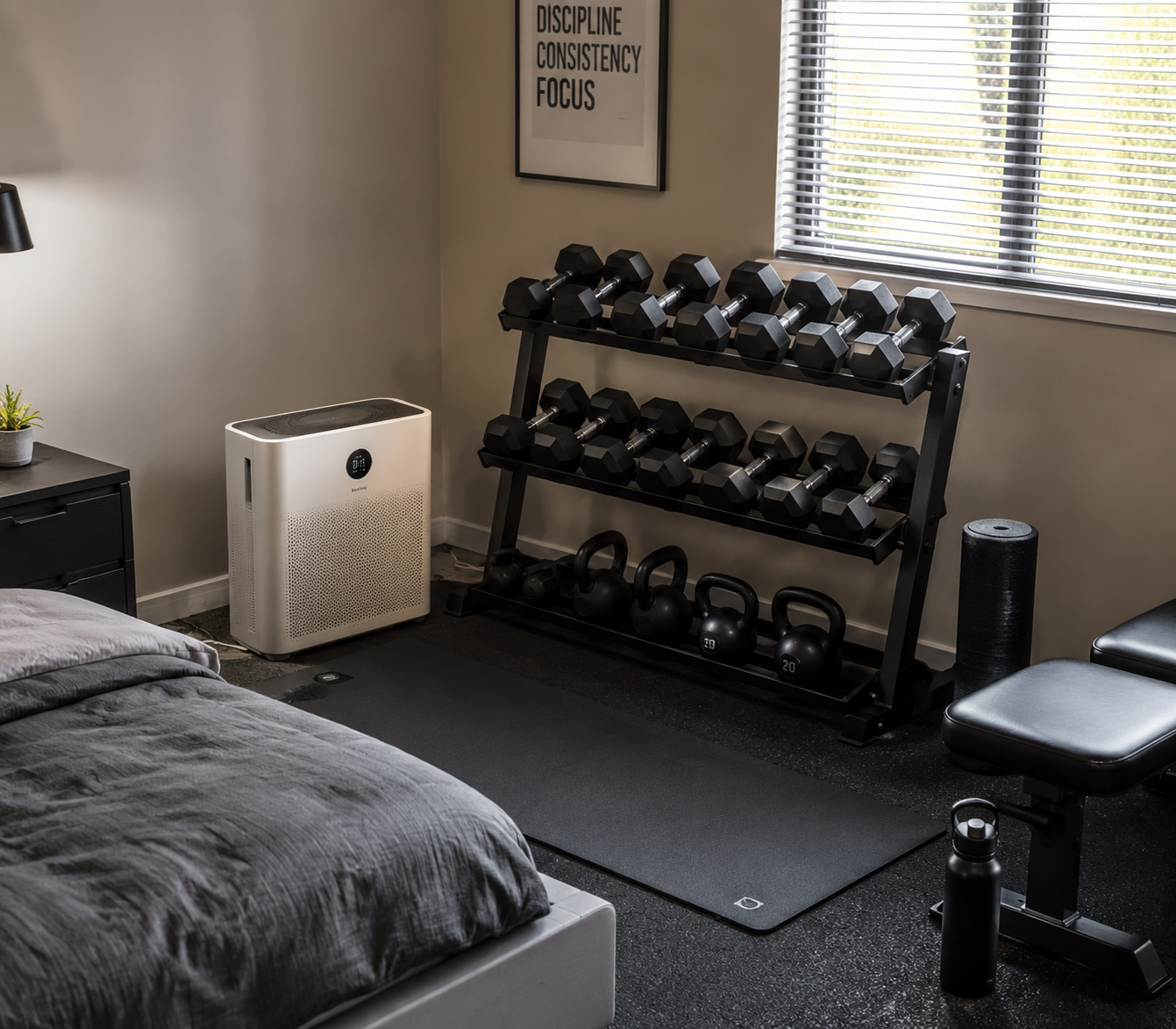
Size filtration to the room, not the marketing box
For many small home gyms, the useful purifier range is more specific than product pages make it sound. A 200–400 sq ft gym generally needs a clean air delivery rate, or CADR, of about 200–300 cubic feet per minute to reach roughly 4–5 air changes per hour.[1] That is a practical target for spare rooms and basement corners, not a guarantee that every 300-CADR unit will perform the same in every layout.
Coverage claims assume certain ceiling heights, open airflow, and placement conditions. A purifier rated for a room larger than yours can still underperform if it sits behind a rack, faces a wall, or runs on quiet mode while you are doing intervals. In a home gym, CADR is not a decorative spec. It determines whether the machine can move enough air before and during the period when breathing rate and particle disturbance rise.
| Gym size | Filtration target | What to watch |
|---|---|---|
| Under 200 sq ft | A purifier near the 200 cfm CADR range can be enough if airflow is open | Do not bury the unit behind equipment or run it only after the workout |
| 200–400 sq ft | Target about 200–300 cfm CADR for roughly 4–5 air changes per hour | Check ceiling height, room shape, and whether the purifier can run on high |
| Garage bay or open basement zone | Use the actual enclosed training volume, not the mat footprint | A half-room gym may need barriers, better placement, or a higher-CADR setup |
For wildfire smoke and ordinary fine particles, look for true HEPA filtration. True HEPA is commonly specified as 99.97% removal at 0.3 microns, and activated carbon is the add-on that matters for odors and some VOCs; one home-gym buying guide recommends at least 1–2 lb of carbon, preferably more, and avoiding ionizers or ozone generators.[2] The carbon point is where a lot of small purifiers disappoint. A thin carbon sheet may help with light odor, but it is not the same thing as a substantial carbon bed.
A purifier also does not remove carbon dioxide. One home-gym air-quality guide warns that small rooms under 300 sq ft can reach roughly 1,500–3,000 ppm during heavy training, but that range should be treated as a caution from vendor-side guidance rather than a universal exercise threshold.[2] The practical point is still solid: if a closed room feels stale during hard work, the purifier is not failing at CO2 removal. It was never built to do that.
How common purifier examples map to a small gym
Product examples are useful only when they are tied back to room size. AirQualityNest lists the Coway Airmega AP-1512HH at $229, 361 sq ft coverage, and 233 CADR; the Honeywell HPA300 at $249.99, 465 sq ft coverage, and 300 CADR; and the Winix 5510 at $179.99, 392 sq ft coverage, and 253 cfm.[1] Those specs put all three in the general band many 200–400 sq ft home gyms need, assuming the room is reasonably open and the unit can run at an effective speed.
| Example | Published spec from source | Home-gym interpretation |
|---|---|---|
| Coway Airmega AP-1512HH | $229; 361 sq ft coverage; 233 CADR | Fits the middle of the small-room target; auto mode may respond to workout particle spikes, but pre-running still matters |
| Honeywell HPA300 | $249.99; 465 sq ft coverage; 300 CADR | Higher CADR gives more margin for larger bedrooms or basement zones; mechanical controls are simple with sweaty hands |
| Winix 5510 | $179.99; 392 sq ft coverage; 253 cfm | A value-oriented option in the same practical range; placement and filter maintenance still decide performance |
The buying mistake is treating “covers 465 sq ft” as permission to ignore the room. In a bedroom gym, place the purifier where it can pull from the room and push clean air back without short-circuiting into a wall. In a garage nook, keep it away from sawdust, stored chemicals, and car exhaust residue. In a basement, do not let the unit become a de facto dehumidifier; it will not control moisture.
Use renter-friendly filtration when permanent changes are off the table
Renters and apartment dwellers usually cannot rebuild HVAC, add a dedicated return, or cut vents into doors. That does not make the room hopeless. EPA wildfire guidance includes using high-efficiency HVAC filters rated MERV 13 or higher where the system can handle them, and it also discusses DIY air cleaners such as Corsi-Rosenthal box fan filter builds as lower-cost options.[3]
A MERV 13 filter in a compatible HVAC system helps the whole apartment or house, but it does not automatically create a clean bubble around a squat rack. A portable HEPA unit inside the gym zone is still the more direct tool for a closed workout room. A Corsi-Rosenthal box can be a sensible budget bridge, especially in a garage or basement, as long as it is built safely, used with the right filters, and positioned where it will not be kicked, blocked, or exposed to moisture.
Run the room before you run the workout
The room should be in workout mode before the first warm-up set. EPA wildfire guidance recommends keeping outdoor smoke out by closing windows and doors, using recirculation settings where applicable, and using portable air cleaners; the home-gym version is to close the room, set HVAC to recirculate if available, and run the purifier for 15–20 minutes before starting, then continue during the workout and for about 30 minutes afterward.[3]
| Timing | Action | Reason |
|---|---|---|
| 15–20 minutes before training | Close windows and doors; set HVAC to recirculate if available; run purifier on high | Reduces particulates already in the room before breathing rate rises |
| During training | Keep purifier running; avoid opening windows just because the room feels warm | Prevents outdoor smoke from becoming the ventilation solution |
| After training | Keep purifier running for about 30 minutes; wipe sweat and dust from surfaces | Clears disturbed particles and reduces moisture left in the room |
| When outdoor AQI improves | Ventilate briefly if conditions permit | Helps with CO2 and stale air that filtration cannot remove |
This is also where a PM2.5 monitor earns its place. Low-cost monitors in the $50–$100 range can give objective feedback on whether the setup is keeping particulate levels below 35 µg/m³ during workouts.[2] The number is not a medical clearance, and inexpensive sensors vary, but the trend is useful. If PM2.5 rises every time the walking pad starts or every time the garage door opens, the room is telling you something specific.
Use an outdoor AQI app for the decision you cannot make from inside the room: whether opening a window helps or hurts. On a smoke day, ventilation is not automatically good. It is useful when outdoor air is cleaner than indoor air, and counterproductive when it brings the event into the gym.
Change the session when smoke is the limiting factor
A controlled room does not make every workout equally sensible. On heavy smoke days, the cleanest adjustment is usually intensity. GU Energy Labs, citing the European Lung Foundation, describes lower-intensity work as a way to reduce breathing rate from roughly 40–60 breaths per minute during hard efforts to about 20–30 during easier sessions.[4] That is not a small detail in a closed room; it changes how much air you pull through your airway during the session.
Swap HIIT, hill sprints, and all-out circuits for strength technique, mobility, zone-easy walking, or controlled bodyweight work. If you need a ready-made routine that fits bad-air indoor days, pair the room protocol with an indoor workout plan for bad air quality. If the AQI is in a range your local guidance calls hazardous, use a more conservative framework like hazardous-air-quality exercise guidance rather than trying to prove the room can handle your hardest day.
Nasal breathing can help during lower-impact exercise because the nose filters particles better than mouth breathing, according to University of Toronto exercise physiology expert Ira Jacobs.[5] That does not mean forcing nasal breathing through a maximal workout. It means choosing a session easy enough that nasal breathing is realistic: walking, light cycling, mobility, carries, tempo strength, or quiet circuits.
For lifters in apartments, bad-air days pair well with quiet strength work: controlled reps, longer rests, no chalk clouds, no dropped weights. A plan built around building muscle without making noise usually fits the air-quality protocol better than a metabolic circuit that turns the room hot and damp in ten minutes.
Do not ask the purifier to solve humidity
Basement and garage gyms have a second problem on top of smoke: moisture. Blueair and AprilAire both flag humidity control as part of home-gym air quality, with basement spaces often needing dehumidification and workout sweat adding moisture that can support mold growth.[6][7] The useful operating range to aim for is about 40–60% relative humidity.[6][7]
A dehumidifier is not a smoke filter, and a HEPA purifier is not a dehumidifier. If the room smells musty after a workout, the answer is not a bigger purifier alone. Wipe down mats and benches, let wet towels leave the room, track relative humidity with a cheap hygrometer, and run a dehumidifier where the space consistently sits damp.
Walking pads, bikes, and machines need the same air check as weights
Cardio equipment changes the room faster than most people expect. A walking pad may be quiet enough for an apartment but still stir dust from the floor, heat the space, and push you toward longer breathing exposure. If you are comparing models, noise is not the only apartment variable; setup, clearance, and airflow matter too. A guide to the quietest walking pads for apartments should be read with the purifier placement in mind.
The same caution applies to cable machines with worn parts, old foam, dusty tread belts, and storage-heavy garages. Anything that sheds, smells, or traps moisture belongs in the source-control conversation before it becomes a filtration problem.
A practical poor-AQI home-gym checklist
For a small-space home gym, the purchasing list should stay boring. The goal is not to build a lab. It is to make the room predictable enough that a bad outdoor AQI reading does not leave you guessing at 6 p.m.
- Flooring: low-VOC rubber if possible, aired outdoors for 3–7 days before installation.
- Filtration: true HEPA purifier sized around the room’s actual square footage, with roughly 200–300 cfm CADR for many 200–400 sq ft gyms.
- Gas and odor control: meaningful activated carbon, with the understanding that carbon helps with some VOCs and odors but does not solve CO2.
- HVAC support: MERV 13 or higher filter only if your system can handle it; otherwise use portable filtration or a safe DIY option.
- Monitoring: outdoor AQI app, a PM2.5 monitor if budget allows, and a hygrometer for basement or garage spaces.
- Maintenance: HEPA filter replacement about every 6–12 months and carbon replacement about every 3–6 months in gym environments, following the device’s actual filter condition and manufacturer guidance.[2]
If you are considering outdoor training with a mask instead, treat that as a separate decision rather than a failure of the indoor setup. The tradeoffs around exercising outside in wildfire smoke with an N95 are different from preparing a closed room.
The finished protocol is simple enough to repeat: keep new-material emissions and dust low, size filtration to the real room, run the purifier before and after training, moderate intensity when smoke is bad, ventilate only when outdoor air permits, and track the few measurements that tell you whether the room is behaving. Safer indoor training during poor air quality comes from that managed system, not from one heroic device in the corner.
References
- Best Air Purifiers for Home Gym (2026), AirQualityNest.
- Air Purifier for Home Gym: What to Look for When Training Indoors, Peak Primal Wellness.
- Wildfires and Indoor Air Quality (IAQ), EPA.
- The AQI Dilemma: Is It Safe to Exercise?, GU Energy Labs.
- Tips from an exercise physiologist on how to stay fit safely when air quality is poor, University of Toronto.
- Why Air Care Matters in Your Home Gym, Blueair.
- Ideas for Home Gyms: Clean Air Makes the Best Home Workout Equipment!, AprilAire.
Comments
Join the discussion with an anonymous comment.