You checked the weather app, saw an air quality alert, and now the workout has a decision attached to it. The useful question is not whether outdoor exercise is always safe or always reckless. It is what today’s AQI number means for this specific run, ride, walk, or interval session.
Use the AQI as a threshold tool. Below 100 is generally workable for most people. From 101 to 150, healthy adults can usually modify the plan, while sensitive groups should move indoors. From 151 to 200, most outdoor workouts should be canceled or replaced, and even healthy athletes are making a real trade-off. Above 200, the outdoor workout is off.
The AQI Decision Framework for Outdoor Exercise
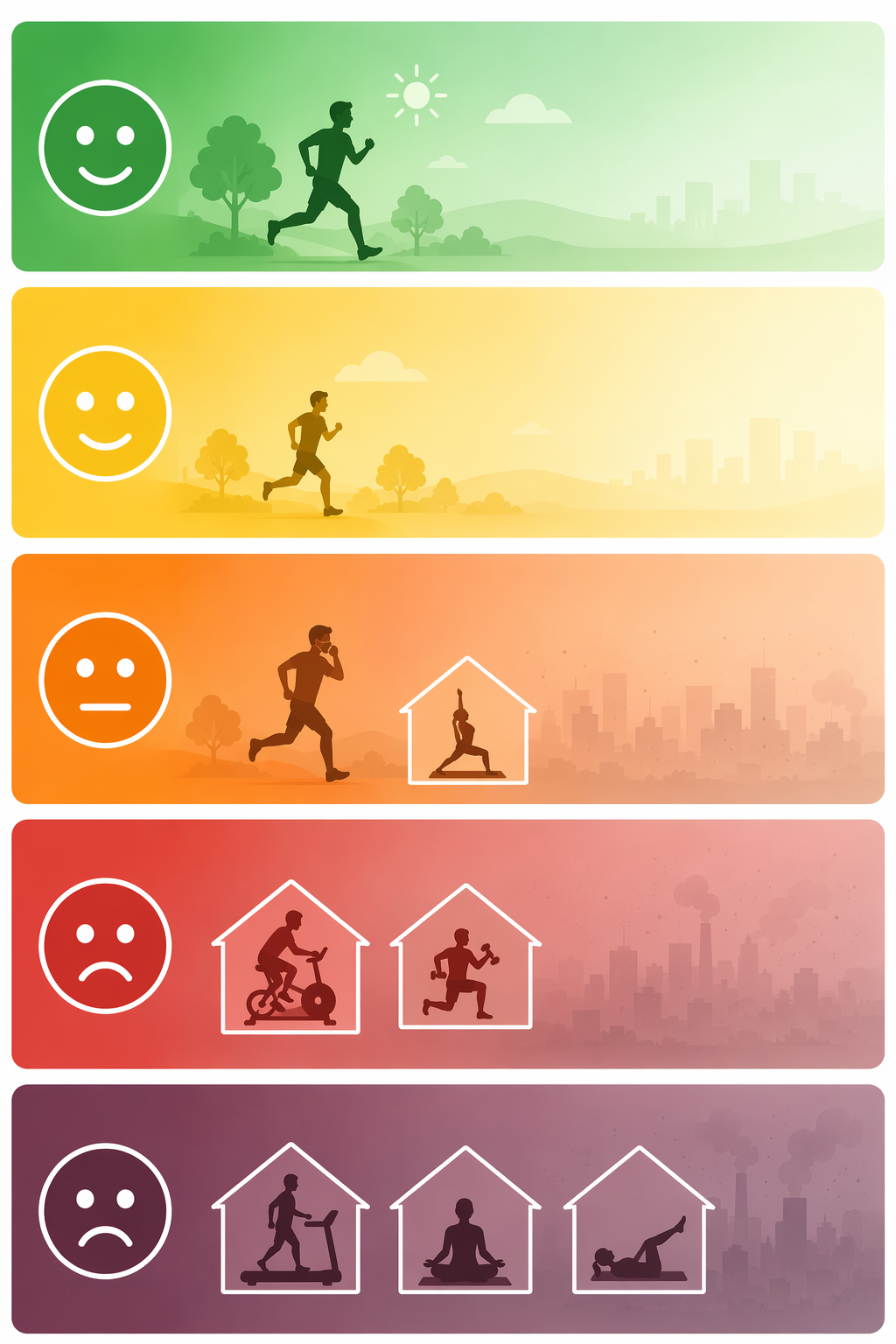
The EPA AQI scale runs from green to maroon: 0–50 is good, 51–100 is moderate, 101–150 is unhealthy for sensitive groups, 151–200 is unhealthy, 201–300 is very unhealthy, and 301–500 is hazardous.[1] Translated into training decisions, the colors are less about bravery and more about exposure management.
| AQI | EPA category | Healthy adults | Sensitive groups |
|---|---|---|---|
| 0–50 | Good | Outdoor exercise is generally fine. Train normally unless local conditions feel obviously irritating. | Usually fine, with normal medication and symptom awareness if you have a known condition. |
| 51–100 | Moderate | Outdoor exercise is usually reasonable. Consider an easier route, less traffic exposure, or a shorter session if the workout is long. | Use caution if you have asthma, COPD, cardiovascular disease, are older, or are unusually reactive to smoke or smog. |
| 101–150 | Unhealthy for sensitive groups | Judgment zone. Keep it shorter, lower the total exposure, and avoid hard efforts if the air is irritating. | Move indoors. This is the cutoff where the outdoor plan stops being worth it for most sensitive exercisers. |
| 151–200 | Unhealthy | Indoor workout is the better default. A healthy, experienced athlete who still goes out should treat it as an exception, not a routine. | Stay indoors for exercise. |
| 201–300 | Very unhealthy | No outdoor workout. | No outdoor workout. |
| 301–500 | Hazardous | No outdoor workout. | No outdoor workout. |
Sensitive groups include people with asthma, COPD, cardiovascular disease, older adults, and people who know from experience that smoke or smog triggers symptoms. The American Lung Association and Ohio State Health both emphasize that these groups need lower thresholds than healthy adults, because symptoms and cardiopulmonary strain can show up sooner.[2][3]
If your AQI is already above 150, do not turn the decision into a personality test. Swap the session. A treadmill, bike trainer, bodyweight circuit, or simple indoor cardio block keeps the routine alive without adding a dose of bad air. If you need an immediate replacement, use this bad-air outdoor workout swap, a wildfire smoke indoor workout, or the deeper hazardous air quality exercise guide.
Why a Run Is Different From Standing Outside
Air quality advice gets vague fast because pollution is invisible until it is not. The missing piece is ventilation. During moderate exercise, breathing volume can rise from about 12 liters per minute at rest to roughly 40–100 liters per minute.[4] That does not make every yellow day dangerous, but it does mean a 45-minute run is a different exposure event than drinking coffee on the porch.

Exercise also changes how air enters the body. As effort rises, many people shift toward mouth breathing. That bypasses some of the filtering, warming, and humidifying work normally done by the nose, which is one reason higher-intensity outdoor sessions deserve more caution when the AQI is elevated.[4]
This is also why duration matters. If the AQI stays the same, a longer session still increases cumulative exposure because you are moving more air through your lungs for more minutes. A slow two-hour ride on an orange day is not automatically safer than a short controlled workout just because the pace is easier.
Green and Yellow: Usually Train, but Do Not Ignore the Obvious
At AQI 0–50, most people can exercise outdoors as planned. If there is an alert in your app but the measured AQI is still green, the practical move is to check whether the forecast is expected to worsen during your session, especially if you will be out for a long run or ride.
At AQI 51–100, the answer is still usually yes for healthy adults. This is the range where common-sense adjustments are enough: choose the lower-traffic route, avoid a hard workout next to a road, shorten the optional extra miles, and pay attention if smoke smell, throat irritation, coughing, chest tightness, unusual breathlessness, or wheezing shows up.
For sensitive groups, yellow is not an automatic stop sign, but it is no longer background noise. If asthma, COPD, heart disease, age, recent respiratory illness, or repeated smoke sensitivity applies to you, this is the range where a walk may still be reasonable but a hard outdoor workout needs more scrutiny. If symptoms start, the session ends.
Orange: Healthy Adult Judgment Zone, Sensitive Group Indoor Zone
AQI 101–150 is the range that causes the most standing-around-in-running-shoes hesitation. The EPA category itself says the air is unhealthy for sensitive groups.[1] For anyone with asthma, COPD, cardiovascular disease, older adults, or people who repeatedly react to polluted air, this is the point to move the workout indoors.
For healthy adults, orange is not a universal cancellation. It is a modification zone. A normal easy run may become a shorter easy run. A workout with intervals may become steady aerobic work. A long ride may become an indoor ride plus a short outdoor errand later if conditions improve. Dr. Jeff Sankoff’s recommendations summarized by TrainingPeaks draw a similar line: sensitive groups should stop outdoor exercise once AQI rises above 100, while healthy athletes face a stricter cutoff as conditions move into the red range.[5]
- Keep the session short enough that you are not multiplying exposure just to protect a training-plan box.
- Stay below the effort where you are gasping or mouth-breathing hard for long stretches.
- Move away from traffic corridors, active smoke, dust, or visible haze when you can.
- Check the hourly trend, not just the current number; do not start a long route if the AQI is rising.
- Have an indoor version ready before you leave, so turning around does not feel like failure.
There is real uncertainty in how well broad activity guidance maps onto individual outcomes. A 2024 JAMA Network Open study questioned whether current EPA wildfire-smoke activity recommendations efficiently produce measurable population-level health benefits, partly because the estimated number needed to treat was high.[6] That does not make orange days harmless; it means the AQI table should be used as a practical risk-reduction tool, not sold as a precise shield for every person.
Red and Above: Stop Negotiating With the Number
At AQI 151–200, the category is unhealthy.[1] For sensitive groups, the decision was already made at orange. For most healthy adults, red should mean an indoor workout. A highly trained, healthy athlete may decide that a very short, low-exposure outdoor session is acceptable in an unusual circumstance, but that is no longer general advice.
At AQI 201 and above, the outdoor workout is not worth defending. Very unhealthy and hazardous air quality is not the place for a tempo run, hill repeats, a long ride, or a boot-camp circuit. Move inside, reduce the intensity if indoor air is also questionable, and keep the streak alive without pretending the lungs are separate from the workout.
If the bad air is expected to last several days, treat it like a temporary training block rather than a daily argument. A 7-day bodyweight plan for wildfire smoke days can preserve structure, and beginners or sensitive-group readers can use a no-equipment Zone 2 indoor routine instead of forcing intensity indoors.
How to Modify an Outdoor Workout When the AQI Is Still Workable
When the AQI is below 100, or when a healthy adult chooses a modified orange-zone session, the useful levers are intensity, duration, timing, and location. They do not all matter equally on every day.
Shorter Is Often the Cleanest Adjustment
Cutting duration is the simplest exposure reduction because it changes total time breathing polluted air. If the plan says 60 minutes and the AQI is orange, a 25- or 30-minute easy session is usually a more defensible compromise than doing the full route and simply promising to go slow.
Lower Intensity Helps, but It Is Not the Whole Math
Lower intensity usually reduces breathing volume and mouth breathing, which is why turning intervals into easy aerobic work makes sense. But duration can complicate the instinct to always go easier for longer. Public Health Institute experts, discussing wildfire-smoke conditions, noted that a short 20- to 30-minute high-intensity workout may result in less cumulative pollution exposure than a longer moderate session at the same AQI.[7]
That is not permission to do HIIT in bad smoke. It is a reminder to compare the whole exposure, not just the pace label. On an orange day, the better move for most people is short and controlled, not long and virtuous. On a red day, move indoors.
Timing and Route Can Change the Dose
Check the hourly forecast if your app provides it. Wildfire smoke, ozone, traffic pollution, and dust do not all behave the same way, so there is no universal best hour. The practical rule is to train when the measured and forecast AQI are lower, not when your calendar is most attached to the old plan.
Route choice matters most when pollution sources are uneven. If you can avoid busy roads, industrial corridors, visible dust, or low-lying smoke pockets without turning the workout into a much longer outing, do it. If the cleaner route adds a lot of time, the exposure trade-off may disappear.
Use Effort Caps Before Symptoms Force the Issue
A heart-rate cap or perceived-effort cap can keep an easy day easy when the air is borderline. If you already train with a watch, this is a good day to use it plainly: no chasing segments, no surprise progression run, no turning an easy ride into a threshold workout because the legs feel fine. If you need help interpreting recovery and heart-rate signals, use this heart rate tracker guide.
Indoor Does Not Have to Mean Doing Nothing
Air quality interruptions are not rare edge cases. In the ACSM American Fitness Index, the 100 largest U.S. cities averaged only 62% of the year with “good” air quality.[8] If outdoor training is part of your routine, bad-air pivots are part of the routine too.
The indoor fallback should match the reason you came inside. If the AQI is orange and you are in a sensitive group, choose low intensity. If the AQI is red or worse, keep the session productive without trying to recreate the hardest outdoor workout in a stuffy room. Poor indoor air can also be a problem when outdoor air has infiltrated the building, so indoor exercise is not automatically clean-air exercise in every home or gym.[9]
For small spaces, the constraint-based home cardio system is a useful way to stop treating indoor training as a consolation prize. On hazardous days, the job is simpler: stay out of the bad air, keep the body moving if your indoor environment allows it, and wait for the AQI to come back under the line.
References
- Air Quality Index (AQI) Basics, AirNow, U.S. Environmental Protection Agency
- Four Things to Know About Air Quality and Exercise, American Lung Association
- Should We Still Exercise Outdoors on Bad Air Days?, Ohio State Health
- Air Quality and Outdoor Exercise, American College of Sports Medicine
- High AQI: Is It Safe to Exercise Outside?, TrainingPeaks
- Evaluation of the US Environmental Protection Agency Air Quality Index Activity Guidelines for Wildfire Smoke, JAMA Network Open, 2024
- Experts Offer Advice on Working Out During Wildfire Smoke Events, Public Health Institute
- American Fitness Index, American College of Sports Medicine
- Tips From an Exercise Physiologist on How to Stay Fit Safely When Air Quality Is Poor, University of Toronto
Comments
Join the discussion with an anonymous comment.