
The first high temperature workout safety tip for a home gym is not about willpower, electrolytes, or buying a bigger fan. It is to stop trusting the weather app as a description of the room you are about to train in. A closed garage can run 15–20°F hotter than the outdoor temperature, and that is before accounting for a sun-facing door, a concrete slab that has been storing heat all afternoon, or a small room with no path for air to leave.[1][2]
That difference changes the decision. A 90°F day is not just a 90°F workout if the barbell is sitting in a sealed garage that feels closer to a storage unit than a training space. The fan aimed at your face may make the first set tolerable while the room itself keeps getting worse: warm air recirculates, sweat stops evaporating well, grip gets slick, rest periods stop feeling restorative, and a normal hard session starts producing symptoms you would not accept from a client, teammate, or training partner.

Make the Room Safer Before You Decide the Workout
A hot home gym is a small building problem before it is a programming problem. If the room has no AC, the goal is not to make it feel perfect. The goal is to create enough air movement, humidity control, and time-of-day advantage that your body is not doing all the cooling work by itself.
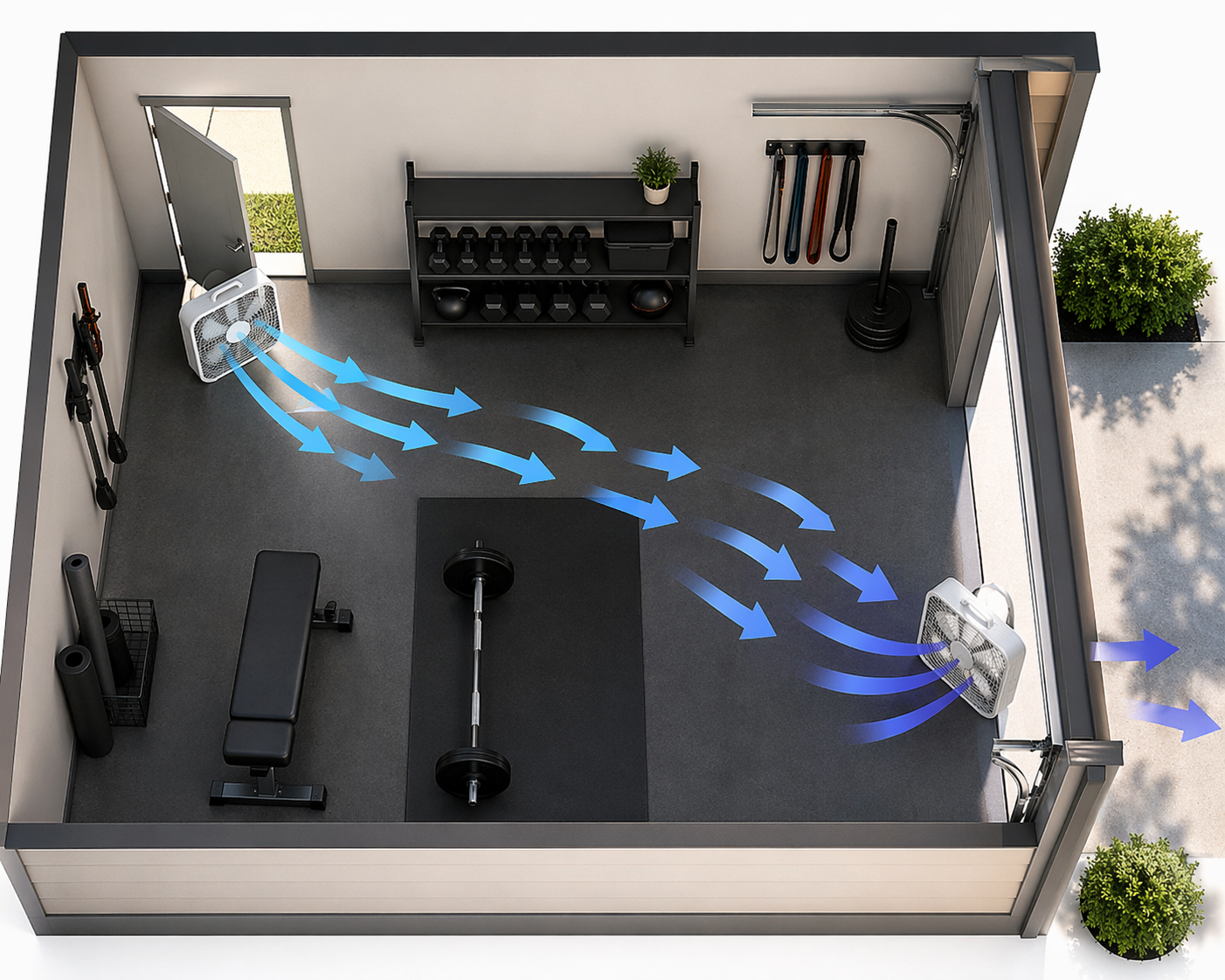
Start with airflow that has a direction. One fan blowing at you is comfort; cross-ventilation is room management. Open two points if you have them: garage door and side door, door and window, window and hallway. Put one fan low or near the cooler opening to pull air in, and place another fan across the room facing outward to push hot air out. If there is only one opening, set the fan to exhaust hot air for a few minutes before training, then reposition it so fresh air can move across your body during the session.
Humidity deserves its own check because sweat only cools you when it evaporates. A room can be merely hot in dry air and much more punishing when the air is damp. A dehumidifier will not necessarily lower the temperature reading, but it can make sweating work better. In a basement, spare room, or garage where the air feels heavy before you even warm up, running a dehumidifier ahead of training may matter more than adding another fan that only moves saturated air around.[1]
Time of day is the cheapest cooling tool. Afternoon garage sessions are different because the door, roof, walls, and slab may already be loaded with heat. Morning workouts, late-evening sessions after ventilation, or split sessions can reduce the thermal load without changing a single exercise. If you have to train after work, open the space early, exhaust the trapped air, and give the room time to change before you start loading plates.
- Open the space before the warm-up, not during the first working set.
- Use two fans when possible: one intake, one exhaust.
- Check humidity, not just temperature.
- Avoid afternoon garage sessions when the structure has been heating for hours.
- Cool the room first; then decide whether the planned workout still makes sense.
Use Heat Index as a Starting Line, Not a Permission Slip
Heat index combines air temperature and humidity to estimate how hot conditions feel to the body. It is more useful than temperature alone because humidity interferes with evaporative cooling. For example, 90°F with 60% humidity produces a feels-like temperature of 100°F, which falls in the “extreme caution” range used in heat-index guidance.[3]
| Heat index range | Outdoor guidance tier | How to adapt it for a hot home gym |
|---|---|---|
| 80–89°F | Caution | Train, but use longer rests and watch whether the room is warming during the session.[3] |
| 90–103°F | Extreme caution | Reduce intensity, shorten the workout, avoid HIIT, and be conservative if the indoor space is hotter than outdoors.[3] |
| 103–124°F | Danger | Do not treat a normal workout as reasonable; move, postpone, or make the session very light and brief.[3] |
| 125°F+ | Extreme danger | Cancel the workout in an unconditioned space.[3] |
The caveat is important: these tiers were not built specifically for your garage, spare room, or apartment corner. A shaded outdoor heat index can understate the risk inside a room with radiant surfaces, poor airflow, or direct sun. If the garage is hotter than outdoors, judge the workout by the room, not the official number.
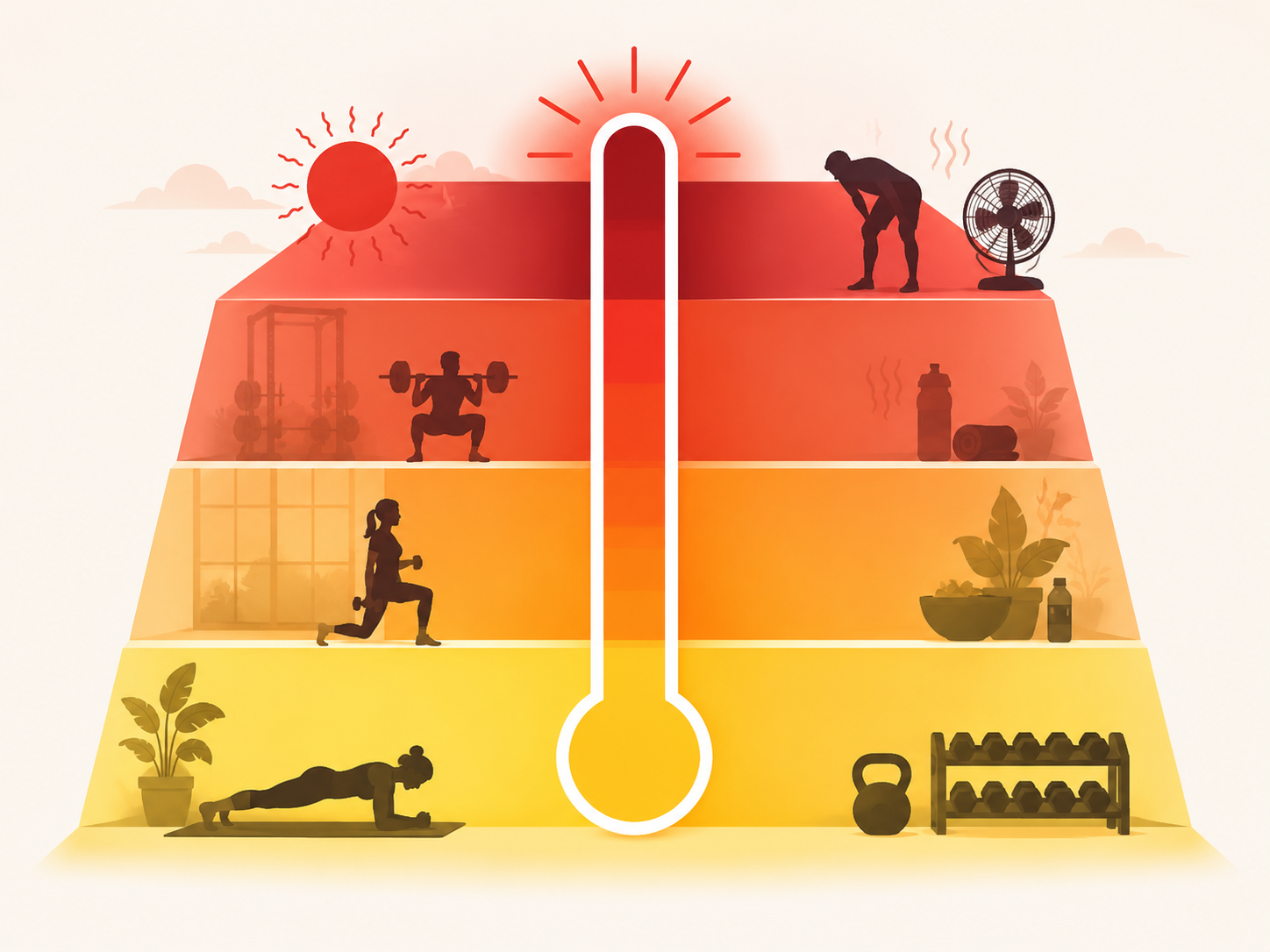
A simple pre-workout rule works better than a vague promise to be careful: if the room is still getting hotter, if the air is not moving, or if the heat index is already in the extreme-caution range, the planned workout has to change before it starts. That may mean fewer sets, lower load, a shorter clock, or a different modality entirely.
Hydrate on a Schedule, Not When the Set Is Already Going Bad
Thirst is a late and imprecise cue when you are training alone in a hot room. Mass General Brigham recommends drinking 17–20 ounces of water 2–3 hours before exercise, then 4–8 ounces every 15–20 minutes during exercise.[4] That does not mean forcing water past comfort or ignoring medical restrictions; it means the bottle is part of the session plan, not a rescue tool after your heart rate has been high for too long.
For a 45-minute strength session, that might look like drinking before you enter the garage, taking a few ounces between blocks, and leaving the room to cool down if your stomach turns, your head feels light, or your rest periods stop bringing your breathing down. For longer sessions or heavy sweating, plain water may not be enough for everyone, but the available guidance supports a baseline hydration range rather than a universal electrolyte formula.
Change the Workout Before Heat Changes It for You
Heat makes familiar work feel harder. Mass General Brigham notes that perceived exertion rises faster in hot conditions, which is why rigid pace, load, or round targets can become the wrong anchor.[4] The better anchor is effort: if a normal RPE 7 set feels like an RPE 9 because the room is hot, treat it as an RPE 9. The bar does not get credit for what you intended to lift.
The most useful changes are boring and effective: extend rest intervals, reduce load, cut total volume, swap HIIT for steady-state work, or split one longer session into two shorter sessions. BBC Future’s 2026 reporting and Mayo Clinic guidance both point toward these kinds of adjustments in hot-weather exercise rather than trying to preserve the original session at all costs.[5][6]
| If the plan was | Use this hot-room version | Why it helps |
|---|---|---|
| Heavy lower-body strength | Keep the main lift, reduce load or sets, and extend rest | Large compound lifts drive heat and heart rate quickly. |
| HIIT intervals | Replace with steady-state cycling, walking, mobility, or easy circuits | Less repeated heart-rate spiking gives cooling time. |
| 45–60 minutes straight | Split into two shorter sessions or stop after the priority work | Total heat exposure drops. |
| Dense supersets | Separate exercises and sit or stand in airflow during rest | Rest becomes actual cooling instead of just waiting. |
| Failure sets | Leave more reps in reserve | Straining in heat gives less margin if symptoms appear. |
This is also where small-space substitutions matter. In an apartment or spare room, low-impact strength circuits, controlled tempo work, and mobility blocks can keep training consistent without turning the room into a sweat box. If jumping, sprint intervals, or dense complexes make heat buildup unmanageable, the correct modification is not a louder fan; it is a quieter, lower-heat session.
Treat Cramps as a Stop Signal, Not a Badge
Muscle cramps during hot workouts are easy to misread because they resemble hard training discomfort. The CDC describes painful muscle cramps during exercise, especially in the legs, arms, or abdomen, as a possible first sign of heat-related illness.[7] In a solo home gym, that should trigger a change immediately: stop exercising, move to a cooler place, drink water, and cool the body.
Do not negotiate with a cramp in a hot garage the way you might negotiate with ordinary fatigue. The problem is not that the set got hard. The problem is that your cooling system may already be losing ground, and no coach is watching your face, coordination, or decision-making for you.
The Solo-Trainer Stop Rules
Training alone changes the threshold for stopping because there is no one else to notice confusion, stumbling, or a blank look between sets. Mayo Clinic cautions exercisers to watch for heat-related symptoms including muscle cramps, nausea or vomiting, weakness, fatigue, headache, excessive sweating, dizziness, confusion, irritability, low blood pressure, increased heart rate, and visual problems.[6] NPR’s heat-workout guidance also emphasizes the risk of exercising alone when symptoms can escalate without another person recognizing them.[8]
- Stop the workout if you feel dizzy, faint, confused, unusually weak, nauseated, or chilled despite the heat.
- Stop if cramps appear in hot conditions, especially if they return after rest.
- Stop if your skin is hot and dry, or if sweating changes in a way that feels wrong for the effort.
- Stop if your heart rate or breathing stays unusually elevated during rest.
- Get out of the hot room first; do not sit in the same heat and hope the next set feels better.
The emergency plan should be set before the workout starts. Keep a charged phone nearby. Tell someone if you are doing a hard session in a hot room. Leave the door unlocked if that is safe in your setting. Know where you will move to cool down. If symptoms suggest heatstroke, such as confusion, fainting, or hot skin with altered sweating, treat it as an emergency rather than a failed workout.
Use Lower Thresholds if Heat Hits You Harder
Some exercisers should not use the same decision points as a healthy, heat-acclimated person in their twenties. The American Heart Association notes that older adults, people with chronic conditions, and people taking medications such as beta blockers, ACE inhibitors, or diuretics may have more difficulty regulating heat and should take extra precautions in warm weather.[9]
In practice, that means moving the cutoff earlier. If the heat index is approaching extreme caution, choose an easier session or a cooler time. If the room cannot be ventilated, postpone. If medication changes your heart-rate response, do not use heart rate alone to judge safety. RPE, symptoms, room conditions, and recovery between sets all matter more than completing the written plan.
A Practical Start, Continue, Stop Check
A hot home gym is not automatically off-limits. It becomes unreasonable when too many protections are missing at once: sealed room, humid air, afternoon heat, hard intervals, no hydration plan, no symptom threshold, and nobody aware you are training. Stack the protections before you stack the plates.
| Decision | Safe-enough condition |
|---|---|
| Start | The room has airflow, humidity is manageable, hydration has started, and the workout has already been adjusted for heat. |
| Continue | RPE is under control, rest periods restore breathing, sweating feels normal, and no cramps, dizziness, nausea, or confusion appear. |
| Shorten | The room is warming, effort is rising faster than usual, grip or coordination is slipping, or the planned volume no longer fits the conditions. |
| Stop | Cramps, dizziness, nausea, confusion, unusual weakness, hot/dry skin, or symptoms that do not improve after cooling begin. |
| Cancel | The room cannot be ventilated, the heat index is in a dangerous range, or your personal risk factors call for a lower threshold. |
The disciplined choice is not always finishing. In a no-AC home gym, the safe workout is the one you are willing to change while you still feel capable of making a good decision.
References
- Garage Gym Cooling: Summer Workout Tips, RitFit.
- Tips for Garage Gyms in Extreme Hot or Cold Weather, Fringe Sport.
- Is It Too Hot to Exercise? Use the Heat Index, Verywell Fit.
- Prevent Overheating During Workouts, Mass General Brigham.
- How to keep exercising when it's really hot, BBC Future, June 18, 2026.
- Mayo Q and A: Hot weather exercise, Mayo Clinic.
- Heat and Athletes, CDC.
- How To Heat-Proof Your Summer Workout, NPR, July 19, 2021.
- How to stay active in warm weather, American Heart Association.
Comments
Join the discussion with an anonymous comment.