
A home gym under 50 square feet usually starts as a negotiation with the room: a 6-by-8-ish corner, the end of a bedroom, a closet wall, or the strip of floor that also has to let a desk chair roll out. In that amount of space, the question is not how much equipment can be squeezed in. It is how much training space is still usable after the equipment is stored.
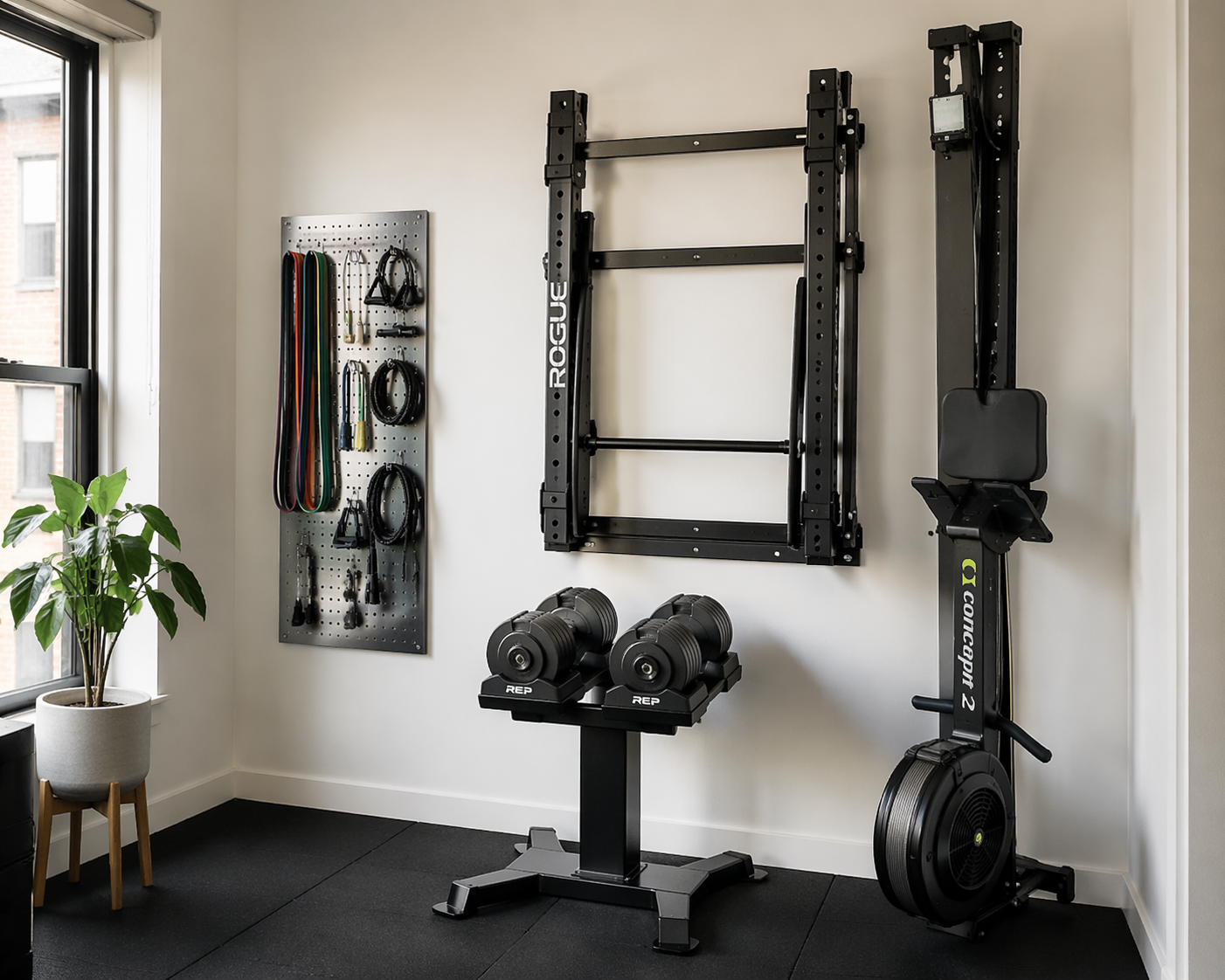
That changes the shopping list. The best small setup is not a miniature version of a garage gym. It is an edited kit: adjustable dumbbells instead of a fixed rack of weights, a foldable or wall-mounted rack instead of a freestanding cage, cardio that stores vertically, bands that disappear into a hook, storage that gets accessories off the floor, and flooring that protects the room without making it impossible to live in.
Start With the Clear Floor, Not the Equipment
Before buying anything, tape out the actual training zone. Do not measure wall to wall. Measure what remains after the closet door swings, the bed drawer opens, the office chair rolls back, and the rower or bench has somewhere to stand when it is not being used.
For compact barbell lifting, one small-space guide gives 8 ft by 7 ft, or 244 cm by 215 cm, as a workable clear zone with a full-length barbell, while recommending 9 ft or more of width for safer plate-loading clearance.[2] That is useful guidance, but it is not a universal rule for every small gym. Dumbbell training, bands, bodyweight work, and a folding bench can operate in less space. Olympic lifting, wide plate changes, and dynamic barbell work need more.
A practical under-50-square-foot layout should preserve one open rectangle for training and push everything else to the wall, upright, under a bench, or onto hooks. If a product permanently occupies that rectangle, it has to justify itself every day.
| Zone | What It Does | Small-Space Rule |
|---|---|---|
| Clear floor | Lifting, rowing setup, mobility, bodyweight work | Keep this open whenever gear is stored |
| Wall | Rack, pegboard, bands, handles, jump rope | Use vertical storage before buying freestanding storage |
| Corner | Upright cardio or folded bench | Store tall items where they do not block doors |
| Floor protection | Noise reduction, surface protection, stable lifting base | Cover the work zone, not necessarily the whole room |
Buy Adjustable Dumbbells First; Skip the Fixed Set
Fixed dumbbells are satisfying until the third pair has to live beside the laundry hamper. In a small apartment or condo, the storage problem arrives long before the strength problem does.
A pair of adjustable dumbbells is the cleanest first purchase because it replaces a whole rack of fixed weights without claiming a wall. Garage Gym Reviews lists the REP QuickDraw adjustable dumbbells at 5 to 60 lb, priced at $336, and notes that they replace up to 12 pairs of fixed dumbbells while occupying roughly a shoebox-sized footprint.[1] That is the kind of trade that actually matters in a room under 50 square feet: one object, many load options, no dumbbell tree.
Pair them with a compact adjustable bench only if the bench folds or stores upright. A non-folding flat bench can be workable in a garage, but in a bedroom corner it becomes furniture with no secondary purpose. If you are choosing between heavier dumbbells and a bench that will always sit in the walkway, buy the dumbbells first and add the bench only when you know where it will live between sessions.
The skip is simple: do not buy a 5-to-50 lb fixed dumbbell run for an under-50-square-foot room unless you have a dedicated closet or alcove for it. The money may be defensible. The footprint usually is not.
Once the dumbbells and bench are in place, a plan like an 8-week adjustable dumbbell and bench program is a better next step than adding more equipment immediately. Small gyms get crowded fastest when purchases outrun programming.
Use a Folding Rack Only If the Wall Can Truly Spare It
A rack is the hardest strength purchase in a tiny gym because it can either expand training dramatically or consume the whole room. Squats, presses, pull-ups, and barbell work become possible, but only if the rack gets out of the way afterward.
This is where wall-mounted and foldable racks earn their keep. Garage Gym Reviews cites the PRx Profile PRO at a 12-inch depth when folded, priced at $1,100, and notes that wall storage can free more than 5 square feet compared with a freestanding rack.[1] Five square feet is not a rounding error in a 48-square-foot corner. It can be the difference between being able to row, lunge, or open a closet door.
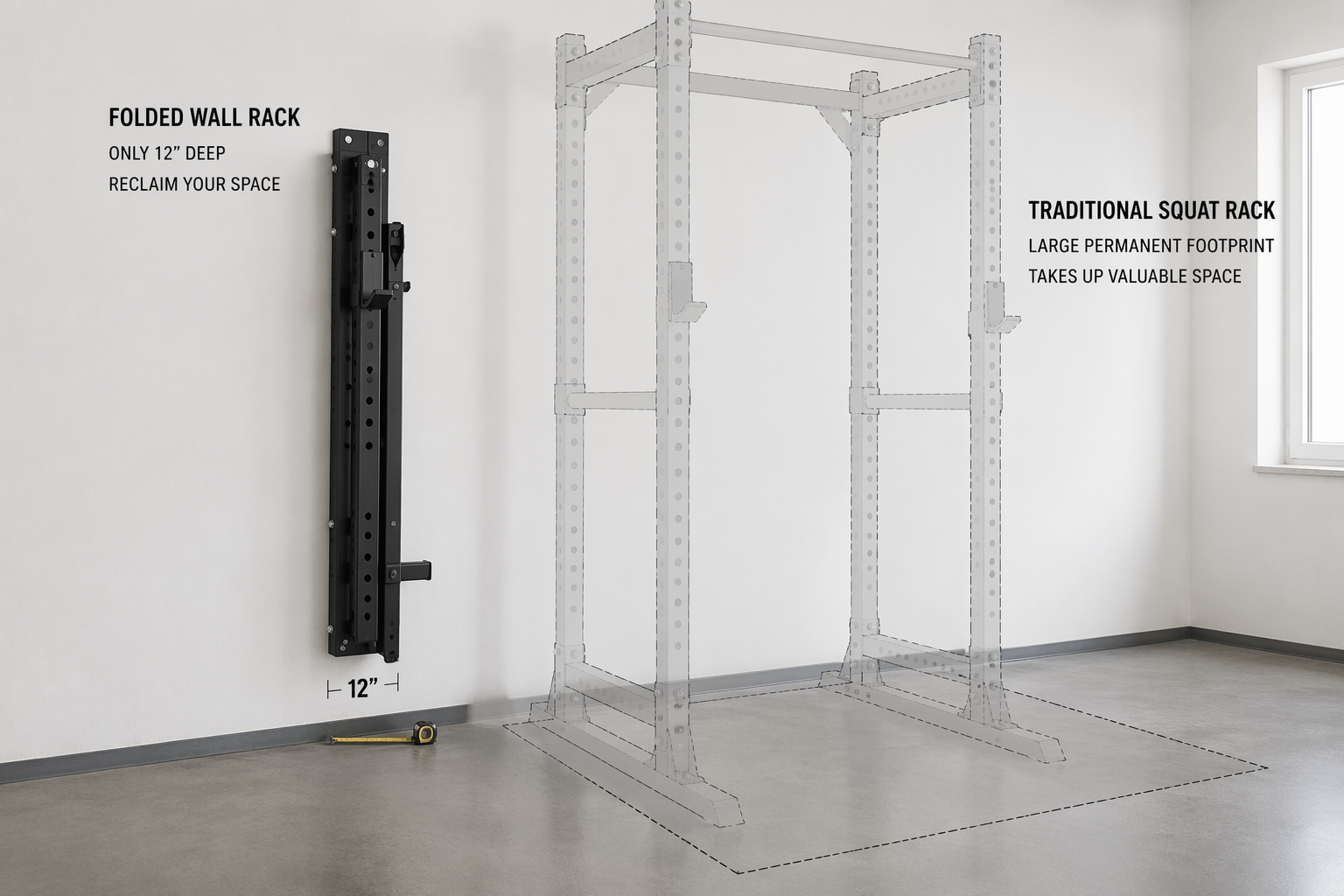
The catch is that a wall-mounted rack is not automatically renter-friendly. It usually needs secure anchoring, appropriate studs or stringers, and permission if you do not own the wall. In a lease-controlled apartment, a heavy rack may be a worse idea than a dumbbell-and-bench setup with bands. For lease limits, shared-wall noise, and downstairs-neighbor problems, use an apartment-specific guide before committing to holes in the wall.
The rack skip list is sharper in small spaces. Avoid all-in-one Smith machines that lock one large footprint into the room. Avoid cheap light-gauge racks if they are likely to become an upgrade problem within a year or two. Avoid a freestanding cage unless you can leave the training zone open around it and still move normally through the room.
If you want a full system but are still comparing price tiers, the compact home gym systems guide is a better place to compare packaged setups. For an under-50-square-foot room, the deciding question is more basic: can the rack disappear enough that the room still works?
Choose Cardio That Stores Upright
A traditional treadmill is often the first cardio idea and the first thing to cut. Many treadmills fold upward, but they still occupy a large parked footprint and can dominate a narrow room. They also create noise and vibration issues that matter more in apartments than in garages.
A rower is usually easier to justify when it stores vertically. Again Faster Europe lists the Concept2 RowErg at $990 and 57 lb, with a 22-inch by 53-inch footprint when flat and a much smaller footprint when stored upright.[2] It still needs floor length while in use, so it is not magic. But once the session is over, it can stand out of the training rectangle instead of owning it all day.
If rowing is not the right fit, look for the same storage behavior in other cardio: vertical storage, rolling transport, short setup time, and no permanent claim on the floor. A jump rope may work for some houses and be impossible in others. A compact bike may be quiet but less stowable. The best choice is the one that can be put away without turning the room into an obstacle course.
For quieter and more stowable apartment options, the companion guide to home exercise equipment for small spaces is worth checking before buying the largest machine that technically fits.
Bands Are Not a Consolation Prize
Resistance bands belong in a small gym because they solve three problems at once: they add pulling angles, they travel between rooms, and they store on a hook. Garage Gym Reviews lists the Living.Fit resistance band set at $129 with a lifetime warranty and a 6-to-250 lb resistance range.[1] No other strength tool gives that much resistance variation for so little storage volume.
They are especially useful when a rack is not possible. Rows, pulldown variations, face pulls, assisted movements, warm-ups, and high-rep accessory work can all happen without adding a cable tower. They also make an adjustable dumbbell setup feel less narrow, because the room gains more pulling options without gaining another machine.
The practical limit is anchoring. Door anchors, rack attachments, and wall anchors each have different safety and lease implications. Do not improvise with fragile trim or a questionable hook just because the band itself is light. Stored bands take almost no space; loaded bands still need a secure path of resistance.
Put Accessories on the Wall Before Buying More Storage
Small gyms often fail in the margins. The dumbbells fit. The bench fits. The rower fits. Then the handles, collars, bands, jump rope, gloves, yoga strap, and charger pile up in a bin that has to be moved every workout.
Wall storage fixes that without taking the clear floor. A galvanized steel Wall Control pegboard mounted to studs is listed at $37 and rated to hold 200 lb of accessories, a meaningful upgrade from standard masonite pegboard that can sag under gym gear.[3] The important word is accessories. This is where bands, collars, handles, jump ropes, and small attachments belong, not heavy plates or anything that exceeds the mounting system.
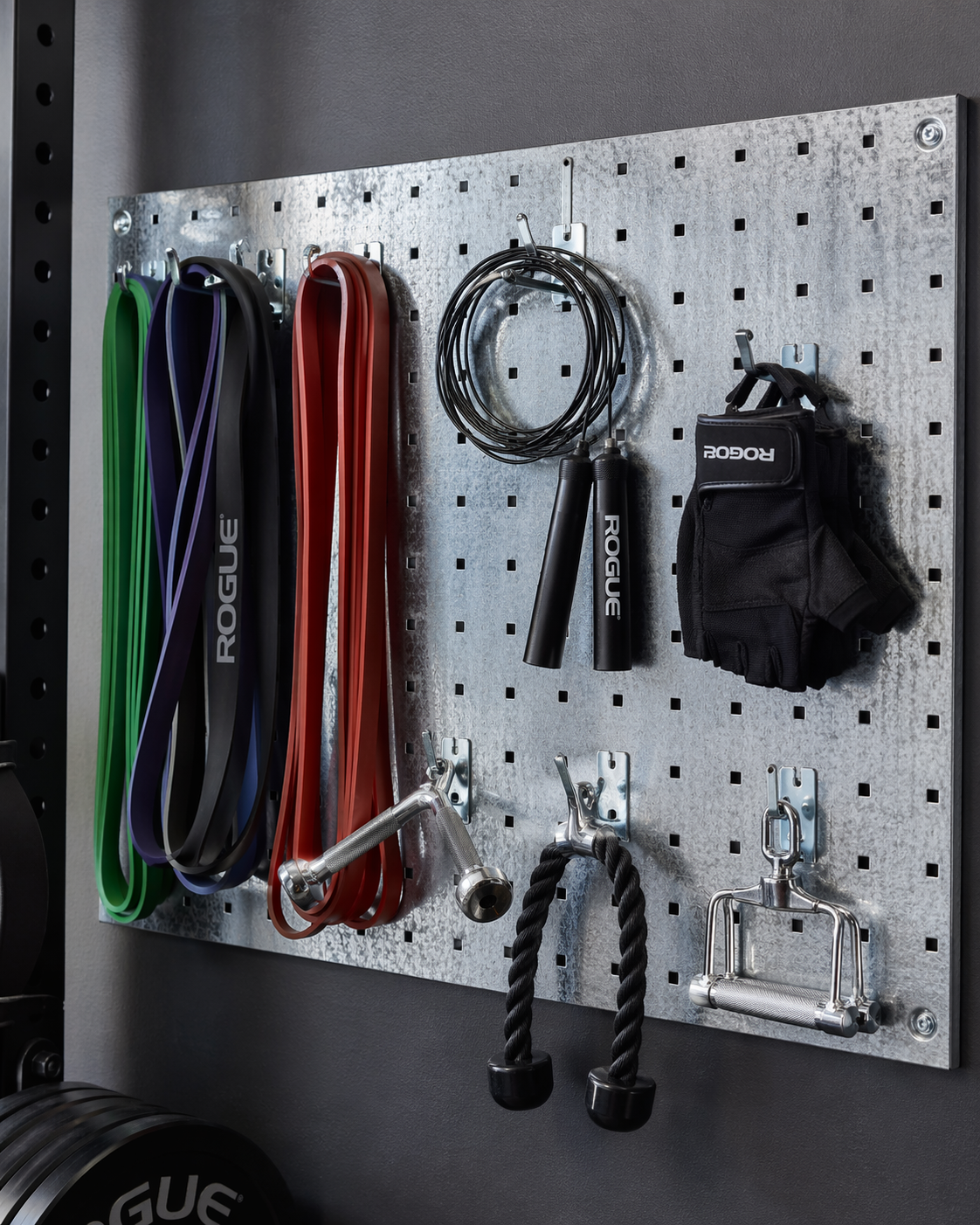
A pegboard also changes behavior. When each item has a visible place, setup time drops and cleanup stops depending on willpower. That matters in a shared room, where leaving equipment out can turn one person’s training plan into everyone else’s clutter.
- Mount storage into studs or an appropriate backing board, not just drywall.
- Keep frequently used items between waist and eye level so setup is quick.
- Store bands without sharp bends, pinched loops, or contact with rough hardware.
- Leave floor bins for soft items only if they can slide fully under a bench or shelf.
Flooring Is Part of the Layout, Not Decoration
In a small home gym, flooring is not just about protecting the floor from a dropped weight. It defines the workout zone. It also affects noise, traction, cleaning, and whether the setup feels temporary enough to fold away or permanent enough to annoy everyone else in the room.
Horse stall mats are a common high-value choice because they are dense, durable, and relatively inexpensive. REP Fitness’ small-space guidance points to Tractor Supply horse stall mats at about $50 for a 4-by-6 ft sheet, making them one of the highest-return purchases under $100 for floor protection.[4] One sheet can anchor a dumbbell-and-bench zone; two can define a larger corner.
They are not perfect for every apartment. They are heavy, can have a rubber smell, and may be awkward to transport or trim. Foam tiles are easier to move but less stable under heavy loads. Rolled rubber can look cleaner but may cost more. The right flooring depends on whether the priority is impact protection, noise control, portability, or easy removal at move-out.
For material-by-material tradeoffs, use the rubber, foam, and stall mat comparison. Renters should also check the apartment home gym flooring guide before assuming a dense mat solves every lease and noise problem.
A Compact Kit That Fits Under 50 Square Feet
A realistic small-space setup does not have to be bought all at once. The full-size “average home gym cost” figure sometimes cited by Garage Gym Reviews is $2,837, but that describes a broader foundational setup, not a requirement for a compact corner.[1] For an under-50-square-foot gym, a more useful planning range is roughly $500 to $1,500 depending on whether you add a rack, premium cardio, or both.
| Priority | Buy | Skip | Why It Wins Under 50 Sq Ft |
|---|---|---|---|
| Strength base | Adjustable dumbbells | Fixed dumbbell set | One compact pair replaces many fixed pairs |
| Pressing and rows | Folding or upright-storing bench | Non-folding bench | The bench leaves the floor when training ends |
| Barbell option | Foldable or wall-mounted rack | Freestanding cage or bulky Smith machine | The clear zone returns between workouts |
| Cardio | Upright-storing rower or compact cardio | Large treadmill that cannot store vertically | Cardio does not permanently claim the room |
| Accessory resistance | Bands with safe anchoring | Cable tower in a tiny room | More angles without another footprint |
| Storage | Stud-mounted steel pegboard | Loose bins on the floor | Accessories stop migrating into the workout zone |
| Flooring | Dense rubber over the work area | Bare floor or unstable foam under heavy loads | The training zone is protected and clearly defined |
If the budget is tight, the first phase should be adjustable dumbbells, bands, a mat, and a storage plan. The second phase can add a folding bench. The third can add upright-storing cardio or a folding rack, depending on what kind of training you will actually do. A staged purchase sequence prevents the classic small-gym mistake: buying the most exciting object first and then discovering it blocks the only open floor.
For a more deliberate build order, the phased home exercise equipment guide can help separate immediate purchases from later upgrades.
Arrange It So the Room Still Has a Second Life
A workable 6-by-8 ft corner might use one wall for the folding rack or pegboard, one corner for an upright rower, and the center rectangle for lifting. The bench folds or stands after use. Dumbbells sit on a compact stand or under the bench. Bands, collars, and handles live on the wall. Flooring marks the workout zone without turning the whole room into a gym.
A closet setup has different rules. It may not support barbell work at all, but it can hold adjustable dumbbells, bands, a folded bench, and a rolled or stacked mat. The workout then happens just outside the closet, with gear pulled out and returned after use. That is still a legitimate home gym if setup takes minutes instead of becoming a weekly excavation.
A narrow wall setup should be judged by door clearance first. Measure the folded rack depth, the bench when stored, and the rower when upright. Then measure the human path through the room. If someone has to turn sideways to reach a dresser every day, the layout is not finished.
- Keep one clear rectangle available for training before and after storage.
- Store the tallest item upright in a corner, not across the main walking path.
- Put small accessories on the wall instead of in movable floor bins.
- Choose folding versions of benches and racks only when the folded position is also livable.
- Treat barbell clearance separately from dumbbell and band clearance.
The final test is ordinary life, not the product photo. Can the closet open? Can the floor be vacuumed? Can the rower be put away by the person who actually uses it? Can someone else walk through the room without stepping over handles? If yes, the gym has a chance of staying useful after the new-equipment mood wears off.
What Not to Buy for an Under-50-Square-Foot Gym
Some equipment is not bad; it is just badly matched to the room. A large treadmill, fixed dumbbell rack, non-folding bench, all-in-one Smith machine, or freestanding rack may make sense elsewhere. In a corner gym, each one has to be judged by the floor it refuses to give back.
| Skip | Why It Fails in a Tiny Room | Better Direction |
|---|---|---|
| Fixed dumbbell sets | They multiply storage faster than they expand training options | Adjustable dumbbells |
| Large non-stowable treadmills | They dominate the open rectangle even when unused | Upright-storing rower or compact cardio |
| Non-folding benches | They become permanent furniture | Folding or upright-storing bench |
| All-in-one Smith machines | They lock in one large footprint and reduce layout flexibility | Modular rack, dumbbells, and bands |
| Cheap racks likely to be replaced quickly | The upgrade cycle wastes money and space | Buy once if the wall, ceiling, and training plan justify it |
| Loose accessory piles | They make setup and cleanup harder than the workout | Pegboard, hooks, and defined storage |
An under-50-square-foot home gym works when the stored state is as carefully planned as the workout state. Preserve the clear training zone, store most items vertically or on the wall, and avoid equipment that permanently claims the floor. Do that, and the setup is not a compromised gym. It is a deliberately edited one.
References
- Expert-Tested: The Best Compact Exercise Equipment (2026), Garage Gym Reviews
- Small Home Gym Setup Guide, Again Faster Europe
- Wall Control Pegboard Review and Organization Guide, Organized-ish / lelaburris.com
- Small-Space Home Gym Guide, REP Fitness
Comments
Join the discussion with an anonymous comment.