
If you want one gym floor mat answer before getting lost in product pages: choose rubber interlocking tiles or rubber rolls for most home gyms. They are the safest default for mixed training, treadmills, dumbbells, benches, and the occasional ugly rep that lands harder than planned. Garage Gym Reviews calls rubber the “gold standard” for home gym flooring, and in its testing, Living.Fit interlocking rubber tiles stayed connected after 300 pounds were dropped from 6 feet.[1]
Foam mats are a different thing. They are fine for bodyweight work, stretching, yoga, mobility, and very light dumbbells. They are not a budget version of rubber flooring. Strength coach Hayden Carpenter told The Strategist that foam mats “get beat up superfast — even doing a simple plank with shoes on can chew up a foam mat,” adding that he has had foam tiles disintegrate within six months and leave gray flecks on his body.[2]
Horse stall mats have their place, but it is a narrower place than internet gym lore suggests. They make sense in a garage or heavy lifting space where you can tolerate 100-pound 4-by-6-foot sheets, rougher seams, recycled-rubber smell, and some dimensional weirdness. Gray Matter Lifting reports that stall mats can need 1–2 weeks of off-gassing, with gaps and shifting made worse by imprecise dimensions and temperature changes.[3]
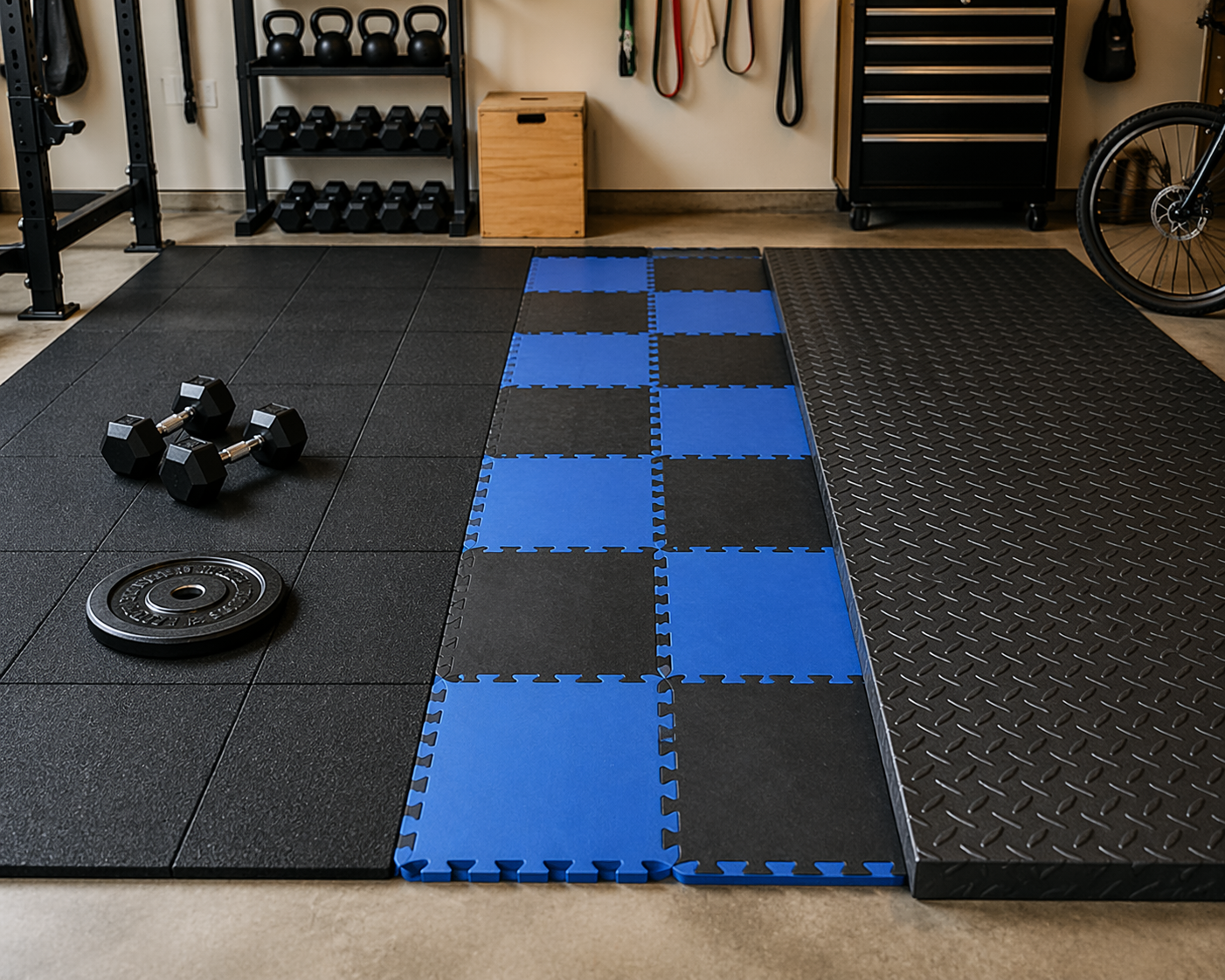
The Quick Decision Matrix
| Your Situation | Choose Rubber Tiles or Rolls | Choose Foam Mats | Choose Horse Stall Mats |
|---|---|---|---|
| Bodyweight, stretching, yoga, mobility | Good, especially if equipment will be added later | Good if shoes, pets, and furniture will not chew it up | Overkill unless the space is also used for heavy lifting |
| Light dumbbells | Best all-around choice | Acceptable for careful work with light weights | Usable, but heavy and awkward for a small room |
| Bench, rack, adjustable dumbbells, cable machine, treadmill | Best fit for most homes | Poor fit; foam compresses under equipment | Possible on concrete, less friendly upstairs or in finished rooms |
| Dropped barbell work | Good with adequate thickness and lifting-specific setup | No | Good budget option in a garage or powerlifting area |
| Noise and vibration matter | Usually the most practical balance | Soft underfoot but not reliable for impact control | Dense and tough, but not automatically quiet |
| Odor sensitivity | Usually manageable, especially with gym-specific tiles | Usually less rubber odor | Highest risk; off-gassing may take 1–2 weeks depending on conditions |
| Installation difficulty | Moderate; tiles are easiest, rolls are cleaner but heavier | Easy | Hard; large sheets are heavy and may not fit tightly |
| Budget pressure | Middle ground | Cheapest upfront, weakest long-term fit for equipment | Often cheap per square foot, but physically demanding |
The price column deserves a warning label. Flooring Inc lists stall mats at about $2.38 per square foot versus about $2.93 per square foot for average gym-specific rubber mats, but those numbers depend on current listings, sales, shipping, thickness, and retailer assumptions.[4] A cheaper square foot is not always a cheaper room once you add delivery, trimming, airing out, and the possibility that you hate living with the material.
Rubber Is the Default Because It Handles Mixed-Use Reality
Most home gyms are not pure powerlifting rooms. They are spare bedrooms with a desk in the corner, garage bays that still need to store bins, basements with a treadmill and adjustable bench, or apartment corners where one mat has to protect the floor without turning the room into a tire shop. Rubber flooring wins there because it is the least dramatic compromise.
A good rubber gym floor mat gives you traction, weight tolerance, and enough density that a bench, rack, bike, or treadmill does not immediately carve permanent-looking dents into it. It is also easier to explain to a landlord, spouse, or future version of yourself than a stack of livestock mats hauled into a finished room.
Interlocking rubber tiles are the friendliest version for first-time builders. You can carry them in manageable pieces, work around a closet or radiator, replace one damaged tile, and pull the floor up if the room changes jobs. Rolls can look cleaner and reduce seams, but they are less forgiving to move and cut. For a small gym, the difference often comes down to whether you value a cleaner surface or an easier Saturday.
Rubber is not magic. If you are repeatedly dropping loaded barbells, you still need appropriate thickness, crash pads or a platform strategy, and realistic expectations about vibration. Manufacturer and retailer pages may describe noise reduction with confident language, but unless the claim comes from independent lab testing in conditions like your room, treat it as a helpful clue rather than a promise. Living.Fit’s noise-reduction guidance, for example, is useful as product education, but it is still manufacturer-published material.[5]
Where rubber makes the most sense
- You lift dumbbells, use a bench, and may add more equipment later.
- You have a treadmill, bike, rower, rack, cable machine, or adjustable dumbbell stand.
- The room still needs to look and function like part of a home.
- You want something durable without hauling 100-pound sheets through the house.
- You care about traction and floor protection more than the lowest possible upfront price.
If you are choosing blind for a mixed-use home gym, rubber tiles are the boring answer. Boring is good here. Flooring becomes exciting only after it curls, smells, dents, sheds, or traps you into an install you do not want to redo.
Foam Works Until You Ask It to Be Flooring
Foam puzzle mats are tempting because they are light, cheap, easy to carry, and soft under knees and elbows. For floor-based training, that can be enough. If your “home gym” is really a yoga mat that grew into a small stretching zone, foam may be the right answer.
The trouble starts when foam gets treated like structural flooring. Heavy dumbbells leave marks. Benches and treadmill feet compress it. Shoes rough up the surface. Puzzle seams lift. The mat can look tired before the rest of the gym is even finished. Carpenter’s six-month disintegration example is only one user’s experience, not a universal lifespan, but it captures the failure mode accurately: foam tends to fail by abrasion, compression, and shedding when used beyond light training.[2]
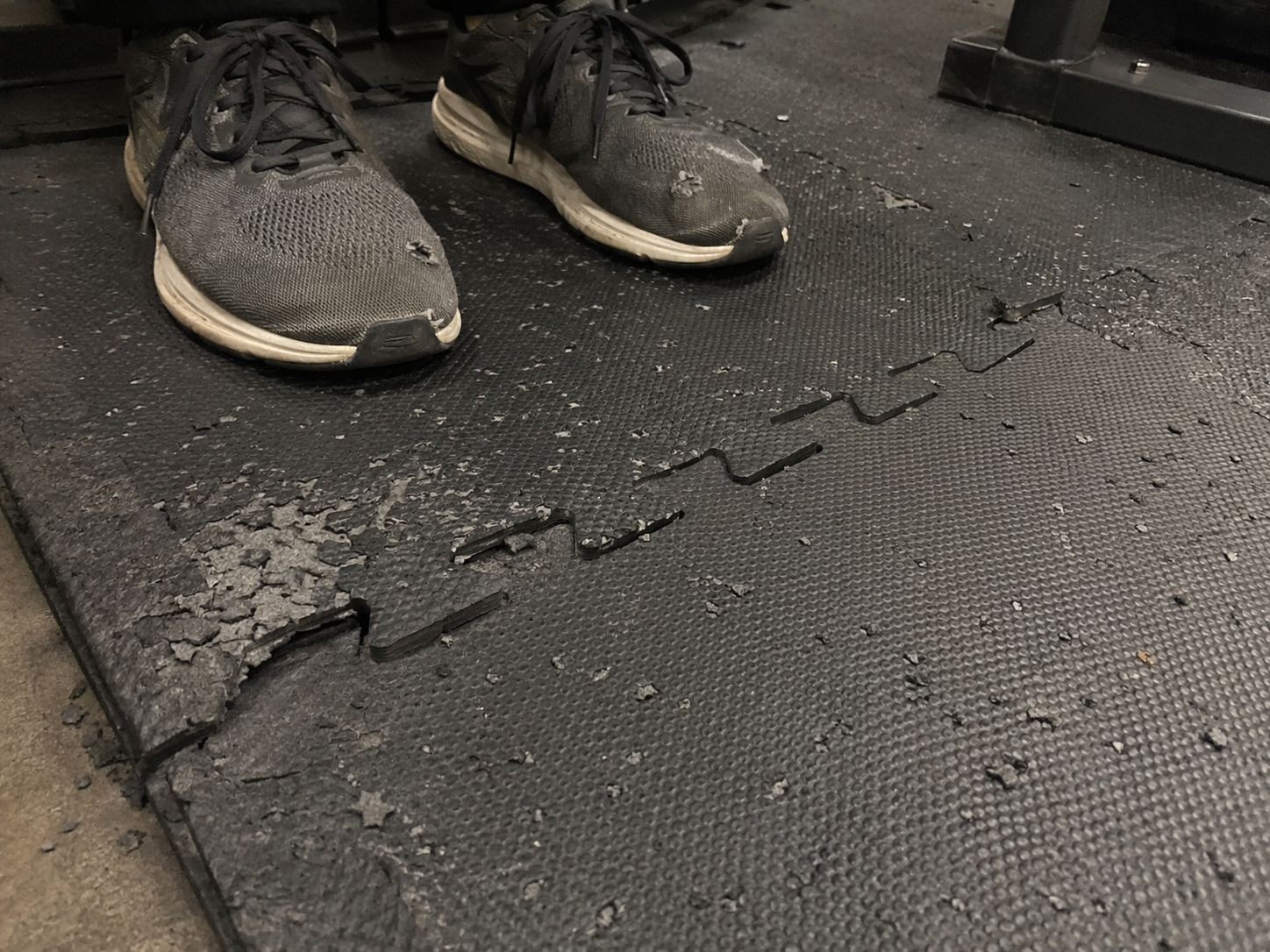
Use foam when the mat is the workout surface, not when it is the foundation for a gym. A few light dumbbells, barefoot mobility, stretching, pilates, core work, and bodyweight circuits are reasonable. A power rack, treadmill, loaded barbell, or adjustable bench is asking foam to do a job it was not built to do.
Foam also has a floor-friendliness trap. Because it feels soft, it can seem protective. But softness is not the same as load distribution. A treadmill foot or bench leg can press through a soft tile and concentrate pressure on the floor underneath. If the room has hardwood, vinyl plank, or a lease attached to it, that difference matters.
The honest foam use case
- Choose foam for bodyweight training, stretching, yoga, mobility, and light dumbbell work.
- Avoid foam under treadmills, racks, benches, heavy dumbbells, and anything with small hard feet.
- Expect it to be more replaceable than permanent.
- Keep shoes, dragged equipment, and chair wheels off it if you want it to last.
If you have already narrowed your choice to rubber versus foam and stall mats are off the table, this deeper rubber-vs-foam gym flooring comparison is the next place to get picky.
Stall Mats Are Tough, Cheap, and Annoying on Purpose
Horse stall mats became popular in garage gyms for a good reason: they are dense, tough, widely available, and often cheaper per square foot than gym-branded rubber. If you are building a lifting area on concrete and you care more about deadlifts than clean seams, they can be a very practical solution.
The part that gets softened in quick recommendations is the physical reality of the material. A standard 4-by-6-foot stall mat weighs about 100 pounds, which means getting one from store to vehicle to garage is already a workout; getting several upstairs or around tight corners is a different project altogether.[3] Once the mats are down, Gray Matter Lifting notes that recycled-rubber dimensions can be imprecise, leaving visible gaps that shift with temperature.[3]
Then there is odor. Some people shrug it off. Some people open the garage door for a week and still regret nothing. Others put a mat in a spare bedroom and discover that “rubber smell” is not a cute delivery-day inconvenience. Gray Matter Lifting’s reported 1–2 week off-gassing range is a useful planning window, not a guarantee; ventilation, heat, mat batch, and personal sensitivity can change the experience.[3]
That does not make stall mats bad. It makes them garage-minded. They are best for lifters who can keep them on concrete, air them out before installation, accept imperfect seams, and recruit help to move them. In that setting, the ugliness is part of the bargain.
When stall mats are the right call
- You are building a garage gym or basement lifting zone on concrete.
- You train with barbells and expect dropped or lowered heavy loads.
- You can transport and move 100-pound sheets safely.
- You can off-gas the mats before living with them.
- You care more about toughness and cost per square foot than appearance or easy removal.
Match the Mat to the Thing Sitting on It
The mistake is shopping for flooring as if the room is empty. It will not stay empty. The mat has to deal with equipment feet, sweat, shoes, cleaning, furniture, pets, doors, baseboards, and the floor underneath.
| What You Own or Plan to Buy | Best Material Choice | Why |
|---|---|---|
| Yoga mat, bands, mobility tools | Foam or rubber | Foam is comfortable enough; rubber is better if the room may become a fuller gym later |
| Light dumbbells | Rubber first, foam only if truly light-use | Rubber handles shoes, impacts, and future equipment better |
| Adjustable bench and dumbbells | Rubber | Bench feet and dumbbell drops punish foam quickly |
| Treadmill, bike, rower | Rubber | Rubber is more stable under equipment and easier to clean around |
| Power rack | Rubber or stall mats | Rubber suits mixed rooms; stall mats suit concrete garage setups |
| Deadlift area | Stall mats or lifting-specific rubber setup | Impact management matters more than comfort underfoot |
Also check the subfloor before you buy. Concrete is forgiving. Hardwood, tile, vinyl plank, and upstairs floors require more caution. A mat can protect against scuffs while still failing to solve vibration, point loading, or lease concerns. For apartments and shared buildings, flooring is only one part of the noise problem; dropped weight travels through structure, not just air.
If the gym is upstairs or lease-sensitive, start with an apartment home gym flooring guide before assuming thicker flooring will solve everything.
The Trade-Offs People Underestimate
Installation is where the cheap answer often becomes the annoying answer. Foam wins the carry-it-upstairs test. Rubber tiles are manageable for most people. Rubber rolls can be beautiful but awkward. Stall mats are a two-person job unless you enjoy wrestling a floppy slab of dense rubber against your own judgment.
Odor is the next underpriced variable. Gym-specific rubber can still smell at first, but stall mats are the bigger risk because they are made for barns, not bedrooms. If the room has poor ventilation or shares air with the rest of the house, buy one sample or one mat before committing to a full floor.
Seams matter more in small rooms than people expect. A lifted foam seam catches shoes. A stall mat gap collects grit and sweat. A rubber tile seam is usually tolerable, but cheap tiles with loose interlocks can creep if equipment is dragged across them. The floor does not need to be showroom-perfect; it needs to stop becoming a chore.
Cleaning is another quiet separator. Rubber is usually the easiest to sweep and wipe. Foam can absorb damage from abrasion and look dirty around torn areas. Stall mats can shed black residue early and may need extra cleaning before they stop marking hands, socks, or equipment. That is not a reason to avoid them in a garage. It is a reason not to pretend they behave like finished interior flooring.
What to Buy From Here
For a mixed-use home gym, buy rubber interlocking tiles unless you have a clear reason not to. They are the best balance of durability, traction, equipment support, installation ease, and livability for most first-time setups.
For a light workout corner, buy foam only if the work stays floor-based and low-impact: stretching, yoga, bodyweight circuits, mobility, and light dumbbells. Treat it as a workout surface, not a permanent equipment floor.
For a heavy garage gym, consider stall mats if you accept the job that comes with them: moving heavy sheets, airing them out, fitting imperfect edges, and living with a rougher finish. If that sounds tolerable, they remain one of the most practical budget choices for barbell spaces.
Once the material choice is settled, the next decision is installation. Use a home gym flooring installation guide if you are cutting around walls, racks, or doorways. If the space is a garage and you are building beyond the floor, a complete garage gym blueprint will keep the flooring decision tied to storage, lifting zones, and equipment layout.
References
- Expert-Tested: The Best Home Gym Flooring Options (2026) — Garage Gym Reviews
- 8 Best Gym Mats 2024 — The Strategist, New York Magazine
- The BEST Home Gym Flooring In 2026 — Gray Matter Lifting
- Horse Stall Mats vs. Gym Floor Mats: Which is Better? — Flooring Inc
- Best Gym Flooring for Noise Reduction & Quiet Training — Living.Fit
Comments
Join the discussion with an anonymous comment.