Yes, you can do indoor workouts during wildfire smoke in a small apartment—but only if three things are true before you start: the room has effective filtration, the room is sealed and not making its own pollution, and the workout is short enough that you are not simply inhaling a smaller dose for a longer time.
The practical version is simple: if outdoor AQI is over 150, move exercise indoors; if AQI is 101–150 and you are in a sensitive group, reduce duration; if AQI is over 200, treat rest as the default even indoors unless your indoor air is well controlled and you have a strong reason to train [1][2][3]. “Indoors” is not the safety condition. A prepared room is.
| Condition | What Has To Be True | If It Is Not True |
|---|---|---|
| Filtration | A HEPA purifier with CADR ≥300, or a validated DIY Corsi-Rosenthal box using MERV 13 filters | Skip the workout or do only very light mobility |
| Clean room | Windows and doors closed; no candles, frying, gas stove use, vacuuming, or dust-making chores | Fix the room first; do not add exercise breathing on top of indoor pollution |
| Short workout | 15–25 minutes of controlled-tempo bodyweight work, not HIIT | Rest, shorten further, or save training for a cleaner-air day |
Start With The Outside Number, Then Stop Trusting It Too Much
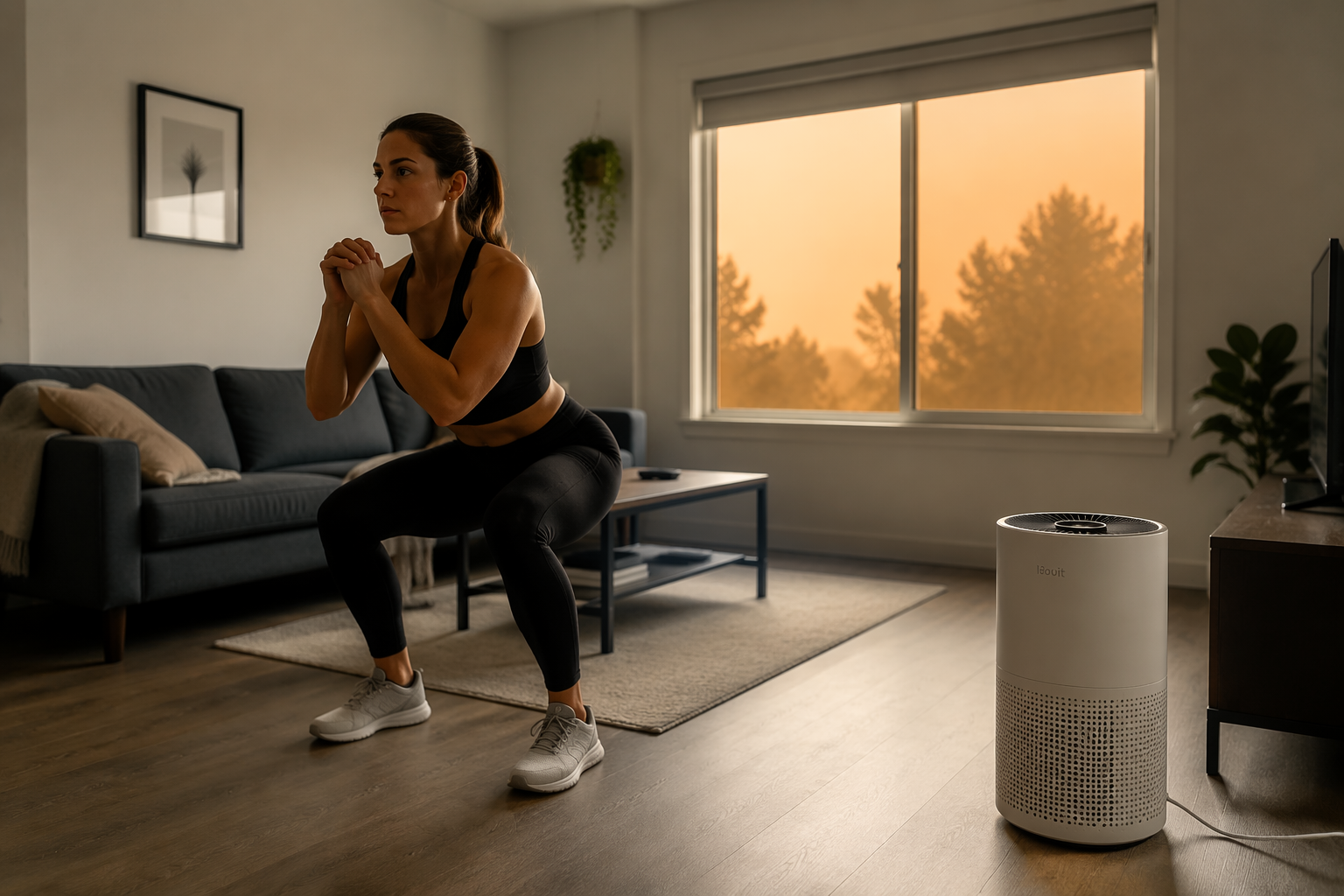
Outdoor AQI is the first gate because it tells you whether the usual plan is still reasonable. At orange levels, sensitive groups—including children, older adults, pregnant people, and people with heart or lung conditions—should reduce exertion and duration. At red levels, everyone should move exercise indoors. At very unhealthy levels, rest becomes a serious training decision, not a failure of discipline [1][2][3].
But the outside number cannot tell you what is happening in your bedroom, living room, or the corner where your mat fits. Indoor particle levels can shift with leaky window frames, window AC gaps, hallway smoke, cooking, cleaning, and whether a purifier has had enough time to turn over the air. If you own an indoor PM2.5 monitor, use it. If you do not, act conservatively: pick one room, close it down, filter it, and keep the workout short.
Condition 1: Filter The Room Before You Ask Your Lungs To Work
A smoke-ready workout room starts with filtration, not with a harder warmup. Oregon State University Extension reports that commercial HEPA air cleaners can reduce indoor PM2.5 by about 45% during wildfire smoke, and the useful target for a small training room is a unit with CADR ≥300 when you can manage it [4]. That does not make the room particle-free. It makes the dose lower, which is the whole point.
Place the purifier in the room where you will actually exercise, not in the hallway “near enough.” Run it on a higher setting before the session if the noise is tolerable, then keep it running during the workout. Give it breathing room; do not wedge the intake against a couch, curtain, laundry pile, or wall. In a one-room apartment, the “clean room” may simply be the part of the living room you can isolate best.
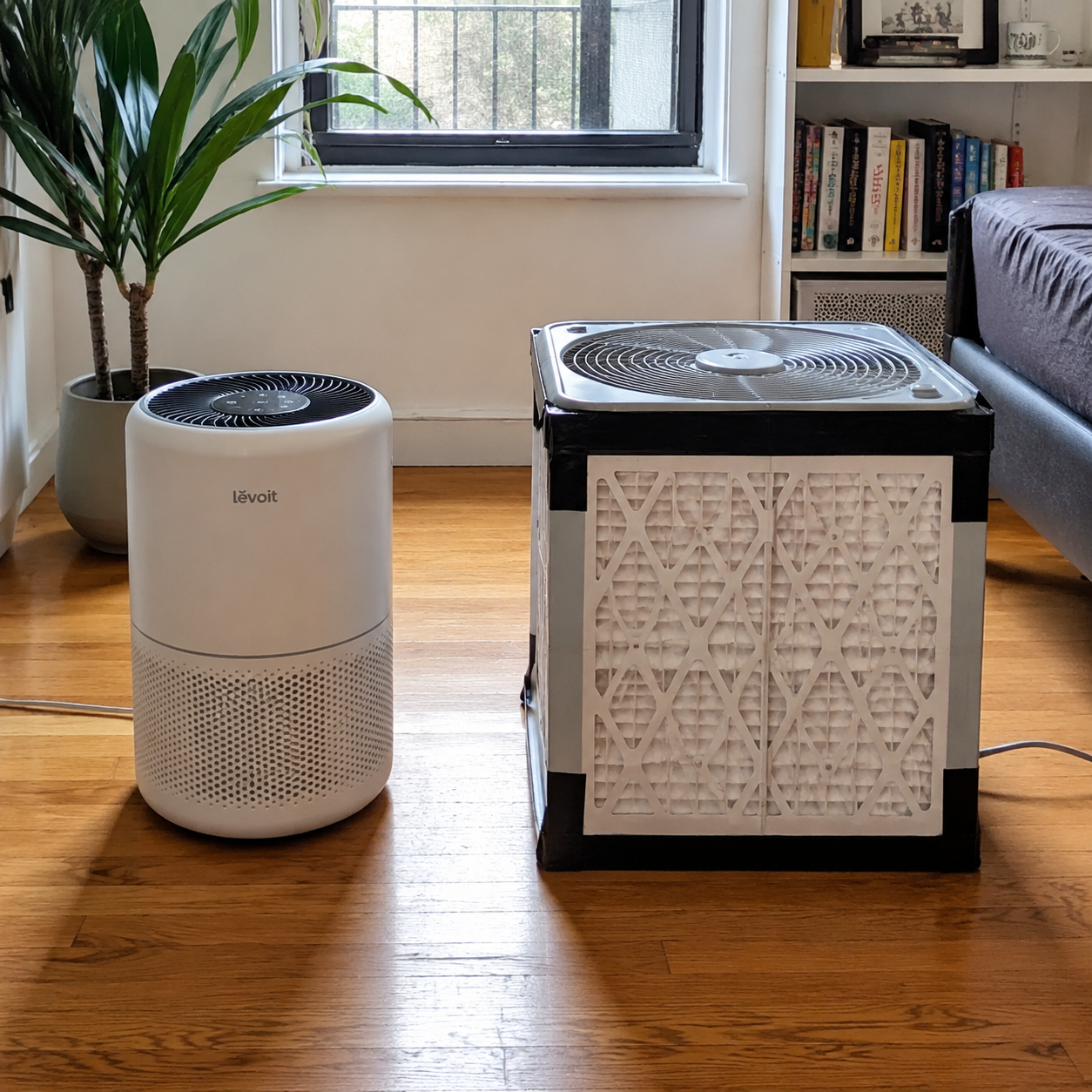
A DIY Corsi-Rosenthal box is a legitimate option, not a craft-project consolation prize. EPA research has evaluated DIY air cleaners for reducing wildfire smoke indoors, and the standard smoke-season build uses a box fan with MERV 13 filters arranged around it [5]. The appeal is obvious: these builds can cost under $100, which can be the difference between having filtration now and waiting through the season.
The tradeoff is also obvious once you live with one. A Corsi-Rosenthal box is bulkier than a sleek purifier, can be louder, and may be awkward in a studio where the same floor space handles sleeping, eating, working, and training. If it blocks the only clear workout area or becomes so loud that you turn it off, the cheaper solution stops being the better solution. Choose the filter you will actually run.
There is also a health reason to treat filtration as more than workout equipment. Harvard Health reported on a JACC study finding that portable HEPA filters lowered systolic blood pressure by about 3 points in people living near polluted areas [7]. That does not mean a purifier turns smoky air into clean mountain air, and it does not prove your workout is safe on any given day. It does make the purchase easier to justify if smoke season is no longer a rare event where you live.
Condition 2: Make One Clean Room, Not A Perfect Apartment
The clean-room standard is deliberately narrow. You are not trying to fix the whole apartment before squats. You are trying to create one defensible pocket of air: windows closed, doors closed where possible, purifier running, and obvious particle sources removed. The American Lung Association’s clean-room guidance emphasizes closing windows and doors and using a portable air cleaner to reduce exposure during wildfire smoke [6].
Start with the leaks you can actually control. Close and latch windows. If a window AC unit leaves a visible gap, seal the gap with weatherstripping, foam, tape, or another temporary barrier that does not create a safety hazard. Put a towel at the base of a drafty door if smoke is coming from a hallway or shared entry. If the cleanest room is the bedroom, train there—even if the living room looks more like a workout space.
- Do not light candles or incense before or during the workout.
- Do not fry food, broil, or use a gas stove in or near the workout window.
- Do not vacuum right before training, because it can stir particles back into the air.
- Do not shake rugs, sort dusty storage bins, sweep aggressively, or start dust-generating chores.
- Do not open the window “for a minute” to cool down unless the outside air has improved.
That list can feel fussy until you remember what exercise changes. You are not sitting quietly in the room. You are increasing ventilation—the amount of air you move in and out of your lungs—and you are doing it at the exact moment when the room’s particle load matters most.
This is why “listen to your body” is incomplete advice during smoke. Symptoms matter, especially chest tightness, unusual coughing, dizziness, headache, wheezing, or a scratchy throat that worsens as you move. But by the time symptoms show up, you have already accepted the exposure. Prepare the room first; then decide whether the body gets asked to train.
Condition 3: Cut The Workout To 15–25 Minutes
During wildfire smoke, duration is not a cosmetic edit. It is one of the main exposure controls. Colorado State University’s discussion of exercise in smoky conditions cites research showing that shortening workout duration can reduce total inhaled PM2.5 more effectively than simply lowering intensity [2]. That is the part many indoor workout plans miss: if you stretch an easy workout into 50 minutes, you may have protected your ego more than your lungs.
The breathing math is not subtle. CTS notes that athletes can breathe 10–20 times more air per minute during exercise than at rest [8]. Atmotube’s review of air quality in gyms reports that higher-intensity exercise can increase PM2.5 deposition up to 4.5 times compared with rest [9]. The exact dose in your apartment depends on the room, filtration, and smoke intrusion, but the direction is clear: longer and harder means more polluted air moved through the body.
So the smoke-season indoor workout is not a hidden HIIT session with the jumping removed. It is a short, controlled maintenance session that keeps the habit alive without pretending the air is normal.
A Small-Space Smoke-Day Session
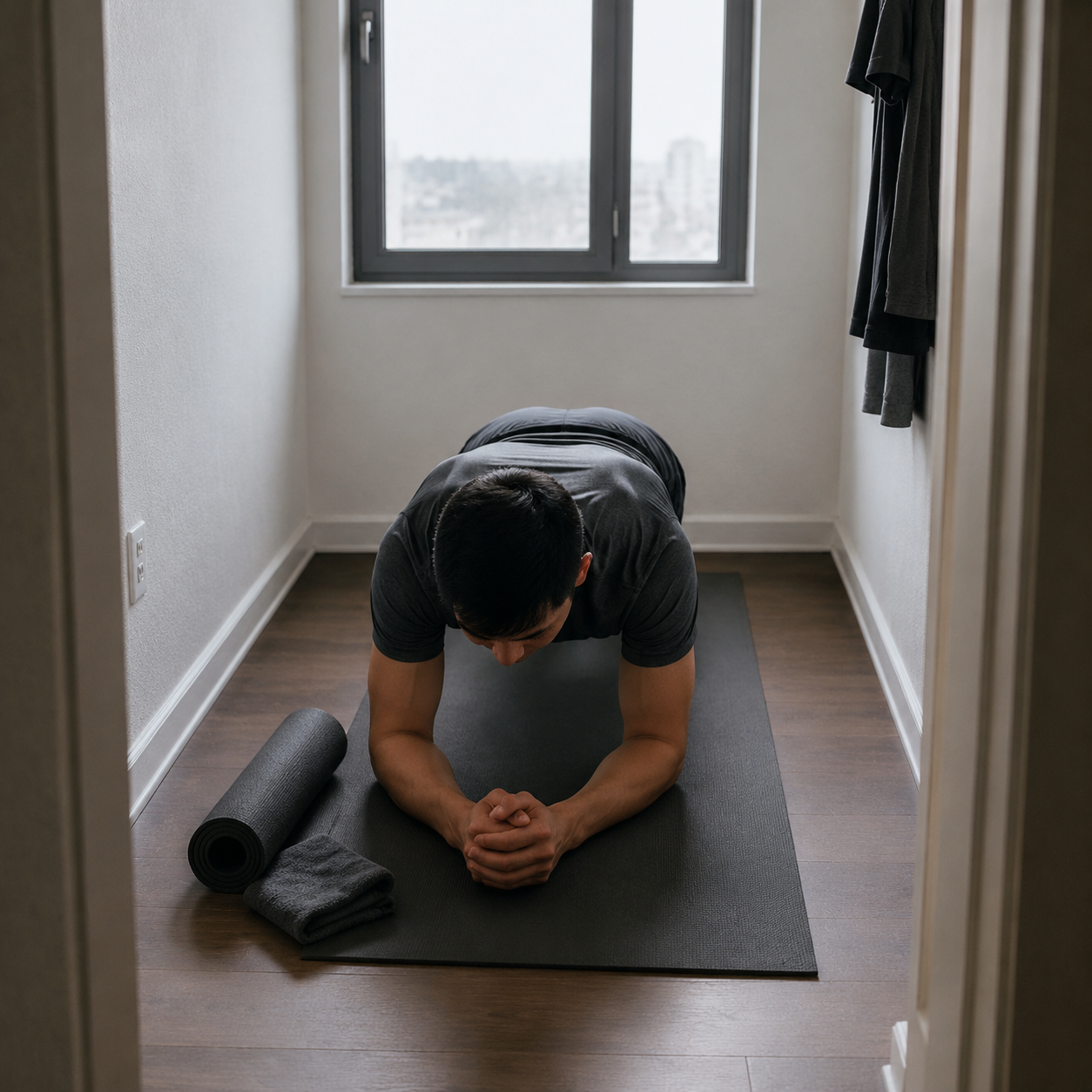
You need very little floor. A small-space bodyweight routine can fit into about 3×6 feet, using movements such as squats, lunges, push-ups, planks, and bridges [10]. That footprint matters in an apartment because it keeps you away from open windows, avoids hallway trips, and does not require equipment that has been stored in a dusty closet.
| Time | Work | How To Keep It Smoke-Appropriate |
|---|---|---|
| 3–4 minutes | Easy warmup: marching in place, shoulder circles, hip hinges | Nasal or relaxed breathing if comfortable; no bouncing or breathless pace |
| 10–16 minutes | Controlled circuit: squats, incline or floor push-ups, reverse lunges, glute bridges, plank | Move at a steady tempo; stop each set before gasping |
| 2–5 minutes | Cooldown: slow walking in place, child’s pose, gentle chest and hip stretches | Let breathing settle before leaving the filtered room |
One practical format is 2–3 rounds of five movements: 6–10 controlled squats, 6–10 push-ups from the floor or a counter, 6–8 reverse lunges per side, 8–12 glute bridges, and a 20–40 second plank. Rest as needed. The goal is not to win the room. The goal is to finish without heavy breathing becoming the dominant feature of the session.
Controlled tempo helps because it lowers noise, reduces joint impact, and makes a small floor plan usable. A three-second squat descent, a one-second pause, and a smooth stand can be plenty of work without turning the room into a cardio chamber. Bridges and planks are useful for the same reason: low travel, low dust, low neighbor drama.
Skip jump squats, burpees, mountain climbers at sprint pace, high-knee intervals, and long circuits designed to make you breathe hard. Those are fine tools on cleaner-air days. During smoke, they solve the wrong problem.
When Rest Is The Cleaner Choice
Rest is the right call if you cannot run filtration, cannot close off a reasonably clean room, or have already added indoor pollution through cooking, candles, vacuuming, or dust work. It is also the right call if AQI is very high and you do not have a way to verify indoor conditions, especially if you are in a sensitive group.
Stop mid-session if breathing feels unusually strained, coughing increases, your chest feels tight, you wheeze, feel lightheaded, or develop symptoms that are not normal for that workout. Do not bargain with those signs because the workout is “only bodyweight.” Bodyweight exercise can still drive ventilation up, and ventilation is the exposure multiplier.
The cleanest decision rule is blunt: no purifier or validated DIY filter, no clean-room control, no smoke-day workout. If the room is prepared but the AQI is very high, shorten further or rest. If the filter is running, the room is sealed and free of indoor pollution sources, and the session is kept to 15–25 minutes of controlled bodyweight work, that is the safest useful version of training indoors during wildfire smoke.
References
- Experts Offer Advice on Working Out During Wildfire Smoke Events — Public Health Institute
- Is it safe to exercise outside when there is wildfire smoke in the air? — Colorado State University
- Four Things to Know about Air Quality and Exercising Outdoors — American Lung Association
- Protecting Indoor Air from Wildfire Smoke (EM 9379) — Oregon State University Extension
- Research on DIY Air Cleaners to Reduce Wildfire Smoke Indoors — EPA
- How to Create a Clean Room to Help Protect Against Wildfire Smoke — American Lung Association
- Indoor air quality and heart health — Harvard Health
- Adjusting Outdoor Exercise for Air Pollution and Wildfire Smoke — CTS/Trainright
- Importance of Air Quality in Gyms — Atmotube
- The Small Space Workout (Train in Any Room) — Nerd Fitness
Comments
Join the discussion with an anonymous comment.