
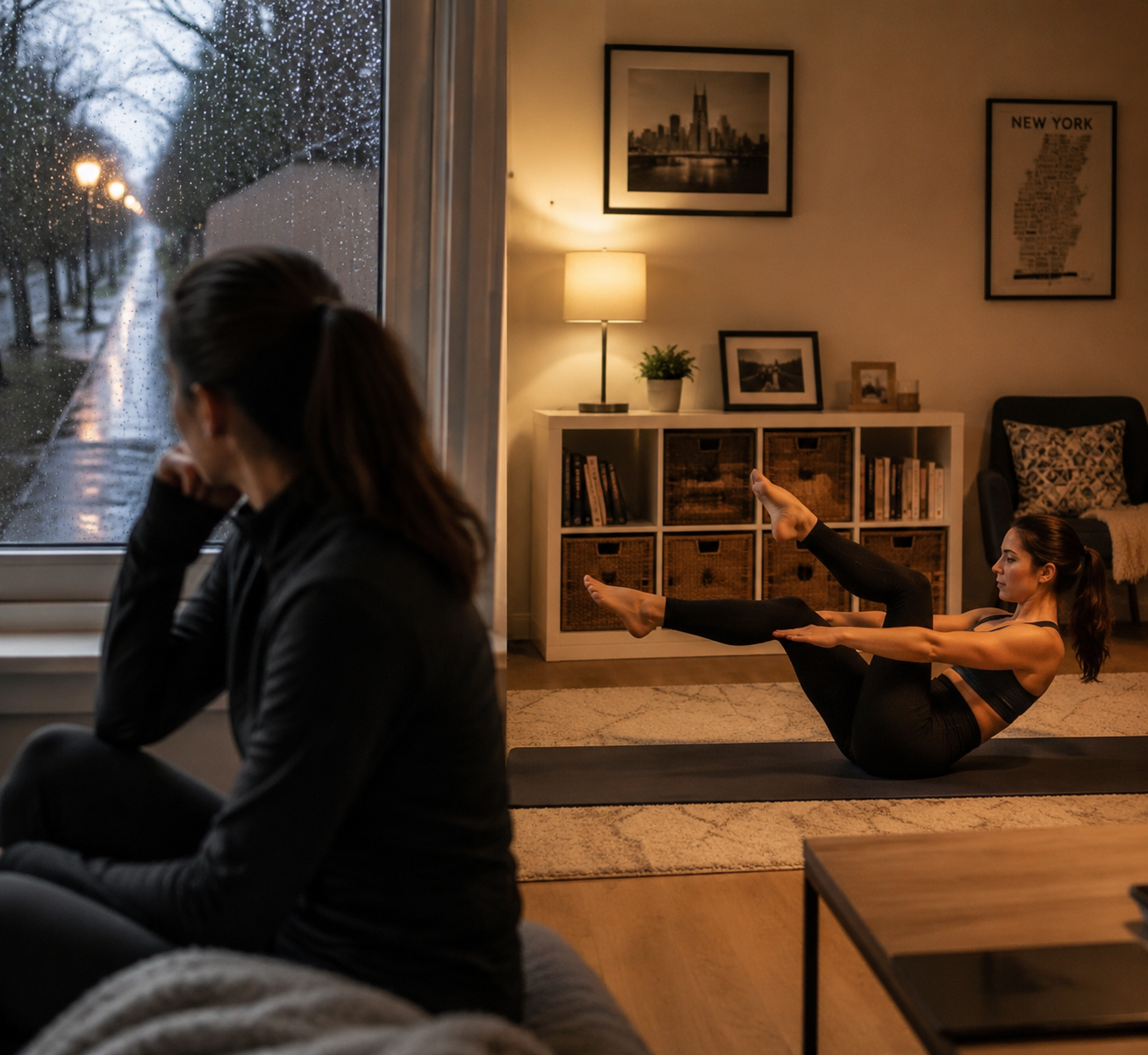
The most useful moment to decide on a bad-weather workout is not after you have spent 20 minutes checking the radar, bargaining with wet shoes, and losing the little energy you had saved for your walk, run, or ride. It is the moment you name what kind of weather disruption you are dealing with.
Rain, ice or snow, and extreme heat or cold do not interrupt outdoor exercise in the same way. In a nationally representative U.S. survey of 502 adults, rain was associated with 3.33 times greater odds of moving exercise indoors and 3.49 times greater odds of delaying exercise compared with heat; ice or snow was associated with 3.34 times greater odds of delaying exercise; and adults 65 and older had 3 times greater odds of choosing indoor exercise during adverse weather.[1] Those are the useful parts of the data: not that weather matters, which anyone with soaked socks already knows, but that different weather conditions push people toward different decisions.
The same survey also reported that 51.8% of adults delayed exercise during summer weather and 43.9% delayed during winter weather, but those absolute numbers came from 2013 survey data published in 2016.[1] Hybrid work, post-pandemic routines, and changed commuting patterns may have shifted the exact percentages. The more durable lesson is the pattern: rain often needs a quick indoor substitute; ice and snow need a lower-friction, lower-risk option; extreme heat or cold needs a session that preserves movement without pretending conditions outside are irrelevant.
First Route the Weather, Then Pick the Workout
For this system, every workout fits inside a 6×3 ft yoga-mat footprint. No equipment. No jumping. No dragging furniture into the hallway. If you can clear a mat-sized rectangle, you have enough space.
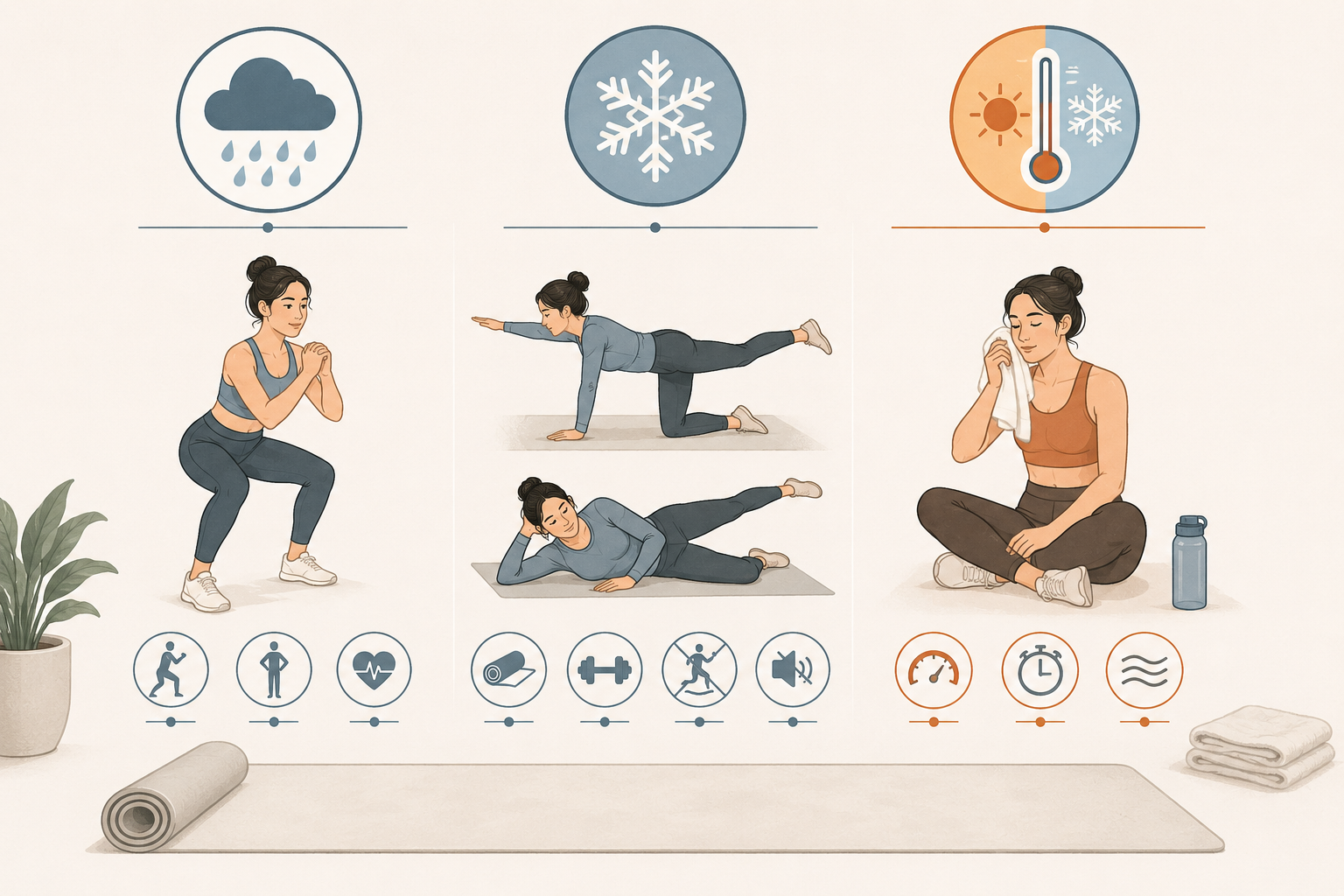
| Today’s outdoor problem | What it tends to do to the workout decision | Use this indoor track |
|---|---|---|
| Rain | Often makes the outdoor session annoying or impractical, but not necessarily high-risk once you are indoors | A compact bodyweight circuit that keeps the day feeling like a workout |
| Ice or snow | Raises the friction and risk of getting outside, and is strongly associated with delaying exercise | Floor-based mobility plus controlled strength, with very little setup |
| Extreme heat or cold | Can make intensity management the main issue, especially if the indoor room is also warm or cold | A low-to-moderate paced circuit with built-in rests |
This is deliberately narrower than a general list of home workout ideas when bad weather hits. A rainy Tuesday after a canceled run does not need the same fallback as a glazed sidewalk, and a hot afternoon in an upstairs apartment does not need someone shouting through burpees. The goal is to remove the second decision: once the weather type is clear, the session is already chosen.
Rain Track: A Compact Circuit When You Still Want a Workout
Rain is the weather condition most likely to make people move indoors in the survey, compared with heat.[1] That matters because a rain fallback can feel more like a normal exercise replacement. You may be irritated about the canceled walk or run, but you are not necessarily managing sidewalk ice, smoke, or heat stress. The session can be upright, simple, and moderately energetic while still staying quiet.
Small-space bodyweight routines from Nerd Fitness and 12 Minute Athlete both lean on movements that can be done in a tight footprint without equipment, which makes them useful raw material for a rainy-day substitute.[2][3] The version below keeps that compact-circuit spirit but removes jumping so it works better for apartments and shared floors.
Do This: 18-Minute Rainy-Day Bodyweight Circuit
Set a timer for 40 seconds of work and 20 seconds of transition. Move through all six exercises, rest one full minute, then repeat for three total rounds.
- Marching squat to calf raise: Stand tall, sit into a comfortable squat, stand, lift both heels, and lower with control.
- Incline or floor push-up: Use the floor if it feels good, or place hands on a sturdy counter or sofa edge if you need a lighter version.
- Reverse lunge or split squat hold: Step back only as far as your mat allows, or stay in a staggered stance and pulse gently.
- Dead bug: Lie on your back, brace lightly, and alternate lowering opposite arm and leg without arching your lower back.
- Plank shoulder tap from knees or toes: Tap one shoulder at a time while keeping the hips as still as possible.
- Step-back good morning: Hinge at the hips with hands across your chest, then alternate a small step back as you stand.
Keep the first round restrained. Rainy-day workouts often fail because they start as compensation: the run was canceled, so the living-room session has to prove something. It does not. If round two feels smooth, deepen the squats, slow the push-ups, or make the plank taps more deliberate. Do not add jumps just to make the room feel like a gym.
Ice or Snow Track: Reduce the Friction Before You Delay the Whole Day
Ice and snow deserve a different fallback because the outside problem is not only discomfort. The survey found ice or snow was associated with 3.34 times greater odds of delaying exercise.[1] That makes sense: the workout is no longer just wet or inconvenient; it may involve a risky walk to the park, a slippery driveway, or the extra mental load of deciding whether the route is safe.
This is where the indoor session should become easier to begin, not more heroic. Floor-based mobility and quiet strength progressions, like those emphasized in Sweat’s small-space quiet workout guidance, fit the situation because they lower impact, reduce noise, and let you start without warming up a freezing room with frantic movement.[5]
Do This: 20-Minute Ice-and-Snow Mobility Strength Session
Use slow breathing and controlled transitions. This session is not trying to mimic a run. It is protecting the habit on a day when the obvious choice is to postpone.
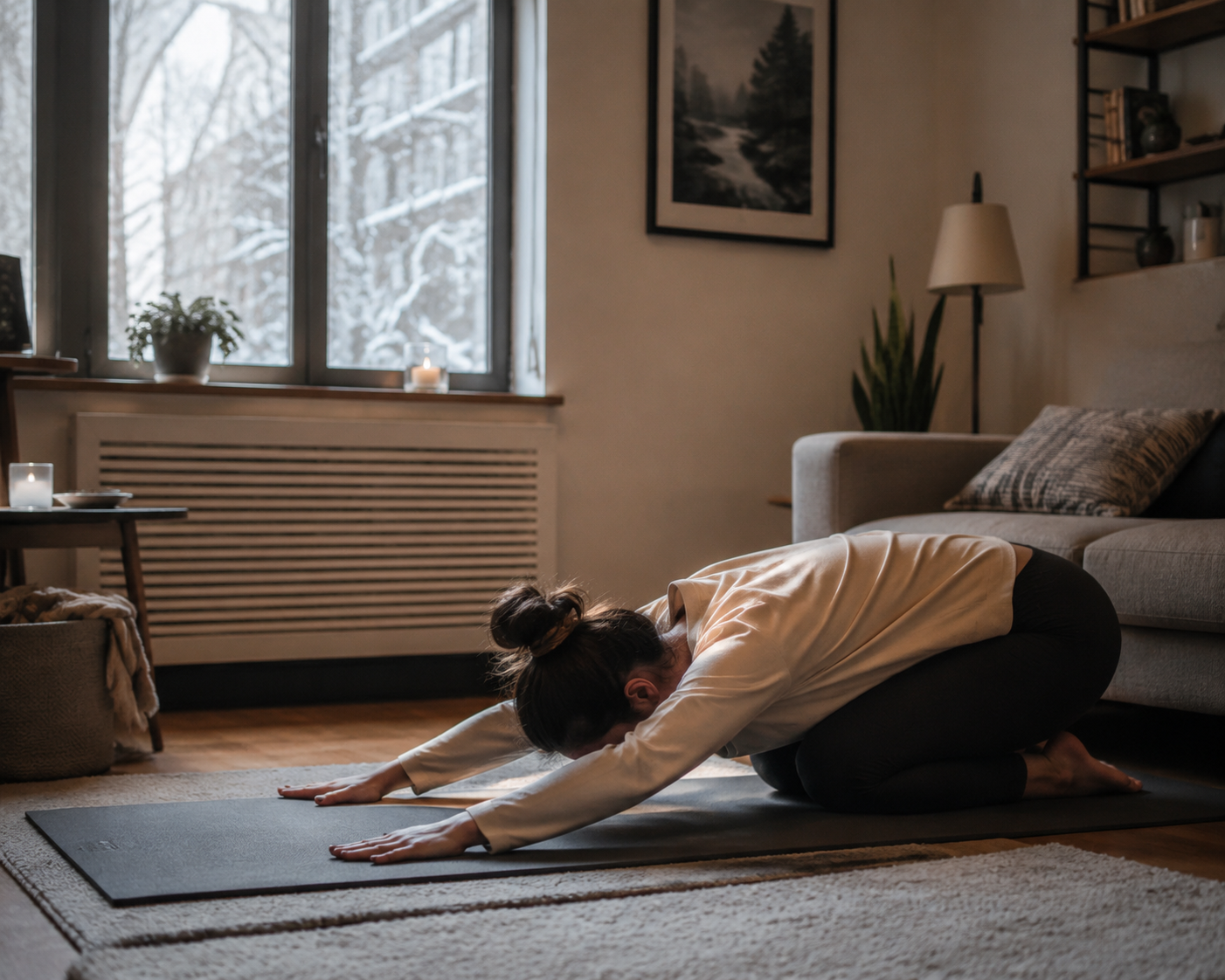
- Two minutes: Cat-cow to child’s pose. Move between spinal flexion, extension, and a comfortable hip-back stretch.
- Three minutes: Half-kneeling hip flexor stretch with reach. Switch sides halfway, keeping the range gentle.
- Three minutes: Glute bridge. Do 8 to 12 slow reps, hold the top for two breaths, then rest briefly and repeat.
- Three minutes: Bird dog. Alternate sides, pause before lowering, and keep the movement quiet enough that a downstairs neighbor would not know it is happening.
- Three minutes: Side-lying leg lift or clamshell. Work one side, switch, and keep the pelvis stacked instead of rolling backward.
- Three minutes: Slow sit-to-stand from a chair or controlled squat to a comfortable depth. Use a chair if balance feels uncertain.
- Three minutes: Supine hamstring stretch, figure-four stretch, or any low-back-friendly position that lets your breathing settle.
For older adults, or for anyone who feels unsteady on slick surfaces, moving the day indoors is not a lesser version of discipline. In the survey, adults 65 and older had 3 times greater odds of choosing indoor exercise during adverse weather.[1] The practical takeaway is plain: if the path outside is questionable, the workout should not require you to test it first.
If ice and snow are a recurring part of your season and this kind of low-noise strength work feels like the right lane, use the single-session plan here as the emergency version. For a fuller multi-day program, the site’s quiet strength plan is the better next step.
Extreme Heat or Cold Track: Keep the Circuit, Control the Pace
Extreme heat and cold can cancel an outdoor workout for opposite reasons, but indoors they share one useful rule: intensity needs more attention than novelty. A bad-weather circuit from EXOS, published by Men’s Fitness, uses familiar bodyweight movements as an at-home template, but the small-apartment version needs to be quieter and more moderate than a standard conditioning circuit.[4]
This is especially true in heat. If the room is warm, the replacement workout should not punish you for avoiding unsafe or miserable outdoor conditions. Use a conversational pace, place water nearby, and extend the rests if your breathing stays high. If you feel dizzy, chilled, nauseated, unusually short of breath, or generally unwell, skip the circuit and choose gentle mobility or rest.
Do This: 16-Minute Temperature-Smart Circuit
Work for 30 seconds, rest for 30 seconds, and complete four rounds. The rest is part of the workout, not a sign that you are underdoing it.
- Squat to reach: Sit into a comfortable squat, stand, and reach overhead without rushing.
- Walkout to plank or hands-elevated plank: Hinge down, walk hands forward, pause, then walk back. Use a counter or sofa edge if the floor version is too much.
- Alternating reverse lunge or supported step-back: Keep the step small enough to stay on the mat.
- Slow mountain climber: From a plank position, step one foot forward at a time instead of hopping.
- Forearm plank breathing hold: Hold a manageable plank while taking slow nasal or relaxed breaths.
- Standing hinge with arm sweep: Hinge at the hips, sweep arms back, stand tall, and reset your breath.
On a cold day, the first round can serve as the warm-up. On a hot day, it can serve as the ceiling: if round one already feels like plenty, repeat it at the same pace instead of chasing a harder version. The point is to finish with the outdoor habit intact, not to turn bad weather into a test of tolerance.
Small-Space Rules That Keep the Backup Plan Usable
A backup plan that requires rearranging the apartment is not really a backup plan. Before starting any of the three tracks, clear the full mat area, move hard-edged objects out of reach, check that the floor is not slippery, and choose the lower-impact option first if you are unsure. Bare feet, socks, or shoes depend on your floor surface; the right choice is the one that gives you traction without annoying your joints.
Noise is a constraint too. No-jumping workouts are not automatically easy; they just shift the work into tempo, control, range of motion, and time under tension. A slow squat, a clean dead bug, or a steady plank can be plenty when the alternative was losing the whole day to weather.
Air quality belongs in a separate decision lane. Smoke, high AQI, and pollution are not just another flavor of bad weather; they change the risk calculation and the indoor/outdoor choice in different ways. If the thing canceling your outdoor workout is air quality rather than rain, ice, snow, heat, or cold, use the companion guide on how to swap your outdoor workout when air quality is bad instead.
Use the Same Decision Every Time Weather Wins
When the outdoor plan gets canceled, do not start by asking what workout you feel motivated to do. Start with the weather: rain, ice or snow, extreme heat or cold. Then use the matching track. Rain gets the compact circuit. Ice and snow get floor-based mobility and controlled strength. Heat and cold get the paced circuit with real rests.
That small routing step is what protects consistency. The backup plan is chosen before willpower is tested, and it matches the actual disruption instead of treating every canceled outdoor workout like the same problem.
References
- PMC6349565, PubMed Central, 2016
- The Small Space Workout, Nerd Fitness
- Cozy Training Plan, 12 Minute Athlete
- 3 Bad-Weather Workouts You Can Do at Home, Men’s Fitness
- Quiet Workouts For Small Spaces, Sweat
Comments
Join the discussion with an anonymous comment.