
Search for pilates home equipment and the first problem is not scarcity. It is the opposite: mats, rings, bands, balls, rollers, sliders, reformers, chairs, towers, subscriptions, bundles, and very confident claims about what makes a home practice “real.” For a beginner, that can turn one reasonable intention into a shopping project before the first session even happens.
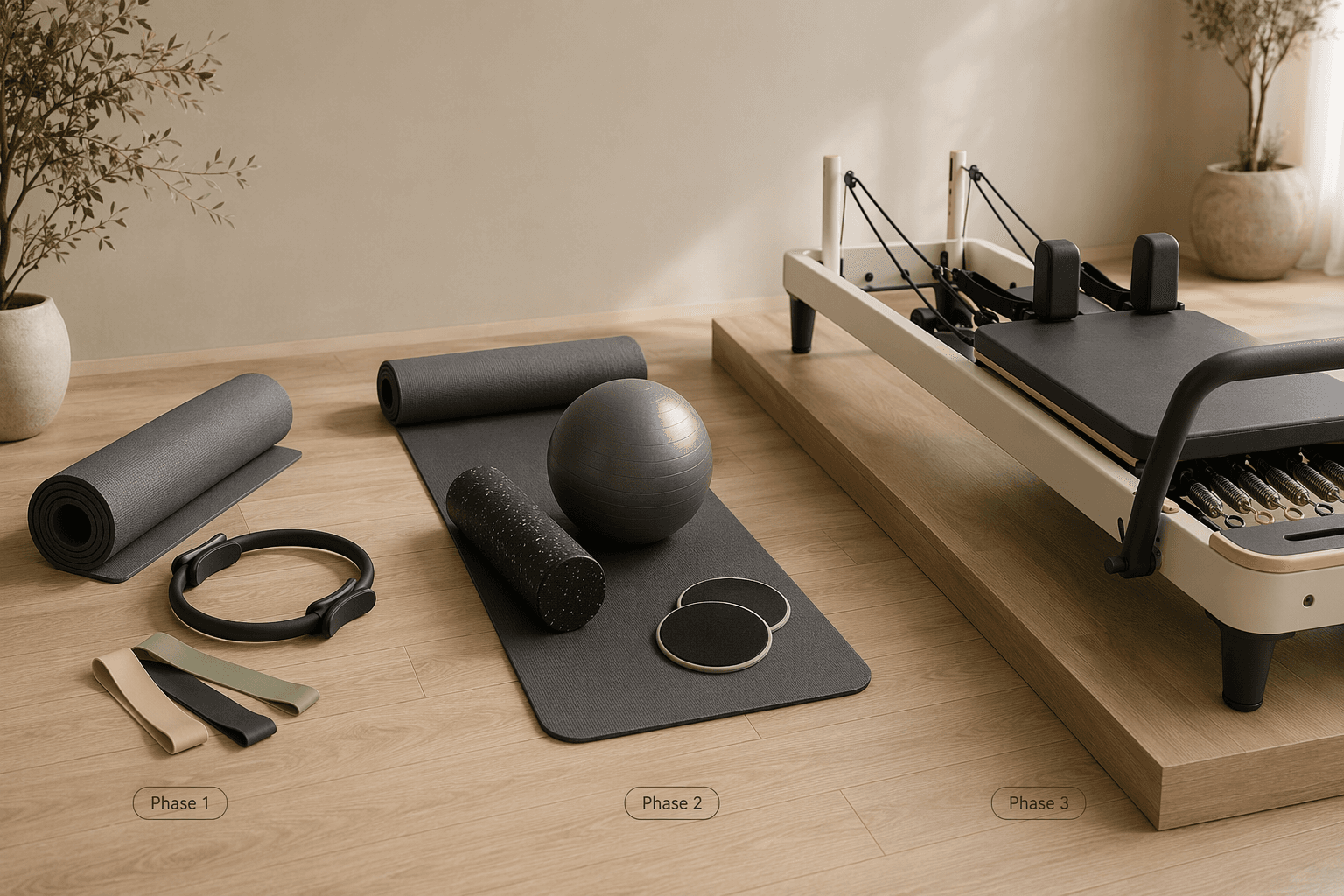
The calmer answer is this: you do not need a reformer first. If you are new to Pilates, start with a mat and a few small props for the first 4–6 weeks. Add depth only after you are practicing consistently. Treat a reformer as a later decision, usually after 3–4 months of steady practice, unless you already have studio experience and are simply moving that practice home.
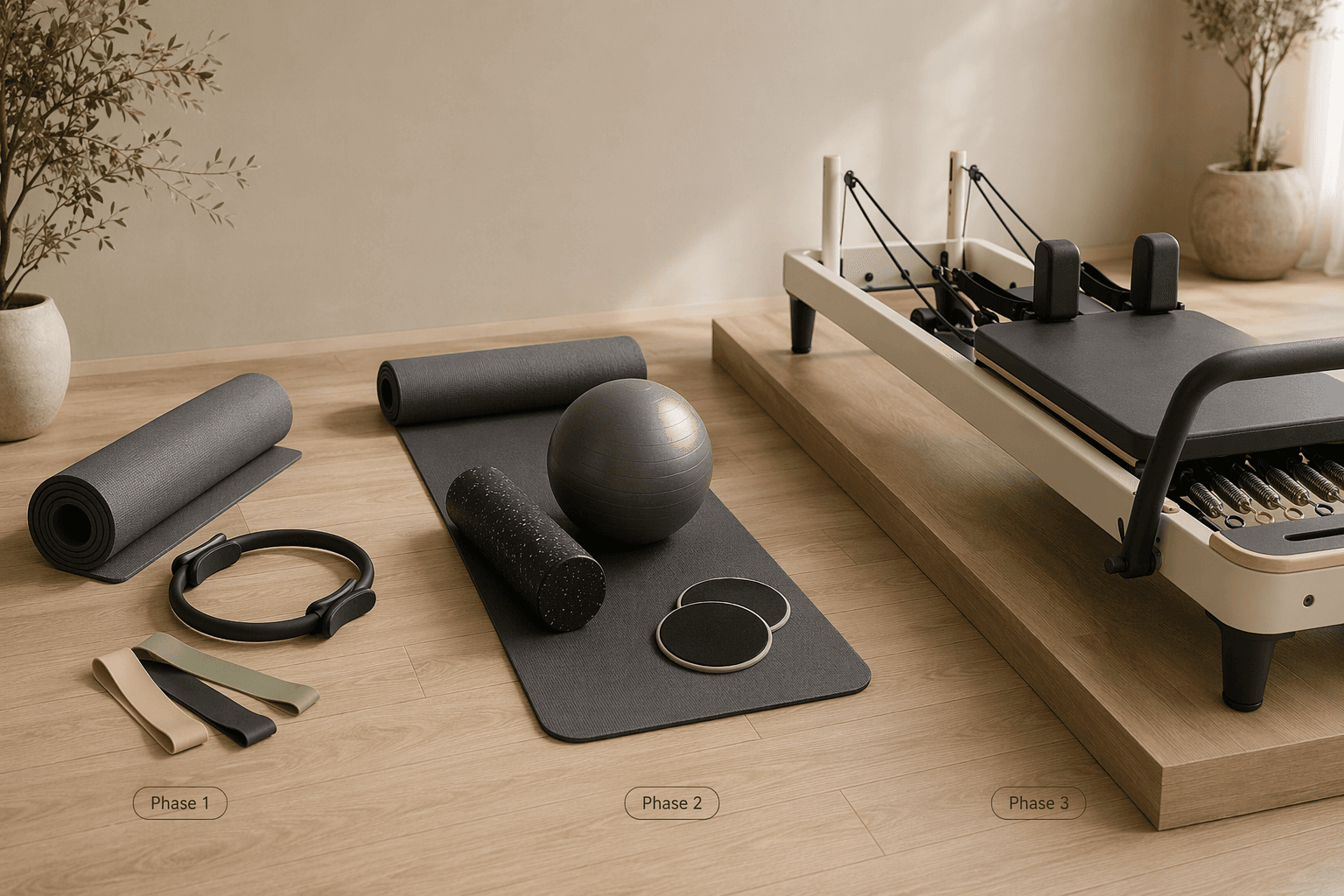
| Phase | When it fits | What to buy | Typical cost |
|---|---|---|---|
| Phase 1 | First 4–6 weeks | Pilates mat, resistance ring, resistance bands | $50–$150 total [1] |
| Phase 2 | Months 2–4 | Foam roller, stability ball, sliders | $45–$125 additional [1] |
| Phase 3 | After 3–4 months of consistency, or sooner for experienced studio practitioners | Home reformer | $800–$3,300 depending on build, springs, frame, and features [2][3] |
That table is the buying guide in miniature. It does not mean every person must buy every item. It means the first purchase should make today’s practice easier to start, not make tomorrow’s imagined practice more expensive.
Phase 1: The Small Kit That Is Enough for the Beginning
The first home setup should be boring in the best possible way: a supportive mat, one resistance ring, and a set of resistance bands. Peak Primal Wellness places this starter kit at $50–$150 total, with a 10–15mm Pilates mat typically at $50–$100, a ring at $20–$60, and bands at $15–$80.[1]
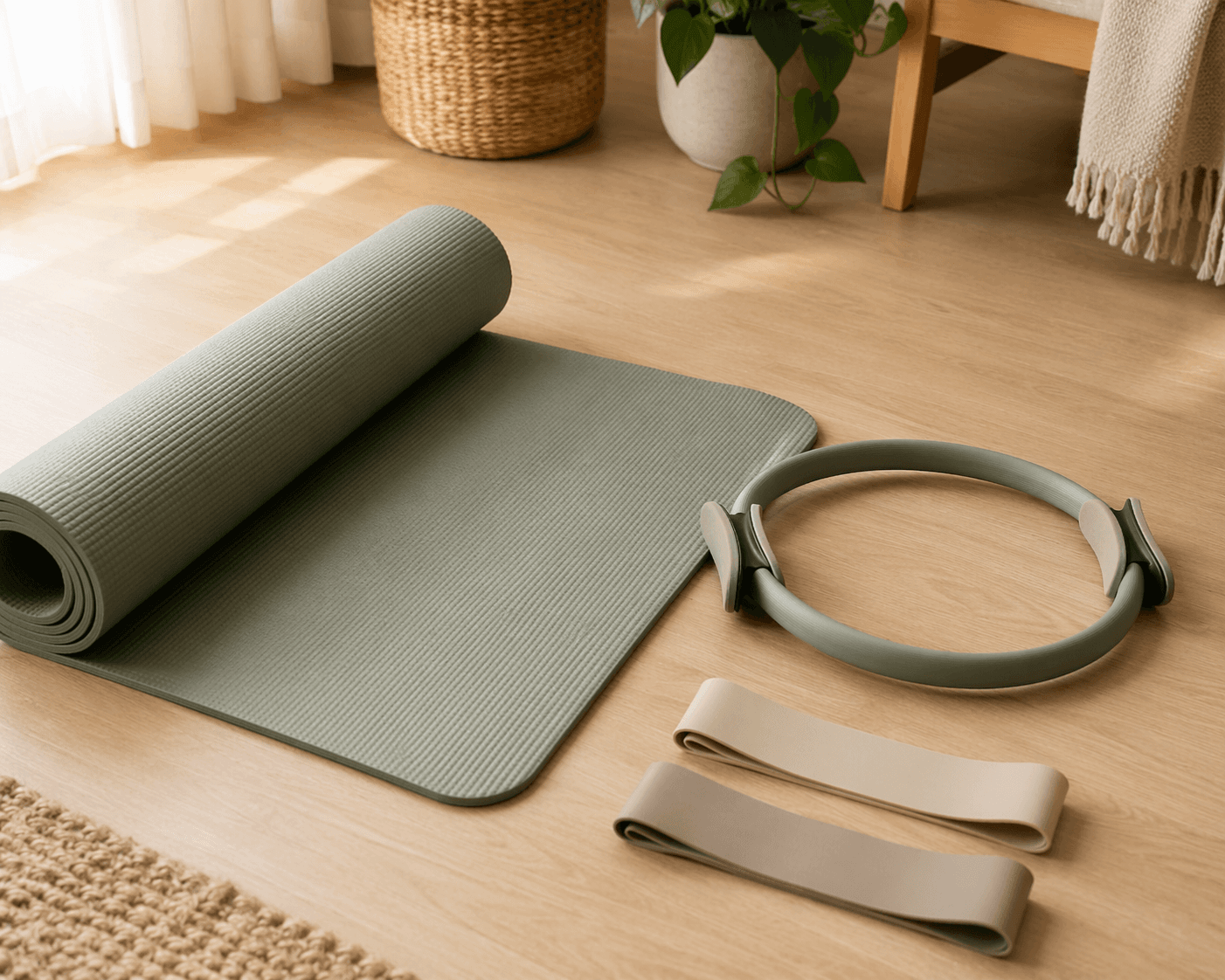
A mat is not a consolation prize. It is where a beginner learns the things that make later equipment useful: how the pelvis moves, when the ribs are flaring, what “neutral” feels like, and whether a leg circle is being controlled by the hip or borrowed from the lower back. A reformer can give wonderful feedback, but it will not magically install that awareness.
The ring and bands earn their place because they make simple movements clearer without taking over the room. A ring between the inner thighs can help a beginner feel midline connection. A band can add assistance or resistance depending on the exercise. Neither requires rearranging furniture, measuring ceiling clearance, or explaining to yourself why a machine has become a clothes rack.
- Choose a Pilates mat rather than a thin yoga mat if floor pressure bothers your spine, knees, or hips.
- Choose one medium-resistance ring; beginners rarely need multiple ring tensions.
- Choose a small band set with at least light and medium resistance so assistance and challenge are both possible.
- Skip ankle weights, weighted bars, and elaborate bundles until you know which movements you actually repeat.
For the first 4–6 weeks, the goal is not to collect options. The goal is to repeat enough sessions that your body starts recognizing the work. If you are still deciding whether Pilates belongs in your week, this kit gives you a fair test without turning curiosity into a major purchase.
What the First Month Should Prove Before You Buy More
A beginner does not need to “deserve” better equipment. That is not the point. The point is that early purchases should answer early questions. Can you practice two or three times a week? Do you prefer short daily sessions or longer classes? Do your wrists, neck, knees, or lower back need modifications? Do you follow verbal cues well, or do you need visual instruction?
Those answers change what equipment makes sense. Someone who struggles with balance may benefit from a stability ball later. Someone who loves slow mobility work may use a foam roller constantly. Someone who discovers that they only practice when a class is scheduled may need instruction more urgently than another prop.
This is also where the small-space reality matters. A mat, ring, and bands can live beside a sofa, under a bed, or in a basket. They do not ask you to redesign the room around a habit that is still forming.
Phase 2: Add Depth, Not Clutter
After the first month or two, the useful additions are still modest: a foam roller, a stability ball, and sliders. Peak Primal Wellness lists foam rollers at $25–$70, stability balls at $20–$55, and sliders at $15–$40.[1]
These props are not trophies for graduating from mat work. They change the task. A foam roller can make balance and spinal mobility more demanding. A stability ball can challenge control because the surface moves. Sliders can make leg and plank variations feel closer to the smooth, continuous work people associate with machines, while still costing little and storing flat.
| Prop | Best reason to add it | When to wait |
|---|---|---|
| Foam roller | You want more mobility work, balance challenge, or feedback under the spine | You are still uncomfortable lying on firm surfaces |
| Stability ball | You want instability work and supported range of motion | You do not have enough clear floor space to use it safely |
| Sliders | You want controlled gliding work for legs, planks, and core transitions | You are still rushing through basic mat exercises |
This phase is easy to overbuy because every small prop looks harmless. The better filter is whether the prop solves a problem you have actually met in practice. If your classes never call for sliders, do not buy sliders because they look professional. If the foam roller keeps appearing in sessions you enjoy, then it has a job.
Phase 3: When a Reformer Starts to Make Sense
The reformer is the first purchase in this sequence that changes both the movement experience and the financial stakes. It can make Pilates feel more supported, more precise, and more varied. It also asks for more money, more space, more maintenance awareness, and better judgment while moving.
For a true beginner, waiting 3–4 months is not punishment. It gives you time to learn basic alignment, understand cueing, and confirm that Pilates is a real habit rather than a January mood. Experienced studio practitioners are the exception: if you already know reformer work, understand spring changes, and are moving an existing practice home, you may reasonably evaluate machines earlier.
Price guidance is not perfectly tidy. Verywell Fit’s expert-tested reformer roundup places a home-quality sweet spot at $800–$2,500.[2] The Core Collab, writing from a reformer and training provider perspective, argues that reformers under $1,500 use bungee cords rather than real springs and are designed for replacement within 6–12 months; it places quality units with real springs and steel frames around $2,399–$3,300.[3]
Those claims do not prove that every lower-priced reformer is a bad purchase. They do mean a discount should slow you down, not speed you up. A machine can be affordable because it is compact, simpler, or on sale. It can also be affordable because the resistance system, frame, or carriage will not feel good for long.
The Reformer Checks That Matter More Than the Deal
Before treating any reformer as a bargain, look at the parts that determine how it moves and how long it is likely to serve you. Go Align Pilates identifies spring type, frame material, carriage smoothness, and footbar adjustability as key home-reformer buying criteria.[4]
- Spring type: real springs generally give a different resistance feel and durability profile than bungee-style systems.
- Frame material: a sturdier frame matters because the machine has to stay stable while the carriage moves.
- Carriage smoothness: a sticky, noisy, or uneven glide makes control harder and can turn slow work into frustration.
- Footbar adjustability: more usable positions can make the machine fit more bodies and more exercises.
- Storage and setup: a folding reformer still has weight, length, and setup time; folding is not the same as disappearing.
Ongoing instruction is part of the real cost if you are not self-directed. The Core Collab lists app subscriptions at $15–$30 per month and presents its $2,899 certification-plus-reformer bundle as a way to replace $360 per year of app subscription spending.[3] That bundle is a vendor offer, not neutral financial advice, but the broader point is useful: the machine price is not always the full cost of using the machine well.
Where Chairs, Towers, and Other Apparatus Fit
Pilates has more apparatus than a beginner equipment guide needs to explore in depth. Chairs, towers, and Cadillac-style setups can be excellent in the right context. They also belong to a later, more specific decision: what style of practice you want, what instruction you have access to, and what your space can safely hold.
If your question is “What do I need to start at home?” they are background, not the next purchase. If your question becomes “Which apparatus best supports the work I already know I want to do?” then you are no longer shopping as a beginner.
A Sensible Upgrade Checkpoint
Use the phase you are actually in, not the phase your cart is trying to sell you.
- If you are in your first month, buy the mat, ring, and bands, then practice long enough to learn what your body does with them.
- If you are in months 2–4 and practicing consistently, add the foam roller, stability ball, or sliders that match the classes you repeat.
- If you have 3–4 months of consistency, enough room, and a clear commitment, start evaluating reformers by spring type, frame, carriage feel, footbar adjustability, storage, and instruction costs.
- If you already have reformer experience from a studio, you can move faster, but the same quality checks still apply.
Not owning a reformer does not put your home practice behind. It may mean you are buying in the right order.
References
- Getting Started with Pilates Equipment, Peak Primal Wellness
- The 10 Best Pilates Reformers, Tested, Verywell Fit
- Best Affordable Pilates Reformer 2026, The Core Collab
- Pilates Reformer Buying Guide for Home Use: What to Look For in 2026, Go Align Pilates
Comments
Join the discussion with an anonymous comment.