
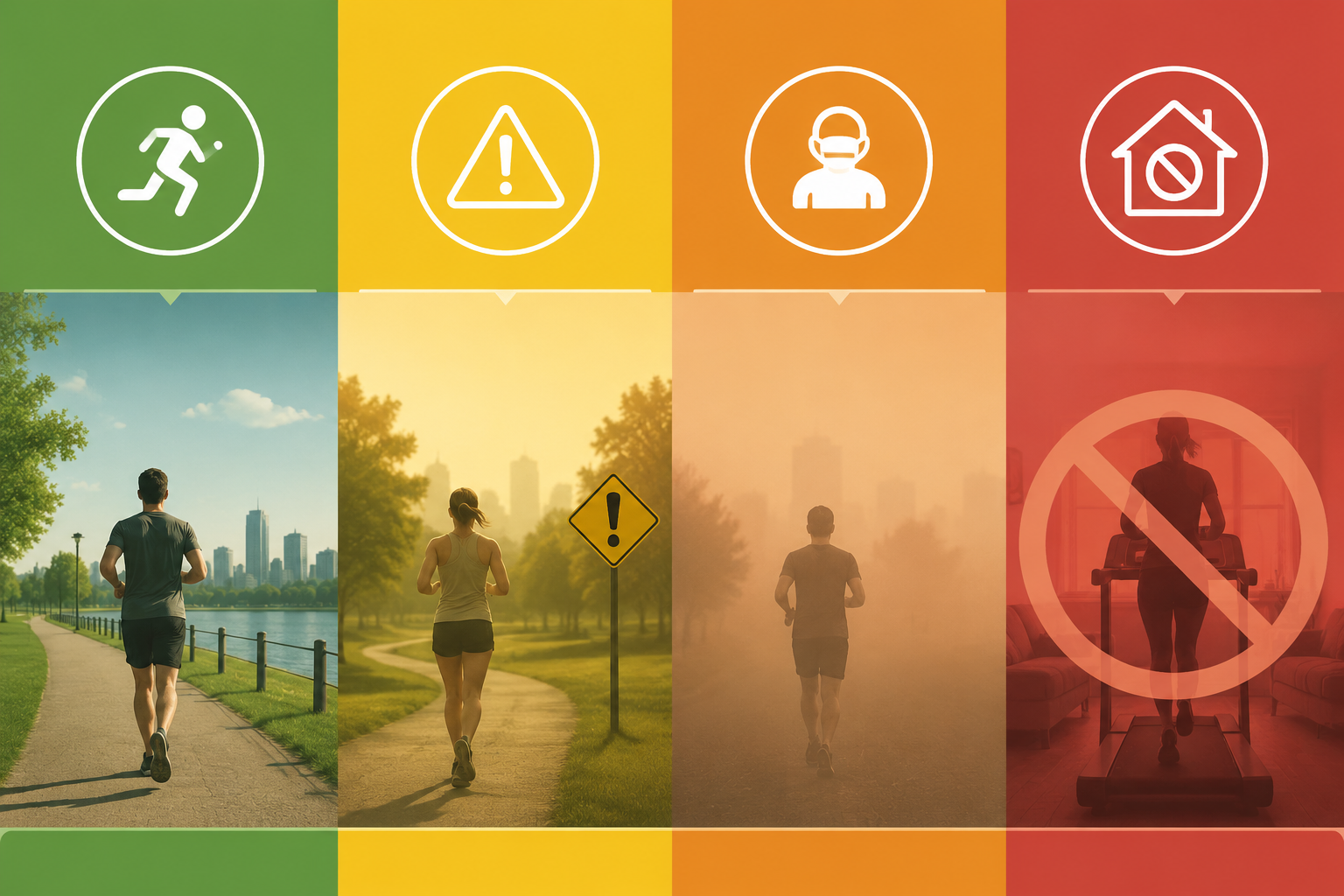
If your shoes are already tied and the air looks questionable, start with the AQI color, not with whether the run “feels fine.” For outdoor running, the cleanest rule is this: green means go, yellow means most runners can go with extra attention to symptoms, orange means sensitive runners should move indoors and everyone else should cut the workout down, and red or higher means take the run inside.

The AQI Running Rule
The American Lung Association points runners and other outdoor exercisers to the Air Quality Index as the practical starting point for deciding whether to exercise outside. The AQI color scale is not perfect medical advice for every body, but it is much better than sniffing the air, checking the sky, and letting the workout plan argue the case for you.[1]
| AQI | Color | Outdoor running decision |
|---|---|---|
| 0-50 | Green | Run outside as planned. |
| 51-100 | Yellow | Most runners can run; sensitive groups should monitor symptoms and consider easing the session. |
| 101-150 | Orange | Sensitive groups should move the workout indoors; other runners should reduce intensity or duration. |
| 151+ | Red or higher | Move the workout indoors. |
Sensitive groups include runners with asthma, heart disease, lung disease, or other respiratory conditions, plus older adults, children and teens, and people who are pregnant. That category matters. A group chat answer that works for a healthy 30-year-old on an easy day may be the wrong answer for someone whose lungs already have less margin.
Green, AQI 0-50, is the easy call. For a typical runner, this is the range where the public AQI guidance says air quality is satisfactory and outdoor activity can go on as planned.[1] You still listen to your body, but you do not need to turn every normal run into an air-quality negotiation.
Yellow, AQI 51-100, is where the answer splits. Most runners can still run outside, especially if the session is easy. Sensitive runners should treat yellow as a check-in point: symptoms count, medication plans matter, and an easy run may be smarter than intervals. This is not a panic range; it is a “do not autopilot” range.[1]
Orange, AQI 101-150, is where sensitive runners should stop trying to make the outdoor run happen. Move inside. For everyone else, the better adjustment is to reduce exposure: shorten the run, skip the hard workout, lower the pace, or change the session to something that does not keep breathing rate high for as long.[1]
Red or higher, AQI 151+, is the point where the decision should harden. The outdoor run is no longer worth the pollutant load that comes with heavy breathing during exercise. This is the day for a treadmill, bike, indoor circuit, mobility work, or a rest day that you do not have to apologize for.[1]
Why Running Is Different From Just Being Outside
The trap is that air quality can feel manageable while the workout changes the exposure. A slow walk to the mailbox, a commute from the car, and a tempo run are not the same event for your lungs.
Runner’s World cites the key runner-specific detail: during exercise, runners may breathe 15 to 18 times more air per minute than they do at rest.[2] That one fact explains why “I was outside earlier and felt okay” is not a solid running decision. The harder or longer the run, the more air you move through your airways, and with it, the more smoke, ozone, or fine particles available to irritate them.
This is also why intensity matters. If the AQI is borderline, replacing mile repeats with an easy jog is not just a training compromise; it changes how much air you pull in per minute. Cutting a 60-minute run to 30 minutes changes total exposure. Moving indoors changes the route entirely.
Symptoms still matter, but they should not outrank the AQI. Coughing, wheezing, chest tightness, unusual shortness of breath, dizziness, or eye and throat irritation are all reasons to stop or change the workout. The mistake is waiting for those symptoms before believing the air can be a problem.
Bad Air Can Matter Before It Looks Dramatic
Wildfire smoke makes the decision feel obvious when the sky turns orange. Smoggy or particle-heavy days can be more annoying because the cue is weaker. The air may not smell terrible. The path may look normal. The calendar may say workout day.
A 2023 study in Nature Scientific Reports looked at male NCAA Division I 5K runners and found that moderate PM2.5 exposure within AQI levels still classified as “good” was associated with race times that were 12.8 seconds slower.[3] That does not mean every recreational runner should expect the same performance hit, and the study should not be stretched beyond its sample. It does show that fine particulate exposure can matter before conditions look obviously awful.
For most neighborhood runners, the performance angle is not the main reason to check AQI. Health comes first. But it is useful evidence against the lazy version of the argument: if the air quality is not visibly terrible, it must be irrelevant. Running is already a high-ventilation activity, and fine particles do not need a dramatic backdrop to be worth respecting.
Check Before Momentum Takes Over
The best time to make the air-quality decision is before the warmup starts. Outside Online recommends checking the AQI before outdoor exercise and adjusting based on the color category, the workout, and personal risk factors.[4] That sounds almost too simple, but it solves the real problem: once the route is chosen and the watch is searching for GPS, runners get very good at bargaining.
- Check the current AQI for the place you will actually run, not just the nearest big city.
- Use the color category first: green, yellow, orange, red or higher.
- Account for the planned session: easy jog, long run, tempo, intervals, or race.
- Account for the runner: asthma, pregnancy, age, heart or lung conditions, recent illness, or unusual symptoms.
- Change the workout before you leave, not halfway through after you have already committed.
Runner-focused guides from Runstreet and Runcoach make the same practical point in different ways: poor air quality is not a toughness test, and smart adjustments include shortening the session, reducing intensity, choosing a cleaner time or place when conditions allow, or moving indoors when the AQI calls for it.[5][6]
Do not turn “how it feels outside” into a second, competing rule system. If it smells smoky, your throat burns, or visibility is low, those are warning signs. But a mild smell does not cancel an orange AQI, and feeling okay for the first mile does not make a red day a good training choice.
When the Right Run Is an Indoor Workout
The indoor pivot works best when it preserves the reason you were running in the first place. A poor-air day does not have to become a lost day; it just may not be an outdoor-running day.
| Original plan | Indoor replacement |
|---|---|
| Easy run | Easy treadmill jog, low-impact cardio, brisk indoor walk, or light bike session |
| Long run | Shorter treadmill run, split cardio session, or aerobic cross-training |
| Speed workout | Treadmill intervals only if indoor air and setup are appropriate; otherwise strength or mobility |
| Recovery run | Mobility, gentle yoga, easy cycling, or a true rest day |
| No equipment available | Bodyweight circuit, step-ups, low-impact cardio intervals, or app-guided home workout |
If poor-air days are becoming a regular part of your training year, even a small indoor setup can remove a lot of decision friction. A compact cardio option, a mat, and a few strength tools can be enough for the days when the AQI says no. For apartment-friendly ideas, start with home gym equipment for small spaces.
Runners who want a more permanent indoor fallback can also compare an all-in-one versus modular home gym. If the problem is less equipment and more structure, fitness apps for home workouts can keep the session from turning into ten minutes of scrolling followed by giving up.
One caveat belongs with every AQI rule: thresholds are general guidance, not personal medical clearance. Runners with asthma, heart or lung conditions, unusual symptoms, or specific medical concerns should follow their clinician’s advice. If symptoms show up during a run, the correct adjustment is not to win the argument with the plan; it is to stop, move to cleaner air, and get help if needed.
The repeatable habit is short enough to use at the door: check AQI, match the color to the running adjustment, respect personal risk factors, and move indoors when the color scale says the outdoor run is no longer worth it.
References
- Four Things to Know about Air Quality and Exercising Outdoors, American Lung Association
- Wildfires Running Safety, Runner’s World
- Nature Scientific Reports NCAA PM2.5 and 5K performance study, Nature Scientific Reports, 2023
- Air Quality Exercise Outdoors, Outside Online
- Running in Bad Air Quality, Runstreet
- Running in Poor Air Quality: Risks, Real Dangers & How to Run Smart, Runcoach
Comments
Join the discussion with an anonymous comment.