
The first test for home gym flooring for apartment use is not whether it looks clean under a squat rack. It is what happens in the ceiling below when a weight hits the floor. In manufacturer testing from Norsk-Store, a 20-lb dumbbell dropped on a bare apartment floor measured about 80-85 dB from the unit below; the same drop on a 0.47-inch, or 12mm, interlocking rubber tile measured about 60-65 dB below.[1]
That is the difference this whole project is trying to buy. A 20 dB drop does not make a deadlift session disappear. It changes a sharp, complaint-ready thud into something closer to a muffled bump. The useful claim is 60-70% less impact noise, not silence.[1]
That distinction matters because apartment gym noise is mostly not the sound of metal in the air. It is structure-borne impact: force traveling through rubber, subfloor, joists, and ceiling drywall until the person downstairs hears the building itself answer back. A mat that feels cushioned under your feet can still transmit a dull knock through the framing.
Aim for a quieter ceiling, not a thicker mat
A single thick-looking exercise mat is often where apartment gym soundproofing goes wrong. Foam can make pushups more comfortable and keep sweat off the floor, but it does not have enough mass or density to tame a dumbbell drop. The floor system has to slow the impact before it reaches the building.
Norsk-Store also reports that 12mm rubber tiles can improve Impact Insulation Class ratings by 20-25 points over a bare subfloor. The same source notes that building-code minimums are typically around IIC 50, while added gym flooring can push assemblies into the high 60s or low 70s; IIC 70+ is associated with better-performing condo conversion assemblies, not ordinary bare apartment floors.[1]
Treat those figures honestly: they are manufacturer-tested, not independently audited lab results for your exact building. Still, they are specific enough to be useful because they measure the thing that actually starts neighbor trouble: impact heard from below.
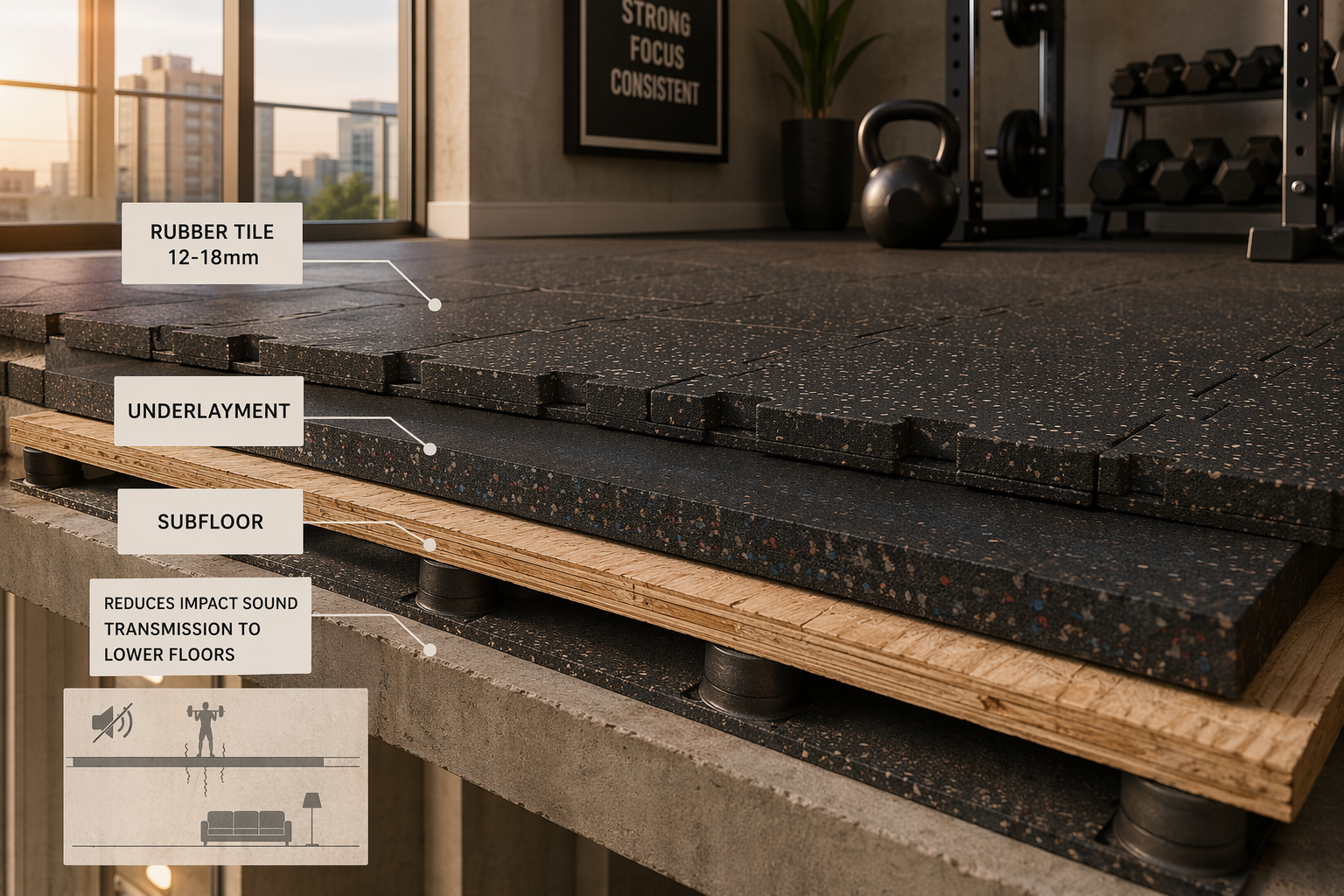
The apartment floor stack that actually makes sense
The quietest practical apartment setup is a stack, not one magic product. Each layer has a different job: mass, decoupling, localized absorption, and vibration control.
| Layer | Where it goes | What it does |
|---|---|---|
| 12-18mm rubber tile | Main workout area | Adds dense mass and reduces the first impact |
| Dense rubber underlayment | Under the tiles | Adds another separation layer between the gym surface and subfloor |
| Crash pads | Only where weights may land | Absorbs localized drops before they load the floor assembly |
| Vibration isolators | Under treadmills, bikes, racks, and machines | Limits repeated vibration and equipment hum traveling into the structure |
Start with 12-18mm rubber tile as the base. Norsk-Store describes this layer as the primary noise reducer, with 65-75% noise reduction in its apartment flooring methodology.[1] Living.Fit similarly treats rubber rolls at 8mm and thicker as the practical baseline for noise reduction in gym flooring, which lines up with the same basic idea: density matters more than softness.[2]
For renters, interlocking rubber tiles are usually the sweet spot. They are heavy enough to help with impact, they come apart when you move, and they let you cover the training zone without gluing rubber to someone else’s floor. Norsk-Store lists interlocking rubber tiles at about $3-7 per square foot in its apartment flooring guidance.[1]
The second layer is dense rubber underlayment under the tiles. Norsk-Store attributes another 10-15% reduction to this layer in its stack methodology.[1] Do not confuse that with soft packing foam or a yoga mat hidden underneath. A too-squishy layer can make the surface unstable under heavy dumbbells and still fail to interrupt the low thud that travels through the floor.
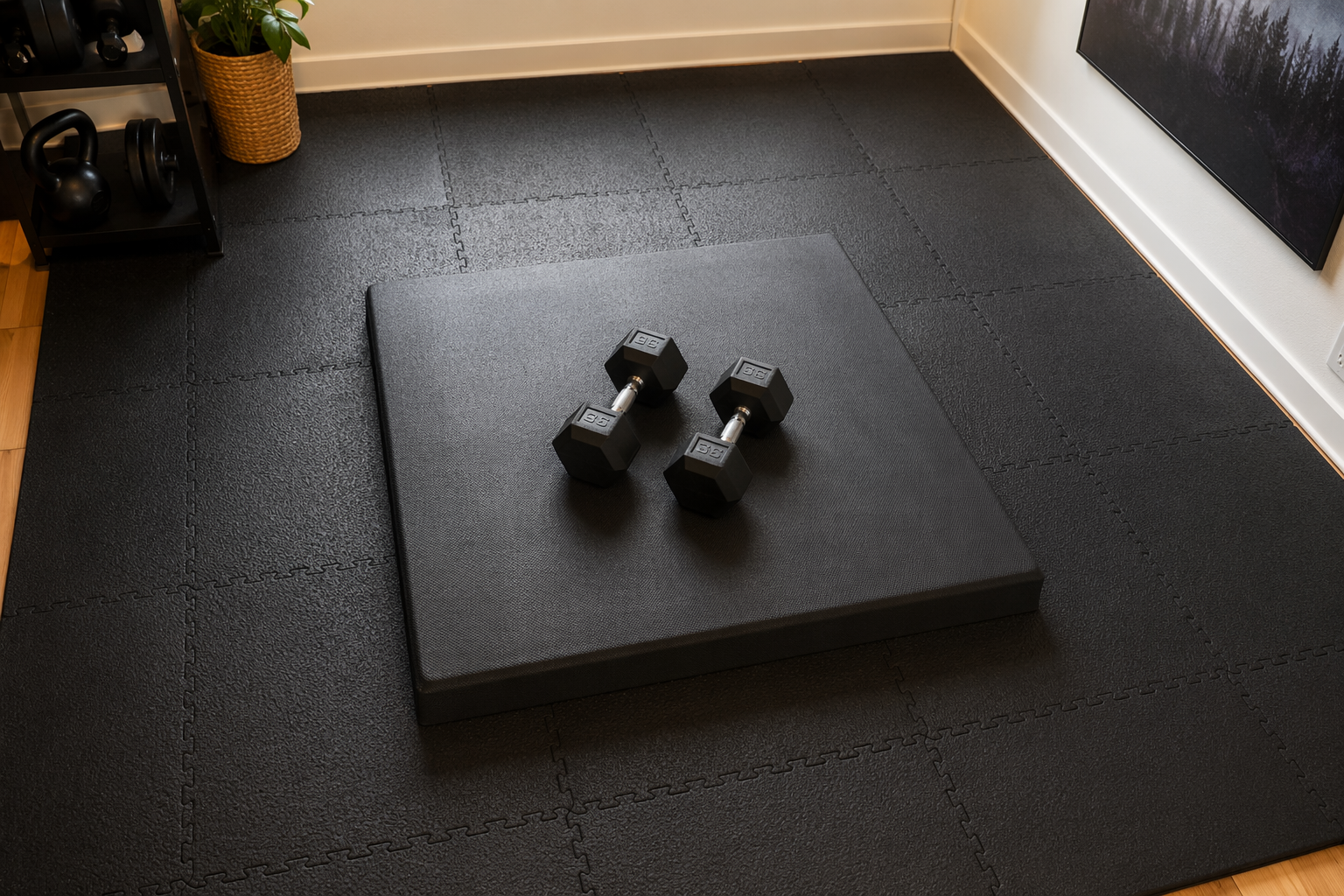
The third layer is not full-room flooring. It is a drop zone. Put 1-2 inch rubber or dense foam crash pads where dumbbells, kettlebells, or plates could actually touch down.[1] That means next to the bench, in front of the rack, or wherever you set adjustable dumbbells between sets. Covering the whole room in crash pads sounds safer, but it usually creates a wobbly training surface and wastes money where no impacts happen.
The fourth layer is for machines and racks. Treadmills, indoor bikes, rowers, and racks do not always create one big bang. They create repeated vibration. Equipment isolators under contact points help keep that vibration from coupling directly into the floor assembly.[1] This is especially important for treadmills, where the problem is not just footfall noise but a steady pulse that can turn a ceiling into a drum.
Choose the rubber format around your lease and your training
Material choice is less about finding the single best gym floor and more about matching the failure mode you are trying to prevent. A renter who trains with adjustable dumbbells in a living room has a different problem than a condo owner building a fixed lifting platform.
| Material | Best apartment use | Main tradeoff |
|---|---|---|
| Interlocking rubber tiles | Most upstairs apartment gyms | Good noise control and removability, with seams |
| Rolled rubber | Larger permanent or semi-permanent spaces | Quieter continuous surface, but often needs adhesive for a clean install |
| Horse stall mats | Budget-heavy setups where weight and odor are acceptable | Cheap and dense, but heavy and slow to air out |
| Workout mats | Bodyweight, stretching, light dumbbells | Comfortable, but not enough for serious impact control |
Horse stall mats deserve their reputation, but not every apartment deserves horse stall mats. Garage Gym Reviews and Gray Matter Lifting both treat 3/4-inch stall mats as a budget standard for home gyms; typical 4-by-6-foot mats run around $50, weigh roughly 100 lb each, and can have a strong initial rubber odor that takes 2-4 weeks to outgas.[3][4] That is a different kind of problem when the mat has to come up three flights of stairs, sit beside your sofa, and survive a landlord walkthrough.
Rolled rubber can be excellent underfoot, especially at 8mm and above, and Living.Fit identifies rubber rolls in that range as a gold-standard option for noise reduction.[2] The catch is installation. Rolled rubber wants to curl, shift, or be adhered depending on the room and product. Adhesive is exactly where many renters should slow down and read the lease before turning a soundproofing project into a floor-damage dispute.
Interlocking tiles avoid most of that drama. They are not perfect: seams can show, edges can creep if the room is not bounded, and cheap tiles can smell. But for an upstairs apartment gym, their balance of density, coverage, and removability is hard to beat.
Where a plywood platform belongs
A plywood-and-rubber platform is useful when the load is high and the impact is predictable. Garage Gym Reviews and Gray Matter Lifting both discuss the value of a 3/4-inch plywood platform topped with rubber for heavier lifting because plywood spreads force across a wider area before it reaches the subfloor.[3][4]
That matters for Olympic lifting and heavy barbell work. A platform can decouple the landing better than a single mat because the impact is not concentrated at one small contact point. It also gives you a flatter, more stable surface than stacking soft pads under your feet.
It is not the default answer for every renter. A platform is heavy, conspicuous, harder to move, and still not a permission slip to drop loaded barbells upstairs at night. In many apartments, the better call is a smaller rubber-tile zone with crash pads and a training plan that avoids true drops.
What does not solve floor impact
A few products show up in apartment soundproofing advice because they look acoustic. Most of them are solving the wrong problem.
- Acoustic foam wall panels: useful for airborne echo in a room, not for dumbbell impact traveling through the floor assembly.[1][2]
- Cork underlayment: too compressible for gym loads and not a strong choice under heavy equipment.[1]
- Rubber thinner than 8mm: usually too light to provide meaningful impact damping for weights.[1][2]
- Soft exercise mats alone: fine for mobility, core work, and light bodyweight sessions, but not a downstairs-neighbor strategy for dropped weights.
This is where many generic flooring guides become irritating. Easy cleaning and scratch protection are nice. They do not answer the harder question of whether the person below you hears every rep. If you only need mat-level comfort for stretching or light dumbbell work, a simple workout mat may be enough; if you are loading the floor with iron, it is no longer a mat-shopping problem.
Build the room around impact zones
Do not cover the apartment first and decide how to train later. Mark the spots where force actually enters the floor. That usually means the bench area, dumbbell change area, rack feet, treadmill feet, and any place a kettlebell might be parked between sets.
- Put 12-18mm rubber tile across the full training footprint.
- Add dense rubber underlayment beneath that footprint if the room below is occupied or complaint-prone.
- Place crash pads only where weights may land or be set down hard.
- Use vibration isolators under treadmills, bikes, rowers, racks, and other fixed equipment.
- Keep the heaviest work away from thin interior spans when the room layout gives you a choice.
A hypothetical example: if your bench sits on rubber tile but your adjustable dumbbells get changed on bare laminate beside it, the floor system is failing at the exact point of impact. Move the dumbbell stand and the set-down zone onto the layered area. The quietest square feet are the ones under the mistake you know you will eventually make.
The floor cannot fix the schedule
Even a good stack has a ceiling. Norsk-Store’s numbers make the reduction meaningful, but they do not turn an upstairs gym into a basement gym.[1] A muffled bump at noon and the same muffled bump at 11:30 PM are not socially equivalent.
Most apartment leases restrict noise-generating activities in a broad quiet-hours range around 9 PM-8 AM, so heavy lifting belongs outside that window whenever possible. A midday training window such as 10 AM-6 PM is lower-risk because fewer neighbors are sleeping, trying to put kids down, or expecting the building to be quiet.
This is not about becoming timid. It is about separating workouts by consequence. Strength work with controlled sets, machines on isolators, bands, bodyweight circuits, and quiet dumbbell sessions are much easier to justify in an apartment than repeated drops. For late sessions, choose quieter apartment-friendly workouts instead of asking the floor to absorb behavior it was never going to erase.
Tell the neighbor before the ceiling tells them
Neighbor communication sounds soft until you have lived under someone else’s “just one more set.” The floor reduces the physics. A heads-up reduces the surprise.
Norsk-Store cites an anecdotal observation that neighbors are 73% less likely to file complaints when they know you personally and have been told about scheduled gym times.[1] That number should not be treated as independent research. The practical point is still sound: people tolerate intermittent noise better when they know what it is, when it will end, and who to contact if it becomes a problem.
A useful message is plain: you have added rubber flooring, you are avoiding late heavy work, and you want to know if a particular exercise is carrying through. Do not make the neighbor become a detective. If the rack or dumbbell zone is the problem, you want to learn that while the fix is still a pad placement change, not after a formal complaint.
A realistic operating rule
A good apartment gym floor is a layered system: 12-18mm rubber tile, dense underlayment when the downstairs risk is real, crash pads where weights land, and isolators under vibrating equipment. That system can move a bare-floor 80-85 dB dumbbell impact toward the 60-65 dB range reported in manufacturer testing, which is a serious improvement.[1]
It is still an upstairs gym. Build the stack, avoid late heavy drops, tell the neighbor what to expect, and keep quieter workouts ready for the days when the floor system is not enough.
References
- Best Apartment Gym Flooring: Quiet Solutions for Renters (2026 Guide), Norsk-Store
- Best Gym Flooring for Noise Reduction & Quiet Training, Living.Fit
- Best Soundproof Exercise Mats (2026), Garage Gym Reviews
- The BEST Home Gym Flooring In 2026, Gray Matter Lifting
Comments
Join the discussion with an anonymous comment.