Shopping for compact home exercise equipment usually goes wrong before anyone compares motors, resistance levels, or app subscriptions. “Compact” can mean it fits under a bed, folds against a wall, uses less floor area than a full-size machine, or simply looks less offensive in a living room photo. Those are not the same problem. A top-floor renter worried about impact noise is not solving the same puzzle as a homeowner with a garage wall, even if both are searching the same product lists.
The audience is not small. Garage Gym Reviews, citing National Apartment Association data, notes that about 39 million Americans live in apartments, which makes the apartment version of home training a mainstream buying problem rather than a niche workaround.[1] The hard part is that apartment constraints are stacked: floor space, ceiling height, downstairs neighbors, lease rules, storage tolerance, budget, and the kind of training someone will actually do after the box is gone.
Start With the Constraint, Not the Product
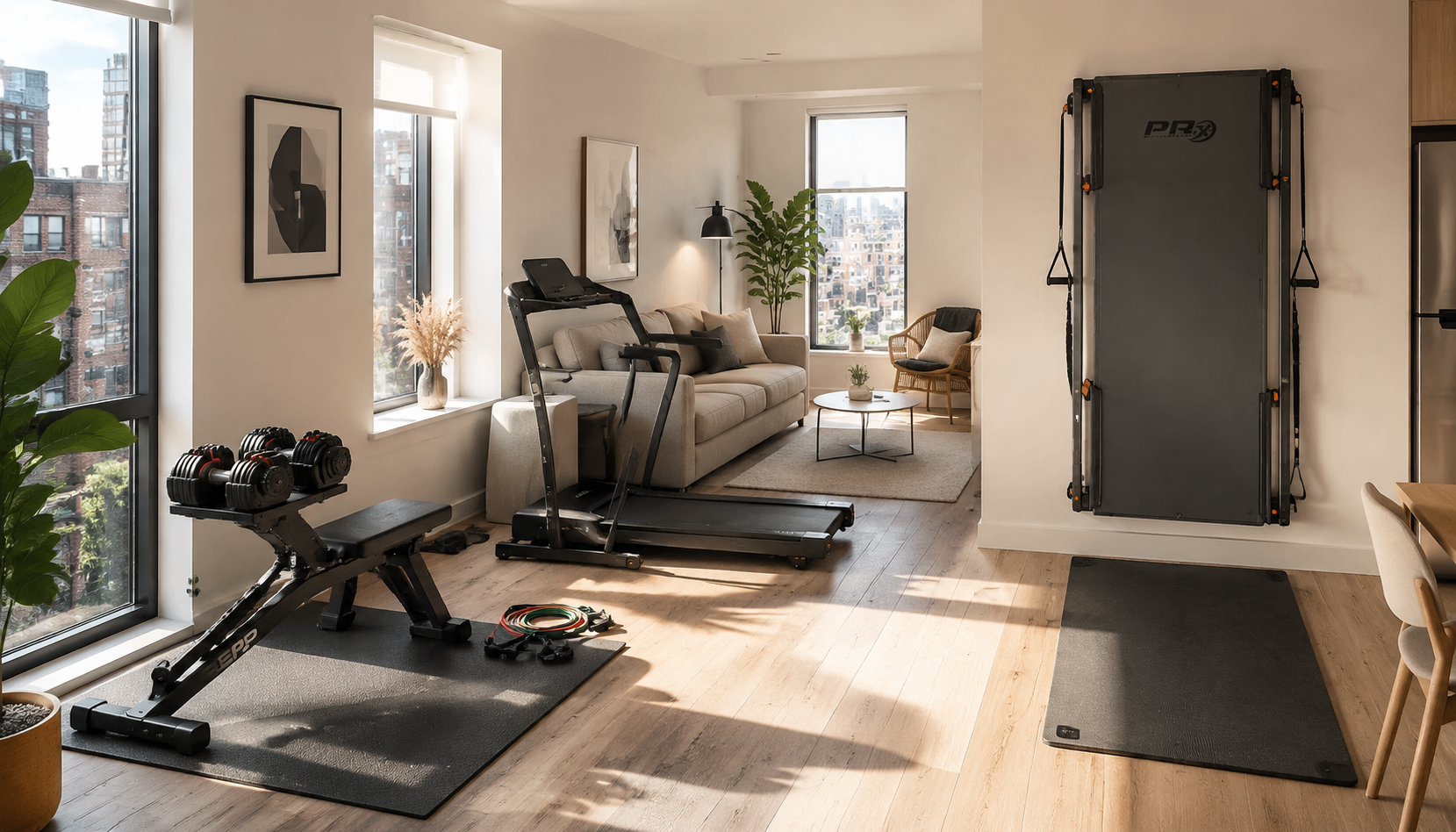
Before choosing an archetype, it helps to name the thing that would make the purchase fail. In small rooms, failure is rarely dramatic. It is the bench that never gets unfolded because it blocks the closet. It is the treadmill that technically stores flat but needs two awkward minutes of furniture shifting before each walk. It is the rack that folds beautifully to the wall but leaves a renter explaining new holes to a landlord.
| Constraint | What to Check Before Buying | Why It Changes the Recommendation |
|---|---|---|
| Usable floor area | Measure the open training area, not the whole room | A machine may store compactly but still need a larger working footprint |
| Ceiling height | Check standing presses, pull-up clearance, and machine step-up height | Low ceilings can rule out racks, pull-up stations, and some cardio machines |
| Noise tolerance | Think impact, vibration, dropped weights, and motor or flywheel sound | Quiet equipment matters more in upper-floor apartments than maximum intensity |
| Rental restrictions | Read the lease before mounting anything into studs or masonry | Wall-mounted systems can be excellent only when installation is allowed |
| Storage tolerance | Decide whether gear can stay visible or must disappear between sessions | Folded size matters only if the folded object can live somewhere practical |
| Training goal | Choose strength, cardio, general conditioning, or cable-based training first | A compact setup that misses the goal becomes expensive clutter |
For most apartment buyers, the answer falls into one of three workable shapes: Minimalist Strength, Quiet Cardio Plus, or an All-in-One Cable System. These are not official product categories. They are practical routes through the same cramped-room problem.
The Three Compact Home Gym Archetypes
| Archetype | Typical Setup | Best Fit | Main Compromise |
|---|---|---|---|
| Minimalist Strength | Adjustable dumbbells, adjustable or folding bench, resistance bands, mat | Renters who want strength training under roughly 6 square feet | No built-in cardio and limited very-heavy barbell work |
| Quiet Cardio Plus | Foldable treadmill, bike, or compact elliptical with mat and light bands | Apartment dwellers who need low-impact conditioning under roughly 10 square feet | Strength training stays limited unless paired with separate weights |
| All-in-One Cable System | Wall-mounted or foldaway trainer, sometimes with rack or smart resistance | Buyers with budget, wall permission, and a dedicated training wall | Higher cost and installation burden |
The cleanest way to use the table is not to ask which setup is best. Ask which compromise you can live with. Every compact setup gives something back to the room by taking something away from the training experience, the budget, or the lease.
Archetype 1: Minimalist Strength
If someone asked me for the most broadly useful apartment setup, I would start here: adjustable dumbbells, a bench, bands, and a floor mat. Not because it looks exciting, but because it solves the most apartment problems at once. It stores small, makes little machine noise, avoids permanent installation, and leaves room for real progression.
The footprint can stay under roughly 6 square feet when stored, depending on the bench and dumbbell cradle layout. The budget usually lands around $500–$1,500 if the buyer is building around quality adjustable dumbbells and a stable bench rather than the cheapest possible pair of spin-lock handles. For renters, the lack of mounting is the quiet advantage: no studs, no drilling, no argument about whether a rack is “furniture.”
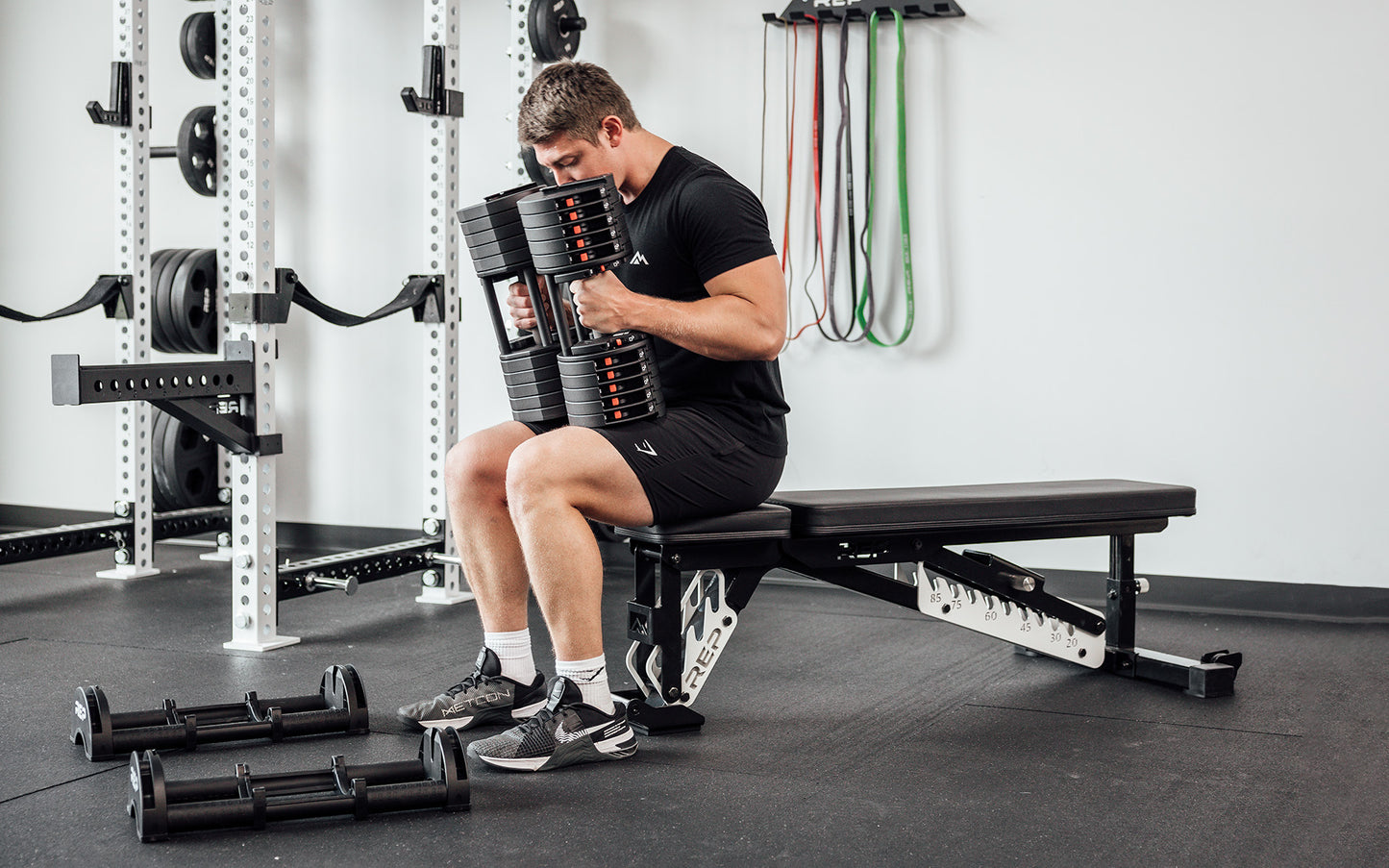
The best example of why this category works is the adjustable dumbbell itself. Garage Gym Reviews’ June 2026 testing lists REP QuickDraw Adjustable Dumbbells at $335.99–$599, replacing up to 12 pairs of dumbbells, with 5-out-of-5 scores for durability and adjustment speed.[2] That does not mean every buyer needs that exact model. It does show why this archetype is so efficient: the space saved is not cosmetic. It removes an entire dumbbell rack from the apartment.
The working footprint is larger than the stored footprint. A bench press, split squat, Romanian deadlift, or dumbbell row needs clearance around the body, not just a spot where the gear can sit. This is where small-space buyers often fool themselves. A pair of dumbbells in a corner is compact; a person lunging with them is not. Measure the movement, not the object.
Noise is lower than with running, jumping, or many cable stacks, but it is not zero. Dumbbells placed down gently on a dense mat are apartment-friendly. Dumbbells dropped after a hard set are not. If the downstairs neighbor is sensitive, the mat is not optional, and neither is the habit of controlling the last rep.
This route is strongest for people who want strength training, body composition work, and enough variety to train for months without turning the room into a gym. It is weaker for buyers who primarily want indoor walking, long cardio sessions, or machine-guided training. If the real goal is daily low-impact cardio while watching a show, buying dumbbells because they are compact is just another way to buy the wrong compact thing.
Readers who choose this path can treat the companion 8-week dumbbell-and-bench plan as the next decision: not what to buy, but how to make the equipment earn its floor space.
Archetype 2: Quiet Cardio Plus
Quiet cardio is where the word compact gets especially slippery. A machine can be small and still annoying. It can fold and still be a nuisance. It can be low-impact for the knees but not low-vibration for the floor. For apartments, the better question is: can this machine be used often without making the rest of the building aware of the workout?
This archetype usually fits someone who wants a foldable treadmill, compact elliptical, or bike, plus a mat and a small resistance-band kit. The budget commonly lands around $600–$1,500. The stored footprint can stay under roughly 10 square feet, but the exact answer depends on whether the machine folds vertically, folds flat, or simply occupies less floor area than full-size cardio equipment.
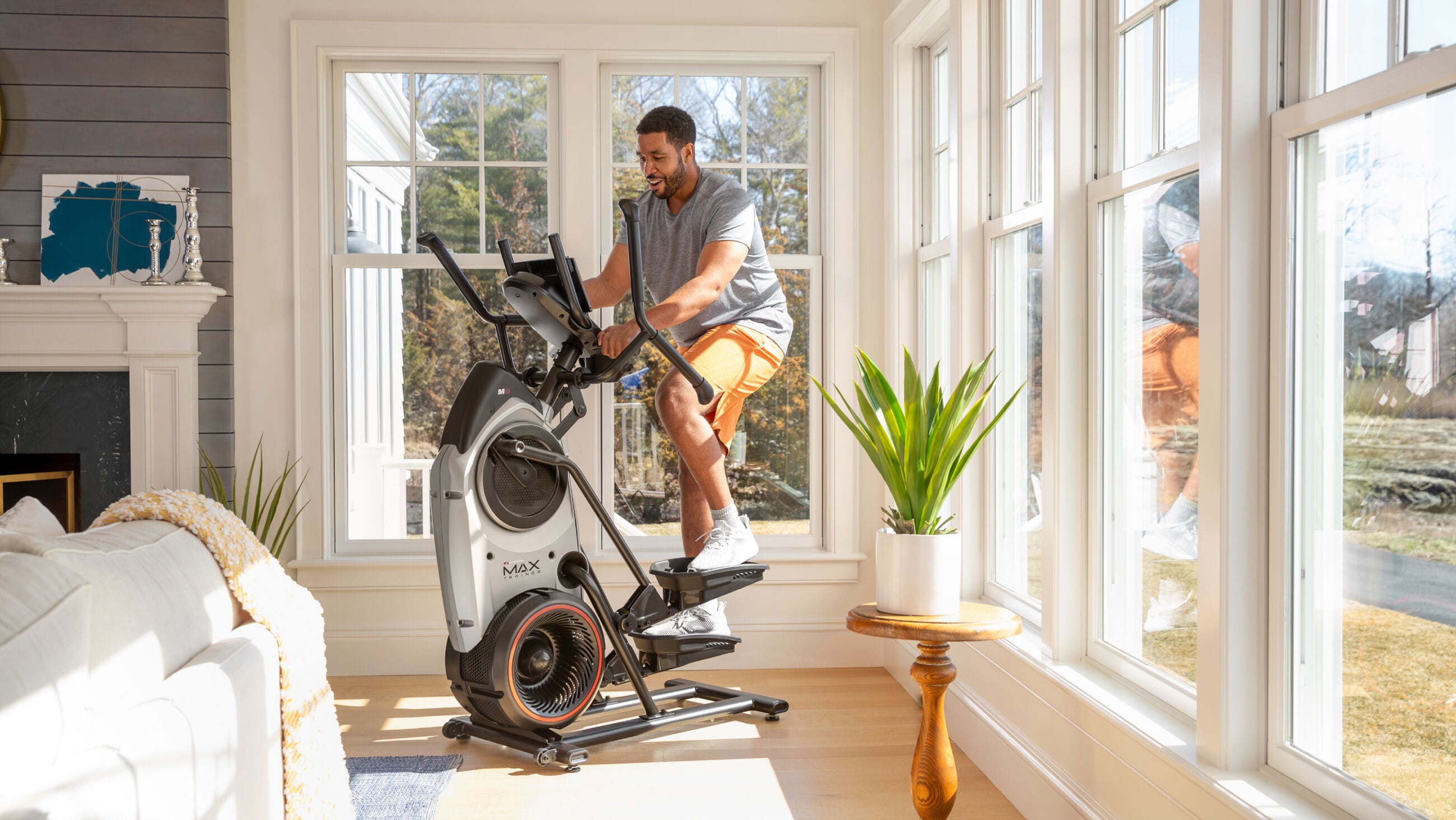
The Bowflex Max Trainer M6 is useful as a space example because Garage Gym Reviews lists it at 46 inches long by 26 inches wide and describes that as more than a 35% space reduction compared with typical ellipticals.[3] That kind of reduction matters in a furnished room. It means the machine may claim a corner rather than a whole wall. It does not mean it disappears.
A flat-folding treadmill solves a different problem. Garage Gym Reviews identifies the Echelon Stride 6s-10 as a treadmill that folds completely flat for bed storage.[3] That is not the same advantage as a compact elliptical. The elliptical saves floor area while remaining present; the flat-folding treadmill can leave the room visually, provided the buyer has a bed, sofa, or storage gap that actually accepts it.
This is where pre-purchase measuring needs to get annoyingly literal. Measure the storage destination, the route to it, and the clearance needed to fold the machine. In a small apartment, “stores under the bed” can fail because of a center bed support, a rug lip, a tight hallway turn, or the simple fact that the buyer does not want to drag a heavy machine twice a day.
Noise deserves careful wording. This article is using equipment type, floor interaction, and tester comments as practical signals; it is not relying on lab-measured decibel readings. In practice, bikes and many ellipticals are usually safer apartment bets than running treadmills because they avoid repeated foot strike. Walking treadmills can work, especially on a good mat, but a top-floor renter should treat impact and vibration as the real issue, not just motor sound.
Quiet Cardio Plus is the better archetype when the main habit is steady movement: walking during calls, low-impact intervals, or conditioning that does not depend on heavy resistance. The “plus” matters because bands or light dumbbells can cover warmups, mobility, and a little strength work without pretending the setup is a complete strength gym.
Archetype 3: All-in-One Cable System
All-in-one systems are seductive in small rooms because they promise the one thing apartment dwellers want most: capability that gets out of the way. Sometimes that promise is real. Sometimes it is real only for owners, not renters.
This archetype includes wall-mounted functional trainers, smart cable systems, and foldaway rack setups. The typical budget is much higher, around $2,000–$4,500, and the stored footprint can be impressively small. But stored footprint is only one column in the decision. Installation, wall structure, ceiling clearance, subscription costs, and lease permission become part of the equipment.
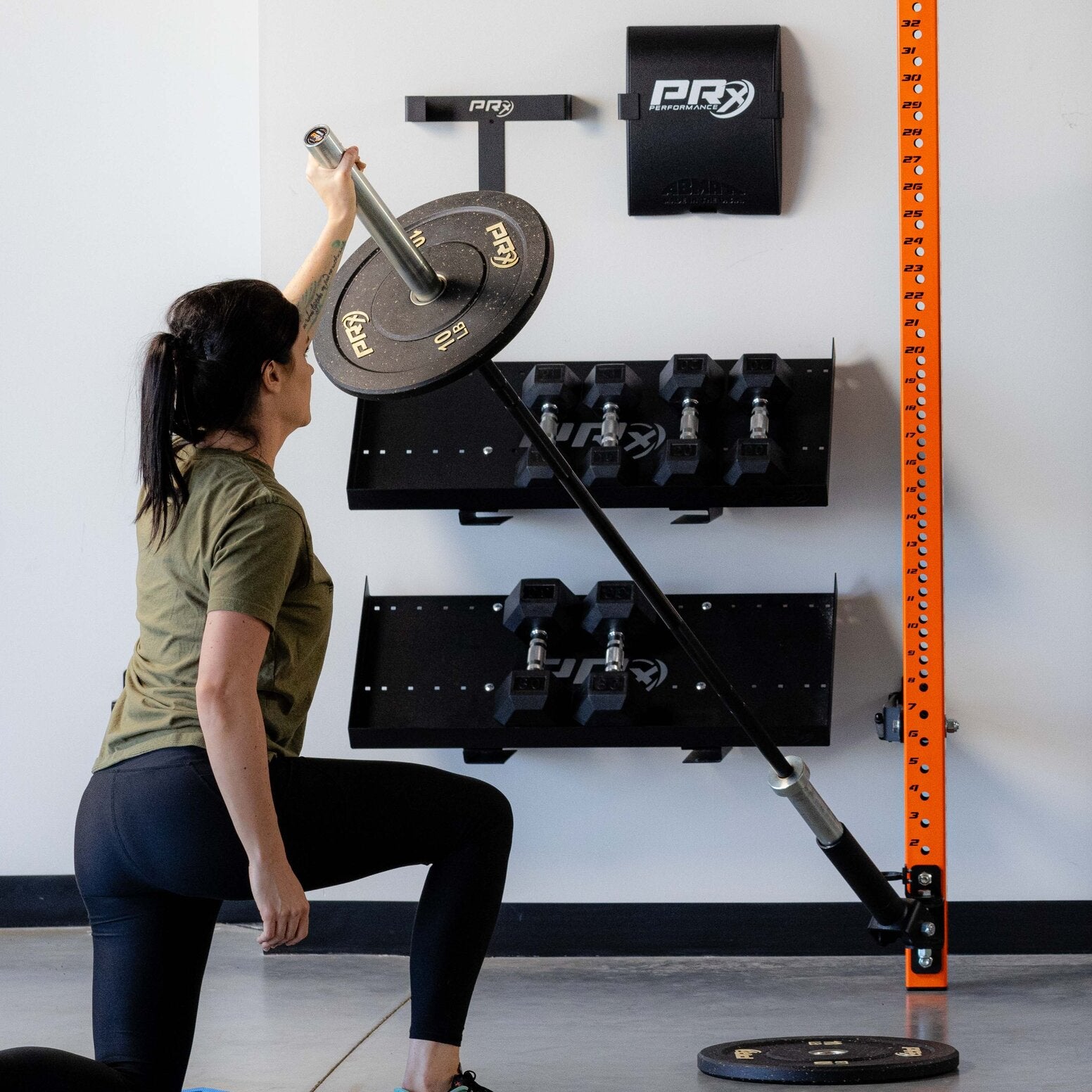
The PRx Profile PRO Squat Rack shows both the appeal and the catch. Garage Gym Reviews notes that it folds to a 12-inch depth and has a 1,000-pound capacity, which is an impressive combination for reclaiming space after barbell training.[4] For the right wall, the right ceiling height, and the right permission, that is a clever answer. For a renter without landlord approval, it is not a compact solution; it is a lease problem waiting to happen.
Cable-based systems also change the training feel. They can make rows, presses, pulldowns, chops, and assisted movement patterns easier to set up than a dumbbell-only corner. They are especially attractive for people who want guided resistance or who dislike handling several separate pieces of gear. The tradeoff is that the system becomes the room’s infrastructure. If it breaks, needs service, requires an outlet, or demands a subscription to feel complete, the small footprint is not the whole cost.
This archetype fits homeowners, long-term renters with explicit mounting permission, and buyers who have already decided that cable training is the center of their routine. It is overkill for someone who has not yet built the habit, and it is a bad first purchase for anyone who is unsure whether the training wall can legally or physically support it. Readers comparing smart or cable-first options can go deeper in the smart home gym systems for apartments guide.
Use This Quick Routing Test
- Choose Minimalist Strength if you want progressive resistance, low noise, no installation, and can leave room to move around a bench.
- Choose Quiet Cardio Plus if your main goal is frequent low-impact movement and you can tolerate a machine that either stays visible or must be moved for storage.
- Choose an All-in-One Cable System if you have the budget, wall permission, ceiling clearance, and enough certainty that cable training will be the core habit.
- Step down to a lower-cost setup if the realistic budget is under $500; a partial setup used consistently is better than a premium system bought too early.
- Delay the purchase if the equipment requires a storage action you already know you will avoid after a long day.
For a more granular pre-purchase filter, use the constraint-based compact equipment guide before looking at individual products. If you already know the archetype and want product-level comparisons, the broader small-space home exercise equipment guide is the more natural next stop.
Two Details That Decide More Than Buyers Expect
Flooring is part of the equipment
A mat does not make bad apartment behavior harmless, but it can reduce slipping, protect flooring, and soften some vibration. Minimalist Strength usually needs a dense lifting surface where dumbbells land. Quiet Cardio Plus needs a machine mat sized to the full contact area. Cable and rack systems may need a more deliberate zone plan, especially if the user is stepping, pulling, or setting down attachments in the same area.
Apartment buyers should look at home gym flooring for apartments before ordering heavy equipment, and the zone-based flooring guide if the room has to switch between living, working, and training.
Budget should include the missing pieces
The equipment price is not always the setup price. A dumbbell setup may still need a bench and mat. A cardio machine may need delivery help, a protective mat, and a storage plan. A cable system may need installation hardware, professional mounting, accessories, or a subscription. Pricing and dimensions cited here are current to June 2026 where the research source provides that timing, but seasonal discounts and model changes can move the final number.
If the real ceiling is lower than the archetype budgets above, the better next read is how to build a budget home gym under $500. It is better to start with fewer pieces than to buy a compact machine that is still too expensive to support with the basics around it.
Where the Recommendation Lands
For most renters, Minimalist Strength is the safest first answer because it combines low noise, low installation burden, real training range, and a stored footprint that can stay genuinely small. Quiet Cardio Plus is the better answer when the habit depends on daily movement and neighbor-friendly conditioning. All-in-One Cable Systems are powerful, but they stop being renter-friendly the moment the wall, lease, or budget says no.
That is the useful split. Compact home exercise equipment is not a single category with one winner. It is a set of compromises that should match the room someone actually has to live in after the workout ends.
References
- Best Workout Equipment for Apartments (2026), Garage Gym Reviews
- Expert-Tested: The Best Compact Exercise Equipment (2026), Garage Gym Reviews
- Best Home Gyms (2026) Personally Tested, Garage Gym Reviews
Comments
Join the discussion with an anonymous comment.