
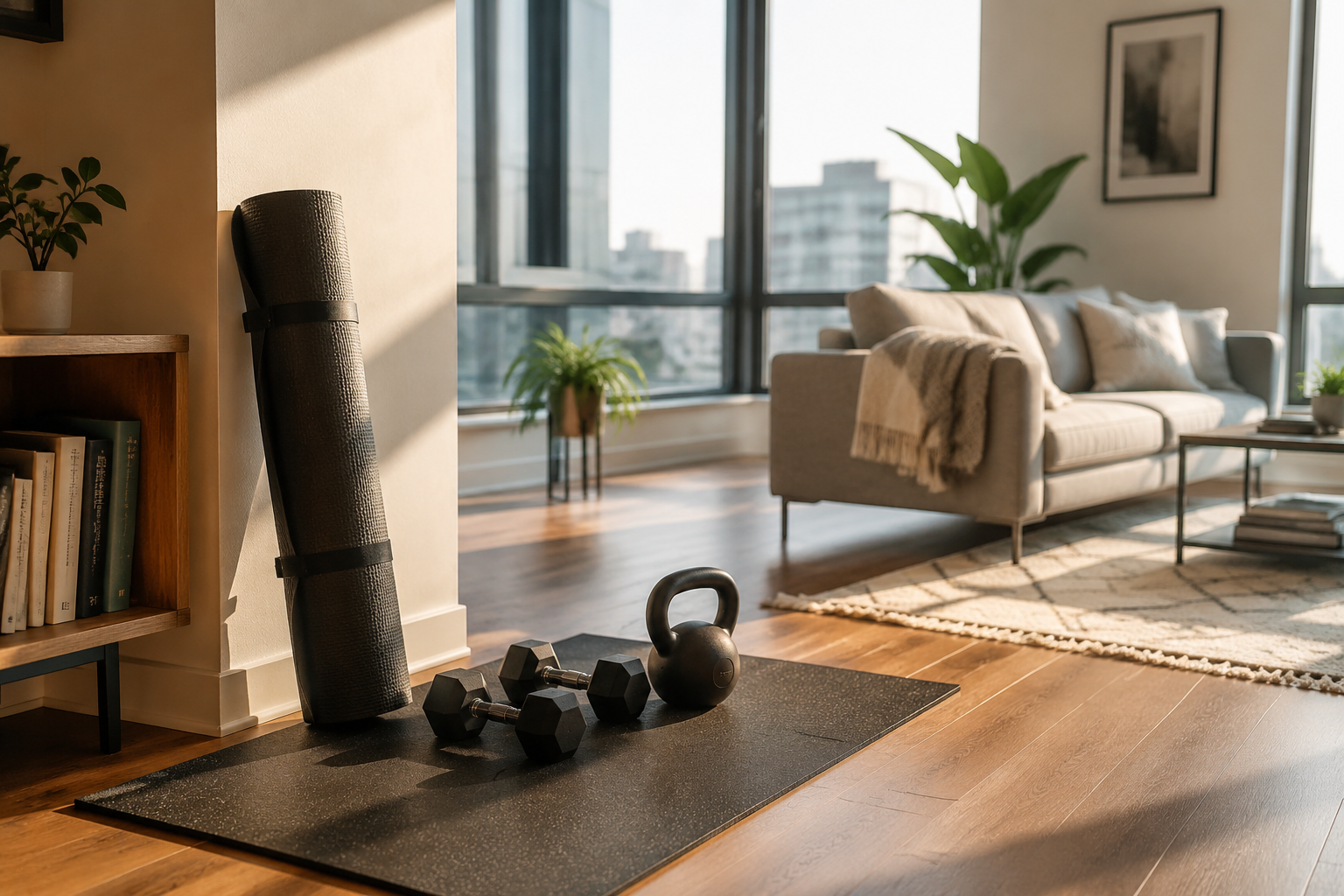
A small home gym mat has a harder job than most product pages admit. In a garage, flooring can stay down forever and look like flooring. In an apartment, spare bedroom, or living room corner, one mat may need to protect finished wood or laminate, keep dumbbells from chewing up the floor, soften some impact noise, stay put during lunges, and then get out of sight before the room turns back into a room.
That is why the useful question is not simply which workout mats for home gym use are thickest. For mixed small-space training, a dense rubber roll-up mat around 6–8mm is usually a better starting point than a thicker, lighter foam tile. Garage Gym Reviews treats 8mm flooring as an all-purpose thickness for mixed cardio and light-to-moderate strength work, and soundproof mat testing points in the same direction: density and the layers under the mat matter more than thickness alone for reducing impact noise transmission.[1][2]
Start With the Room, Not the Mat Category
Before choosing rubber, foam, tiles, rolls, puzzle edges, or stall mats, picture the actual floor. Are you doing slow mobility work beside a bed? Kettlebell swings near a sofa? Step-back lunges on hardwood? Dumbbell presses in a room where someone downstairs can hear heel strikes? The answer changes the mat.
A mat for yoga, stretching, and bodyweight work can prioritize cushion and low weight. A mat for dumbbells, kettlebells, jump rope alternatives, burpees, or standing strength work needs more density and less squish. If the room has to look normal again after training, the mat also needs to roll, lift, slide behind a door, or stack without becoming another piece of furniture.
The practical decision is less about finding one universal best mat and more about matching the mat to two things: what happens on top of it, and what the room has to do afterward.
The Short Version: Which Mat Fits Which Workout?
| Workout setup | Better mat choice | Why it fits |
|---|---|---|
| Yoga, mobility, stretching, core work | EVA foam or a cushioned exercise mat | Comfort matters more than load stability |
| Bodyweight circuits with light movement | Dense foam or thin rubber | Enough cushion without much equipment load |
| Dumbbells, kettlebells, bands, mixed cardio | Dense rubber roll-up mat around 6–8mm | Better stability, floor protection, and relative impact control |
| Regular barbell drops or heavy deadlifts | Thicker rubber flooring or stall-mat-style coverage | Higher impact protection, but less portable |
| Multi-use apartment room | One roll-up rubber mat before tiles or permanent coverage | Easier to move, clean, and store |
This table is deliberately plain because most small rooms do not need a flooring system. They need a surface that solves the next workout without creating a new storage problem.
Rubber Versus Foam Is Really Stability Versus Cushion
Foam gets popular for good reasons. It is light, cheap in many sizes, soft under knees and elbows, and easy to assemble as interlocking tiles. If your home training is mostly stretching, Pilates-style floor work, yoga, mobility, or low-load bodyweight work, EVA foam can be the right answer. Comfort is not a fake requirement; a mat that makes floor work tolerable gets used more often.
The trouble starts when foam thickness is treated as protection. Living.Fit describes rubber flooring as lasting 10–20 years under normal home gym use, while EVA foam may compress and degrade within 6 months to 3 years under similar use conditions.[3] Greatmats also notes the functional difference that matters under weights: foam can feel comfortable for bodyweight movement but becomes less stable for standing lifts because it compresses under load.[4]
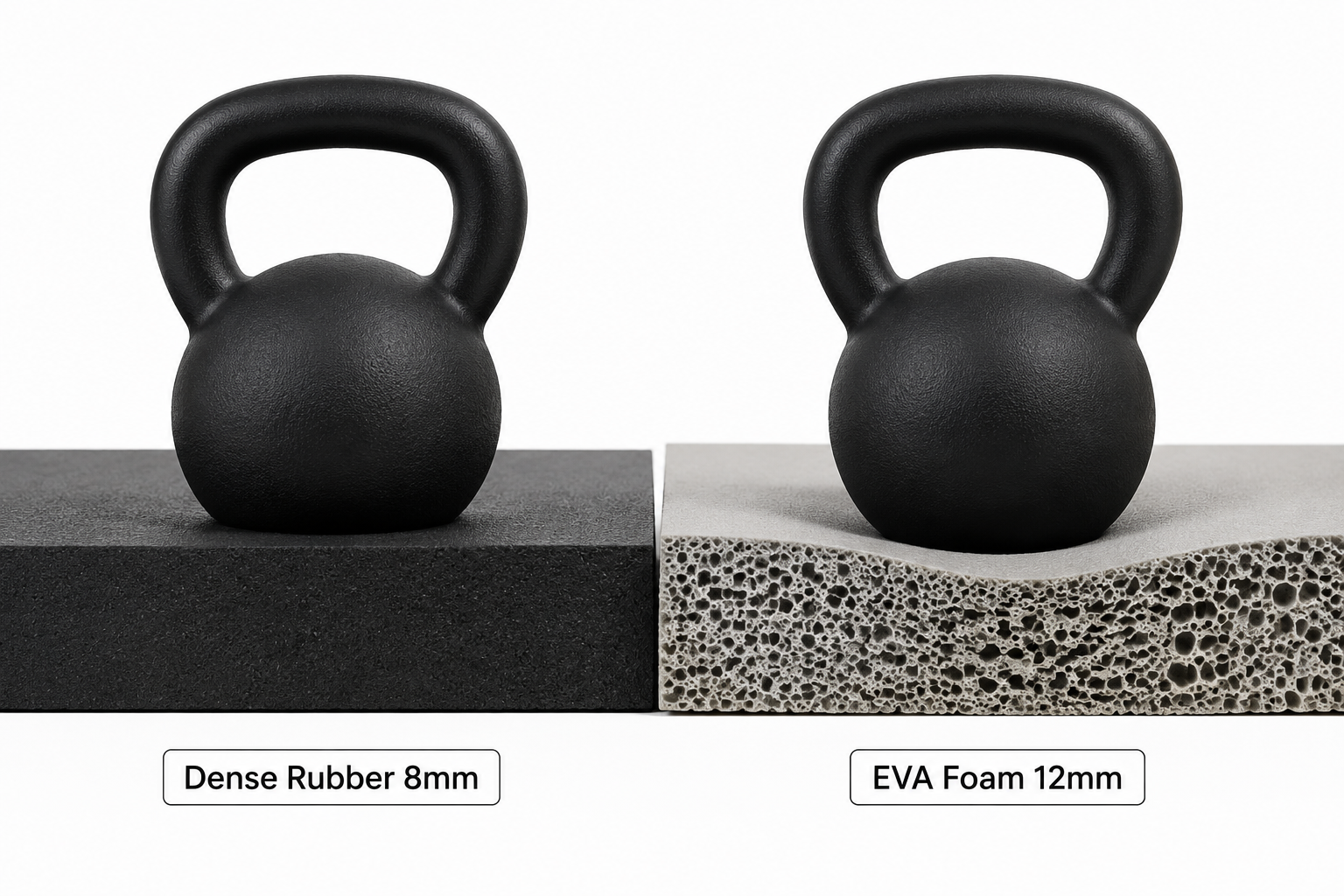
That compression is not just cosmetic. A dumbbell resting on soft foam can leave dents. A kettlebell placed down quickly can push through the cushion more than expected. During a loaded split squat or hinge, a squishy surface can make the foot and ankle work against the mat instead of the floor. None of that means foam is useless. It means foam is best kept in its lane.
Rubber earns its place when the workout includes equipment. Dense rubber resists compression better, grips the floor more consistently, and gives a firmer surface for standing movement. It is also less pleasant in a few very real ways: it can smell at first, it is heavier to move, and thicker rubber is not something most people casually roll up after dinner.
What Thickness Actually Means
Thickness is easy to compare online because it is a number. Density is harder to see, so it gets skipped. That is how a 12mm foam tile can look more protective than an 8mm rubber mat even when the rubber is the better small-gym surface for loaded training.
For a mixed apartment setup—dumbbells, kettlebells, resistance bands, bodyweight intervals, maybe some low-impact cardio—8mm rubber is a sensible middle. It is thick enough to be useful for general home gym work without crossing into the heavy, semi-permanent feel of commercial flooring or stall mats. Garage Gym Reviews identifies 8mm as a strong all-purpose thickness for mixed cardio and light-to-moderate strength work.[1]
Once intentional drops enter the picture, the mat category changes. Rubber Surface recommends at least 1/2-inch flooring for regular barbell drops and 3/4-inch flooring for heavy deadlifts.[5] That is a useful dividing line for apartment readers because it separates ordinary small-space strength training from activities that ask too much of a roll-up mat, and possibly too much of the building.
A dense 6mm rubber mat can still work for light dumbbell training and floor protection when storage matters. An 8mm mat gives more margin for mixed movement. A 1/2-inch or 3/4-inch rubber setup belongs to heavier lifting, more permanent zones, or rooms where weight, odor, and storage are acceptable trade-offs.
Noise Reduction Is Relative, Not Magic
A mat can reduce impact and vibration, but it cannot make jumping, dropping, or fast footwork disappear in a quiet apartment building. Soundproof mat testing emphasizes that density and underlayment matter more than thickness alone, which is why a dense rubber surface can outperform a thicker light foam mat for impact behavior.[2]
The practical takeaway is to avoid treating “apartment-friendly” as a guarantee. A rubber mat may make kettlebell set-downs duller, soften heel contact, and reduce floor scuffs. It will not turn overhead drops, repeated jumps, or heavy deadlift misses into neighbor-proof activities. In a shared building, exercise selection still does part of the noise control.
Check the Backing Before It Touches Hardwood
Finished floors introduce a second problem: the underside of the mat. A top surface can look perfect while the backing quietly traps grit, holds moisture, or leaves texture pressed against wood or laminate. Garage Gym Reviews recommends smooth-backed mats with a non-slip coating over textured or grooved bottoms for finished hardwood because grooves can trap moisture and dirt.[6]
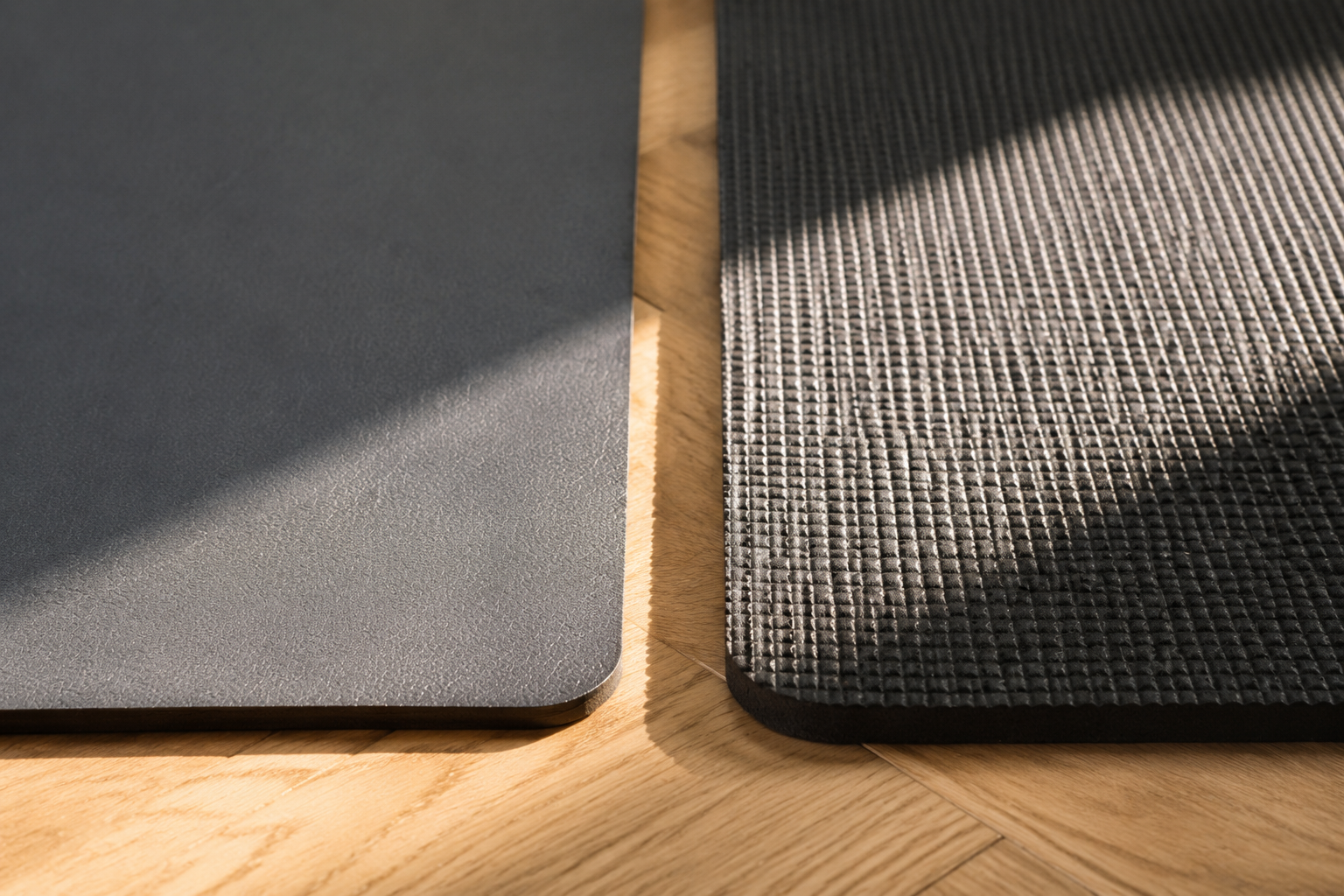
This matters more in a multi-use room than in a garage. In a living room, dust, pet hair, tracked-in grit, and spilled water are already part of life. A mat that gets rolled and unrolled can drag that grit across the finish if the underside is rough or dirty. If the mat stays down for days, trapped moisture becomes the thing to avoid.
For hardwood, laminate, or vinyl, look for a smooth underside, enough grip to prevent sliding, and a material that can be lifted for floor cleaning. If the manufacturer warns against use on a particular floor finish, take that more seriously than the product photo of someone doing mountain climbers in a spotless apartment.
Roll-Up Mats Beat Tiles When the Room Has to Reset
Puzzle tiles look modular, and modular sounds small-space friendly. Sometimes it is. If the mat will stay assembled in a corner, tiles can cover an awkward area and replace one damaged piece later. But if the room has to reset after every workout, tiles become a chore: edges separate, seams catch dirt, and the assembled square is often more annoying to move than expected.
A single roll-up rubber mat is less dramatic and usually more livable. It creates one continuous surface, has fewer seams to collect grit, and can lean behind a door or slide under a bed if the size and weight are reasonable. For many apartments, that is the real premium feature: not maximum coverage, but low-friction setup and cleanup.
Size still matters. A mat around 4 feet by 6 feet gives enough room for floor exercises, a pair of dumbbells, and most kettlebell work without claiming the entire room. Smaller mats are easier to store but can create the irritating problem of stepping partly on and partly off the mat during lunges or lateral work.
The Stall Mat Temptation
Rubber stall mats deserve a mention because they are the value benchmark in home gym flooring. Garage Gym Reviews cites Tractor Supply 4-foot by 6-foot rubber stall mats at about $57 each, or $2.38 per square foot, with one mat covering roughly 24 square feet.[7] For a garage, basement, or semi-permanent lifting corner, that math is hard to ignore.
For an apartment, the same mat becomes less charming. The common stall mat downside is clear: about 94 pounds per mat, strong initial rubber odor, and too much thickness and weight to roll up and store between workouts. Carrying one upstairs is not a clever budget hack if the mat then makes the room smell like a tire aisle and cannot be moved without planning.
The stall mat is not a bad product. It is a bad default for someone whose home gym vanishes after training. Use it as a price and durability reference, not as proof that every small-space buyer should accept a semi-permanent slab of rubber.
Odor, Cleaning, and Price Are Secondary Until They Are Not
Rubber smell is not a detail if the mat lives in a bedroom. Some rubber products off-gas more strongly at first, and cheaper heavy rubber can be harder to tolerate in small rooms. If odor sensitivity matters, the safer move is to buy from a retailer with clear return terms, unpack the mat in a ventilated area when possible, and avoid assuming that every rubber mat will behave like a boutique yoga mat.
Cleaning should be boring. That is the point. A continuous rubber mat with a smooth underside and limited seams is easier to wipe, lift, and vacuum around than a field of puzzle tiles. Foam can be easy to wipe on top, but seams and texture complicate things once dust, sweat, pet hair, and floor grit get involved.
Price comparisons also need a little humility. Per-square-foot prices from 2025–2026 sources vary by region and retailer, and commercial guides often blend education with product marketing. A cheap mat that dents quickly, slides under movement, or cannot be stored conveniently is not necessarily cheaper in the room where it has to live.
A Practical Buying Filter
- If your workouts are mostly bodyweight, stretching, yoga, or mobility, choose comfort first and consider EVA foam or a cushioned exercise mat.
- If you use dumbbells, kettlebells, bands, or mixed circuits, start with dense rubber around 6–8mm rather than thicker light foam.
- If you regularly drop barbells, move beyond roll-up mats and look at thicker rubber flooring around the 1/2-inch to 3/4-inch range.
- If the mat sits on finished wood or laminate, favor a smooth non-slip backing and lift the mat often enough to clean underneath.
- If the room has to reset daily, treat roll-up weight and storage size as performance features, not afterthoughts.
The best small-space mat is the one that makes the next workout easier without making the next hour of normal life harder. For most apartment and multi-use rooms with dumbbells, kettlebells, cardio intervals, or mixed movement, that points to one dense rubber roll-up mat around 6–8mm. Use foam when bodyweight comfort matters more than load stability. Save stall-mat-style solutions for spaces that can tolerate the weight, odor, and semi-permanent setup.
Once the floor decision is settled, the next question is what equipment the space can realistically handle. A compact mat creates the boundary; the dumbbells, kettlebells, bench, bands, or storage plan should fit inside it rather than slowly taking over the room.
References
- How Thick Should Gym Flooring Be, Garage Gym Reviews
- Best Soundproof Exercise Mats, Garage Gym Reviews
- Rubber vs Foam Flooring, Living.Fit
- Foam vs Rubber Flooring Video, Greatmats
- Rubber Surface Guide, Rubber Surface
- Best Exercise Mats, Garage Gym Reviews
- Best Home Gym Flooring, Garage Gym Reviews
Comments
Join the discussion with an anonymous comment.