
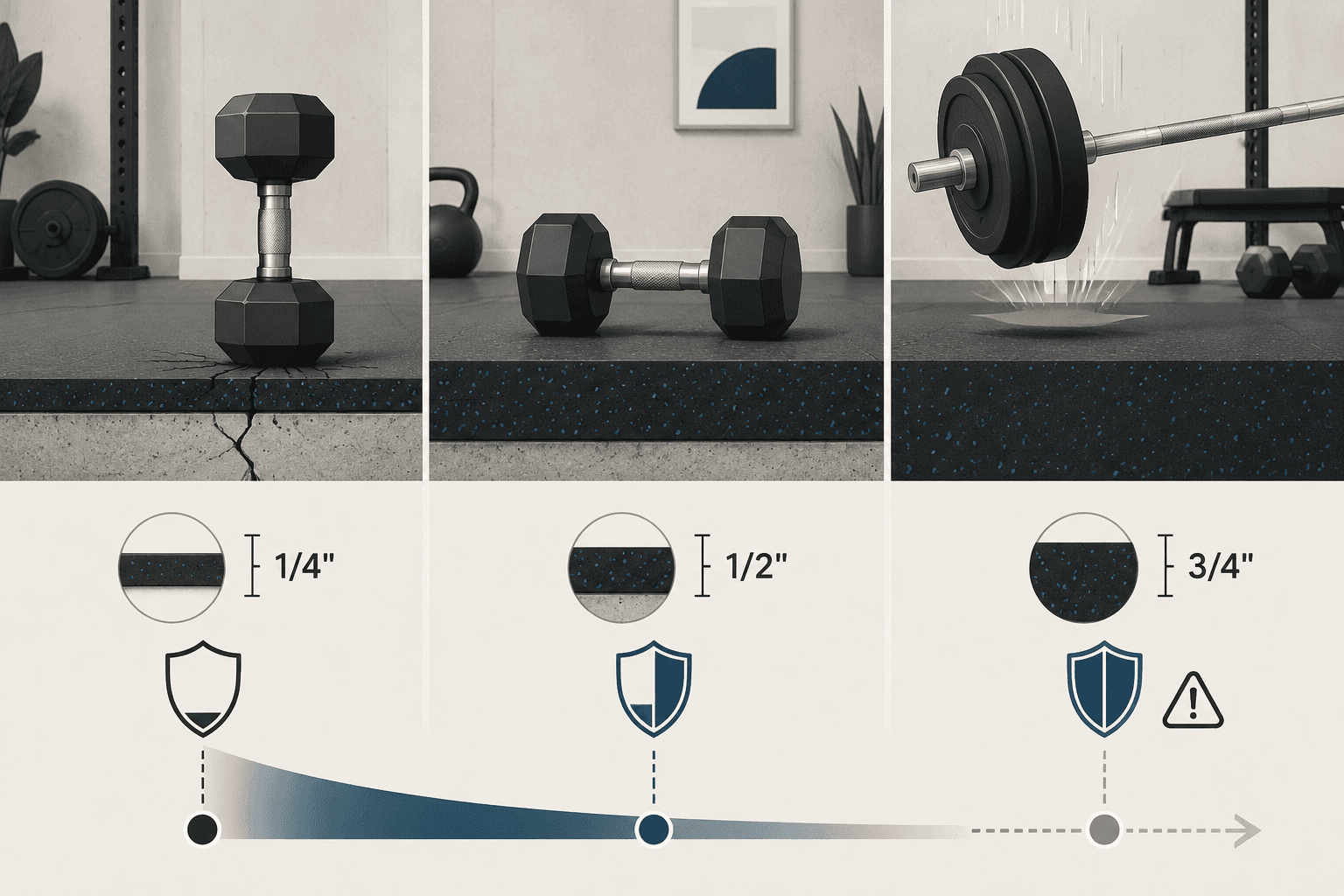
The right home gym flooring thickness is the thinnest floor that protects the surface underneath and stays stable under the way you train. That sounds obvious until a $1.12-per-square-foot foam tile starts looking like the bargain beside a $7.50-per-square-foot soundproofing mat, even though neither price tells you whether your garage slab, basement concrete, upstairs wood floor, or rental deposit is actually protected. Garage Gym Reviews’ tested flooring data puts the broad material range at about $1.12 to $7.50 per square foot, with an average around $2.93 per square foot across types, but that spread is not a simple ladder from bad to good.[1]
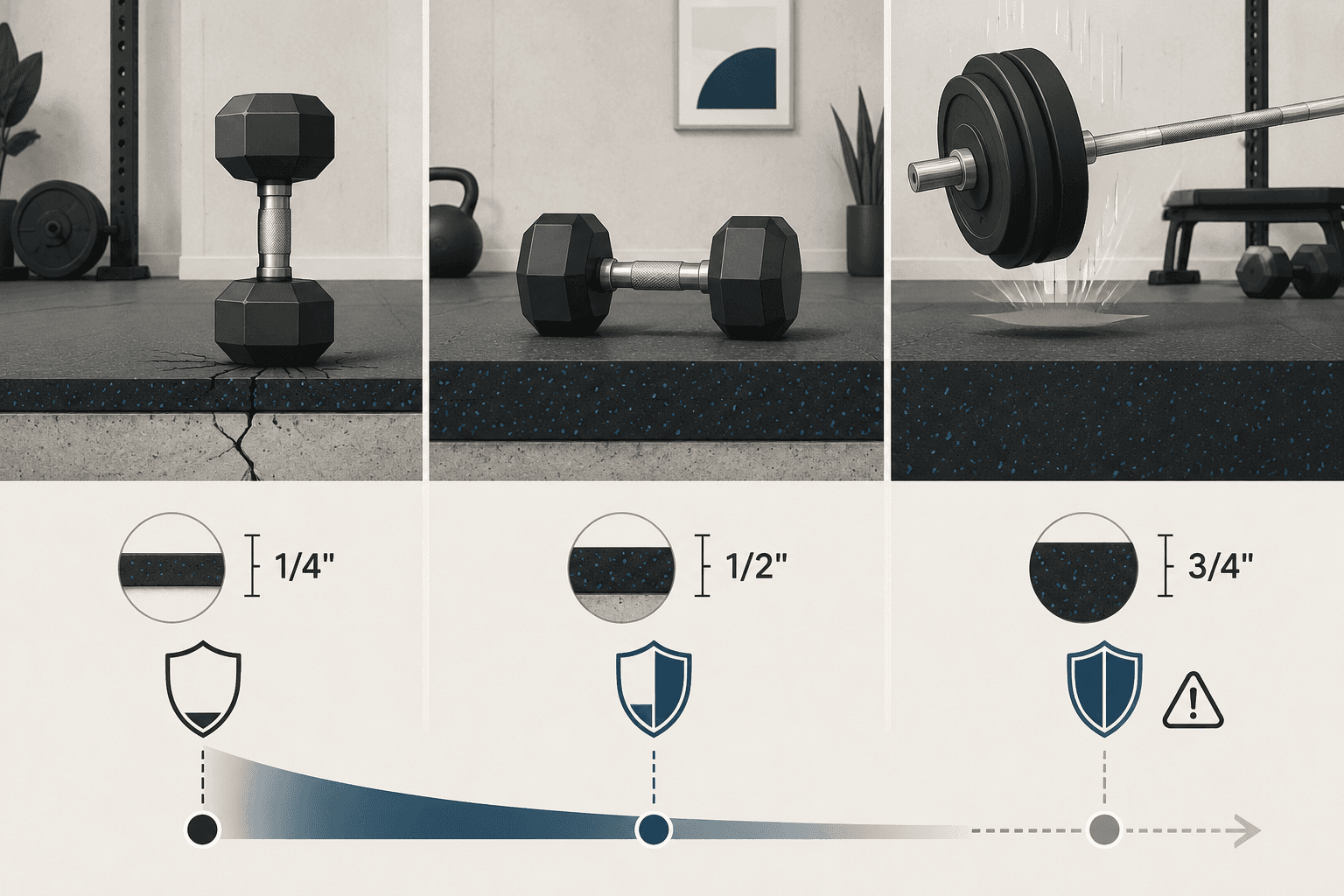
Start with the floor you have and the worst thing you plan to do on it. A yoga mat over a wood subfloor is one problem. Dumbbells over concrete are another. Barbell drops over concrete are a different purchase entirely.
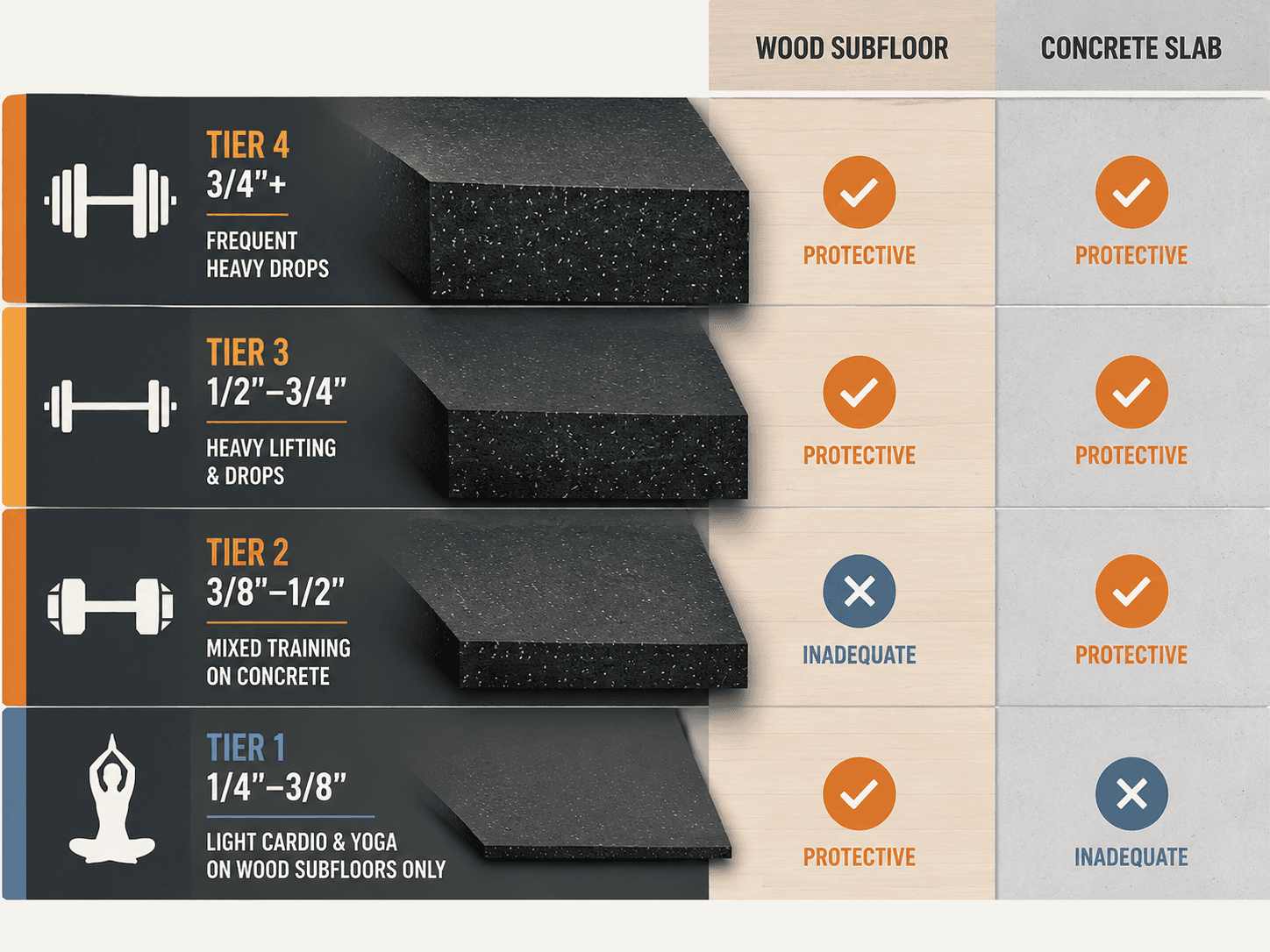
| Training and subfloor | Practical thickness range | What that range means |
|---|---|---|
| Yoga, mobility, bodyweight, light cardio on wood | 1/4"-3/8" | Adequate cushion, not a drop-protection layer |
| Mixed training on concrete: dumbbells, machines, general strength work | 3/8"-1/2" | Minimum protective zone for most garage and basement gyms |
| Heavy lifting on concrete, occasional controlled drops | 1/2"-3/4" | Protective enough to stop treating the slab like a disposable surface |
| Frequent heavy drops or noise-sensitive settings | 3/4"+ | Useful for impact reduction, but not true soundproofing |
Those ranges line up with published thickness guidance that places 1/4"-3/8" flooring in the light-use category, 3/8"-1/2" as the minimum range for mixed training on concrete, 1/2"-3/4" for heavy lifting or frequent drops on concrete, and 3/4"+ for frequent heavy impact or noise-sensitive spaces.[2]
The floor underneath changes the answer
Wood gives a little. Concrete does not. That is why the same thin rubber tile can be acceptable in one room and cheap insurance that does not actually insure much in another.
On wood, 1/4"-3/8" rubber can make sense for yoga, mobility work, light dumbbells, and basic cardio. The flooring is mostly improving grip, comfort, and scuff protection. It is not there to absorb repeated iron impacts. In an upstairs room, thinner material also has one real advantage: less weight to haul, less height added at door transitions, and fewer awkward cuts around trim.
On concrete, that same 1/4"-3/8" layer becomes much easier to outgrow. A basement or garage slab feels indestructible until a dumbbell edge, kettlebell corner, or loaded bar finds the same spot enough times. For mixed training on concrete, 3/8"-1/2" is the practical floor, not the luxury upgrade.[2]
This is where a lot of home gym flooring advice gets too smooth. “Go thicker” is lazy if the person is stretching in a spare bedroom. “Save money with thin tiles” is just as lazy if the person is building a garage gym around a rack and adjustable dumbbells. The question is not how thick flooring can be. It is where a thinner product stops doing the job you bought it to do.
Where each thickness tier stops making sense
1/4"-3/8": light work, preferably over wood
This is the budget-friendly zone for people who are not dropping weight. It can be enough for yoga, stretching, bodyweight circuits, light cardio, and light dumbbell work on a wood subfloor. The typical price band in the cited thickness guidance is about $1-$3 per square foot.[2]
The limit is impact. Thin rubber may protect against scuffs and make a room feel more finished, but it is not a serious answer for repeated dumbbell drops on concrete. Thin EVA foam is even easier to oversell. Foam feels friendly under bare feet, but it can compress under load and create a less stable surface for loaded lifts. Garage Gym Reviews and Rubber Flooring Direct both treat foam as a poor fit for strength training compared with rubber.[1][3]
3/8"-1/2": the mixed-training minimum on concrete
This is the range that handles the most normal garage and basement gyms: dumbbells, benches, machines, kettlebells, cardio equipment, and a rack where the bar is controlled instead of dumped. It usually sits around $2-$4 per square foot in the cited thickness guidance.[2]
The common 8mm rubber floor belongs near this conversation. It is popular because it is widely available, not because it is automatically enough for every lifter. Garage Gym Reviews lists 8mm rubber around $2.24 per square foot, while the thickness guidance still points frequent heavy drops toward thicker material.[1][2] If the plan is a bike, a rack, dumbbells, and controlled deadlifts, 8mm can be sensible. If the plan includes missed Olympic lifts, dropped deadlifts, or heavy dumbbells falling from bench height, it is no longer the place to squeeze the budget.
1/2"-3/4": the heavy-lifting zone
Once concrete and heavy lifting are both in the picture, 1/2"-3/4" is the range that starts to feel like real protection instead of decoration. It is also where horse stall mats enter the argument. The cited flooring data identifies 3/4" stall mats at roughly $2.38 per square foot as a standout value for heavy lifting zones, with better drop protection than many purpose-built rubber products that cost more per square foot.[1]
That does not make stall mats a universal hack. The downsides are not small. The same sources flag mats around 100 pounds each, strong off-gassing, rougher aesthetics, and poor practicality for upstairs apartments.[1][4] If you have a ground-floor garage, a truck, and tolerance for the smell while they air out, stall mats are hard to beat for a lifting zone. If you are carrying them through an apartment hallway or trying to make a shared room look polished, the “cheap” solution may charge you in other ways.
3/4"+: impact help, not magic
Three-quarter-inch rubber can reduce impact and protect surfaces in ways thinner floors cannot. For frequent heavy drops, it is a reasonable target. For noise-sensitive spaces, it is only part of the answer. The cited sources do not support the promise that drops or jumps become fully soundproof. The neighbor below may still hear structure-borne impact, especially in an upstairs unit.
That distinction matters because soundproofing mats can sit at the high end of the price range. If your real problem is floor protection, do not pay soundproofing prices for a claim the material cannot fully deliver. If your real problem is a lease, a downstairs neighbor, or a fragile old building, thickness is only one constraint. The better next read is the apartment-specific guide, Your Compact Home Gym in an Apartment: Train Heavy Without Losing Your Deposit.
The cheap floor is not always the low-cost floor
Per-square-foot pricing is useful for sorting options, then immediately incomplete. A small basement corner and a full two-car garage produce different receipts. So do pickup-only stall mats and shipped rubber rolls. The $2.93-per-square-foot average is a decent orientation point, but it should not be treated as a quote.[1]
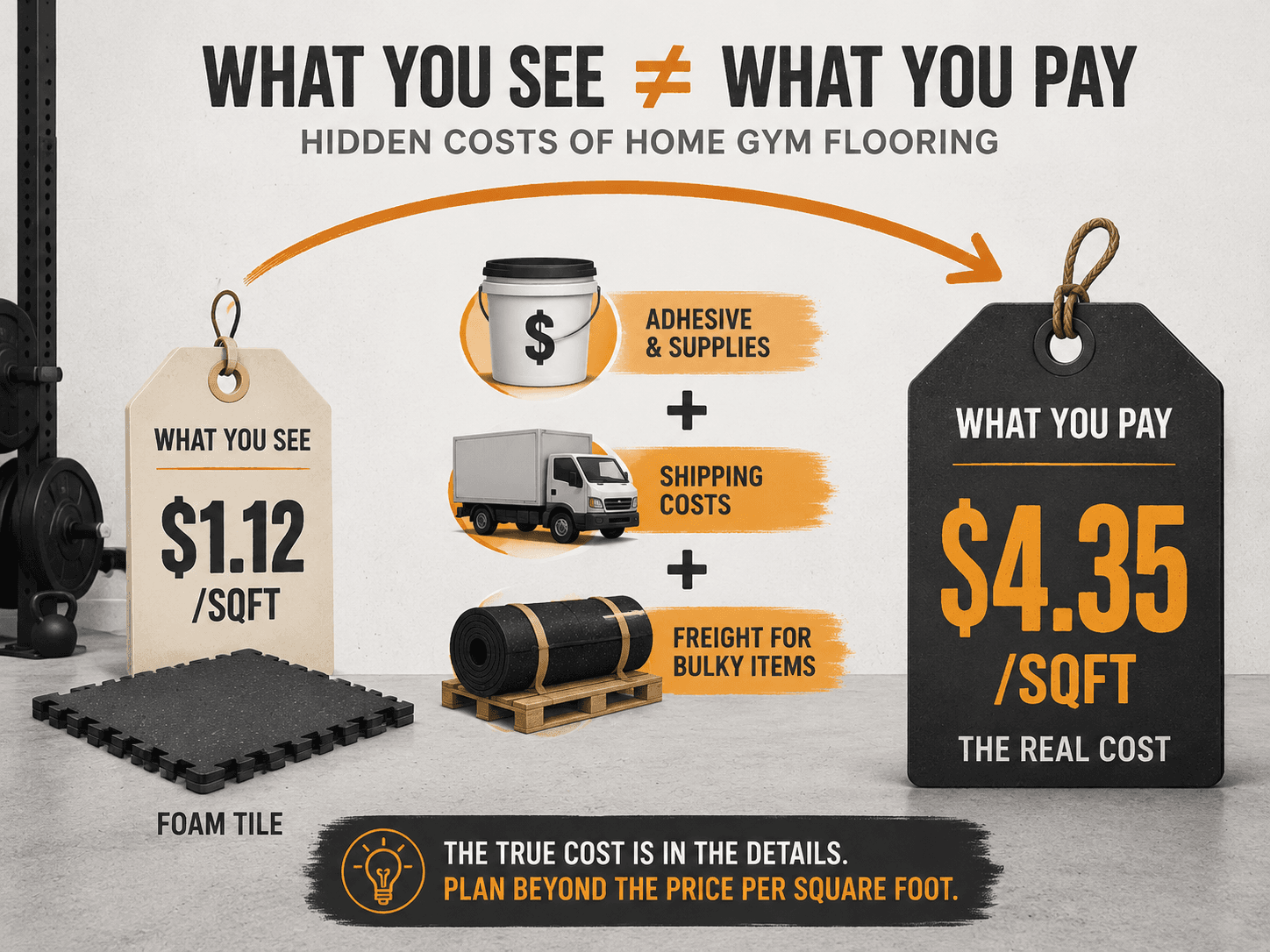
Adhesive is the line item people underestimate because it is not visible in the finished gym. Gray Matter Lifting documented a rubber-roll garage build where urethane glue added more than $600, and the same account notes that heavy roll shipping can become significant when freight crosses long distances.[5] That changes the comparison. A roll that looks clean and professional may still be the right choice, but the adhesive and shipping belong in the first estimate, not in the “somehow this got expensive” pile after checkout.
Stall mats have their own hidden cost. If you do not own a vehicle that can move them, transport can add roughly $100 or more through truck rental or similar logistics in the documented flooring-cost discussion.[5] That still may leave stall mats ahead for a heavy-lifting zone, but only if the math includes the trip, the loading help, and the fact that each mat is heavy enough to turn a casual Saturday project into a real moving job.
Foam hides cost in a different place: replacement. Rubber flooring is commonly described as lasting 10-20 years with proper maintenance, while EVA foam tiles may compress and need replacement within 1-3 years under regular use.[6][7] That is the difference between a cheap purchase and a cheap-looking first payment. For a stretching corner, foam can be fine. For strength training, the replacement window and instability make it a poor place to save money.
Readers who want the straight price catalog after narrowing the thickness range can use How Much Does Home Gym Flooring Cost? Per-Square-Foot Pricing for Every Material (2026). The order matters: choose the required thickness first, then shop within that lane.
A useful buying rule
Buy the least expensive material that meets the required thickness for your workout intensity and subfloor. That rule cuts both ways. It keeps a garage lifter from pretending thin foam is a floor-protection plan, and it keeps a light-use spare bedroom from turning into a rubber fortress for no training benefit.
- For yoga, mobility, bodyweight work, and light cardio on wood: 1/4"-3/8" can be enough.
- For mixed training on concrete: start at 3/8"-1/2" and avoid foam.
- For heavy lifting on concrete: look at 1/2"-3/4", with 3/4" stall mats as a strong value when ground-floor logistics work.
- For frequent heavy drops: 3/4"+ is reasonable, but do not confuse impact reduction with full soundproofing.
The money saved by not overbuilding the floor can go toward equipment that changes training more directly. That might mean a better rack, adjustable dumbbells, plates, a bench that does not wobble, or simply getting the first phase bought without turning the room into a half-finished project. For broader budgeting, use Home Gym Cost Breakdown: What $500 to $5,000+ Actually Buys You in 2026; for staged buying, use How to Build a Compact Home Gym in 3 Phases.
Once the material and thickness are chosen, the next mistake is usually installation: bad seams, curled edges, trapped odor, adhesive surprises, and pieces cut before the room is squared up. That is a separate job. Move from buying to layout with How to Install Home Gym Flooring: A Complete Step-by-Step Guide for Every Material Type.
References
- Best Home Gym Flooring, Garage Gym Reviews
- Gym Flooring Thickness Guide, Living.Fit
- Rubber Flooring Home Gym 2026 Guide, Rubber Flooring Direct
- Best Flooring Options for Home Gyms: Material Cost & Installation, NHC Now
- The Best Home Gym Flooring, Gray Matter Lifting
- Ultimate Guide Gym Flooring, Iron Company
- Product lifespan data, Greatmats
Comments
Join the discussion with an anonymous comment.