
The Real Cost of a Fitness Tracker: What You Actually Pay Over Two Years
A fitness tracker's sticker price can be misleading. This article breaks down the two-year total cost of ownership for 10+ popular models, including mandatory and optional subscription fees, replacement bands, and other hidden costs, so you can make a truly informed purchase.
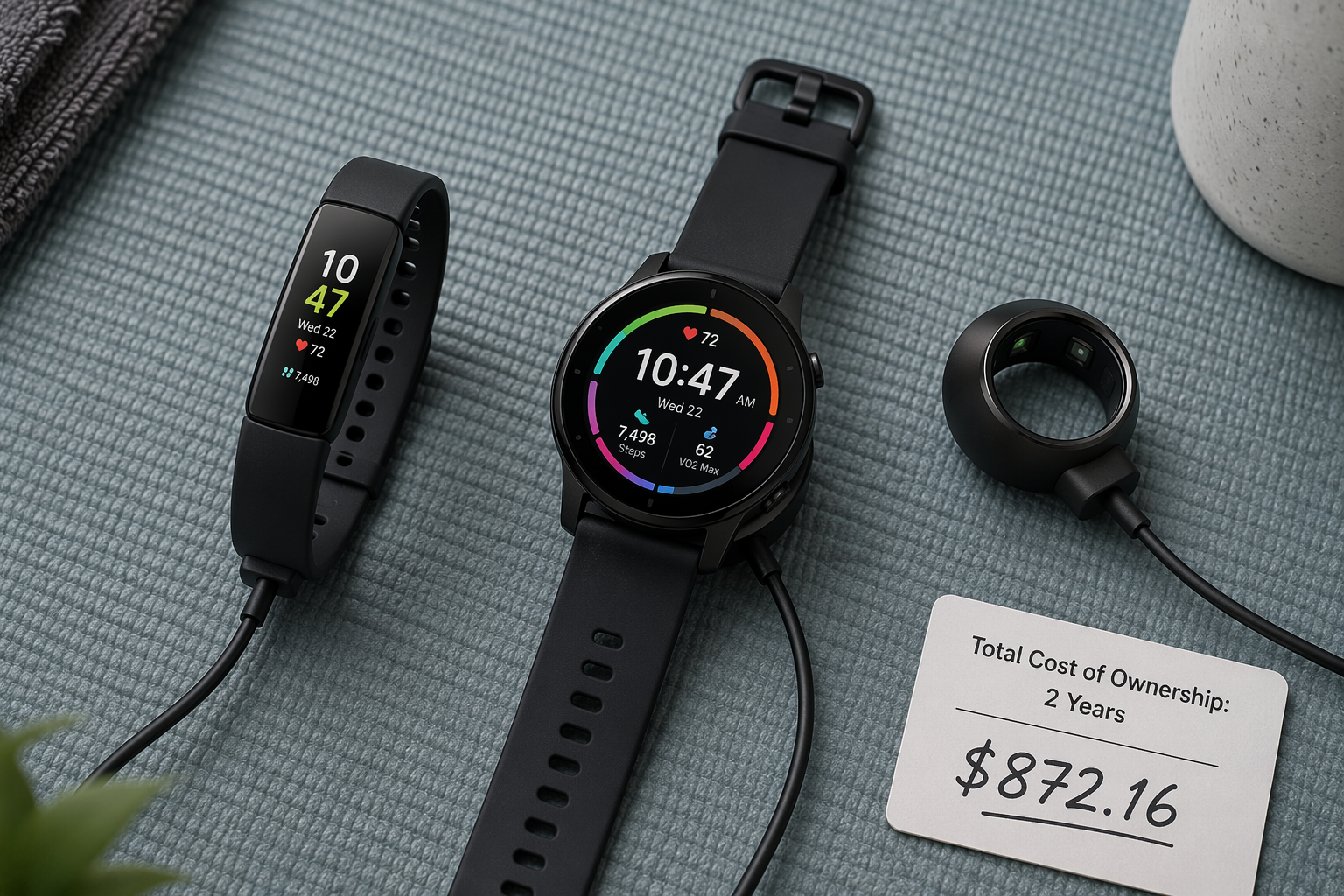
Why the Sticker Price Is the Most Misleading Number in Fitness Trackers
Walk into any electronics retailer or scroll through an online marketplace, and the first thing you see is the upfront price. A $50 band looks like a bargain next to a $400 smartwatch. But in the fitness tracker market of 2026, that initial number tells you almost nothing about what you will actually spend over the life of the device.
The reason is simple: a growing number of brands have shifted their business model from selling hardware to selling subscriptions. The device becomes a loss leader — or is even given away for "free" — while the recurring membership fee becomes the real revenue driver. For a buyer who only compares sticker prices, this creates a trap. A $0 device can end up costing more than a $500 one over two years.
This article breaks down the total cost of ownership (TCO) for more than 10 popular fitness trackers available in mid-2026. We account for upfront hardware costs, mandatory and optional subscription fees, and the less obvious expenses like replacement bands and accessories. The goal is not to declare a single "best" device — it is to give you the real numbers so you can decide which tracker fits your budget over the long term.
The Subscription Landscape in 2026: Who Charges and What You Lose Without Paying
The fitness tracker market in 2026 is split into three distinct subscription models. Understanding which category a device falls into is the first step toward calculating its real cost.
Mandatory Subscriptions: The Device Is Just the Entry Fee
For some brands, the subscription is not optional — it is the product. Whoop is the clearest example. You do not buy a Whoop sensor; you buy a membership, and the hardware comes with it. Whoop offers three annual tiers: One at $199 per year, and higher tiers at $239 and $359 per year, the latter branded as Whoop Life. The sensor is effectively free, but you cannot use it without an active subscription.
The Oura Ring operates on a hybrid model. You pay $349 upfront for the ring hardware, but accessing most of its advanced features requires a separate Oura Membership at $6 per month or $70 per year. Without the membership, you get basic Sleep, Readiness, and Activity scores — but the detailed insights that make the ring valuable are locked behind the paywall.
Optional Subscriptions: Core Features Stay Free, Extras Cost Extra
Several major brands offer a subscription as an upsell rather than a requirement. Fitbit Premium costs $10 per month or $80 per year. It is entirely optional for devices like the Fitbit Charge 6 ($99.95) and Fitbit Inspire 3 ($99.95). Without it, you still get step tracking, heart rate monitoring, and basic sleep tracking. What you lose are guided workouts, audio mindfulness sessions, deeper sleep score breakdowns, and stress management insights.
Garmin introduced Connect+ in 2025 at $70 per year. Unlike Fitbit Premium, Garmin has kept all core features — activity tracking, sleep monitoring, body battery, training readiness — completely free. Connect+ adds advanced analytics, performance dashboards, and exclusive coaching content. It is the most consumer-friendly optional model on the market today.
No Subscription Required: What You See Is What You Pay
A handful of brands have resisted the subscription trend entirely. Samsung devices like the Galaxy Fit3 ($46.90) and Galaxy Watch 8 ($349) have no required subscription and no gated features. Amazfit models such as the Bip 6 ($80) and Bip 3 Pro ($59.99) also carry zero subscription fees. The Apple Watch Series 11 (starting at $399) has a free tier that covers all core fitness tracking features. Even the new screenless Fitbit Air ($100) has no required subscription — only the Gemini-powered AI Coach and workout videos require a premium payment.
| Subscription Model | Brands | Annual Cost | Core Features Without Paying |
|---|---|---|---|
| Mandatory | Whoop | $199 – $359 | Nothing — sensor is unusable without membership |
| Mandatory | Oura Ring | $70 | Basic Sleep, Readiness, Activity scores only |
| Optional | Fitbit | $80 | Step count, heart rate, basic sleep tracking |
| Optional | Garmin | $70 | All core features remain free |
| None | Samsung, Amazfit, Apple, Fitbit Air | $0 | All features included with hardware purchase |
Two-Year Total Cost of Ownership: A Side-by-Side Comparison of 10+ Models
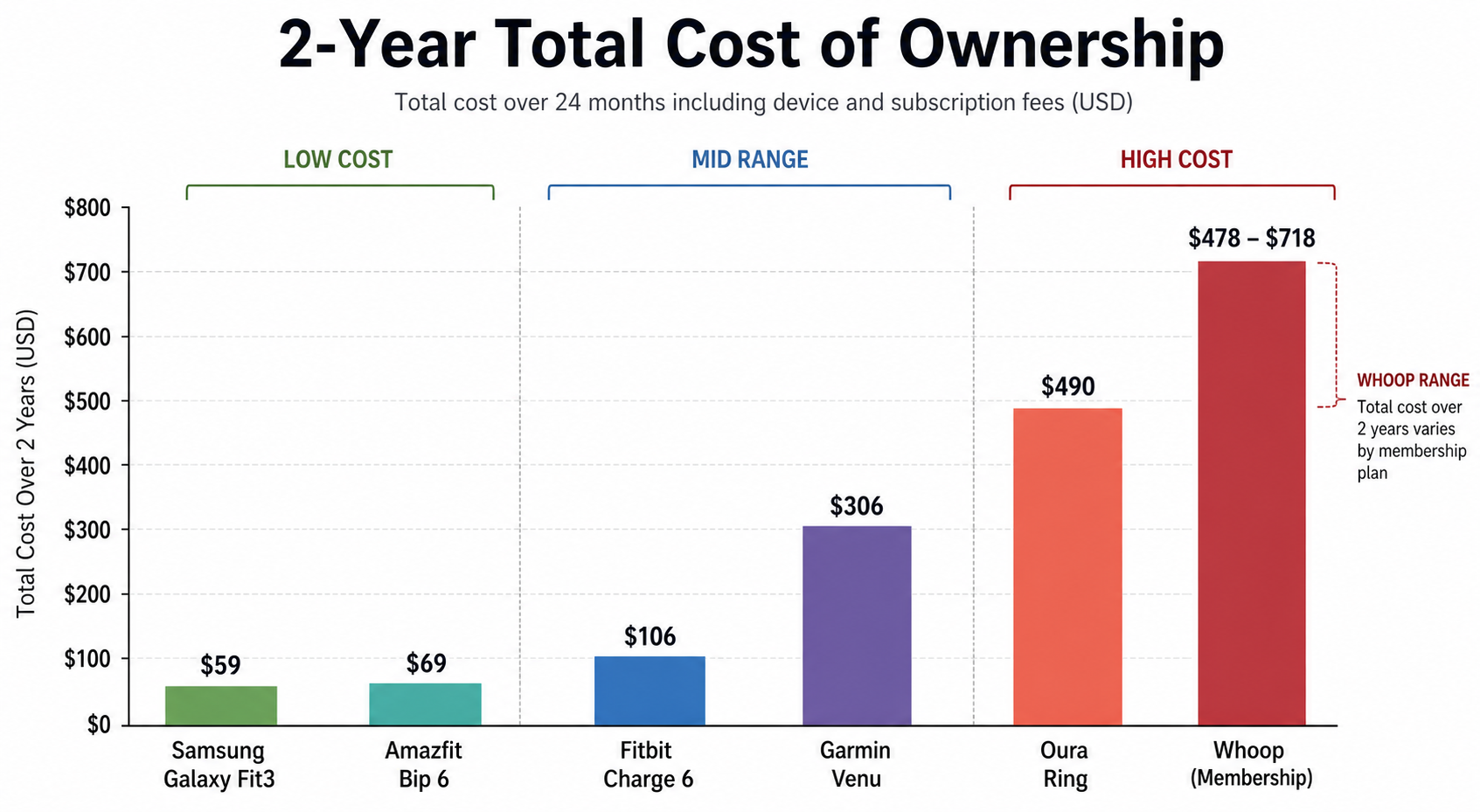
The table below calculates the two-year total cost for each device. We use a two-year window because that is the typical upgrade cycle for fitness trackers — battery degradation, new feature releases, and wear and tear often prompt a replacement by year three. For devices with optional subscriptions, we show both the base cost (no subscription) and the cost with the subscription added, so you can see the full range.
| Device | Upfront Price | Subscription Required? | Annual Subscription | 2-Year Total (No Sub) | 2-Year Total (With Sub) |
|---|---|---|---|---|---|
| Whoop 5.0 / Whoop MG | $0 (sensor included) | Yes — mandatory | $199 – $359 | N/A | $398 – $718 |
| Oura Ring 4 | $349 | Yes — mandatory for full features | $70 | $349 (basic only) | $489 |
| Fitbit Charge 6 | $99.95 | No — optional Premium | $80 | $99.95 | $259.95 |
| Fitbit Inspire 3 | $99.95 | No — optional Premium | $80 | $99.95 | $259.95 |
| Garmin Venu 3 | $450 – $500 | No — optional Connect+ | $70 | $450 – $500 | $590 – $640 |
| Garmin Vivoactive 6 | $300 | No — optional Connect+ | $70 | $300 | $440 |
| Apple Watch Series 11 | $399+ | No | $0 | $399+ | $399+ |
| Samsung Galaxy Watch 8 | $349 | No | $0 | $349 | $349 |
| Samsung Galaxy Fit3 | $46.90 | No | $0 | $46.90 | $46.90 |
| Amazfit Bip 6 | $80 | No | $0 | $80 | $80 |
| Amazfit Bip 3 Pro | $59.99 | No | $0 | $59.99 | $59.99 |
| Fitbit Air (screenless) | $100 | No — optional Premium | $100 | $100 | $300 |
| Xiaomi Smart Band 10 | ~$50 | No | $0 | ~$50 | ~$50 |
The counterintuitive result is immediately visible. A $47 Samsung Galaxy Fit3 costs $47 over two years. A $349 Oura Ring 4 costs $489 over two years — more than a $450 Garmin Venu 3 with no subscription. And a "free" Whoop sensor costs between $398 and $718 over two years, depending on the tier you choose. The cheapest upfront option is often the most expensive in the long run.
What Free Tiers Actually Include vs. What Gets Paywalled
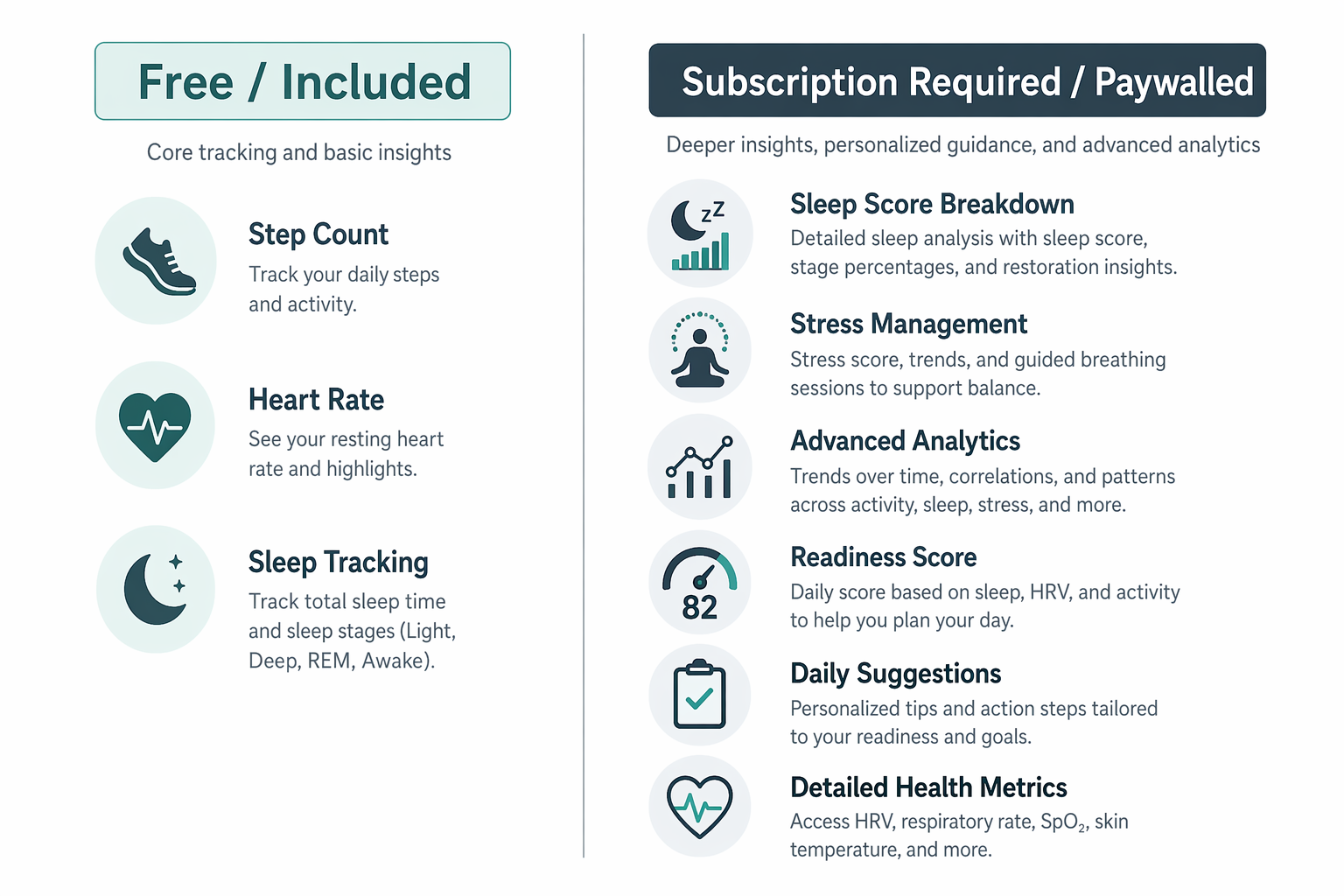
Knowing that a subscription exists is only half the picture. The real question is: what do you lose by not paying? The answer varies dramatically by brand, and it directly affects whether the subscription is worth it for your specific needs.
Oura: Basic Scores vs. Actionable Insights
Without the $70/year Oura Membership, you still see your daily Sleep, Readiness, and Activity scores. What you lose is the context that makes those scores useful: sleep stage breakdowns, HRV trends over time, personalized activity recommendations, and the detailed readiness analysis that tells you whether to train or rest. For many users, the scores alone are not enough to drive behavior change — the paywalled insights are where the value lives.
Fitbit: Step Counting Is Free, Coaching Is Not
Fitbit's free tier is generous for basic tracking. You get step count, heart rate, active zone minutes, and sleep stages. The $80/year Premium subscription unlocks guided workouts, audio mindfulness sessions, a deeper sleep score with breakdowns, stress management insights, and the Daily Readiness Score. If you primarily use your tracker to count steps and monitor resting heart rate, the free tier may be sufficient. If you want guided programming and recovery recommendations, Premium becomes more compelling.
Garmin: The Most Consumer-Friendly Model
Garmin's approach is the most straightforward: everything you need for daily training — activity tracking, sleep monitoring, Body Battery, Training Readiness, and most performance metrics — is included with the device. Connect+ ($70/year) adds advanced analytics, performance dashboards, and exclusive coaching content. It is a genuine upsell, not a feature gate. If you never subscribe, your Garmin experience remains essentially complete.
| Brand | Free Tier Includes | Paywalled Features | Annual Cost |
|---|---|---|---|
| Oura | Basic Sleep, Readiness, Activity scores | Sleep stage breakdowns, HRV trends, personalized recommendations | $70 |
| Fitbit | Step count, heart rate, sleep stages, active zone minutes | Guided workouts, sleep score breakdown, stress management, Daily Readiness Score | $80 |
| Garmin | Activity tracking, sleep, Body Battery, Training Readiness, most metrics | Advanced analytics, performance dashboards, exclusive coaching | $70 |
| Whoop | Nothing — membership required | All features require active membership | $199 – $359 |
| Samsung / Amazfit / Apple | All features included | No paywalled fitness features | $0 |
Hidden Costs Beyond the Subscription: Bands, Chargers, and Accessories
Subscription fees are the largest hidden cost, but they are not the only one. Several devices require ongoing spending on accessories that are not included in the upfront price or that wear out faster than the device itself.
- Proprietary replacement bands: Oura rings come with a sizing kit, but if your size changes or the band wears out, you are buying a new ring — not just a strap. Whoop bands are replaceable and come in various materials, but they are proprietary and cost $30–$60 each. Fitbit and Garmin use standard quick-release bands, but official replacements from the manufacturer can cost $30–$50.
- Charging cables and docks: Most devices include a charging cable in the box, but replacements are proprietary. Losing or damaging the cable for an Oura Ring or Whoop means buying a specific replacement, often for $20–$40.
- Screen protectors and cases: For smartwatches like the Apple Watch and Garmin Venu, a screen protector ($10–$20) and a protective case ($15–$30) are common purchases, especially for users who wear the device during workouts or outdoor activities.
- Chest straps for HR accuracy: Optical heart rate sensors on wrist-worn devices have known accuracy limitations during high-intensity interval training and weightlifting. Users who need precise heart rate data often add a chest strap ($50–$100) that pairs with their watch or band.
These costs are small individually, but they add up. Over two years, a user who buys two replacement bands, a screen protector, and a charging cable could spend an additional $80–$150 on top of the device and subscription costs.
Which Brands Charge for Advanced Features (and Which Don't)
The feature-paywall landscape can be summarized by brand. This section distills the key claims from the comparison above into a quick-reference guide.
| Brand | Subscription Model | Annual Cost | Key Paywalled Features | Verdict |
|---|---|---|---|---|
| Whoop | Mandatory | $199 – $359 | All features — device unusable without membership | Highest TCO in the market; only worth it if you want the full ecosystem |
| Oura | Mandatory for full features | $70 | Detailed readiness, HRV trends, personalized insights | Moderate TCO; basic scores are free but limited |
| Fitbit | Optional | $80 | Guided workouts, sleep breakdown, stress management | Good value if you want coaching; free tier is solid for basics |
| Garmin | Optional | $70 | Advanced analytics, exclusive coaching | Best optional model — core features are genuinely free |
| Samsung | None | $0 | N/A | Best value for budget buyers |
| Amazfit | None | $0 | N/A | Best value for budget buyers |
| Apple | None | $0 | N/A | Strong free tier; cellular adds carrier cost, not subscription |
| Fitbit Air | None (optional Premium) | $0 – $100 | AI Coach, workout videos | Screenless option with no mandatory fees |
How to Evaluate: Is the Subscription Worth It for Your Use Case?
Not every subscription is a bad deal. The key is matching the cost to the value you actually get. Here is a practical framework for deciding.
Ask Yourself These Three Questions
- What metrics do I actually care about? If you only track steps, sleep duration, and resting heart rate, a $50–$80 device with no subscription (Samsung Galaxy Fit3, Amazfit Bip 6) gives you everything you need. If you want HRV trends, sleep stage analysis, and daily readiness scores, you will need a device that provides those — and you will likely pay for a subscription to get the full picture.
- Do I need deep analytics or just basic tracking? Garmin devices offer deep analytics without a subscription. Fitbit and Oura gate their deeper insights behind paywalls. If you want detailed recovery metrics without ongoing costs, Garmin is the clearest path.
- What is my budget horizon? If you plan to keep a device for one year, the subscription cost is less painful. If you keep it for two to three years — which is typical — the subscription can double or triple the effective price. Use the two-year TCO table above to compare devices on an apples-to-apples basis.
Matching Use Cases to TCO Tiers
| Use Case | Recommended TCO Tier | Example Devices | Estimated 2-Year Cost |
|---|---|---|---|
| Basic step counting and sleep tracking | Under $100 total | Samsung Galaxy Fit3, Amazfit Bip 6, Xiaomi Smart Band 10 | $47 – $100 |
| Heart rate monitoring and basic fitness tracking | $100 – $200 total | Fitbit Charge 6 (no Premium), Fitbit Inspire 3 (no Premium) | $100 |
| Guided workouts and stress management | $200 – $300 total | Fitbit Charge 6 + Premium, Fitbit Air + Premium | $260 – $300 |
| Advanced training metrics and recovery analytics | $300 – $500 total | Garmin Vivoactive 6, Garmin Venu 3 (no Connect+) | $300 – $500 |
| Full ecosystem with coaching and deep insights | $400 – $700+ total | Whoop (any tier), Oura Ring 4 + Membership | $398 – $718 |
| No subscription, full-featured smartwatch | $350 – $500 total | Apple Watch Series 11, Samsung Galaxy Watch 8 | $349 – $500 |
The Bottom Line: Don't Let the Sticker Price Fool You
The fitness tracker market has fundamentally changed. In 2026, the upfront price is often the least important number in a purchase decision. A $47 device with no subscription can outperform a $349 device with a mandatory $70 annual fee when you look at total cost over two years.
Before you buy, calculate the two-year total: upfront price plus (annual subscription × 2) plus estimated accessory costs. Compare that number across devices, not just the sticker prices. The device that looks cheapest on the shelf may be the most expensive one you ever wear.
For readers exploring specific form factors, our Screenless Fitness Tracker Buyer's Guide 2026 covers options like Whoop and Fitbit Air in more detail. And if you are considering an Apple Watch as your primary fitness device, our guide on using the Apple Watch as Your Home Fitness Hub walks through which model to choose and how to build a weekly training schedule around it.
This result comes from one real apartment under the stated conditions — it is a strong signal, not a guarantee your space will measure identically.
Builds this evidence supports
No build currently links to this specific test. Browse all builds with a matching tag.
Spot something off?
If this result didn't match your own space, let us know — floor-damage and noise claims carry real deposit-risk consequences if we get them wrong.