
A useful MMA home training routine is not a fight camp squeezed into a living room. It is a four-week conditioning and movement-skill plan that uses MMA patterns—shadowboxing, footwork, sprawls, shrimps, technical stand-ups, jump rope, bodyweight strength, and optional bag rounds—to make your training organized enough to repeat and improve.
You need enough clear floor to move without clipping furniture. A 2x2m space is a practical minimum for basic home MMA drills, and the week should usually fit inside 2-4 sessions if the goal is steady progress rather than exhaustion for its own sake.[1][2] If you have a medical condition, a recent injury, dizziness during intense exercise, or joint pain when you jump, get medical clearance first. This plan also does not replace coaching, sparring, live grappling, or supervised fight preparation.

The Setup: Three Equipment Tiers
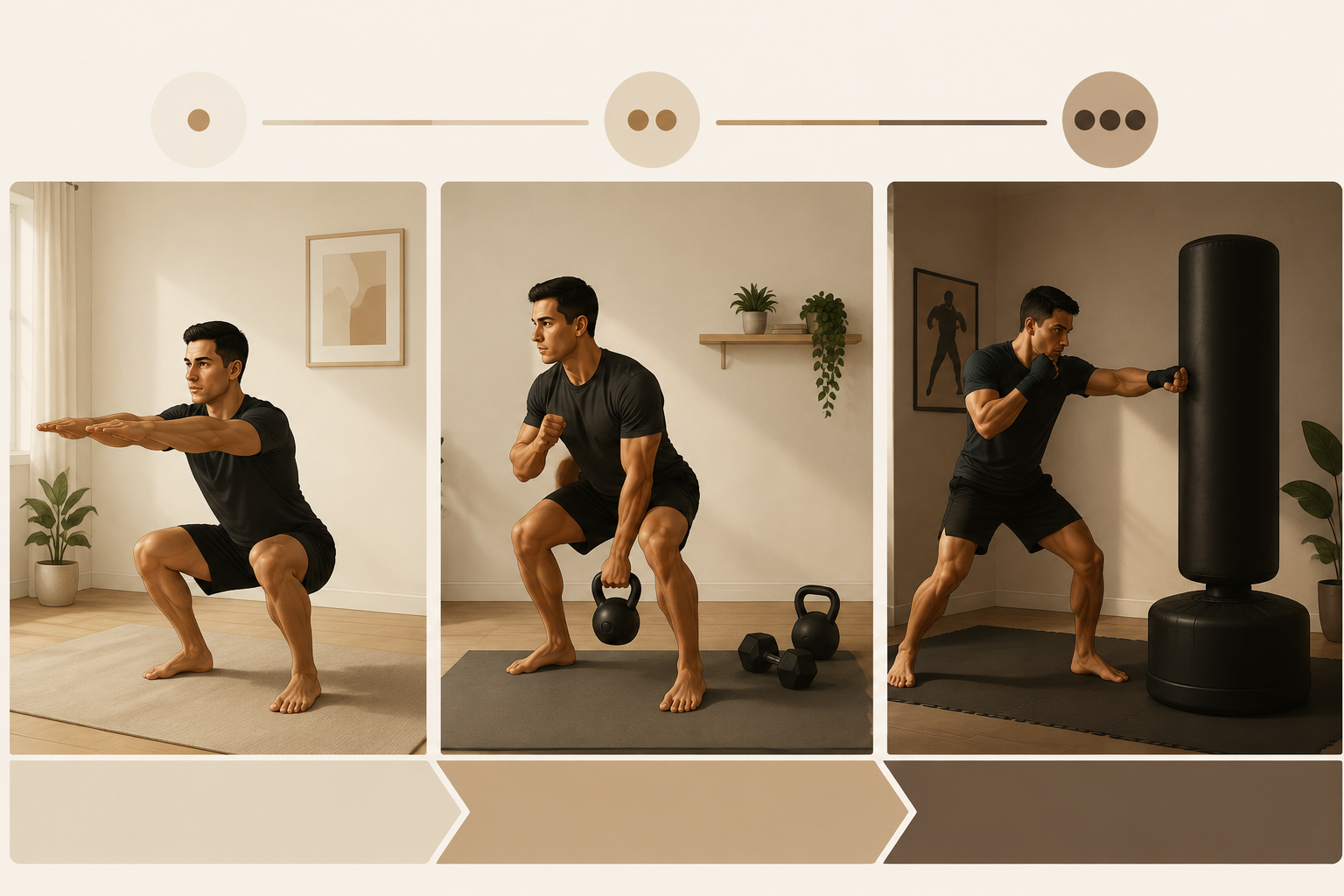
Start with the tier you already have. A heavy bag can be useful, but it does not make the routine more “real” if your footwork, posture, recovery, and weekly progression are still random.
| Tier | What you use | Best for | When to advance |
|---|---|---|---|
| Tier 1: Bodyweight | Clear floor, timer, optional jump rope; roughly $10 if buying a rope | Beginners, apartments, low-noise training, learning movement patterns | Move up only when you can finish all rounds with clean posture and controlled breathing |
| Tier 2: Minimal Load | Dumbbells or kettlebells, jump rope; roughly $50-$200 | Adding strength and power without needing a bag | Move up when loaded hinges, squats, carries, and presses stay crisp under fatigue |
| Tier 3: Bag Setup | Heavy bag or freestanding bag, gloves, wraps, jump rope; roughly $150-$400 | Striking conditioning, round pacing, impact tolerance | Use it after you can shadowbox without crossing your feet, dropping your hands, or overreaching |
If you are building a broader training space, the same tiered thinking applies to a home gym workout plan that grows with your equipment. For buying decisions, compare this routine against how to build a budget home gym under $500 before spending money on a bag stand, gloves, or kettlebells.
Why the Week Has Different Session Types
MMA conditioning is messy when every session tries to be everything. Fighters need aerobic conditioning to recover between rounds, anaerobic alactic power for short explosive actions such as takedown entries, and anaerobic lactic conditioning for hard exchanges that last long enough to burn.[3] A home program can borrow that structure without pretending the living room is a cage.
The main evidence anchor here is a four-week MMA-specific strength and conditioning study that reported 16-20% strength gains and a 13% VO₂max improvement in trained male MMA athletes.[4] That does not mean a beginner at home should expect the same results. The useful part is the design principle: short training blocks, sport-specific movements, progressive loading, and round-based conditioning can be organized well enough to change fitness.
If you are completely new to structured exercise, pause here and use a simpler starting point such as the home fitness decision guide for complete beginners. This plan assumes you can squat, hinge, step back into a lunge, hold a plank, and get up from the floor without pain.
Four-Week Overview
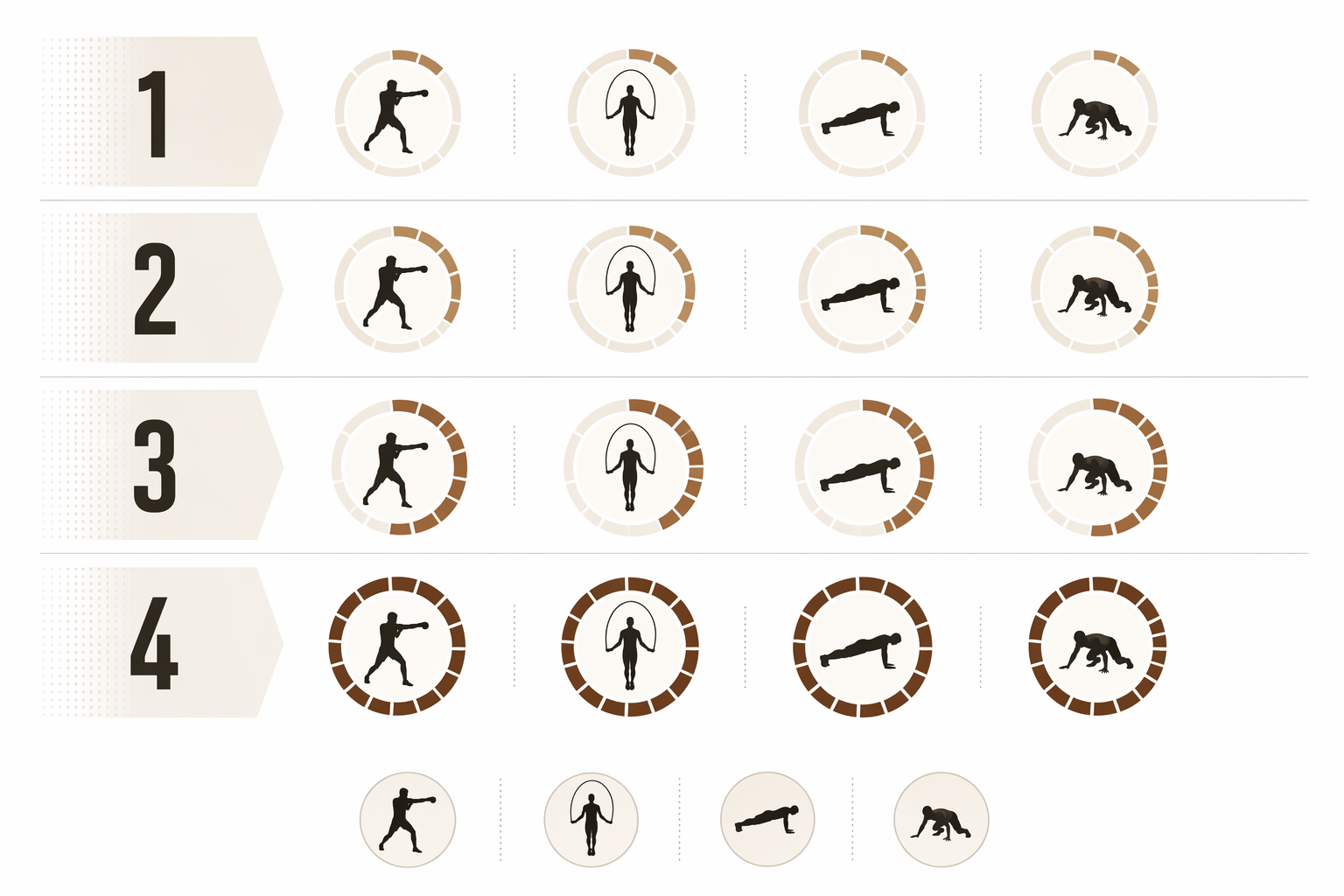
Train three days per week by default. Add the optional fourth day only if your joints feel good, sleep is normal, and the next session does not suffer. Rounds use MMA-style timing: 3-5 minutes of work with 1 minute of rest.[5]
| Week | Sessions | Round timing | Main change | Training emphasis |
|---|---|---|---|---|
| Week 1 | 3 sessions | 3-minute rounds, 1-minute rests | Learn the pattern and keep intensity moderate | Aerobic base, movement rehearsal, basic strength |
| Week 2 | 3 sessions | 3-minute rounds, slightly denser work | Add combinations, sprawls, and shorter rest inside circuits | Aerobic base plus alactic bursts |
| Week 3 | 3-4 sessions | 4-minute rounds, 1-minute rests | Increase round length and decision-making under fatigue | Lactic conditioning and mixed skill rounds |
| Week 4 | 3 sessions | 5-minute peak rounds or scaled 4-minute rounds | Test pacing without turning every session into a max effort | Fight-simulation conditioning, consolidation, recovery |
Warm-Up Used Before Every Session
Do not skip the warm-up. Most home-training mistakes happen before the hard work starts: cold hips, stiff ankles, sloppy first sprawls, then a tweaked wrist or lower back.
- 2 minutes easy bounce, march, or low-impact rope pattern
- 1 minute hip circles, ankle rocks, and shoulder circles
- 1 minute alternating reverse lunges or squat-to-stand
- 1 minute plank shoulder taps or dead bugs
- 2 minutes easy shadowboxing: stance, guard, jab-cross, step out
Week 1: Learn the Floor, the Clock, and Your Breathing
Week 1 is not a test of toughness. It teaches you how much space you actually have, how noisy your footwork is, and whether you can recover during a 1-minute rest instead of collapsing into it.
Session 1: Aerobic Shadowboxing and Footwork
| Block | Work | Rest | Purpose |
|---|---|---|---|
| Warm-up | Use the standard warm-up | None | Prepare ankles, hips, shoulders, and trunk |
| Round 1 | Shadowbox with jab-cross, guard reset, step back, step out | 1 minute | Aerobic base and stance control |
| Round 2 | Add lead hook, rear knee motion, and lateral step | 1 minute | Skill rehearsal while breathing stays steady |
| Round 3 | Footwork-only: forward, back, left, right, pivot, reset | 1 minute | Balance and quiet movement |
| Finisher | 3 rounds of 20 seconds fast shadowboxing, 40 seconds easy movement | As written | Short speed bursts without heavy fatigue |
| Cool-down | Walk, nasal breathing if comfortable, hip flexor stretch, chest opener | None | Lower intensity gradually |
Tier 2 can hold light dumbbells only for slow guard-position marches or farmer carries, not for punching. Tier 3 can replace Round 2 with light bag touches, but the bag should not become a place to swing as hard as possible.
Session 2: Bodyweight Strength and Sprawl Mechanics
This session uses a home-friendly version of common MMA conditioning drills: squats, push-ups, planks, sprawls, and controlled shadowboxing intervals. Similar home MMA templates commonly combine shadowboxing rounds, bodyweight circuits, and sprawls, but the volume here stays beginner-manageable.[5]
| Block | Tier 1 | Tier 2 | Tier 3 |
|---|---|---|---|
| Round 1: 3 minutes | Bodyweight squat x 8, incline or floor push-up x 6, plank x 20 seconds; repeat smoothly | Goblet squat x 6, push-up x 6, suitcase carry in place x 20 seconds | Same as Tier 1, then 20 seconds light bag straight punches at the end of each cycle |
| Round 2: 3 minutes | Step-back sprawl x 3, technical stand-up x 3 each side, shadowbox reset | Step-back sprawl x 3, kettlebell deadlift x 6, technical stand-up x 2 each side | Step-back sprawl x 3, technical stand-up x 2 each side, bag touch-and-exit x 20 seconds |
| Round 3: 3 minutes | Reverse lunge x 6 each side, dead bug x 6 each side, easy shadowboxing | Reverse lunge x 6 each side holding light load, dead bug, carry | Reverse lunge, dead bug, then light kick or knee mechanics on the bag if you know the form |
The sprawl in this plan is not a chest-flop. Step or hop the feet back, brace the trunk, keep the neck neutral, then return to stance with control. If jumping bothers your knees or wrists, use the step-back version for the full four weeks.
Session 3: Grappling Movement Rehearsal
You cannot recreate live grappling alone, but you can practice getting your hips off the floor and standing up without turning your back into a folding chair.
- Round 1: Shrimp, bridge, hip heist, technical stand-up; move slowly for 3 minutes.
- Round 2: Shadowbox for 30 seconds, sprawl or step-back sprawl once, technical stand-up once, repeat for 3 minutes.
- Round 3: Low-noise conditioning: mountain climber steps, plank, squat, march; repeat for 3 minutes.
- Optional Tier 2 add-on: 3 sets of 8 kettlebell deadlifts or dumbbell Romanian deadlifts after the rounds.
- Optional Tier 3 add-on: 2 easy bag rounds at 50-60% effort, focusing on exit steps after every combination.
For kettlebell technique outside this plan, use the 20-minute beginner kettlebell workout at home before adding swings or cleans to MMA circuits.
Week 2: Keep the Rounds Short, Make the Work Denser
The second week keeps 3-minute rounds but asks more from each minute. A practical way to manage intensity is the talk test: during easier aerobic work you should be able to speak in short phrases; during hard bursts you should not want to talk, but you should regain control during the rest.[6]
Session 1: Combination Flow
| Round | Main work | Cue |
|---|---|---|
| 1 | Jab-cross, step out; jab-cross-hook, reset | Every combination ends with your feet under you |
| 2 | Add teep motion or rear knee motion after the boxing combination | Do not lean backward to make the kick higher |
| 3 | 30 seconds steady shadowboxing, 10 seconds fast hands, 20 seconds easy footwork; repeat | Speed is allowed only if balance stays clean |
Basic MMA movement libraries commonly include jab-cross-hook combinations, teep kicks, sprawls, shrimps, and technical stand-ups; that is enough vocabulary for this month.[7] More techniques are not automatically better when you are training without feedback.
Session 2: Alactic Power Intervals
Alactic work is short and explosive. The mistake is turning it into a long grind. Hit the burst, stop before form scatters, then actually rest.
| Set | Work | Rest |
|---|---|---|
| 1-6 | 10 seconds fast shadowboxing or bag straight punches | 50 seconds easy walk |
| 7-12 | 1 clean sprawl or step-back sprawl, then 5 seconds fast hands | 50 seconds easy walk |
| 13-15 | Tier 1: squat jump or fast squat; Tier 2: kettlebell deadlift or swing only if trained; Tier 3: 5-second bag flurry | 55 seconds easy walk |
Apartment version: replace squat jumps with fast bodyweight squats and replace jump rope with shadow rope. Your downstairs neighbor should not have to know you are doing MMA conditioning.
Session 3: Strength Circuit Plus Movement
- Round 1: Squat pattern, push-up pattern, plank pattern; repeat for 3 minutes.
- Round 2: Hinge pattern, reverse lunge, technical stand-up; repeat for 3 minutes.
- Round 3: Shadowboxing flow with one defensive move after every combination: slip, step back, pivot, or cover.
- Tier 2: Use a goblet squat, dumbbell floor press, and kettlebell deadlift if you can keep the reps smooth.
- Tier 3: Add one light 3-minute bag round after the circuit, not before it.
Week 3: Longer Rounds, More Fatigue, Better Pacing
Week 3 moves to 4-minute rounds. That extra minute changes the session. You can no longer sprint the first 45 seconds and hope the timer saves you.
Session 1: Lactic Fight-Simulation Conditioning
| Minute | Tier 1 | Tier 2 | Tier 3 |
|---|---|---|---|
| 0:00-1:00 | Steady shadowboxing | Steady shadowboxing | Light bag combinations |
| 1:00-2:00 | Sprawl or step-back sprawl every 15 seconds | Sprawl every 20 seconds plus light hinge between | Bag combination, exit, sprawl every 20 seconds |
| 2:00-3:00 | Squat, push-up, plank rotation | Goblet squat, push-up, carry or march | Bodyweight circuit away from the bag |
| 3:00-4:00 | Shadowboxing with 10-second surges | Shadowboxing with 10-second surges | Bag round with 10-second surges |
Do 3 rounds with 1 minute rest between rounds. The target is controlled discomfort: breathing is hard, legs are heavy, but you are still making choices.
Session 2: Aerobic Recovery Skill
This session should feel almost too easy after the previous one. That is the point. Aerobic work helps you practice movement while recovering instead of adding another high-stress day.
- 4 rounds of 4 minutes, 1 minute rest.
- Round 1: Footwork grid—forward, back, lateral step, pivot.
- Round 2: Easy shadowboxing, no power shots.
- Round 3: Shrimp, bridge, technical stand-up, slow reset.
- Round 4: Jump rope or shadow rope at a pace that lets you recover.
Session 3: Mixed Circuit
Set a 4-minute timer and cycle through the following without rushing: 30 seconds shadowboxing, 5 sprawls or step-back sprawls, 8 squats, 6 push-ups, 20 seconds plank, 2 technical stand-ups each side. Rest 1 minute and repeat for 3-4 total rounds.
Tier 2 can turn the squats into goblet squats and add a suitcase carry after the plank. Tier 3 can replace the 30 seconds of shadowboxing with bag work, but keep the exits: combination, step out, reset, then continue.
Optional Session 4: Mobility and Easy Conditioning
Only add this if the first three sessions are not dragging you down. Do 20-30 minutes total: easy walk, shadow rope, hip mobility, thoracic rotations, hamstring flossing, calf work, and relaxed shadowboxing. If you want variety on a no-equipment day, a circuit-style routine such as the Dallas Cowboys Cheerleader workout routine at home can sit outside this plan, as long as it does not replace recovery.
Week 4: Peak the Round Structure, Then Decide What Comes Next
Week 4 uses 5-minute rounds if your form is holding. If not, stay at 4 minutes and make the work cleaner. Round length is not a trophy.
Session 1: Five-Minute Round Test
| Round | Work | What to watch |
|---|---|---|
| 1 | 5 minutes steady shadowboxing or light bag work | Can you keep stance and breathing under control? |
| 2 | 5 minutes mixed: combination, sprawl, technical stand-up, reset | Do you rush the floor work when tired? |
| 3 | 5 minutes conditioning circuit: squat, push-up, plank, footwork, shadowboxing | Does your posture collapse before your lungs do? |
Score this session simply: clean, mixed, or messy. Clean means you could repeat the week or progress. Mixed means repeat Week 4 once. Messy means return to Week 3 and keep the shorter rounds.
Session 2: Power and Strength Maintenance
- Warm up, then do 8 rounds of 10 seconds fast work and 50 seconds rest.
- Choose one fast option: shadowboxing flurry, bag straight punches, squat jump, fast step-back sprawl, or rope sprint.
- After the intervals, do 2-3 strength rounds: squat or goblet squat, push-up or floor press, hinge or kettlebell deadlift, plank.
- Stop each strength set with 2-3 good reps left. This is not the day to fail a push-up into the floor.
Session 3: Controlled Final Circuit
Do 4 rounds of 4 or 5 minutes with 1 minute rest. Each round follows the same order: 1 minute shadowboxing or bag work, 1 minute bodyweight strength, 1 minute grappling movement, 1 minute footwork, and, if using 5-minute rounds, 1 final minute of steady output.
The final minute is where people usually start forcing the pace. Do not throw yourself around to prove the month worked. Keep the same rules: stance, breath, exits, quiet landings, controlled floor transitions.
Scaling Rules That Keep the Program Usable
Progression should be visible, not dramatic. Across four weeks, you change one or two levers at a time: round length, work density, movement complexity, or intensity. Changing all of them at once is how a good plan becomes a one-week plan.
| If this happens | Change this |
|---|---|
| You cannot finish rounds without bending over during every rest | Cut one round or return to the previous week’s timing |
| Your knees or wrists dislike sprawls | Use step-back sprawls and elevate push-ups |
| Footwork is loud or cramped | Use smaller steps, remove pivots, and train shadow rope instead of jump rope |
| You own dumbbells or kettlebells but form gets sloppy | Use carries, deadlifts, and goblet squats before ballistic lifts |
| Bag rounds turn into wild swinging | Limit power, require an exit step after every combination, or return to shadowboxing |
A beginner should usually stay at three sessions. An intermediate trainee can add the fourth recovery-skills day in Week 3 or repeat selected sessions, but only if sleep, joints, and motivation are holding steady.
Cool-Down and Weekly Recovery
After each session, spend 5-8 minutes bringing the system down: slow walk, long exhales, hip flexor stretch, adductor rock-back, calf stretch, chest opener, and gentle trunk rotation. If the session had a lot of sprawls, give your wrists and shoulders a little extra attention.
On rest days, do not secretly run another hard circuit because the plan made you feel good. Walk, stretch, or do easy mobility. For a fuller template, use your complete post-workout recovery routine at home after the harder Week 3 and Week 4 sessions.
After Four Weeks
At the end of the month, you should have a better sense of your conditioning, cleaner basic movement patterns, and a more honest answer about equipment. If Tier 1 still challenges you, repeat the plan. If Tier 2 feels strong and controlled, add slightly more load or one extra round to selected sessions. If Tier 3 made your training more focused instead of more chaotic, the bag was probably worth it.
What you should not take from these four weeks is the idea that solo home training makes you fight-ready. It can make you fitter, sharper, and more prepared to learn when coaching is available. That is already a good result.
References
- How Much Space Do You Need To Train Martial Arts At Home?, Etobicoke Martial Arts.
- How Often Should You Train MMA?, Evolve MMA.
- MMA Conditioning: The Complete Guide, TRX Training, 2025.
- The Effect of Short-Term Sport-Specific Strength and Conditioning Training on Physical Fitness of Well-Trained Mixed Martial Arts Athletes, PMC, 2018.
- MMA Workout You Can Do at Home, Verywell Fit.
- 6-Week MMA Fitness Program, 369MMAFIT.
- MMA Training at Home, Made4Fighters.
Comments
Join the discussion with an anonymous comment.