
If your gym week already has a split, your putting week should too. The problem with most golf putting tips for home practice is that they sound like warmups: roll a few balls, work on feel, try to make more short ones. That is not a program. A program gives Monday a job, Tuesday a different job, and Friday a test that shows whether the earlier work carried over.
| Day | Training Focus | Main Work |
|---|---|---|
| Monday | Face control and alignment | Gate drill, start-line checks, mirror work |
| Tuesday | Stroke path and wrist stability | Path rods, stroke rails, wrist-angle awareness |
| Wednesday | Distance control and touch | Speed ladder, towel zones, lag-putt reps |
| Thursday | Pressure putts and short-range confidence | Make-streak challenges, consequence sets |
| Friday | Full-routine integration | Read, aim, stroke, reset, score |
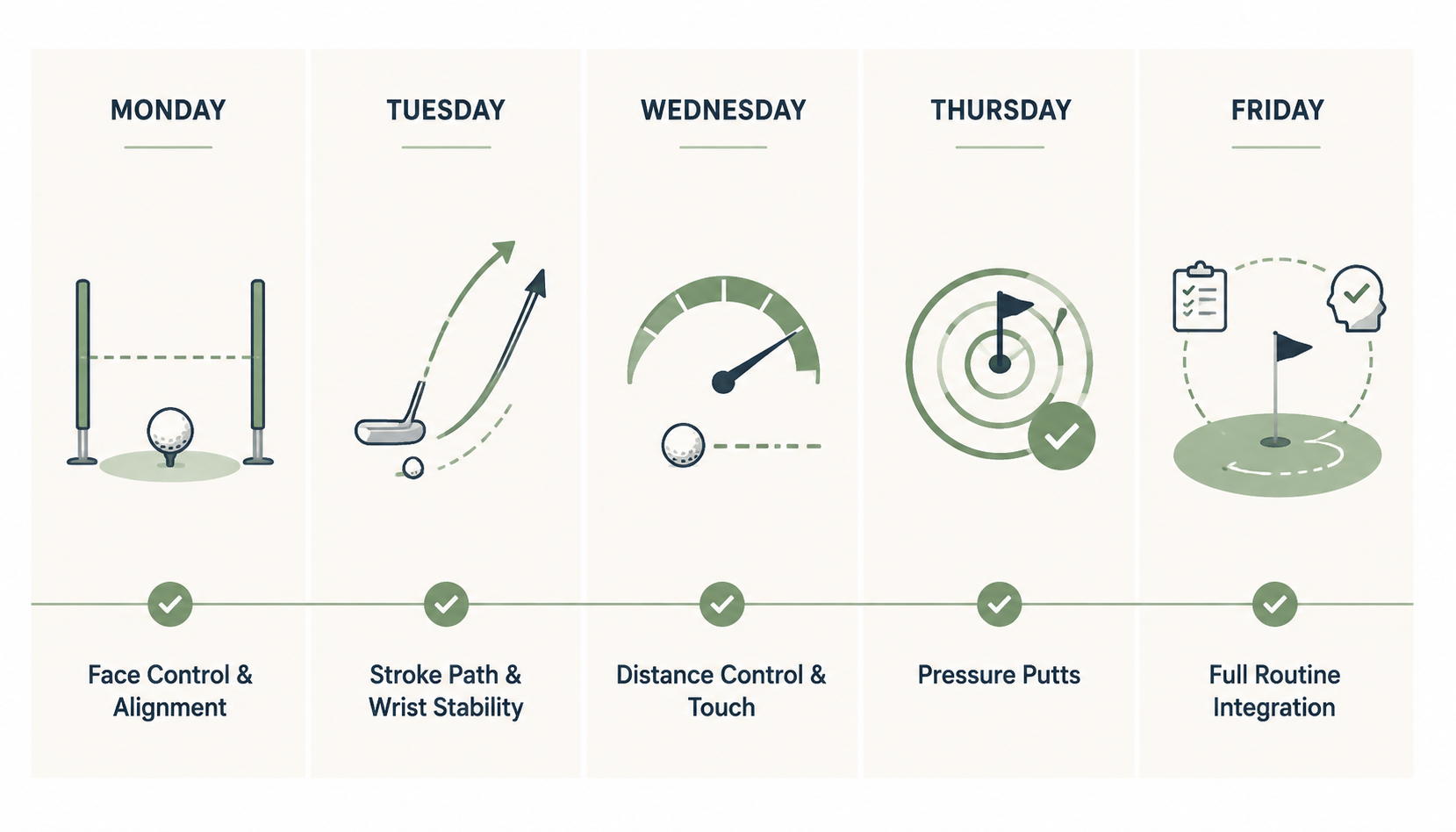
The split is not just tidy. It solves the main failure of home putting practice: everything gets mixed together too soon. Face, path, speed, pressure, and routine are different problems. If you train them all at once every night, you mostly learn how to tolerate noise.
Putting is worth that level of structure because it takes up a large share of the scorecard. GolfWRX, citing a ShotByShot.com database of about 12,000 rounds, reported that putting accounts for roughly 40% of all strokes in a typical round. The same source put a 17-handicap golfer’s 50% make distance at about 5 feet, compared with about 8 feet for a PGA Tour player, a gap that gives home practice a concrete target instead of a vague hope for better feel. [1]
That does not mean every carpet session needs to become a lab. The useful range is 20 to 25 minutes: long enough to get meaningful reps, short enough to repeat after work without negotiating with the rest of your life. HackMotion’s weekly putting plan separates days by face control, path, distance, and pressure, while Perform for Golf uses a similar rotation with counted drill volumes such as short-putt and lag-putt assignments. [2][3]
Set Up the Space Like a Small Training Station
You do not need a studio. You need a repeatable lane. A putting mat is easiest, but a flat section of carpet can work if the roll is consistent enough for start-line work. Keep the station boring on purpose: one target cup or coin, two gates, an alignment stick or strip of tape, a towel, and a notebook or phone note for scores.
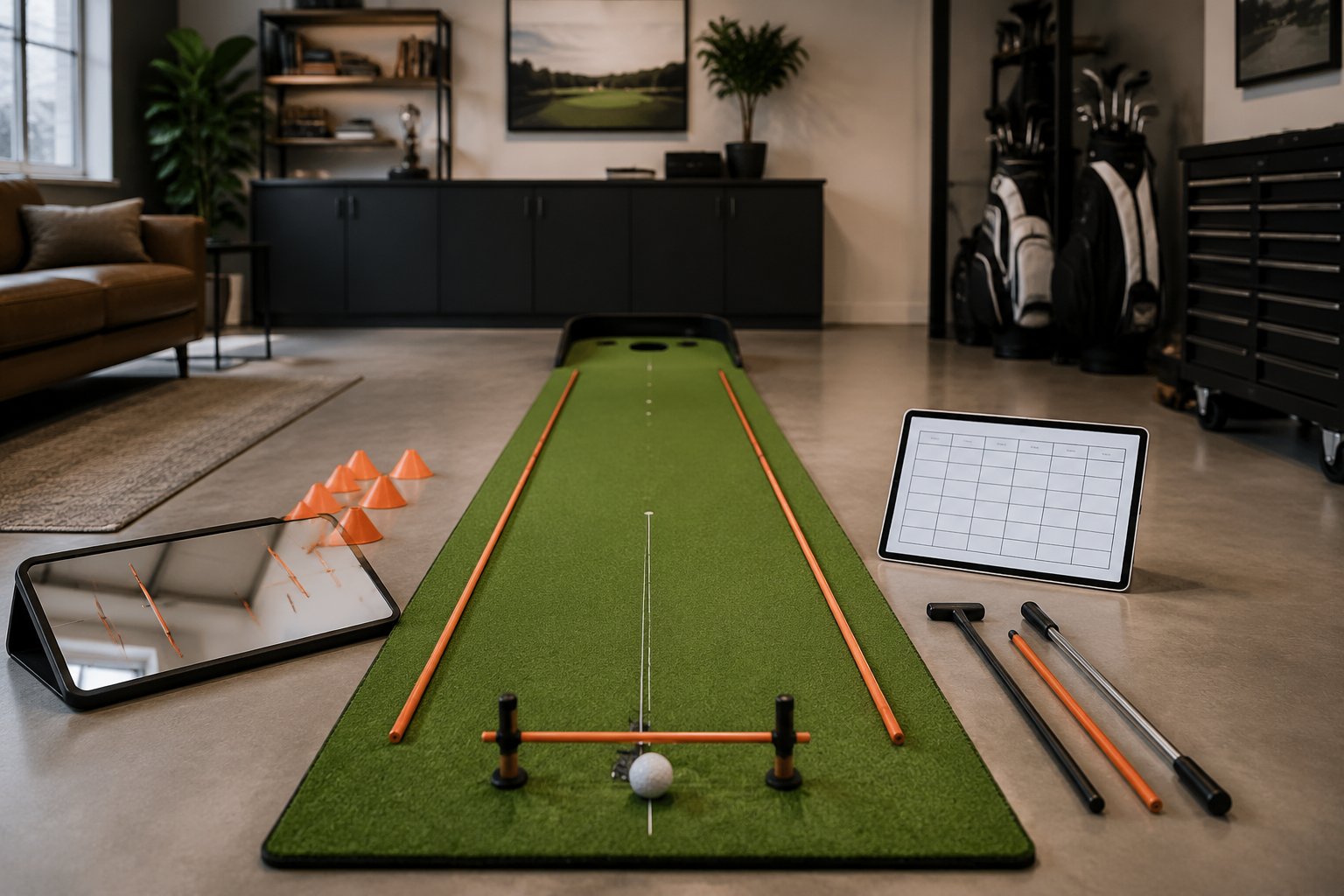
The station should let you measure two things quickly: whether the ball starts where you aimed, and whether it finishes with the speed you intended. That is enough. If setup time takes longer than the first drill, the routine will eventually lose to the couch.
The 5-Day Home Putting Split
Each session starts with 2 minutes of easy rolls from short range. Do not score them. They are the equivalent of ramping up a lift: find posture, grip pressure, and tempo before the counted work starts. After that, the day has one priority.
Monday: Face Control and Alignment
Monday is start-line day. If the putter face is not predictable, every other putting conversation gets polluted. You think you are working on speed, but the ball starts left. You think you misread a break, but the face was open. At home, where most putts are straight or nearly straight, this is the easiest weakness to expose.
- Gate drill: Set two objects just wider than the ball about 12 to 18 inches in front of the ball. Hit 3 sets of 10 putts from 4 to 5 feet. Count only balls that pass cleanly through the gate.
- Face-angle mirror work: Use a putting mirror if you own one, or place tape on the floor to square the putter face. Make 2 sets of 8 slow strokes, checking the face at address and impact.
- Finish set: Make 10 putts from 5 feet. Record makes and clean starts separately.
Do not rush the gate narrower on week one. The first win is knowing whether your ball is starting on line often enough to make speed practice useful. If the ball hits the gate, pause, reset the face, and repeat the same distance. No heroic compensation.
Tuesday: Stroke Path and Wrist Stability
Tuesday keeps the face work honest. A square face can still get dragged around by a stroke path that cuts across the ball, or by wrists that add a last-second hit. HackMotion’s putting material emphasizes wrist-angle awareness as part of path and face stability, but the principle does not require buying a sensor. The home version is to remove excess movement and make the stroke repeatable. [2]
- Path-rod strokes: Place two alignment rods, books, or strips of tape parallel to the target line, wide enough for the putter to move freely. Make 3 sets of 12 strokes without striking the rails.
- Ball set: From 5 feet, hit 3 sets of 8 putts through the same stroke lane. Count makes, but also count clean strokes that did not brush the boundaries.
- Wrist-stability set: Hit 10 putts with the feeling that the back of the lead wrist maintains its angle through impact. Keep the stroke small enough that you can actually monitor it.
This is also the best day to connect putting practice with the rest of your stability work. If you already train wrists, forearms, and tempo for the full swing, the putting stroke is the low-speed test. It shows whether control survives when there is no athletic motion to hide behind.
Wednesday: Distance Control and Touch
Wednesday is the day that feels least like a carpet drill and most like golf. You are not trying to make everything. You are training the ball to finish in the right neighborhood. Perform for Golf’s weekly structure includes lag-putt work alongside short-putt counts, which is the right instinct: even at home, speed needs its own slot instead of being treated as a bonus after make practice. [3]
- Speed ladder: Place targets at three distances that fit your room, such as short, medium, and long. Hit 5 balls to each zone, then reverse the order.
- Towel drill: Lay a towel beyond the target line and try to stop the ball on it or just short of its front edge. Hit 3 sets of 6 putts from different starting points.
- No-repeat distance set: Hit 12 putts while changing distance every ball. Do not let two putts in a row use the same target.
The key rule is that Wednesday does not become another make-streak day. A putt that misses the coin but dies in the intended zone did its job. A putt that hits the cup and races 4 feet past did not.
Thursday: Pressure Putts and Short-Range Confidence
Thursday is short-range pressure, and it should feel slightly annoying. That is the point. The 5-foot range matters because it sits near the practical gap between a mid-handicap make distance and elite make distance in the GolfWRX/ShotByShot benchmark. You are not trying to become a Tour putter on a mat. You are trying to make the common home-practice distance less emotionally expensive. [1]
- Make-5 ladder: Start at 3 feet. Make 5 in a row, then move to 4 feet. Make 5 in a row, then move to 5 feet. If you miss, restart that distance only.
- Consequence set: Pick a number before you start, such as 18 makes out of 24 from 4 to 6 feet. If you miss the target, repeat one short set, not the whole session.
- Last-ball rule: End with one putt from 5 feet. Go through the full routine. Record make or miss.
Pressure at home has to be manufactured, but it should not be theatrical. No need to pretend the hallway is Augusta. The pressure is simply that the set has a standard, the standard is written down, and the miss changes what happens next.
Friday: Full-Routine Integration
Friday is not a harder drill. It is a cleaner transfer day. The earlier sessions isolate the parts; Friday checks whether you can put them back together without turning into a robot. Read the putt, aim the face, settle the stroke, hit the speed, and reset. Every rep gets a routine.
- Nine-ball circuit: Hit 3 short putts, 3 medium putts, and 3 long putts. Use the full routine on every ball. Score makes on short putts and speed-zone success on longer putts.
- Random restart: Change distance and aim after every ball for 12 total putts. No block practice.
- Weekly test: Repeat the same 10-putt test every Friday from your standard home distance. Track the score, but do not adjust the test every week.
A Golf Digest author reported measurable Strokes Gained improvement after 9 sessions using a structured 10-30 putting routine. That is one real-world example, not a guarantee that a mat program will shave a fixed number of strokes from every player. The useful takeaway is narrower and stronger: repeated, structured sessions can produce measurable change when the work is specific enough to score. [4]
How to Progress Without Turning It Into Busywork
A workout split only works if the load changes. Putting is the same. If you roll the same 20 balls from the same spot with the same target for six weeks, you are not training; you are rehearsing comfort. Progressive overload in putting means the task becomes slightly less forgiving while the skill stays recognizable.
| Skill | Easy Version | Progression |
|---|---|---|
| Face control | Wide start-line gate | Narrow the gate or move it farther from the ball |
| Stroke path | Wide stroke lane | Tighten the lane or add a make requirement |
| Distance control | Large towel zone | Fold the towel smaller or vary distance every ball |
| Pressure | Make 3 in a row | Make 5, 7, or 10 in a row before moving on |
| Routine | Blocked putts from one distance | Randomize distance and require a full reset each ball |
Make only one variable harder at a time. If Monday’s gate gets narrower, keep the distance the same. If Thursday’s streak requirement increases, do not also move back 2 feet. The point is to find the edge of control, not to design a drill that proves you can miss.
A simple four-week progression is enough for most home setups. Week 1 establishes baseline scores. Week 2 tightens the gate or stroke lane. Week 3 adds distance changes and longer make streaks. Week 4 keeps the tougher setup but reduces total reps slightly so the Friday test is not buried under fatigue. That is the same logic as adding reps, narrowing rest, or increasing range of motion in a home workout plan: the stress changes just enough to force adaptation.
Short sessions help because they are easier to repeat and easier to keep focused. HackMotion and Chiputt both frame daily putting work around brief, deliberate sessions rather than occasional marathons, with Chiputt also promoting a 5-minute daily version. Treat 5 minutes as the minimum-dose fallback for a busy day, not the main plan if you can consistently protect 20 to 25 minutes. [2][5]
Track Only the Numbers That Change Behavior
A putting notebook can become fake productivity fast. You need enough data to see progress and expose avoidance, not enough to create a second hobby. Two numbers cover most of the job: make streaks and feet holed per session.
- Make streak: Your best consecutive-make run from a fixed distance. Best for Thursday pressure work.
- Feet holed: Add the distance of every made putt during a scored set. Ten makes from 4 feet equals 40 feet holed.
- Clean starts: Count how many balls pass through the gate without touching it. Best for Monday face-control work.
- Speed-zone hits: Count how many longer putts finish in the intended towel or target zone. Best for Wednesday.
Feet holed is especially useful because it rewards both volume and difficulty without needing a launch monitor or app. A session with 16 makes from 3 feet gives you 48 feet holed. A later session with 12 makes from 5 feet gives you 60 feet holed. Fewer makes, harder work, better score. That is the kind of metric that keeps you from chasing only easy repetitions.
Keep the Friday test identical for at least four weeks. If you change the test every time you improve, you lose the trend. If the test becomes too easy for two straight weeks, then raise the standard: add distance, narrow the gate, or require the full routine before every ball.
What to Do When You Miss a Day
Do not cram. If you miss Tuesday, do Tuesday on Wednesday and skip the original Wednesday session, or move straight to the next scheduled day. Doubling up path work and distance control in one tired 45-minute block usually turns into low-quality reps. The weekly rhythm matters more than perfect attendance.
On a minimum-dose day, do this: 5 putts through a gate, 5 putts through a stroke lane, 5 putts to a towel zone, and one final 5-foot putt with full routine. That will not replace the full split, but it keeps the habit alive without pretending a rushed session is the same stimulus.
Use Training Aids, But Make Them Earn Their Place
Putting mirrors, gates, rails, mats, wrist sensors, and pressure cups can all help. They can also clutter a simple practice plan until the tool becomes the session. The standard is straightforward: a training aid should make feedback clearer, setup faster, or progression easier. If it only makes the drill look more official, it can stay in the closet.
That is why brand drills are useful but should not be swallowed whole. HackMotion’s wrist-angle work fits Tuesday because wrist stability affects face and path. Perform for Golf’s counted short-putt and lag-putt volumes fit the split because they give sessions a workload. Those ideas are worth using because they cross-check against the logic of skill isolation and repeatable scoring, not because a commercial page says the product proves the drill. [2][3]
Run the Split for Four Weeks Before You Judge It
One week teaches the format. Two weeks reveal which days you avoid. Four weeks give the numbers enough time to show whether the work is compounding. The most useful signs are not dramatic: cleaner start lines on Monday, fewer path-rail brushes on Tuesday, more speed-zone hits on Wednesday, longer short-putt streaks on Thursday, and a steadier Friday test.
This is the reason the workout-split frame works for putting. It gives each day a job, keeps sessions short enough to repeat, and makes improvement visible without turning practice into accounting. Home putting will not fix every green-reading problem or promise a magical handicap drop. It can make the stroke, speed, and routine harder to fake, and that is where reliable improvement starts.
References
- ShotByShot.com database putting analysis, GolfWRX, circa 2017.
- Weekly putting plan, HackMotion.
- Weekly putting practice schedule, Perform for Golf.
- 10-30 putting routine, Golf Digest, August 2025.
- 5-minute daily putting routine, Chiputt.
Comments
Join the discussion with an anonymous comment.