
Start this wrestling strength training at home program with a test, not a speech. Before loaded training, Westside Barbell recommends assessing wrestlers on bodyweight movements such as push-ups, pull-ups, Hindu squats, hanging leg lifts, and planks.[1] That is the right entry point here. If a wrestler cannot tell whether his push-ups, pull-ups, squats, trunk control, and repeat efforts improved, he does not have a program. He has sweat.
Bodyweight-only work is not a consolation prize for missing a weight room. Wrestling rewards relative strength: how much force an athlete can produce, repeat, and control without dragging extra useless mass through a match. A hallway, a floor, a doorframe pull-up bar if available, and disciplined progression can cover a lot of that work. The catch is that the difficulty has to move from week to week.
Baseline Test Before Week 1
Run this test after a normal warm-up. Record every result. Do not round up. Do not count ugly reps. A rep stops counting when position breaks badly enough that you would not accept it from a teammate.
| Test | Standard | Record |
|---|---|---|
| Push-ups | Max clean reps without hips sagging or chest cutting depth | Total reps |
| Pull-ups or inverted rows | Max clean reps from full hang or controlled row position | Total reps |
| Hindu squats | Max clean reps in 2 minutes | Total reps |
| Hanging leg lifts or lying leg raises | Max controlled reps without swinging or lumbar collapse | Total reps |
| Front plank | Max hold with ribs down and glutes tight | Time |
| Single-leg squat pattern | Controlled pistol to box, assisted pistol, or full pistol | Best variation and reps per leg |
The pull-up number deserves special handling. Dane Miller of Garage Strength lists pull-ups for wrestlers in the range of 3-5 sets of 5-20 reps and has set 20-plus pull-ups as a target for wrestlers under about 190 pounds, with heavier wrestlers aiming more around 10-15.[2] Treat that as a goalpost from one coach, not a law of the sport. A 220-pound wrestler with 12 clean pull-ups is not behind a 132-pounder with 18. They are different bodies with different leverage problems.
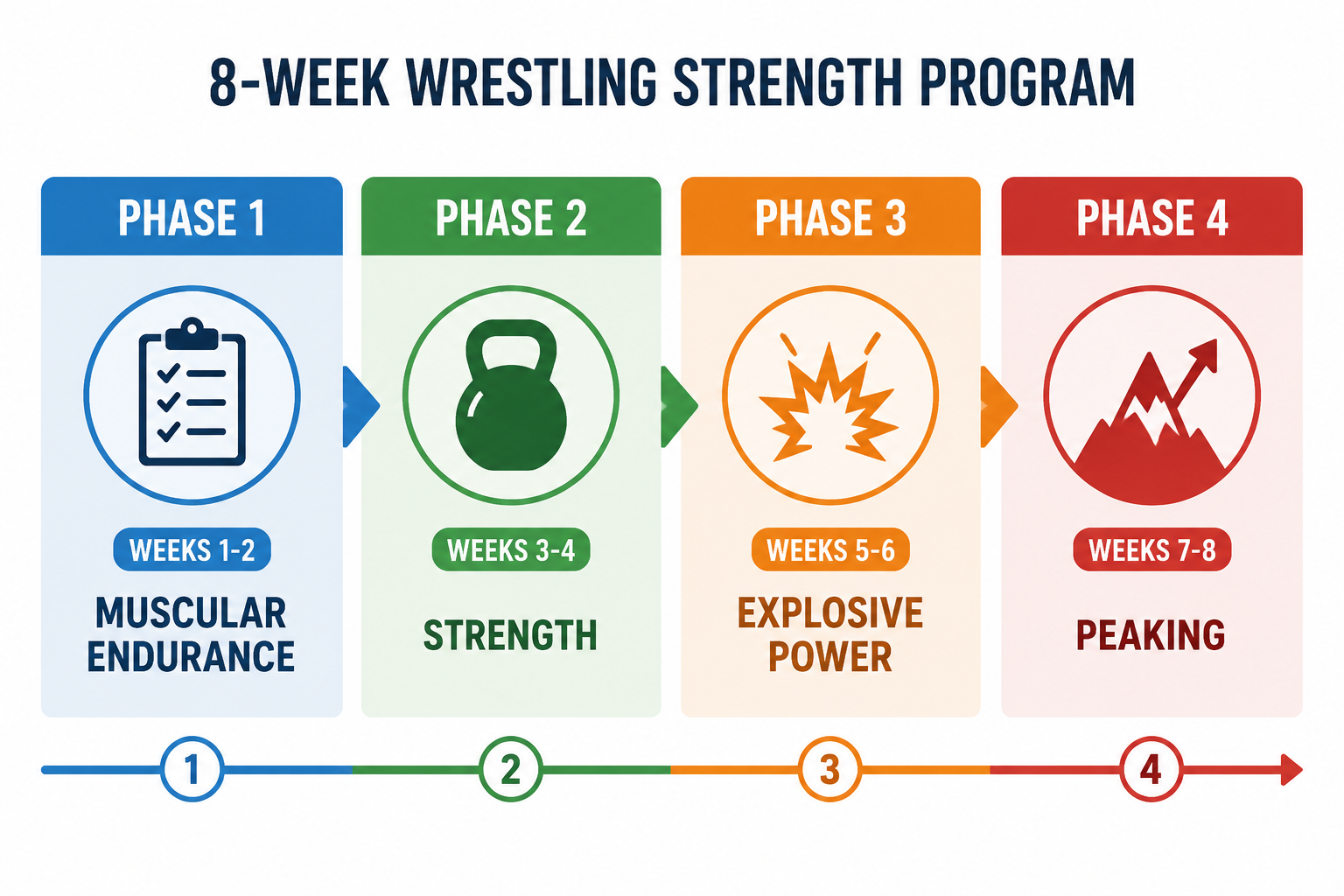
The 8-Week Road
This is a 4-day-per-week plan. That lines up with the kind of off-season hypertrophy and endurance slot Kyle Hunt places in an annual wrestling framework, before shifting toward lower-frequency full-body strength and power work closer to the season.[3] This version stays bodyweight-only for eight weeks, so the overload comes from reps, tempo, range of motion, leverage, density, and unilateral work.
| Weeks | Phase | Main aim | Assessment point |
|---|---|---|---|
| 1-2 | Muscular endurance and positions | Build clean volume and stop leaking position under fatigue | Baseline before Week 1; repeat short test after Week 2 |
| 3-4 | Strength | Make each rep harder through tempo, pauses, leverage, and single-leg work | Recheck key maxes after Week 4 |
| 5-6 | Explosive power | Move fast without losing landing, trunk, or shoulder position | Track rep speed and quality, not just totals |
| 7-8 | Peaking | Blend strength, power, and repeat efforts while reducing junk volume | Full retest at the end of Week 8 |
The weekly template stays stable so the athlete can see what changes. Monday is upper-body push and pull. Tuesday is lower body and trunk. Thursday is power and total-body repeat effort. Saturday is wrestling-specific conditioning strength. Wednesday, Friday, and Sunday are for mobility, easy drilling, walking, or nothing. If every day is hard, no day is actually measured.
How Bodyweight Overload Works
A barbell makes progression obvious. Add weight. Bodyweight training makes lazy coaching obvious. If the same athlete does the same push-ups for the same sets every week, the body has no reason to adapt past the first bump. This plan uses three main levers.
- Lever length: move from standard push-ups to feet-elevated, pike, archer, or pseudo-planche variations; move from assisted pistols to box pistols to full pistols.
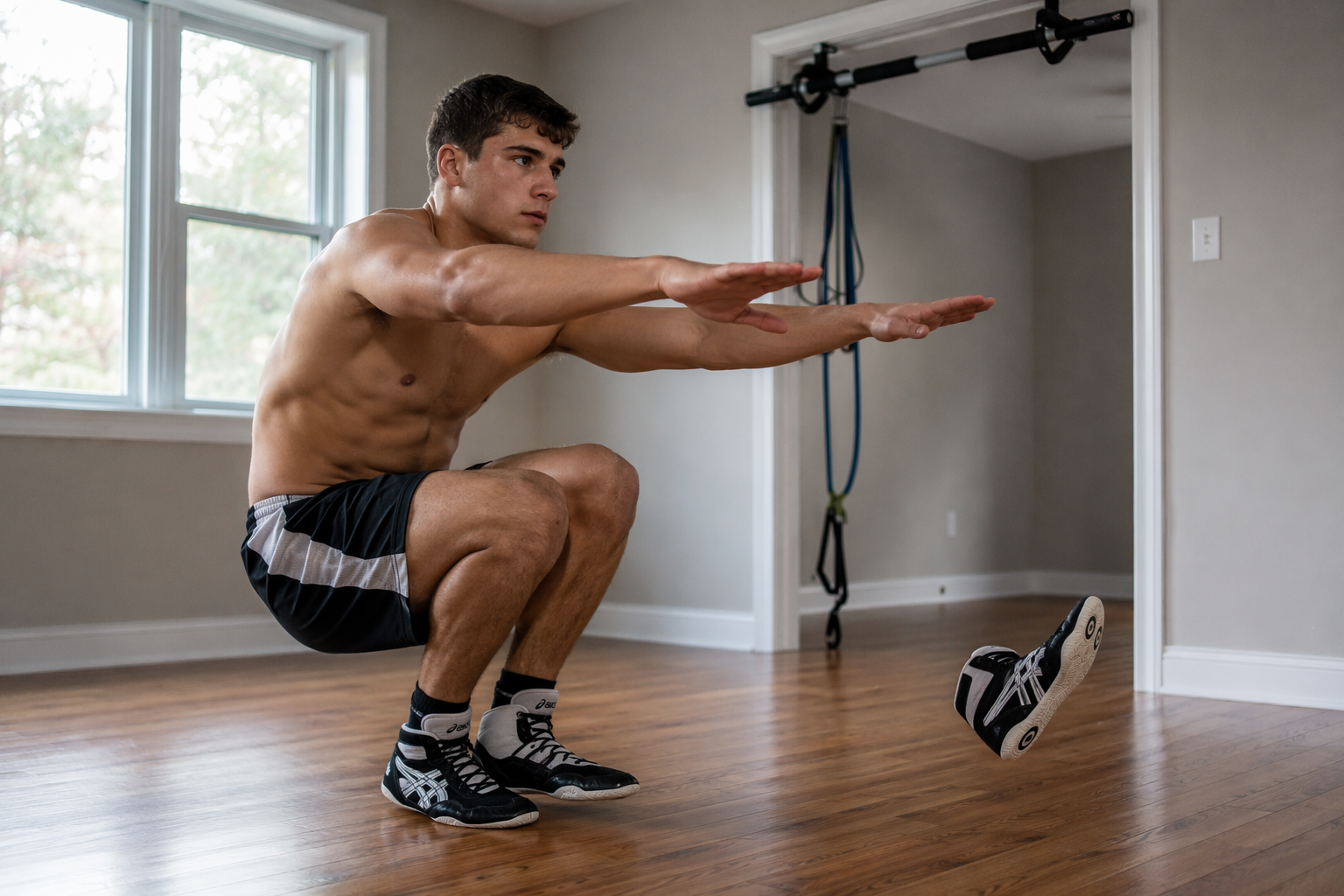
- Tempo: slow the eccentric, pause in bad positions, then finish the rep clean. A 5-second lower on a pistol squat will expose more than another loose set of 25 air squats.
- Unilateral loading: one arm or one leg takes more of the work, even when the total bodyweight has not changed.
- Density: finish the same quality work in less time, or complete more quality work inside the same time cap.
- Power intent: once strength is established, move with speed while keeping landings and positions under control.
The rep ranges are not invented from thin air. Garage Strength gives bodyweight wrestling ranges such as dips for 5-6 sets of 7-15 reps, handstand push-ups or progressions for 4-6 sets of 7-10, pistol squats for 4-5 sets of 3-8 per leg, and pull-ups for 3-5 sets of 5-20 depending on body weight.[2] This program adapts those ideas to an at-home setup where some athletes have only the floor and maybe a pull-up bar.
Weeks 1-2: Build the Engine Without Hiding Bad Reps
The first two weeks are not punishment weeks. They are clean-volume weeks. The wrestler should finish sessions tired, but still able to report exactly what improved: more clean reps, shorter rest, better trunk position, or a harder variation held for the assigned range.
| Day | Week 1 | Week 2 progression |
|---|---|---|
| Monday: upper push/pull | Push-ups 4x12-20; pull-ups or rows 4x5-12; pike push-ups 3x8-12; close-grip push-ups 3x10-15; hollow hold 3x20-40 sec | Add 1 set to the first two movements or add 2-3 reps per set while keeping form |
| Tuesday: lower/trunk | Hindu squats 4x25-40; reverse lunges 3x10-15/leg; glute bridge march 3x20 total; lying leg raises 4x8-15; side plank 3x20-40 sec/side | Keep rest tighter; add reps only if depth and knee tracking stay clean |
| Thursday: total-body repeat effort | 5 rounds: 10 push-ups, 15 squats, 6-10 rows or pull-ups, 20 mountain climbers, 30-sec rest | Complete 6 rounds or keep 5 rounds and reduce rest to 20 sec |
| Saturday: wrestling conditioning strength | Bear crawl 5x20-30 steps; squat thrusts 4x10-15; sprawls 5x5; plank shoulder taps 4x20 total; wall sit 3x45-60 sec | Add one set to crawls and sprawls, not to everything |
At the end of Week 2, repeat only three tests: max clean push-ups, 2-minute Hindu squats, and plank. If those numbers are flat but soreness is high, the athlete is not undertrained; he is recovering poorly or counting garbage work as training. Fix sleep, food, and rep quality before adding volume.
Weeks 3-4: Make the Reps Heavier Without Weights
Now the work shifts from surviving sets to owning harder reps. This is where bodyweight training either becomes strength training or turns into aerobics with a wrestling label. The main rule: if the athlete can beat the top of the rep range on every set, he moves to a harder variation the next session.
| Movement pattern | Use this if strong enough | Use this if still building |
|---|---|---|
| Horizontal push | Feet-elevated push-up, archer push-up, or 3-second pause push-up | Standard push-up with 3-second eccentric |
| Vertical push | Wall handstand hold or handstand push-up negative | Pike push-up with slow lower |
| Pull | Pull-up with 2-second top hold | Inverted row, towel row setup, or controlled eccentric pull-up |
| Squat | Pistol squat to box or full pistol | Assisted pistol or split squat with 5-second lower |
| Trunk | Hanging leg lift or hollow rock | Lying leg raise or hollow hold |
| Day | Week 3 | Week 4 progression |
|---|---|---|
| Monday: upper strength | Hard push-up variation 5x6-12; pull-ups or hard rows 5x5-10; pike push-ups 4x7-10; slow eccentric close-grip push-ups 3x8-12; hollow hold 4x30-45 sec | Add tempo: 3-5 sec lower on push and pull; keep total reps slightly lower if needed |
| Tuesday: lower strength | Assisted or box pistols 5x3-6/leg; split squat 4x8-10/leg with 5-sec lower; single-leg hip bridge 4x10-15/leg; leg raises 4x10-15; side plank 4x30-45 sec/side | Move pistol depth lower or reduce assistance before adding reps |
| Thursday: controlled density | Every 3 min for 6 rounds: 8 hard push-ups, 6 pull-ups or rows, 10 split squats/leg, 8 leg raises | Same rounds, finish each round faster while form stays clean |
| Saturday: isometric and position strength | Wall sit 4x60 sec; push-up bottom hold 5x15-25 sec; squat bottom hold 4x45-60 sec; bear crawl 6x20 steps; sprawl-to-stance 6x4 | Add time to holds or make positions stricter; do not turn this into sloppy conditioning |
After Week 4, retest pull-ups or rows, the best single-leg squat variation, and hanging leg lifts or lying leg raises. A good result is not just a bigger number. It can be the same number with a harder variation, cleaner range of motion, or slower eccentric control.
Weeks 5-6: Add Speed Only Where Control Exists
Power work is earned. If the athlete cannot land quietly, brace the trunk, and keep the shoulder from dumping forward, he does not need more explosive work. He needs more strength and control. Sweet Science of Fighting cites research suggesting elite wrestlers can generate up to 30% more muscle power and have greater aerobic capacity than sub-elite wrestlers, but the site does not provide a specific study citation for that figure.[4] Use the claim carefully: power matters, and structured training can target it, but this eight-week plan is not a lab-validated guarantee.
| Day | Week 5 | Week 6 progression |
|---|---|---|
| Monday: upper power-strength | Explosive push-ups 6x3-5; pull-ups 5x4-8; pike push-ups 4x6-10; archer or feet-elevated push-ups 3x6-10; hollow rocks 4x15-25 | Make the explosive reps faster, not sloppier; stop each set before speed dies |
| Tuesday: lower power-strength | Jump squats 6x3-5; pistols or assisted pistols 5x3-6/leg; reverse lunge to knee drive 4x6-8/leg; single-leg hip bridge 4x8-12/leg; leg raises 4x10-15 | Add broad jump or split jump only if landings are quiet and knees track |
| Thursday: alactic repeat effort | 10 rounds: 10-sec hard effort of sprawls, explosive push-ups, or jump squats; 50-sec easy walk/rest | Keep 10 rounds; make each 10-sec burst sharper, not longer |
| Saturday: chain wrestling strength circuit | 6 rounds: 3 sprawls, 5 push-ups, 5 jump squats, 10 bear crawl steps forward/back, 30-45 sec rest | Add 1-2 rounds only if all rounds look the same |
The mistake in these two weeks is chasing fatigue. A wrestler already knows how to get tired. The job here is to produce force repeatedly. If round one is crisp and round six looks like a calf getting dragged back to the center, the set count is too high.
Weeks 7-8: Peak the Work and Retest
The final phase cuts some filler and keeps the work that should transfer: harder strength reps, fast reps while fresh, and repeat efforts that do not collapse. This is not a taper for a specific tournament. It is a short peak so the athlete can show what eight weeks built.
| Day | Week 7 | Week 8 |
|---|---|---|
| Monday: upper test prep | Pull-ups 4x5-10; hard push-up variation 4x6-10; pike or handstand push-up progression 4x5-8; hollow hold 3x40-60 sec | Early week: 3 moderate sets each, no grinding |
| Tuesday: lower test prep | Pistol progression 4x3-6/leg; split squat 3x8/leg; jump squat 5x3; leg raise 3x10-15 | Early week: 2-3 clean sets, leave reps in reserve |
| Thursday: sharp repeat effort | 8 rounds: 5 explosive push-ups, 5 jump squats, 3 sprawls, 40-sec rest | Skip hard circuit; use mobility, stance motion, and light drilling |
| Saturday: final assessment | Practice standards only; no max testing | Full baseline retest |
The final retest is the same as the baseline: push-ups, pull-ups or rows, Hindu squats, hanging leg lifts or lying leg raises, plank, and single-leg squat pattern. Same warm-up. Same standards. Same honesty. If the athlete changed the test every time he got uncomfortable, the results are useless.
What Counts as Progress
Progress is not one number. A wrestler can improve by doing more clean reps, reaching a harder variation, controlling a slower eccentric, holding better position under fatigue, or recovering faster between rounds. Those are different adaptations, and this program touches all of them.
| Result after 8 weeks | What it probably means | Next move |
|---|---|---|
| More reps at the same variation | Muscular endurance improved | Move to harder leverage or slower tempo |
| Same reps at a harder variation | Relative strength improved | Build volume in the new variation |
| Faster rounds with the same form | Repeat effort improved | Tighten rest windows slightly |
| Explosive reps higher but landings worse | Power intent outran control | Reduce jump volume and return to strength work |
| No measurable change | Programming, recovery, or effort was inconsistent | Repeat the last successful phase before advancing |
Static exercise lists can be useful when an athlete needs ideas; Cisco Athletic, for example, presents no-weights wrestling strength exercises as a reference point.[5] A list is not the same thing as training. The difference is progression. Week 4 has to demand something Week 1 did not. Week 8 has to test something the athlete actually trained.
Adjustments for Different Starting Points
A remedial athlete should not be embarrassed by regressions. He should be embarrassed by pretending he does not need them. If push-ups break after six reps, use incline push-ups and build the set honestly. If pull-ups are not there yet, use rows, negatives, or holds. If full pistols twist the knee and hip into a mess, use an assisted version or a box.
- If max push-ups are under 15: start every push-up slot with incline or standard push-ups and use slow tempo before advanced variations.
- If pull-ups are 0-3: use rows, flexed-arm hangs, and 3-5 second negatives until clean reps appear.
- If single-leg squats collapse: train split squats and assisted pistols before chasing full depth.
- If conditioning is poor: keep the rest periods as written for two weeks before cutting them.
- If recovery is poor: cut one accessory movement, not the main assessment lifts.
At-home wrestling training also has a practical history. During quarantine-era restrictions, FloWrestling published at-home training guidance for wrestlers who had to keep working without normal facilities.[6] The lesson still holds for any athlete without a gym: constraints are real, but they do not excuse random work.
Where This Fits in a Wrestling Year
This plan fits best in the off-season or in a temporary no-gym block. Hunt’s annual model separates off-season higher-frequency work from pre-season strength and power and in-season maintenance.[3] That matters because a wrestler in the middle of a hard competition schedule does not need four extra bodyweight strength days piled on top of practices, weight cuts, and matches.
If practices are already brutal, run only two days: Monday upper strength and Thursday lower/power. If the athlete is in a true off-season with no hard mat work, the full four days are reasonable. The program should support wrestling, not become another opponent.
After 8 Weeks, Add Load When Bodyweight Stops Biting
A good bodyweight program has a ceiling. That is not a weakness; it is honest programming. Once the athlete can handle high-quality pull-ups, hard push-up variations, pistol squats, slow eccentrics, and explosive work without much strain, more clever bodyweight variations give smaller returns.
The next step does not have to be a full gym. A loaded backpack, sandbag, bands, or a weighted vest can extend the same patterns: weighted pull-ups, backpack split squats, band-resisted push-ups, sandbag carries, and loaded crawls. Add the smallest external load that makes clean reps hard again. Then keep testing.
References
- Wrestling Strength Training, Westside Barbell, https://www.westside-barbell.com/a/blog/wrestling-strength-training
- Bodyweight Exercises For Wrestling, Garage Strength, https://www.garagestrength.com/blogs/news/bodyweight-exercises-for-wrestling
- Wrestling Workouts: A Full Year of Training, Kyle Hunt Fitness, https://kylehuntfitness.com/wrestling-workouts-a-full-year-of-training/
- Wrestling Workouts at Home - No Equipment, Sweet Science of Fighting, https://sweetscienceoffighting.com/wrestling/wrestling-workouts-at-home-no-equipment
- No Weights Needed: Wrestling Strength Training Exercises, Cisco Athletic, https://www.ciscoathletic.com/blog/no-weights-needed-wrestling-strength-training-exercises/
- At-Home Training For The Quarantined Wrestler, FloWrestling, https://www.flowrestling.org/articles/6741390-at-home-training-for-the-quarantined-wrestler
Comments
Join the discussion with an anonymous comment.